← Everything Everywhere Daily: History, Science, Geography & More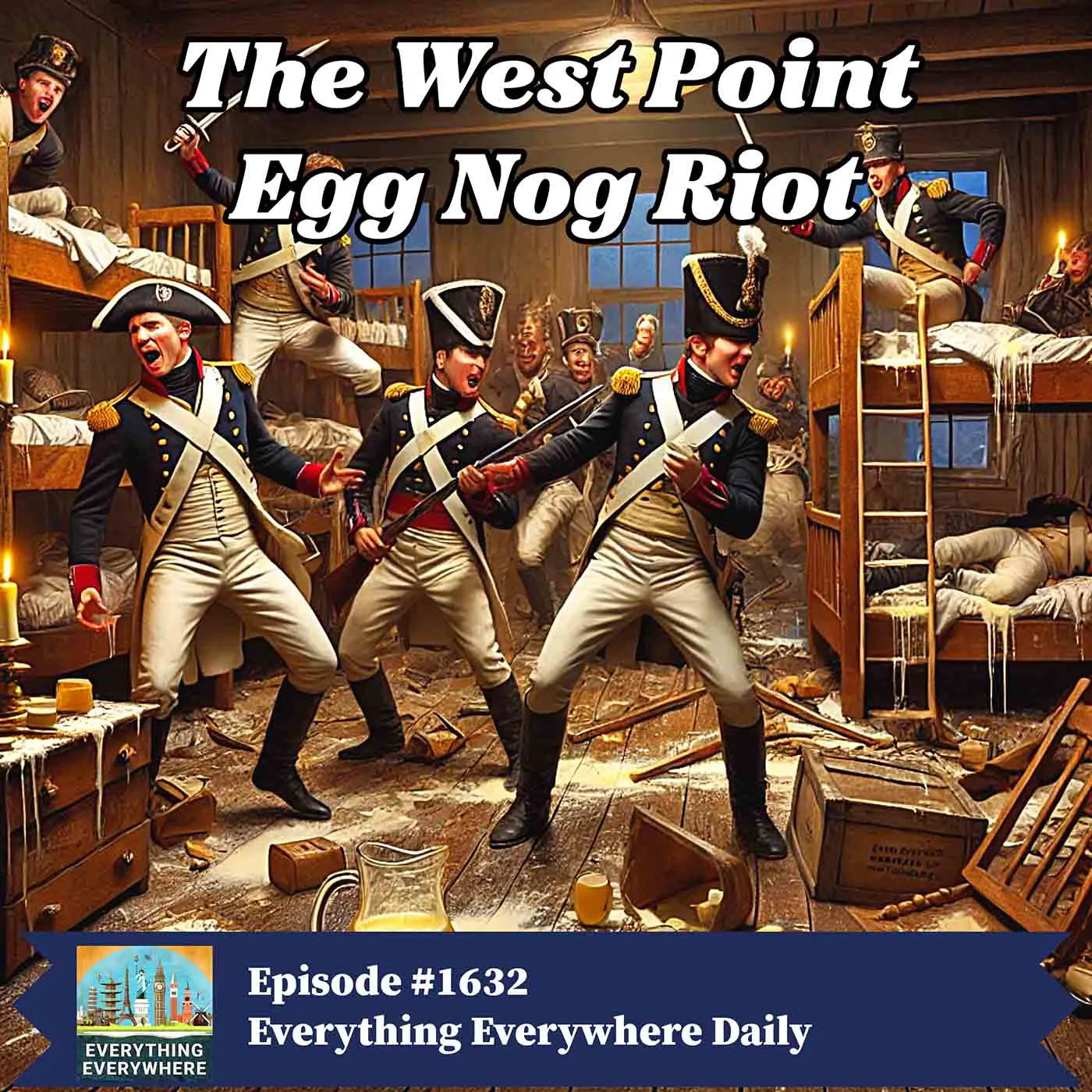
Everything Everywhere Daily: History, Science, Geography & More
The 1826 West Point Egg Nog Riot
00:15:24
Learn more about the Christmas Riot at West Point
Loading summary
Transcript7 lines
- [00:00]
Gary Arndt
The United States Military Academy in West Point, New York is one of the most prestigious academic and military institutions in the United States. Their motto, Duty, Honor, country is something that every cadet that attends the academy aspires to. However, things always haven't been that way. There was a period when West Point was downright rowdy and rambunctious. Learn more about the 1826 West Point Eggnog riot and how the Military Academy completely went out of control one Christmas on this episode of Everything Everywhere Daily.
- [00:45]
Unknown Sponsor Voice
This episode is sponsored by ButcherBox. You've probably heard me talk about how ButcherBox only sells 100% grass fed grass finished beef, but what exactly is that and why does it matter? This type of beef comes from cattle that have grazed on grass for their entire lives as opposed to being finished on a diet of grains and other feed at a feedlot. Basically, cattle eat what cattle are designed to eat. Grass fed beef tends to have higher levels of omega 3 fatty acids and grass fed beef often contains more antioxidants such as vitamin E. Beyond personal health benefits, choosing grass fed grass finished beef can also improve soil health through natural fertilization and aeration and can also promote greater biodiversity on grazing lands. Consuming grass fed grass finished beef not only contributes to better health, but also supports more sustainable farming practices. Sign up@butcherbox.com daily and get a special deal. New users who sign up for Butcherbox will receive 2 pounds of grass fed ground beef in every box for the lifetime of their subscription, plus $20 off your first box when you use code daily at checkout. This episode is sponsored by Masterclass. If you're listening to this podcast, then you are someone who is curious about the world and loves to learn.
- [02:00]
Gary Arndt
And if you want to give the.
- [02:01]
Unknown Sponsor Voice
Gift of learning and knowledge this Christmas, you can't do better than Masterclass. Masterclass offers online classes from some of the most successful instructors in the world in their fields. You can learn cooking from Gordon ramsay, conservation from Dr. Jane Goodall, disruptive entrepreneurship from Sir Richard Branson, mathematical thinking from Fields Medal winner Terrence Tao, and diplomacy from former Secretaries of State Madeleine Albright and Connor. You can access over 200 classes across 11 different categories. Masterclass always has great offers during the holidays, sometimes up to as much as 50% off. Head over to masterclass.com everywhere for the current offer that's up to 50% off@masterclass.com everywhere. Once again, that's masterclass.com everywhere.
- [02:59]
Gary Arndt
The United States Military Academy in West Point, New York has a long and distinguished history. Almost every significant American army leader that you can think of over the last 225 years has graduated from West Point.
- [03:11]
Unknown Sponsor Voice
And that includes many generals who fought.
- [03:13]
Gary Arndt
Against the United States during the Civil War. As the place where future military officers are trained, West Point has a tradition of high standards and a very strict honor code. However, that wasn't always the case. I've never really had a chance to talk about West Point before on this podcast, so I should briefly explain how the academy got to where it was in 1826. The idea of a military academy for the country had its origins in the beginning of the United States. During his first presidential term, George Washington felt that the country should have an institute to train qualified military officers. To be fair, while the United States did manage to beat the British in the Revolutionary War, it wasn't because they had great officers. Washington himself was a great leader and a statesman, but he wasn't really a great military tactician or strategist. He was good, but the best thing he did was avoid any major engagements that would have been catastrophic for the Continental Army. As much as Washington wanted a military academy, he found resistance, particularly from his Secretary of State, Thomas Jefferson. Jefferson wasn't necessarily against the idea of an academy per se, but there was nothing in the Constitution that allowed the country to create a military academy, so Jefferson was against it. Other people in Congress felt that creating a military academy was too European and aristocratic and were against it for those reasons. Nonetheless, in 1794, Congress authorized a corps of engineers to be based in West Point, which had been a military outpost since the Revolution. In 1802, during the presidency of Thomas Jefferson, Congress passed authorization to create a military academy at West Point, and this time, Jefferson approved it. Jefferson changed his mind for a host of reasons. He felt that the engineers who came out of the academy could be used for civilian projects and that the United States needed protection from threats from European countries. Also, there were many Americans who were going to Europe for military training and and he felt it would be better if they were trained at home. West Point initially only offered courses in engineering, science, mathematics, and military science. The early years of the academy were a mess. There was almost no criteria for admission, and there was little in the way of academic standards. The cadets were as young as 10 years old, and some were as old as 37. Some studied there for six months and others for six years. By the War of 1812, things were so bad that Congress considered disbanding it altogether. They had only graduated 89 officers in 10 years. By the outbreak of war. To solve these problems, Colonel Sylvanus Thayer was appointed Academy Superintendent in 1817. Thayer completely overhauled West Point. For this reason, he is considered to be the father of the United States Military Academy. Thayer introduced advanced teaching methods, including a structured sequential curriculum, regular written exams, and the use of textbooks, particularly in mathematics and engineering. Thayer upgraded the academy's facilities, including classrooms, barracks, and libraries, to provide a better learning environment. His reforms established West Point as a model for military academies worldwide. Part of his reforms was instilling strict discipline and an honor code, which remains a cornerstone of West Point to this day. One element of that strict discipline was banning alcohol on campus. And he didn't just ban alcohol, he also banned tobacco, playing cards, and novels. He did make a few exceptions, however. In a rare display of leniency, the father of West Point permitted alcohol consumption during the 4th of July and Christmas celebrations. However, this policy changed after a particularly unruly Fourth of July in 1825, when cadets staged a snake dance and carried the commandant, William Worth on their shoulders back to the barracks. So going into 1826, the campus was completely dry and there were no exceptions. After the Independence Day celebrations of that year, a group of cadets vowed that they were going to get booze for their annual Christmas celebration, which had been the tradition up until recently. Despite the prohibition, cadets traditionally celebrated Christmas with festive eggnog, which was made alcoholic by smuggling in spirits from nearby taverns or off campus suppliers. For those of you in countries that don't have eggnog, let me briefly explain what it is. Eggnog is a rich, creamy beverage traditionally made from milk, cream, sugar, whipped egg yolks and whipped egg whites. It's often spiced with nutmeg, cinnamon or vanilla. During the Christmas holidays, eggnog is frequently mixed with alcohol such as rum, brandy or bourbon. The drink's origins are traced back to medieval Britain, where it evolved from a warm ale based beverage called posset, which was flavored with eggs and milk. Over time, due to the cost of eggs, dairy and spices, it became the drink of the wealthy. When the recipe reached the American colonies, where these ingredients were more abundant, eggnog became a popular holiday staple, often with locally produced rum as the spirit of choice. Eggnog is still consumed today around Christmas, although it's not as popular as it used to be. A group of cadets led by Jefferson Davis and others plotted to procure alcohol for their Christmas eggnog. The cadets smuggled large quantities of whiskey and rum from local taverns, specifically Benny Haven's Tavern, to prepare their illicit drink. And just in case you were wondering. The Jefferson Davis in question is in fact that Jefferson Davis, who later became the President of the Confederate States of America. The cadets didn't just sneak in a couple bottles of alcohol. They managed to sneak in gallons of the stuff, even taking a rowboat across the Hudson river to procure booze in secret. The celebration started innocently enough on Christmas Eve in the north barracks. It began in one room, but soon expanded into other rooms as more cadets joined and became intoxicated. As the night progressed, the party turned into chaos, with drunken cadets shouting, fighting and causing extensive property damage. By 4am now Christmas Day, the party had gotten so loud that it woke up Captain Ethan Allen Hitchcock, an academy staff member who looked after the north barrack. Captain Hitchcock began wandering the halls to see what was going on. The cadets got wind that something was up, and Jefferson Davis shouted, put away the grog. Captain Hitchcock is coming. Hitchcock chewed out the parties and ordered Davis back to his room and reminded everyone that any gathering of 12 or more cadets was considered an unlawful assembly. Until this point, what the cadets had done wasn't that big of a deal. Sure, they might get in trouble, but this really wasn't anything more than what you would find on any college campus. And I've been involved in several dorm room celebrations just like this myself. If everyone had gone back to their rooms as ordered, I would not be doing an episode on this. Almost 200 years later, however, most of them didn't do that. Jefferson Davis, oddly enough, was one of the few cadets who did return to his room. Instead, the cadets decided to exact revenge on the perceived party pooper. One cadet shouted, get your dirks and bayonets and pistols if you have them. Before this night is over, Hitchcock will be dead. They hurled sticks of wood at Hitchcock's door and shattered his windows with rocks. Dozens of cadets rampaged through the halls armed with swords, muskets and bayonets, with one even firing a pistol as Hitchcock attempted to force a door open. During the chaos, two superior officers were assaulted. The disturbance spread with nearly a third of the cadet corps, around 70 cadets involved in the melee. Windows were broken, furniture destroyed, and the Academy's discipline entirely collapsed during the riot. The unruly behavior only subsided when the school's commandant, William Worth, arrived to restore order. When reveille sounded at 6:05am on Christmas morning, the sober cadets in the south barrack rose with their usual military discipline. The north barracks, however, told a very different story. The dormitory was in shambles, with broken windows, smashed furniture, torn banisters, and Shattered plates, dishes and cups scattered all about. The cadets who had taken part in what would later be called the Eggnog Riot looked just as disheveled as the wreckage around them. As the first light of day revealed the aftermath, the Eggnog Riot put the academy in a very tricky position. According to the academy's code, a third of the entire Cadet Corps should probably have been expelled. However, that would have gutted the Academy and would have severely hamstrung the future of the United States Army. And I should note that many of the cadets at this point, although not necessarily part of the riot, went on to have stellar careers in the United States army, in the Mexican American war, and the US Civil War. On December 26, a faculty meeting took place and Colonel Thayer notified the staff that an investigation was going to take place in January while cadets were undergoing their final examinations. That day, 22 cadets, who were the most egregious defenders, were placed on house arrest. Over the next several months, 19 cadets and one regular army soldier were court martialed. The court martials lasted until mid March and were widely publicized in newspapers across the country. What should have been a public relations disaster for West Point ended up being a positive for them, as the court martial showed that they were being tough on discipline. The regular army soldier who was court martialed, Private John Dugan, was sentenced to a month of hard labor and had his whiskey ration revoked for a month as well. The 19 cadets were all found guilty. 17 of them were expelled from the academy and some of them were offered clemency. Two were reduced in rank and one cadet was allowed to resign so he wouldn't be expelled. Two notable cadets were not court martialed. The first was Jefferson Davis. Although he helped organize the party, he didn't take part in the riot. He went on to become the United States Secretary of War and later, as I mentioned, the President of the Confederacy. The other cadet who was involved but not court martialed was John Archibald Campbell. He's notable because in 1853 he went on to become an Associate justice of the US Supreme Court for eight years. One of the expelled cadets was Benjamin G. Humphries, who served as a general for the Confederacy during the Civil War. As for the institution of the United States Military Academy, it came through relatively unscathed. The riot reinforced Thayer's resolve to maintain strict discipline and further cemented West Point's reputation as an institution committed to rigorous standards. It also highlighted the challenges of managing young military cadets and set a precedent for future responses to insubordination. The eggnog Riot remains a quirky yet significant episode in US Military history, illustrating the tension between youthful rebellion and institutional discipline. It has since been recounted as a cautionary tale and as an example of the sometimes unexpected consequences of enforcing strict regulations, as well as a lesson to what happens when you take away alcohol at Christmas. The executive producer of Everything Everywhere Daily is Charles Daniel. The associate producers are Benji Long and Cameron Keever. I want to give a big shout out to everyone who supports the show over on Patreon, including the show's producers. Your support helps me put out a show every single day, and also Patreon is currently the only place where Everything Everywhere Daily merchandise is available to the top tier of supporters. If you'd like to talk to other listeners of the show and members of the Completionist Club, you can join the Everything Everywhere Daily Facebook group or Discord server. Links to Everything are in the show. Notes.