← Everything Everywhere Daily: History, Science, Geography & More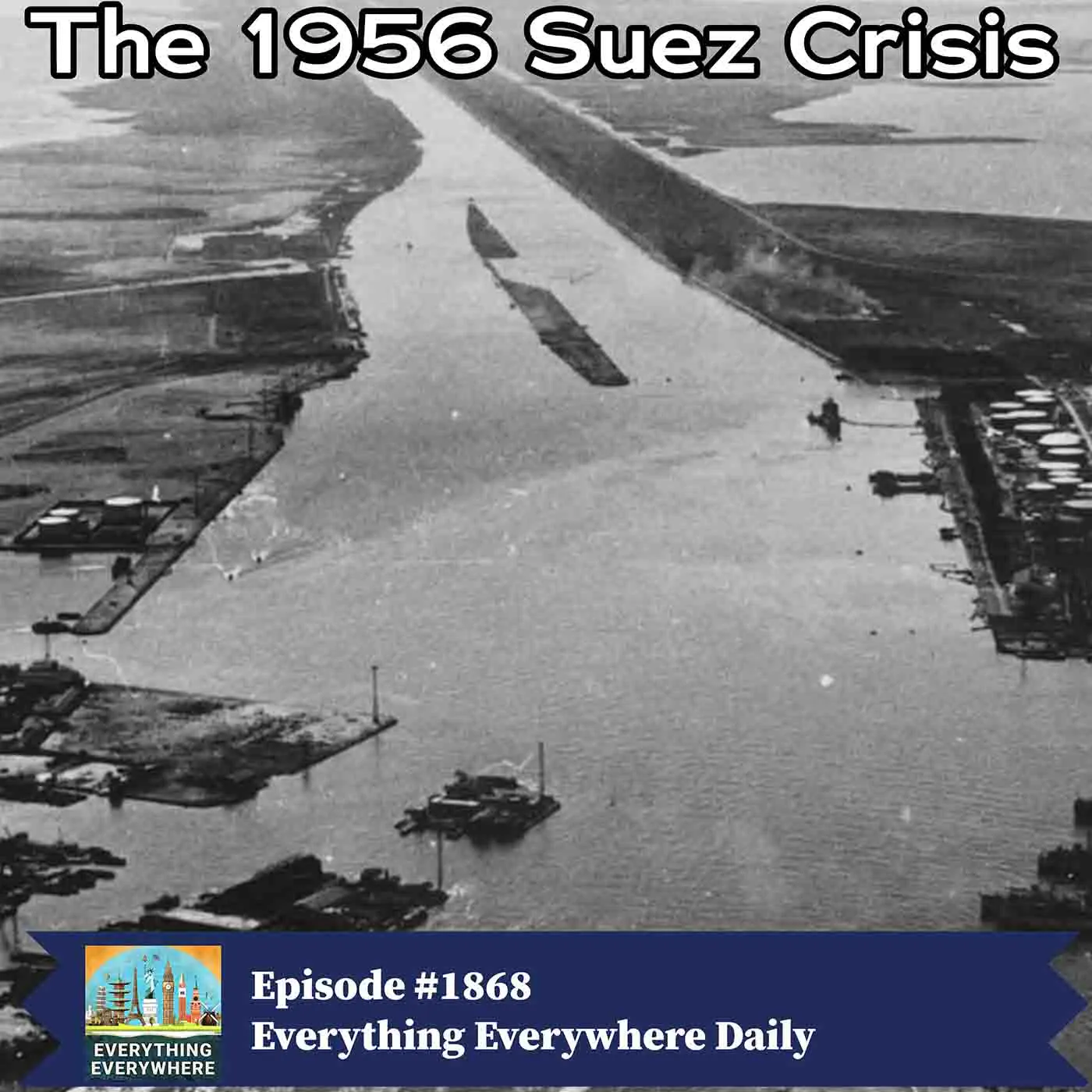
Everything Everywhere Daily: History, Science, Geography & More
The 1956 Suez Crisis (Encore)
00:14:10
Loading summary
Transcript10 lines
- [00:00]
A
The following is an encore presentation of.
- [00:02]
B
Everything Everywhere Daily.
- [00:08]
A
In 1956, one of the most important geopolitical events of the post war period took place in Egypt. The Egyptian President Gamal Abdel Nasser nationalized the Suez Canal, one of the most important waterways in the world. In response, a coalition of several countries tried to take it back. However, it didn't go as planned and it signaled a major reshuffling of the geopolitical order. Learn more about the Suez crisis and how it shaped the second half of the 20th century on this episode of Everything Everywhere. D.
- [00:52]
B
This episode is sponsored by Fiji Water. You've probably heard of Fiji Water and have seen it in stores. Well, Fiji Water really is from the islands of Fiji. Drop by drop, Fiji Water is filtered through volcanic rock 1600 miles away from the nearest continent in all its pollution, protected and preserved naturally from external elements. In this process, it collects a unique profile of electrolytes and minerals, resulting in more than double the electrolytes as the other top two premium bottled water brands, giving Fiji Water its smooth taste. Fiji Water's electrolytes are 100% natural and this water even has a perfectly balanced pH of 7.7. I've recently been trying to reduce my consumption of diet soda and I've found Fiji Water to be a great alternative. Visit your local retailer to pick up some Fiji Water today for your next backyard party, beach day hike, or even your home office. Fiji Water is Earth's finest water. This episode is sponsored by Newspapers.com Break Down Genealogy brick walls with a subscription to the largest online newspaper archive. Did you know that newspapers.com has over a billion pages of digitized newspapers going back to the year 1690? Their growing collection includes papers from the United States, United Kingdom, Canada, Australia and more. Discover birth and marriage announcements, obituaries and everyday stories about your ancestors and seconds. Newspapers.com can help you fill in the gaps between vital records and reveal details about your ancestors lives that you can't find anywhere else. Their easy to use search feature will let you filter your results by date, location, specific paper and more. When you find something interesting, newspapers.com makes.
- [02:37]
A
It a snap to share it with.
- [02:39]
B
Your family and friends and you can even save it directly to your ancestry Tree. Come explore one billion pages and make infinite discoveries. Today on Newspapers.com use promo code Everything Everywhere for a 20% discount on your subscription.
- [02:58]
A
What I'll be referring to as the Suez Crisis is known by other names in other countries. It is also referred to as the Second Arab Israeli War, the the War of Tripartite aggression in the Arab world and the Sinai War in Israel. Although it didn't rank anywhere near the top of the major conflicts of the 20th century in terms of casualties, it played an outsized role in shaping the post war geopolitical order, the effects of which can still be felt today. In a previous episode, I covered the history of the Suez Canal. The idea of a canal connecting the Mediterranean and Red Seas was an idea that went back almost 4,000 years. It wasn't until the 19th century, however, that a canal was built by a French company that received a 99 year lease from Mohammed Ali Pasha, the then ruler of Egypt. After more than a decade of work, the Canal opened in 1869. The British initially objected to the Canal's construction because they controlled the routes around Africa. But once it opened, they purchased 44% ownership in the canal and it became a vital link between India and Britain. In 1882, the British were invited by the then leader of Egypt to put down an uprising and they took control of the Canal. The British continued to control the Canal through the first and Second World wars, considering it to be vital to defending the British Empire. However, after World War II, the world changed. India became independent and almost every other British colony started down the road towards independence. France too saw many of its colonies move towards independence, most significantly Algeria, which began a war for independence independence in 1954. Britain and France were perhaps the two greatest global powers before the Second World War, if for no other reason than their extensive empires. Also relevant to this story was the creation of the State of Israel in 1947, as well as the backlash against Israel by neighboring Arab states and the subsequent rise of Pan Arabism. And of course all of this needs to be placed in the context of the biggest geopolitical development in the post war world. The the start of the Cold War between the United States and the Soviet Union. With that, the story of the Suez Crisis actually begins in 1952. At the time, Egypt was a monarchy ruled by King Farouk. Farouk was one of the last kings of Egypt in the Muhammad Ali dynasty which began in 1805. Farouk and several of the other monarchs before him used the British to help secure their rule. Egypt was never technically a colony of Britain per se. Rather it had been a protectorate since 1882 when the British took over control of the Canal. The close ties to the British, the presence of British troops and the British control of the Canal didn't sit well with the Egyptian nationalists who wanted Egypt for Egyptians. And this all came to a head on July 23, 1952, when a group of Egyptian military officers who called themselves the Free Officers Movement overthrew King Farouk in a bloodless coup d'. Etat. Farouk abdicated the throne and was sent into exile and his infant son Ahmed Fouad was placed on the throne with the Free Officer Movement serving as regents. This situation was short lived, however, as Egypt was declared a Republic in 1953. This new government instituted a wide range of programs, including land reform and a crackdown on political activities by groups on both the right and the left, including the Communist Party and the Muslim Brotherhood. A new constitution was announced in January of 1956. And on June 23rd, Gamal Abdel Nasser, one of the leaders of the 1952 revolution, was elected as president of Egypt. And just 10 days earlier, the last British troops left Egypt under a previous agreement. Nasser was truly a revolutionary leader. He had big plans for Egypt and at the core was his desire to build a dam on the Nile River. A dam would not only control the annual flooding on the river, but also provide an enormous source of electricity which was necessary to modernize Egypt. To build his dam, however, he needed money. Nasser's foreign policy was to pit the United States and the Soviet Union against each other. For example, in 1955 when he was serving as Prime Minister, he first went to the United States for weapons and when they didn't give him the terms that he found acceptable, he. He went to the Soviets. So when he needed money for the dam, he turned again to the Americans and the British in an effort to gain favor with Egypt. In December of 1955, the Americans promised $56 million and the UK $14 million to construct the dam. However, the US and the UK soon became irritated at Nasser's attempts to play both sides of the Cold War. In particular, Nasser recognized Communist China. Furthermore, many other Arab countries that sided with the west in the Cold War were angered that they weren't rewarded as well as Egypt was, who wasn't siding with the West. So on July 19, the United States and the United Kingdom announced that they would be pulling their funding for the dam, citing concerns that Egypt wasn't capable of building the project. The removal of funding forced Nasser's hand and on July 26 he announced his decision to nationalize the Suez Canal, taking control away from the British. Payments from ships using the canal would be used to build his dam. This infuriated both the British and the French governments, both of whom owned an interest in the canal operation. They wanted to control the canal, not just to access their colonies, but to protect the flow of oil from the Middle East. The British and the French were accustomed to getting their way for the last couple centuries in this part of the world. So they immediately began plotting to take back the Canal and remove Nasser. The world seemed to support Egypt on the matter. In early October, the United nations voted on a resolution supporting Egypt's right to the Canal. Privately, after the UN vote, Nasser assumed that the chance of an invasion had now dropped down to about 10%. The worst, he figured, was now over. Except that it wasn't. Britain and France found another country that had an axe to grind against Egypt, Israel. Israel fought a war with Egypt when it was founded, and Egypt had been blocking ships from reaching Israel via the Red Sea. Egypt could do this through its position along the Red Sea on the Sinai Peninsula. Israel didn't care so much about the Canal per se. Rather, they were concerned about the Sinai Peninsula, which happened to be separated from the rest of Egypt by the Suez Canal. Moreover, Egypt had signed a major arms deal for Soviet weapons, which Israel thought was going to be used for another invasion. With their interests aligned, Britain, France and Israel made a secret agreement to invade Egypt and seize control of the Suez Canal. They became known as the Tripartite Alliance. The plan was that Israel would enter the Sinai Peninsula first, and then Britain and France would deploy troops to keep Egypt and Israel apart. Supposedly, but in reality they would use it to seize control of the Canal. The invasion began on October 29, 1956. At approximately 3:00pm The Israeli forces attacked Egyptian positions and the Israelis quickly took over their objectives in the Sinai, taking the Egyptians by surprise. While the invasion was taking place, British and French forces were assembled in Malta, Cyprus and in ships on the Mediterranean. Nasser's response to the invasion was primarily to try and protect the Canal. He ordered tanks to fall back to the Canal, which many of his generals disagreed with. They were concerned that the Egyptian tanks would be stranded on the other side of the Canal, where they couldn't be supported from the rest of Egypt. On October 31, France and Britain began bombing Egyptian positions along the Canal and sent in troops. Nasser's response was something that they didn't expect. There were 40 ships in the Canal at the time of the invasion, and Nasser ordered all of them to be sunk, rendering the Canal useless. The Egyptian forces performed horribly. They suffered large losses compared to the Tripartite Alliance. Thousands of Egyptian soldiers were killed and thousands more captured, compared to only 22 British and 10 French fatalities and 172 Israeli. While Egypt didn't perform well, militarily they did have one thing going for diplomacy. The international reaction to the Sinai invasion was almost unanimously against the tripartite alliance. One of the biggest condemnations against the invasion came from the United States. The Americans were looking at the bigger picture and weren't as concerned about who was controlling the canal. They were looking at the geopolitical situation around the world vis a vis the Soviet Union. The Americans didn't want to condone the aggression of Western powers because they were concerned that it would drive other Arab states into the arms of the Soviets. In addition to the reaction from Arab states, the Soviets had recently entered Hungary to put down a revolution. The American Vice president at the time, Richard Nixon, later said, we couldn't on one hand complain about the Soviets intervening in Hungary and on the other hand approve of the British and French picking that particular time to intervene against Nasser. Across the Muslim world, there were protests and condemnations of the attack. One of the only countries supporting the attack was Iraq, and their support resulted in Syria closing a pipeline from Iraq to the Mediterranean. Saudi Arabia issued a total oil embargo on both France and Britain. The Soviets likewise condemned the attack. However, they went further and threatened to send forces to Egypt to fight the British and the French. On November 1st, the United nations began debating a resolution that was passed by the General assembly by a margin of 64 countries in favor and only five opposed. Australia, New Zealand, Britain, France and Israel. Nasser also reached out to President Eisenhower to provide diplomatic assistance, something that he did not ask of Nikita Khrushchev. The United States began to put heavy pressure on Britain and France to withdraw their forces. Eisenhower didn't want something that the United States didn't even care about to be the thing that sparked World War Three. On November 7, the United nations approved the formation of the United Nations Emergency Force, the first UN peacekeeping force in history. With increasing international and domestic outrage, and with the Canal out of commission anyhow, due to the sinking of the ships, Britain and France withdrew all of their soldiers by the end of December. The Israelis kept troops in Sinai till 1957, when they were replaced by UN peacekeeping troops. Ultimately, they got the one thing out of this that they really wanted. Lifting the blockade on the Red Sea. Nasser, despite the abysmal performance of the Egyptian military, came out of the entire affair smelling like a rose. He wound up with full control of the Suez Canal and his stature rose in the Arab world, which now looked upon him as their natural leader. But the biggest thing that came out of the entire Suez crisis was that Britain and France were no longer seen to be the great powers that they used to be. The entire affair was a disaster for them, and they achieved none of the objectives that they set out to achieve. They showed that they were no longer the great powers that they used to be and were now subordinate to the United States and the Soviet Union in the Cold War.
- [14:43]
B
The executive producer of Everything Everywhere Daily is Charles Daniel. The associate producers are Austin Otkin and Cameron Kiefer. My big thanks go to everyone who supports the show over on Patreon. Your support helps make this podcast possible, and I also want to remind everyone about the community groups on Facebook and Discord. That's where everything happens that's outside the podcast, and links to those are available in the show Notes. As always, if you leave a review on any major podcast app or in.
- [15:08]
A
The above community groups, you too can.
- [15:10]
B
Have it read on the show.