← Everything Everywhere Daily: History, Science, Geography & More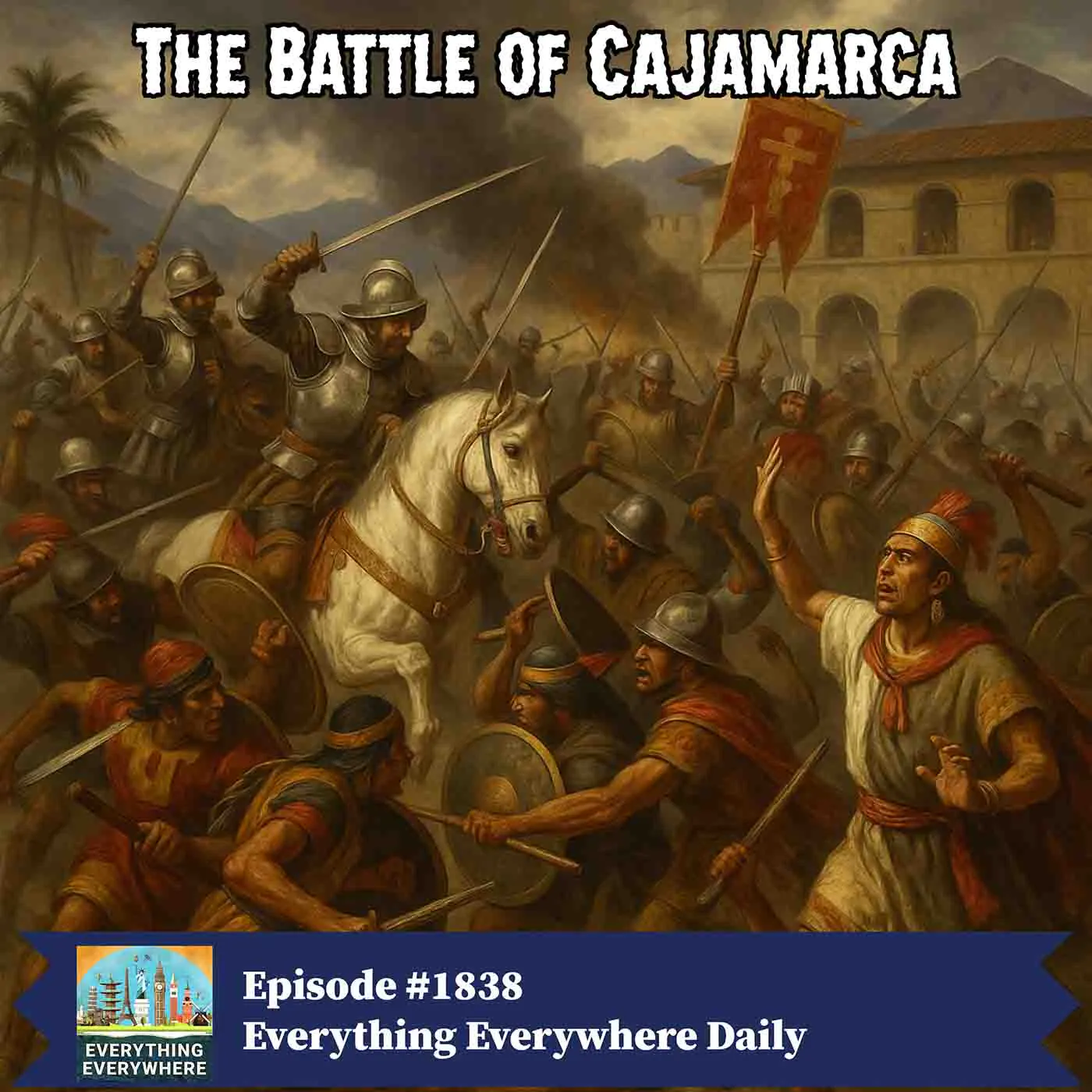
Everything Everywhere Daily: History, Science, Geography & More
The Battle of Cajamarca (Encore)
00:14:30
Loading summary
Transcript1 lines
- [00:00]
Dan Carlin
The following is an encore presentation of Everything Everywhere Daily. Some of the most important battles in history, the ones that change the course of civilizations, are often very small battles. In 1532, a battle, really just a skirmish, took place which completely changed the future paths of Peru, Spain and the entire continent of South America. Despite the importance of this battle, few people have ever even heard of it. Learn more about the Battle of Cajamarca and how it changed the shape of the world on this episode of Everything Everywhere Daily. This episode is sponsored by Fiji Water. You've probably heard of Fiji Water and have seen it in stores. Well, Fiji Water really is from the islands of Fiji. Drop by drop, Fiji Water is filtered through volcanic rock 1600 miles away from the nearest continent, in all its pollution, protected and preserved naturally from external elements. In this process, it collects a unique profile of electrolytes and minerals, resulting in more than double the electrolytes as the other top two premium bottled water brands, giving Fiji Water its smooth taste. Fiji Water's electrolytes are 100% natural and this water even has a perfectly balanced pH of 7.7. I've recently been trying to reduce my consumption of diet soda and I found Fiji Water to be a great alternative. Visit your local retailer to pick up some Fiji Water today for your next backyard party, beach day hike, or even your home office. Fiji Water is Earth's finest water. This episode is sponsored by Mint Mobile. There are numerous subscriptions that you pay for every month. If you want to reduce your monthly spending, your only option is usually to cancel and go without. But in case of your phone, you can significantly reduce your cost while still enjoying almost the exact same service by switching to Mint Mobile. With plans Starting at just $15 a month, Mint Mobile gives you premium wireless service on the nation's largest 5G network. With Mint Mobile, you can use your same phone, phone number, contact list, and even connect to the exact same towers and cellular network. The only difference is price and that's why I recommend Mint Mobile this year. Skip breaking a sweat and breaking the bank. Get your summer savings and shop premium wireless plans@mintmobile.comeed that's mintmobile.comeed upfront payment of $45 required equivalent to $15 a month limited time new customer offer for first three months only. Speeds may slow above 35 GB on unlimited plan taxes and fees extra. C Mint Mobile for Details I'm guessing that most of you listening to this are not familiar with the Battle of Cajamarca. However, you should be by the end of this Episode I hope you have an appreciation for the event that took place almost 500 years ago and how it shaped the world in ways that still can be felt today. The year 1532 was 40 years after Columbus arrived in the Americas. Spain had established a foothold in the New World. Hernan Cortes had conquered the Aztec Empire in Mexico. Spain had major ports in the Caribbean and had begun the takeover of Central America. However, at this point, they still hadn't conquered what would be perhaps their most lucrative Peru. Peru was further away than Mexico, where the islands in the Caribbean, which could be accessed directly by ship from Spain. It was in the Andes Mountains and had to be accessed by land or at least by ship from the Pacific coast. Peru at the time was ruled by the Incan Empire. The Incas were not an ancient empire at that time. It was established in the 13th century in the Peruvian highlands around the city of Cuzco. According to Incan mythology, the first emperor, Manco Capac, founded Cuzco and started the dynasty. Initially, the Incas were one of several small and competing tribes in the region that happened to become the one that was the most powerful. The Incan Empire is certainly worthy of its own episode in the future, but for the purpose of this episode, we can establish that the Incans were the dominant power in the region, a position that they had held at this point for several centuries. Most importantly, in the early 16th century, just before the arrival of the Spanish, the Incan Empire had reached its zenith under the 11th Incan Empire, Huayna Capac. The empire stretched from present day southern Colombia to central Chile, including most of Peru, Ecuador, Bolivia and northern Argentina. This vast area was home to diverse peoples and environments, all integrated into the empire through an extensive system of roads, sophisticated agricultural techniques and a centralized administration. Of all the great pre Columbian civilizations in the Americas, the Incas were by far the largest and the most powerful. However, a united powerful empire under a great ruler is not what the Incan Empire was by the time the Spanish arrived. Huayna Coppac died in 1527 of some disease, which was probably a disease brought by the Europeans like measles or smallpox. Around the same time of his death, his eldest son, an heir apparent, died as well. This resulted in a struggle for the throne between the two youngest sons of Huayna, Huscar and Atahualpa, and the start of the Incan civil war. Atahualpa, based in the northern city of Quito and Huscar, ruling from the traditional Incan capital of Cuzco, engaged in a bitter and bloody struggle for the control of the empire. The conflict weakened the Inca state both militarily and administratively, culminating in Atahualpa's victory in 1532. The timing of the civil war could not have been worse. The war weakened the Inca empire just at the exact moment that the Spanish were about to enter, under the leadership of Francisco Pizarro. Estimates have been placed on the number of Incan losses on both sides of the conflict at around 100,000. Francisco Pizarro was a Spanish conquistador, born around 1474 in Trujillo, Spain. Motivated by tales of rich civilizations in the New World, he traveled to the Americas for fame and fortune. He joined Vasco Nunez de Balboa in his expedition to cross Panama to the Pacific Ocean. And he later turned on Balboa, resulting in Balboa's arrest and execution. And he was rewarded for this by being appointed the mayor of the newly founded Panama City. Having heard stories of the wealth of Peru, he led an expedition down the coast in 1524 and again in 1526. He then returned to Spain to raise money and men and to get crown approval for another expedition to Peru to finally conquer it. He set out from Panama on December 27, 1530, with three ships, 180 men and 27 horses. After establishing a base on the coast and being reinforced by Hernando de Soto, he set out into the interior of Peru on September 24, 1532. The time he spent on the coast gave him a clearer picture of the political and military situation in Peru, especially what had been happening with the civil war, which had ended only months before. Atahualpa had been resting in the mountains not far from the city of Cajamarca. After the end of the war with his brother, Pizarro wanted to conquer Peru, but he was vastly outnumbered. There were perhaps millions of people in the Incan empire, and Pizarro had about 200 men in total now spread across several camps, plus some guns and horses. Despite a massive advantage in technology, it really didn't matter. When they were that outnumbered, they literally wouldn't have had enough ammunition. Pizarro set up a base in cajamarca with only 110 infantry, 67 cavalry, three muskets and two cannons. Atahualpa, who was not that far away, had an army of 50,000. Pizarro's plan was to use subterfuge and to use Atahualpa as the means to conquer Peru with just a skeleton force. He had sent his brother Hernando, as well as his chief lieutenant, Hernando de Soto to meet with Atahuallpa in his camp, surrounded by his army. They were sent there to deliver a message that Pizarro wanted to meet with Atahualpa the next day in Cajamarca, November 16, 1532. Atahualpa agreed and the two men returned to Pizarro at his base in Cajamarca. The next day, Atahualpa arrived in cajamarca with about 6 to 8,000 people in tow. It isn't known if these were non military personnel or if it was just a smaller number of his larger 50,000 man army. Either way, Atahualpa didn't come prepared for combat. He came assuming that he was there to parlay with the Spanish. When Atahualpa arrived in the central plaza of the city, he was approached by a priest and an interpreter. The priest demanded that he adopt the one true faith and that he pay tribute to Emperor Charles V, the King of Spain and the Holy Roman Emperor. Atahualpa is reported to have replied, I will be no man's tributary. With that, Pizarro unleashed his plan. He and his men were hiding in buildings surrounding the central plaza. At the appointed moment, they opened fire with his muskets and cannons and his cavalry ran into the central plaza. And here I should note that while this is usually called the Battle of Cajamarca, it's also sometimes referred to as the Massacre of Cajamarca. And I can't say that is an unfair description. Atahuallpa and his entire retinue were not prepared for battle. They had come under the guise of diplomacy, not looking for a fight. When the fighting began, the Incas were not just caught by surprise, but they were simultaneously experiencing firearms and horses for the first time in their lives. They were in a state of shock, not just from the surprise attack, but from the loud guns and cannons and the strange creatures that these men were riding. Over the course of the next hour, several thousand Incas were killed, with the estimates being placed between 2 to 5,000 and thousands more being captured. The Spanish had zero casualties. In fact, the only injury that was sustained was on Pizarro himself. He had a cut on his hand when he rushed in to capture Atahualpa. His wound didn't even come from an Incan, but from another Spanish soldier who was trying to kill Atahualpa. That was the point of the entire ambush. Pizarro knew that the best chance they had was to capture Atahualpa alive, not kill him. Atahualpa wasn't even Standing upright, by all accounts, he was sitting on the litter that he was carried in on. His servants would throw themselves in the way of the Spanish, sacrificing their lives to protect their ruler. Not only had the Spanish captured the leader of the Incan empire, but they had also killed many of Atahualpa's top commanders in the process, leaving the Incas leaderless. The remaining Incan forces that were outside of town ended up scattering after the attack. Pizarro then demanded a ransom for the release of Atahualpa, an incredibly steep ransom. He demanded that the Incas provide a room filled with gold and then two more rooms filled with silver. Pizarro was going to get the riches that he had come to the New World for. After several months, the Incas managed to assemble the ransom, a room filled with gold and two with silver. However, Pizarro didn't hold up his end of the bargain. Instead, Atahualpa was put on trial for 12 different counts, including killing his brother during the civil war and plotting against the Spanish. Pizarro didn't want to put Atahualpa on trial at first. Rather, he agreed to do it after pressure from his men. Pizarro wanted to send Atahualpa back to Spain, where he could be judged by the King of Spain. Atahualpa was found guilty and sentenced to death. He was to be burned alive, which was normally reserved for heretics, but he was allowed to convert, which he did at the last minute, and then was executed by strangulation. The execution of Atahualpa was not received well by Holy Roman Emperor Charles I, who wrote to Pizarro, we have been displeased by the death of Atahuallpa, since he was a monarch and. And particularly as it was done in the name of justice. With Atahualpa dead, Pizarro, still with a very small number of men, managed to conquer the rest of Peru. At first, they did it with puppet rulers, and then finally through direct rule. The Incan army, weakened after years of civil war and with the loss of all of their top commanders, wasn't a force that had to be reckoned with. There were some minor skirmishes with the Spanish, but there were never any major battles that were fought that could have resulted in a conclusive victory. The diseases that took the life of the previous emperor, Huayna Capac, spread throughout Peru over the next several years, making the conquest of the region just that much easier. Spain ended up ruling Peru for almost 300 years, until it finally became an independent country in the early 19th century. During that time, Peru was the greatest source of silver for the Spanish Empire, and it was the driving force behind the Manila galleon trade across the Pacific Ocean with China. The Battle of Cajamarca was the effective end of the Incan empire, the greatest such empire in the New World. It opened the way for the Spanish to conquest the rest of the continent, all the way down to Tierra del Fuego. Pizarro managed to defeat a massively larger force with an absurdly small number of men, and he managed to do this via a sizable advantage in technology and a whole lot of deception. The Battle of Cajamarca wasn't a great battle in terms of the number of combatants, but it was an incredibly significant battle insofar as its outcome shaped world history. The Executive producer of Everything Everywhere Daily is Charles Daniel. The associate producers are Austin Oakton and Cameron Kiefer. I want to thank everyone who supports the show over on Patreon. Your support helps make this podcast possible. I'd also like to thank all the members of the Everything Everywhere community who are active on the Facebook group and the Discord server. If you'd like to join in the discussion, there are links to both in the show notes and as always, if you leave a review or send me a boostogram, you too can have it read on the show.