Loading summary
Transcript1 lines
- [00:01]
A
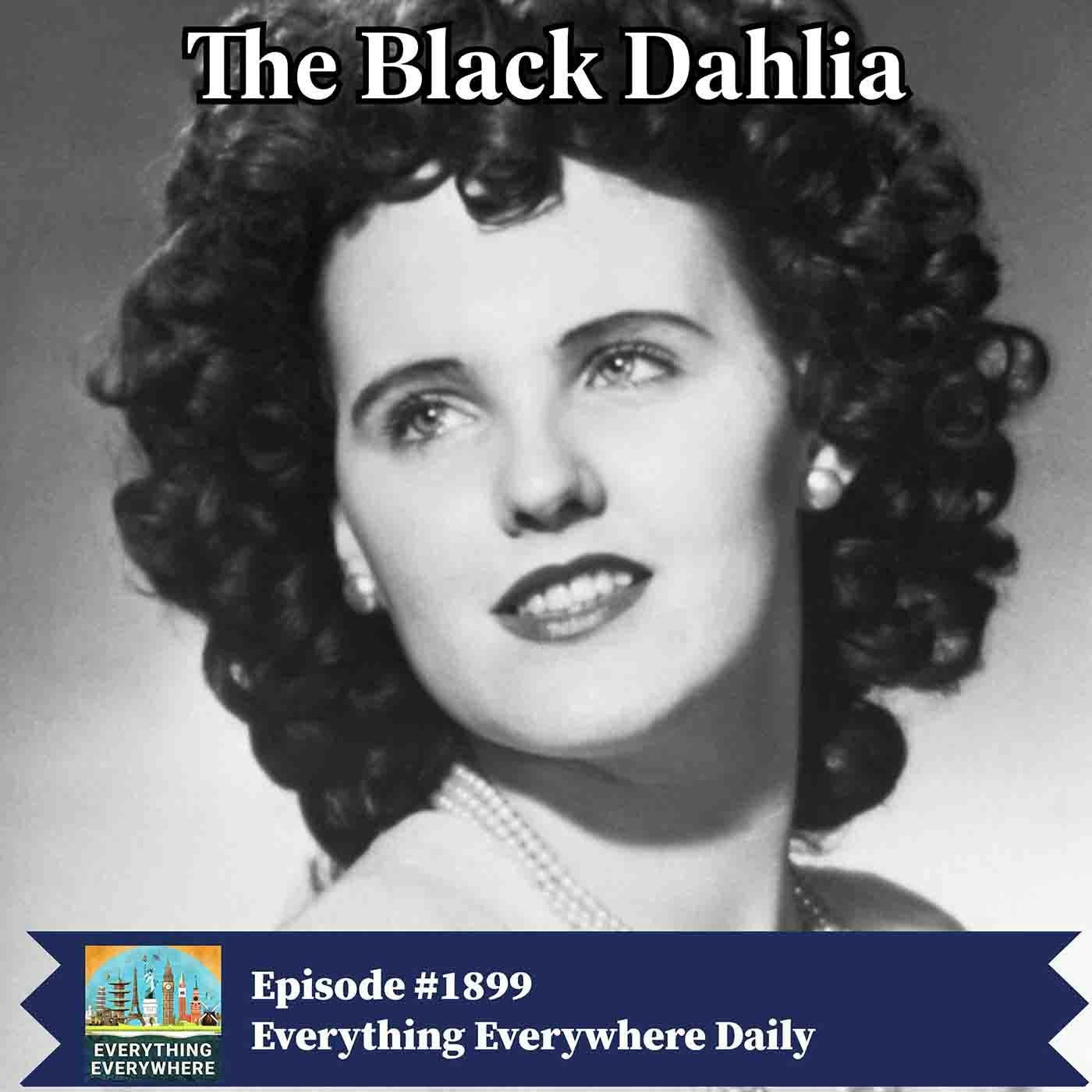
On January 15, 1947, a young woman was found dead in Los Angeles, California. She was found naked, cut in half and drained of blood. When the crime was reported in the newspaper, the deceased woman was given a nickname, the Black Dahlia. Though the case has been cold for the better part of a century, the murder of the Black Dahlia has remained one of the best known true crime cases in America and still fascinates people to this day. Learn more about the murder of the Black Dahlia, potential suspects and the media frenzy surrounding the case on this episode of Everything Everywhere Daily. This episode is sponsored by Fiji Water. You've probably heard of Fiji Water and have seen it in stores. Well, Fiji Water really is from the islands of Fiji. Drop by drop, Fiji Water is filtered through volcanic rock 1600 miles away from the nearest continent in all its pollution, protected and preserved naturally from external elements. In this process, it collects a unique profile of electrolytes and minerals, resulting in more than double the electrolytes as the other top two premium bottled water brands, giving Fiji Water its smooth taste. Fiji Water's electrolytes are 100% natural and this water even has a perfectly balanced pH of 7.7. I've recently been trying to reduce my consumption of diet soda and I've found Fiji Water to be a great alternative. Visit your local retailer to pick up some Fiji Water today for your next backyard party, beach day hike, or even your home office. Fiji Water is Earth's finest water. This episode is sponsored by ExpressVPN. Netflix has more than 18,000 titles globally, but only 7,000 of those are available in the U.S. you're missing out on literally thousands of great shows unless you use ExpressVPN. ExpressVPN lets you change your online location so you can control where you want Netflix to think you're located. ExpressVPN can also save you money on flights or hotels by allowing you to change your virtual location as booking sites often display different prices based on the country you appear to be in. ExpressVPN's apps are available on phones, laptops, tablets and smart TVs and it also has blazing fast speeds which let you stream in full high definition. I spent over a decade traveling around the world and I Wish I had ExpressVPN during my travels as it would have made my life a whole lot simpler. So be smart. Stop paying full price for streaming services and only getting access to a fraction of their content. Get your money's worth@expressvpn.com eed don't forget to use the link@expressvpn.com eED to get an extra four months of ExpressVPN for free. The Black Dahlia, otherwise known as Elizabeth Short, was born in Boston, Massachusetts on January 29, 1924. Short was the third of five daughters to Cleo Alvin Short, Jr. And Phoebe Mae Sawyer. Elizabeth's father had previously worked in the US Navy as a sailor before the family moved to Boston. After moving, he took up a job as a builder of mini golf courses. Unfortunately, the 1929 stock market crash caused the family to lose most of their money. The following year, her father abandoned his car by a bridge and it was believed that he had committed suicide by jumping into the river. In the years following her father's death, Elizabeth would develop severe asthma and bronchitis, forcing her to undergo lung surgery. To prevent further complications, the doctors recommended that Elizabeth move to a warmer area, which led her to live in Miami during the winter. During this arrangement, Elizabeth would decide to drop out of high school. As a sophomore. In 1942, 12 years after the supposed death of her father, Elizabeth's mother received a letter that would change their family's lives. Elizabeth's father, who was assumed to be dead, was in fact very much alive. Within the letter, he told the family that he had a new life in California and offered an apology for faking his death. After learning the truth about her dad, Elizabeth took the opportunity to move to Viejo, California to live with her father. As you might guess, this arrangement did not go so well. The two got into fights, leading Elizabeth to move out of her father's house just a month after arriving. Her move to California was pretty much a disaster. Shortly after moving out, Elizabeth got into an abusive relationship and was later arrested for underage drinking. The arrest ultimately resulted in Elizabeth leaving California and moving back to Florida. And during her time in Florida, she got engaged to an Air Force officer. But he died in a crash shortly after 1945. With nothing left in Florida, Elizabeth decided to move back to California, this time to Los Angeles to reach her goal of becoming an actress. She would live there for just six months. Elizabeth Short's last known whereabouts were reported on January 9, 1947. On the night of January 9, Elizabeth was returning to her home in Los Angeles after visiting her married boyfriend, Robert Red Manley. Manley dropped Short off at the Biltmore Hotel where she was supposed to be meeting one of her sisters who was visiting. Some of the staff reported seeing her that night, corroborating Manley's story. Later that evening, it was also reported that Short was At a cocktail lounge just down the street. And after that, her whereabouts are unknown. Fast forward six days to the early morning of January 15th. A mother was walking with her children at Leimert park in Los Angeles. She had noticed a body just a few feet away from the sidewalk. The body was so pale that she initially thought that it was a mannequin, but quickly realized the dark truth. The mannequin was a woman. It was Elizabeth Short, dead at the age of 22. She was stripped naked and sliced in half at the waist. The body was extremely mutilated, despite no blood being found at the crime scene. The body was laid out in a posed position and had been completely drained of blood, giving her skin a whitish color. It's believed that she was washed before being placed at the crime scene. Her face was slashed from her mouth to her ears in what's known as a Glasgow smile. Near the body, detectives did find some clues. A cement sack nearby contained watery blood, and a footprint was found near the crime scene. An autopsy was performed the following day which found rope marks on her wrists, neck and ankles. The autopsy also found that the technique used to cut Elizabeth in half was a type of surgery called a hemicorporectomy. Fortunately, evidence showed that Elizabeth was already dead when this happened. Hemicorporectomy has only been reported 66 times in medical literature, and it removes every part of the body below the waist, leading investigators to believe that whoever killed Elizabeth had medical knowledge and training. Her cause of death was reported as lacerations to her face combined with blows to her head. Her body was identified through her fingerprints, which were on record from her previous arrest for underage drinking. Following her body's identification, a team of reporters from the Los Angeles Examiner, a Hearst owned tabloid paper, called Elizabeth's mother. During the call, the reporter first told her that her daughter had won a beauty contest. They asked her mother questions before finally revealing that her daughter was not a beauty contest winner, but rather a murder victim. Phoebe Short was reportedly in disbelief over the news, and it wasn't until the police confirmed it that she realized that it was true. The examiner offered to fly Phoebe to Los Angeles so she could supposedly help the police. However, this aid was offered with malicious intent. Their real goal was to keep Phoebe away from other newspapers to protect their story. A significant aspect of the case's notoriety stemmed from the media sensation surrounding it. This case in particular blew up bigger than most and became a major story, with the examiner selling the most copies it had since the end of the second World War. It was quite Common for murder cases to be given a nickname during this time, Elizabeth Short was nicknamed the Black Dahlia from a film titled the Blue Dahlia. The nickname played on the film and reference Elizabeth's dark hair and rumored preference for wearing sheer black clothing. Other newspapers had been referring to the case as the Werewolf murders, but seeing the popularity of the Black Dahlia caused newspapers to pivot to the new nickname, the case quickly became a sensationalized spectacle, dominating front page news for months. However, despite the constant media coverage and public attention, no arrests were ever made. Despite the lack of arrests, the police received some information during their initial investigations. On January 21, 1947, a person who claimed to be the murderer called into the examiner congratulating the paper on the coverage of the case and claimed that he would be sending the paper some souvenirs. An envelope was then sent to the paper three days later. Inside the envelope was a letter written from cut up paper clippings with a letter, Short's birth certificate, business cards, an address book and photographs were found. The packet had been cleaned with gasoline. The gasoline caused police to believe that the packet was sent by the killer and they were fortunate enough to find some fingerprints on the envelope. Unfortunately, the prints were compromised at some point in transit. The same day the envelope arrived, a packet was also dropped off. The packet contained a handbag and black shoes, both of which had also been cleaned with gasoline. A few days later, the examiner got another letter, this time handwritten. The letter stated, here it is turning in Wednesday, January 29, 10am and my fun at Police Black Dahlia Avenger End quote. The letter said the killer would turn himself in at a specific location. Though no one ever appeared, he instead left another letter claiming the killing was justified. Despite this, the LA police worked to solve the case and quickly began to investigate and interrogate suspects. One of the men was her boyfriend, Robert Manley, who had dropped her off at the hotel. He was cleared after passing multiple polygraph tests. The lapd, desperate to solve the case given its high profile status, had a combined total of 750 investigators working on it. They investigated multiple areas for evidence including storm drains and abandoned buildings, but found nothing. They eventually offered a $10,000 reward for information, but this didn't help either. Instead, they received hundreds of false confessions to the crime. As mentioned earlier, the police believed that the murderer was likely a surgeon or someone with medical training due to the precise nature of the cuts on her body. To follow up on this lead, they collaborated with local universities to investigate medical students, but again had no success despite this, there were a few theories as to who killed the Black Dahlia. One theory is that the killer committed suicide. This comes from a note of an unidentified man who committed suicide at a beach just two months after the murder. The man had left his clothes at the shore with a note, and the note said that the man was too cowardly to hand himself in for the Black Dahlia murder and that he had jumped into the water instead. The clothes gave no indication as to the man's identity. A detective on the case provided another suspect. Though the suspect's name was never given to the public. The detective claimed that he had interviewed a man observed at the crime scene before the body was discovered. A neighbor said that he had seen a man in a sedan parked with its rear door open at the scene. The sedan owner was followed to a restaurant where he worked, but was cleared of suspicion by the lapd. Despite this, the detective remained convinced that it was him. Another prime suspect was George Hodel. Hodel was a doctor in Los Angeles who was accused by his own son Steve, of the crime. Shortly before Short's death, Hodel was suspected of murdering his secretary and accused of raping his daughter. Although he was never charged, Steve used his father's experience as a surgeon and his previous accusations as evidence. The police took this accusation seriously and bugged his house. It has since been revealed that Hodel discussed supposedly killing Short and his secretary. Unfortunately, in the 1950s, Hodel fled the United States and moved to the Philippines before he was ever formally questioned. A book published in 2017 titled the Black Dahlia focuses on a suspect named Leslie Dillon. Dillon was a former mortician's assistant working at the Astor Motel in Los Angeles as a bellhop. The book claimed that on the morning Elizabeth's body was found, a room in the motel was reported to be covered in blood and fecal matter. Though the police denied that the motel had any involvement with the case. The book's author, Pugh Eatwell, believes that Dylan and his associates Mark Hanson and Jeff Connors, were involved in a robbery scheme and were paying off Sergeant Finis Brown at the LAPD to keep the scheme under wraps. The theory is that Elizabeth learned too much about the scheme and was killed by Dylan to keep the robberies a secret. Despite being never charged or even formally accused, members of the LAPD believe Dylan could be the killer. A few other theories have to do with other notorious crimes. One such case was the Cleveland Torso Murders. The Cleveland Torso Murders were a series of gruesome killings in the 1930s in which an unidentified serial killer dismembered at least 12 victims in Cleveland, Ohio, many of whom were never even identified. These murders happened about a decade before Elizabeth Shore was killed and the connection was investigated, though no evidence ever connecting the two crimes were found. Another theory was that the Chicago Lipstick murderers and the Black Dahlia case were connected. In 1946, a six year old was dismembered in Chicago. The captain of the LAPD at the time stated this theory publicly and believed that they were connected. The very tenuous evidence came from Elizabeth being found three blocks away from Degnan Boulevard. As the victim's name in the Chicago case was Degan, they believed there was somehow a connection. Initially, the ransom note's handwriting from the Lipstick Killer was similar to the one found in the Black Dahlia Avenger letter. Though the cases were never formally connected, the Black Dahlia case has endured as a symbol of Hollywood's darker underbelly, tied up with themes of exploitation, broken dreams and sensationalist media. The case remains officially unsolved, one of Los Angeles most haunting cold cases, and continues to capture the imagination of true crime researchers and the public alike. Despite all of the theories, the Black Dahlias killer has never been found and justice for Elizabeth Short has never been served. The Executive producer of Everything Everywhere Daily is Charles Daniel. The associate producers are Austin Otkin and Cameron Kiefer. Research and writing for this episode was provided by Olivia Ashe. My big thanks go to everyone who supports the show over on Patreon. Your support helps make this podcast possible and I also want to remind everyone about the community groups on Facebook and Discord. This is where everything happens that's outside of the show. As always, if you leave a review on any major podcast app or in the above community groups, you too can have it read on the show.