Loading summary
Transcript6 lines
- [00:00]
A
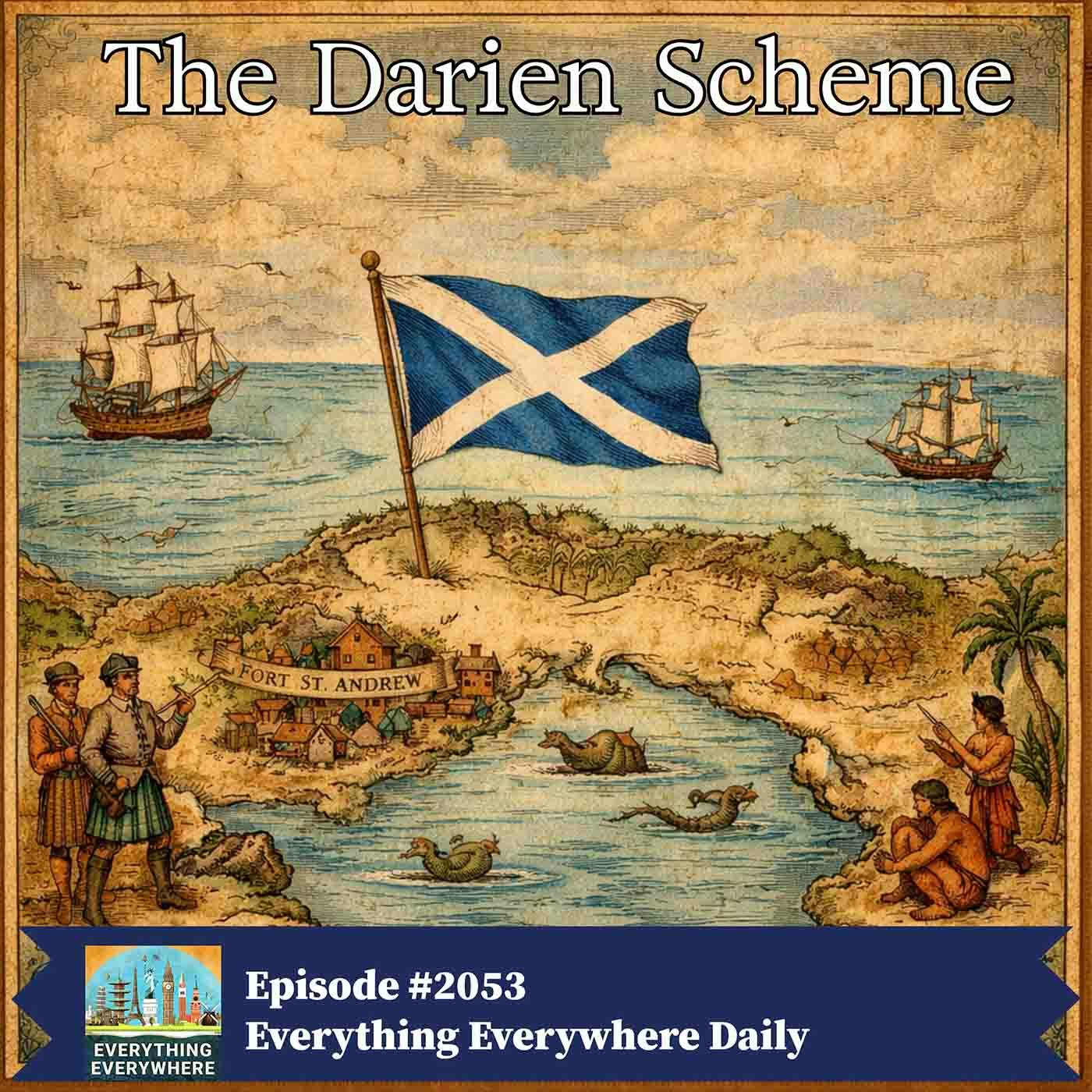
During the 17th century, European nations dominated the world by aggressively establishing colonies across the globe. Late in that century, Scotland sought to join the ranks of these colonial powers with an ambitious effort to seize control of the Darien region in Panama. This attempt to gain a colonial foothold in the Americas began with tremendous national optimism and unified the country as no prior venture ever had. And it was a total disaster. Learn more about the Darien scheme and Scotland's failed attempt at becoming a colonial power on this episode of Everything Everywhere Daily. Carvana is so easy. Just a click and we've got ourselves a car.
- [00:54]
B
See so many cars. That's a clicktastic.
- [00:57]
A
Invent inventory and check out the financing options payments to fit our budget. I mean that's Clickonomics 101 delivery to.
- [01:04]
B
Our door Just a hop, skip and a click away and bought. No better feeling than when everything just clicks. Buy your car today on Carvana. Delivery fees may apply.
- [01:19]
C
Residence Day savings are happening now at the Home Depot with up to 40% off select appliances. Looking to upgrade your fridge? Check out LG's newest model serving up ice in all kinds of styles. Cube Crush Craft Ice and now new Mini Craft Ice straight from the dispenser. From cold brew to fizzy favorites, these refrigerators will have you entertaining like a pro. Shop President's Day Savings and get up to 40% off plus free delivery on select appliances like LG at the home Depot. Free delivery on appliance purchases of $1,498 or more offer valid February 5th through the 25th US only. See store online for details.
- [01:53]
A
In the 17th century, the world's powers were establishing lucrative overseas colonial holdings under the banner of mercantilism. Mercantilism, which will be the subject of a future episode, held that trade was a zero sum contest. The easiest way to achieve that was for a nation to have a favorable balance of trade, which it gained by accumulating natural resources through the establishment of overseas colonies. For Scotland, this became an important objective in 1661 when its neighbor and the burgeoning colonial power England passed the Navigation Acts. The Navigation Acts were created to promote English trade over other nations. The Navigation Acts forbade foreign nationals from trading in English ports within the growing English colonial empire. This was especially problematic for Scotland in the 17th century as it had been part of a complicated relationship with England since the death of Queen Elizabeth in 1603. The Scottish king James Vill also became the English King James I. Although England and Scotland shared the same monarchy, they remained two separate countries at this time Scotland's economy was smaller and more fragile. It faced periodic harvest failures, limited capital and now restricted access to the expanding British imperial trading system. The English Navigation Acts and wartime priorities often meant Scottish merchants could not freely participate in the most lucrative routes. A persistent Scottish hope was that a bold commercial venture could leapfrog these constraints, building national wealth and strategic leverage. The Scottish hatched a risky plan. They were going to establish their own colony. However, maritime expansion and colonialism were very expensive. It required technology and capital, both of which were in short supply in Scotland. The world's most powerful colonial empires of the day had achieved their empires with a blend of luck and skill. The Dutch had gained control over lucrative spice producing regions thanks in large part to the Dutch East India Company. The Portuguese developed a trading post empire in the Indian Ocean, owing to favorable settlement rights granted by the Pope in the Treaty of Tordesillas and their early lead in maritime exploration. Thanks to Columbus and his voyages, the Spanish gained great mineral wealth from their holdings in the Americas. So Scotland was now poised to join this club. Or so they thought. Late 17th century, Scotland was in an economic crisis. In the 1690s, Scotland suffered a severe blow in a series of failed harvests that led to a devastating famine. Scotland saw as much as 15% of the population die in what became known as the Seven Ill Years. Many who did not die were cast into poverty and homelessness. Scotland saw a path out of its struggles by establishing a lucrative trading colony. Scotland had a brief period of overseas colonization in the early 17th century when King James, himself a Scot, granted William Alexander a charter for Nova Scotia. Nova Scotia is literally Latin for New Scotland. As a colony, Nova Scotia initially failed. The first arrivals were ill equipped to cope with the region's climate and farming challenges. Like Many other early 17th century colonies in North America, the death toll during the first winter was too high to continue the colony as a viable enterprise. The Anglo French war of the late 1620s prevented Scotland from supplying the colony, and in 1632 the colony was ceded back to France. While Scottish religious groups such as the Presbyterians and individual Scotsmen held influence throughout North American colonial history, there was no lucrative Scottish colony to speak of. The Scots hoped that the Darien venture would propel Scotland towards becoming a global power. The Darien region refers broadly to the Panama isthmus and nearby coasts. Ever since it had been mapped, it had attracted the attention of imperial strategists. The geography invited a seductive control. A narrow land bridge and you can tax, facilitate or dominate the movement of goods between oceans. In an era before canals. Even a rough portage could be lucrative if it sat astride the world's largest oceans. In 1693, the Scottish Parliament laid the groundwork for the Darien scheme by passing the Scottish act of Encouraging Foreign Trade. The act legalized and encouraged the formation of mercantile groups who sought to build trade relationships with any country or region not at war with the Crown. In essence, Scotland sought to emulate the highly successful Dutch East India Company. However, Scotland in 1693 had very little in common with their Dutch counterparts. The Dutch had cosmopolitan cities, a long storied banking history, a rich maritime exploration history, and a history of public stock exchanges. Scotland was poised to pursue its colonial ambitions without the same background as the Dutch. The inspiration behind the Darien venture was the Scottish banker William Paterson Patterson had co founded the bank of England, bringing experience to the newly created organization, the Scottish Company. Patterson, a geography student, had developed a profound interest in modern day Panama. Patterson believed that this region held the keys to the universe. Patterson's vision centered on Panama's narrow isthmus between the Atlantic and Pacific oceans. Portugal and Spain rose to prominence by establishing maritime empires that controlled the world's primary shipping lanes. To get to the Indian Ocean, you had to go around the Cape of Good Hope, while in the Atlantic, you couldn't get to the Pacific without going through Spanish control of the Cape of Horn. If Scotland could control this narrow strip where the Atlantic and Pacific were so close, then Scotland could become a world power. Patterson had high hopes that the Scottish company could become the next Dutch East India Company or British East India Company. Securing the funds required for the colonial effort was a severe challenge for Patterson and the Scottish Company. Initially, the venture received English support, which was vital to the project's success. That support didn't last very long as leaders from Europe's two most powerful companies, the Dutch and British East India companies, urged Parliament to withdraw their financial support. Without the support of the English government, the funding for the effort became the responsibility of the Scottish people. Records from the Scottish Company archives tout a national public contribution of half a million pounds. It's estimated that this was nearly half of the nation's liquid wealth at the time. For a country in dire straits like Scotland, this was an extraordinary effort. Any Scot who had a few pounds to share contributed to the effort during a time of great poverty and famine. But raising money was only the beginning. Thousands of hopeful Scots volunteered to be part of the first wave of immigrants. And In July of 1698, five ships packed with settlers finally departed their homeland. For the shores of Panama. Patterson's grand vision was in place. It had come with great struggle and had taken all of the Scottish support that he could muster. Unfortunately, Paterson had failed to consider several essential realities. The Darien Gap region of Panama, where the Scottish hope to settle, is remarkable for its geography. The Scots thought that they'd find a tranquil landscape to build their colonial bridge between the oceans. The Scots found the Darien Gap to be incredibly inhospitable. The Darien Gap is so inhospitable that it is the only break in the Pan American Highway. There is no road traversing the 60 mile or 97 kilometer gap between Yaviza, Panama and Turbo, Colombia. Roads are not possible because the terrain in the Darien Gap is too inhospitable. The dense rainforests in the region's steep mountains make it impossible to build roads, or, as the Scots found out, impossible to build settlements and live. The region is also among the wettest in the world, with some places seeing a staggering 9,000 millimeters of rain per year. While the region's geography posed insurmountable challenges, the Scots also failed to consider the indigenous population in their grand design. It should have been a clue to Patterson and the Scots that Spain had not asserted its control over the region. They were well aware of the isthmus economic potential. The Spanish also knew of the remarkable difficulties in sailing through the Drake Passage around Cape Horn, some of the world's most dangerous waters. Standing in the way of Spanish domination of the region were the Kuna and Mbarawonoon peoples. The Scots soon learned what the Spanish already knew. The local tribes fiercely guarded their independence and did not tolerate any encroachment. The advantage of European weaponry was of little importance in a dense jungle environment with which they were hopelessly unfamiliar. The first Scottish settlers landed in October of 1698 after an arduous four month journey and began building Fort Andrew. And the troubles began almost immediately. Under Spanish pressure, English colonies in the region refused to trade much needed supplies to the fledgling Scottish community. The first wave of Scottish colonists in 1698 was also completely unprepared for the region's tropical diseases. The lack of immunity to diseases such as malaria and yellow fever proved catastrophic to the venture. Scottish colonial hopes in Panama seemed doomed to fail. Seven months into the founding of the colony, they had lost more than a third of their original settlers. And the remaining Scots were in dire straits due to disease and food shortages. Unaware of the impending disaster awaiting them, the second group of settlers set off for Panama in 1699. Due to the immense distances. Communication was delayed, leaving the new arrivals unaware of what was happening. They arrived to find Fort Andrew in ruins. The first Scottish settlers on the coast not only had to deal with starvation, diseases and indigenous peoples, but also with the Spanish. The Spanish had launched a campaign against the Scottish colony, while Spanish ships blockaded the settlement to prevent escape. After several weeks of a demoralizing and starving siege, Fort Andrew surrendered on March 31, 1700. Though the Scottish survivors were permitted to return home, most did not survive the subsequent journey. The cost of the Darien scheme for Scotland was catastrophic. Not only did they lose more than 2,000 people to starvation, warfare and disease, but they lost their entire initial investment. The loss of the investment put the country on the edge of bankruptcy. In this case, the bankruptcy did not just affect a joint stock company. It was borne by the Scottish government and the people of Scotland. And the people of Scotland blamed the English for the disaster, as it was the English who had pulled their support. By the time of the Darien disaster, England and Scotland's shared king was James great grandson William iii. By siding with Spain during the Darien scheme, Scottish critics accused William III of prioritizing English interests over Scotland's. The anger had reached a fever pitch as the Scottish Parliament passed the act of Security, which threatened to split the monarchy in two. Once again, however, it was acts passed in the English Parliament that ended up sealing Scotland's fate. The alien act of 1705 was an English law that threatened to treat Scots as aliens and to cut off their access to English trade and property rights unless Scotland accepted the Hanoverian succession or entered into negotiations for political union. Scotland was staring at a collapse. By 1706, the Scottish economy was effectively insolvent and the only option available to repay their debts was to sell them to England. The act of Union created the United Kingdom in 1707, uniting England and Scotland and providing 398,085 pounds to repay the debt owed to thousands of Scotsmen who contributed to the Darien scheme. History sometimes works in mysterious ways. The United Kingdom became the world's largest empire in the 19th century. Yet the reason why the country was founded in the first place was directly related to a failed colony in Central America that bankrupted the nation of Scotland. The executive producer of Everything Everywhere Daily is Charles Daniel. The associate producers are Austin Otkin and Cameron Keefer. Research and writing for this episode was provided by Joel Hermanson. My big thanks go to everyone who supports the show over on Patreon. Your support helps make this podcast possible and I also want to remind everyone about the community groups on Facebook and Discord, as this is where everything happens outside of the podcast. As always, if you leave a review on any of the major podcast apps, you too can have it running the show.