← Everything Everywhere Daily: History, Science, Geography & More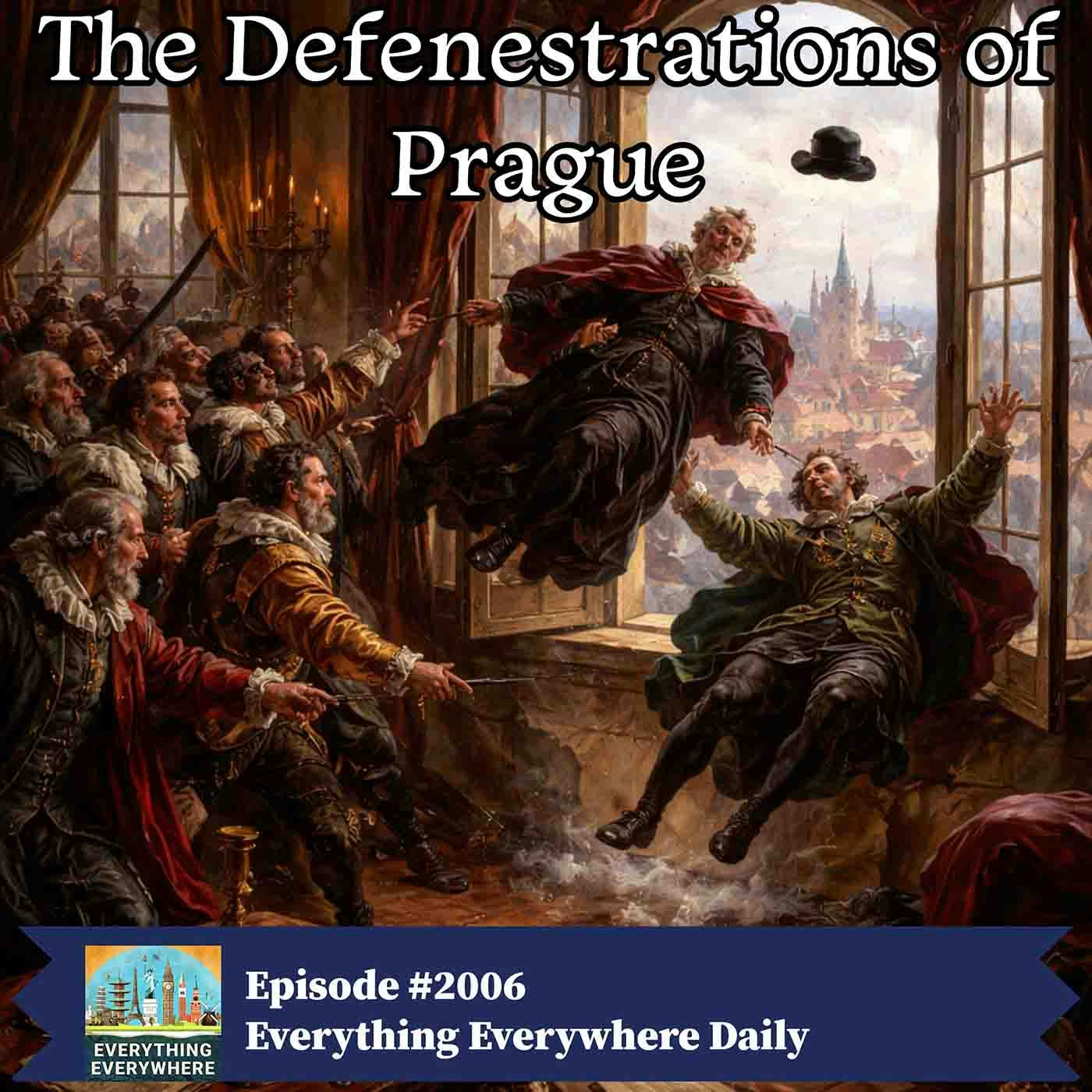
Everything Everywhere Daily: History, Science, Geography & More
The Defenestrations of Prague
00:15:13
Loading summary
Transcript1 lines
- [00:01]
A
Prague is one of the truly great cities of Central Europe. It's noted for its preserved medieval and baroque architecture, the Charles Bridge, the Prague Castle, its astronomical clock and its Gothic Old Town. In addition, it has one of the world's greatest beer and brewing cultures and they also happen to like to throw people out of windows. Learn more about the defenestrations of Prague, why they happened, and their impacts on this episode of Everything Everywhere Daily. This episode is sponsored by Drip Drop. When you're properly hydrated, everything functions better. Your energy, mood and focus all rise together. That's why Dripdrop was created. It's not only about quenching thirst, it's about keeping your body and brain operating at peak performance. Drip Drop is doctor developed and proven to hydrate fast, helping both your mind and body perform at their best. It uses an exact balance of electrolytes and glucose for quick absorption, delivering three times the electrolytes and half the sugar of leading sports drinks. You feel the difference quickly with sharper focus, stronger energy and even a better mood. And it genuinely tastes great. There are 16 original flavors and eight zero sugar options. I've been using the zero sugar lemon lime packets to start my day with a glass of water. Right now, Dripdrop is offering podcast listeners 20% off your first order. Go to dripdrop.com and use promo code everything. That's dripdrop.com, promo code everything for 20% off. Stock up now@dripdrop.com and use promo code everything. This episode is sponsored by Quints. A new year is upon us and that means new resolutions, new goals and maybe a new wardrobe. If you're craving a winter reset, start with pieces truly made to last season after season. Quince brings together premium materials, thoughtful design and enduring quality so you stay warm, look sharp and feel your best all season long. One of the sweaters I recently got from Quince is something that I have been wearing almost every single day and I love it. By partnering directly with ethical factories and top artisans, Quince cuts out the middleman to deliver premium quality at half the cost of similar brands and often even bigger discounts. Moreover, those competitor prices are often listed right on the Quince website. Refresh your winter wardrobe with Quince. Go to Quince.com daily for free shipping on your order and 365 day returns. Now available in Canada too. That's Q-U-I-N-C-E.com daily free shipping and 365 day returns. Quince.com daily. Prague is without question the defenestration capital of the world. Most cities never even have a single major defenestration in their entire history, and if they do, they probably had just one. But Prague has had multiple defenestrations. The people of Prague just seem to love a good defenestration. And before I go any further, I should probably explain what a defenestration is. Defenestration is just a fancy word for throwing someone or something out a window. It's derived from the Latin with d meaning out and fenestra meaning window. If you look up the defenestrations of Prague, you'll usually find at least two mentioned, sometimes three, and occasionally four. And because this is a defenestration themed episode, I'm going to cover all four, although they do not all have the same importance and historical weight. The first defenestration of Prague took place amid growing religious and social tensions in bohemia in the 15th century. The kingdom of Bohemia was technically part of the Holy Roman Empire, but it was culturally distinct and had seen a surge in religious reform movements. The central figure who set the stage was Jan Hus, a Czech preacher who criticized the Catholic Church for corruption, selling indulgences and its wealth. His execution for heresy in 1415 at the Council of Constance turned him into a martyr and made tensions in Bohemia explode. Many Czechs believed that his idea reflected a national struggle against foreign domination, both German and papal. After the death of Huss, the Hussites formed a reformist movement demanding a vernacular scripture and a less corrupt clergy. Negotiations with the monarchy and the church failed. The situation deteriorated into street clashes, sermons that stirred large crowds and political fragmentation. On July 30, 1419, a procession led by the radical priest Jan Zulevsky marched towards the new town hall in Prague to demand the release of imprisoned Hussites. When the town council refused and someone allegedly threw a stone at the crowd from a window, the mob stormed the building. They seized several Catholic city councilors and and hurled them from the windows to their deaths below. This defenestration became the spark that ignited the Hussite wars. King Wenceslaus IV reportedly suffered a fatal stroke shortly afterwards when he learned of what had happened. Central Europe descended into 20 years of war as the Hussites defended their religious and political autonomy against imperial and papal crusades. The immediate aftermath was a revolutionary period in Bohemia in which the Hussites created their own political structures and developed military innovations such as war, war, wagons. The eventual resolution came with the Compacts of Basel in 1436, a peace that allowed limited religious concessions but left Bohemia weakened and divided between the Utraquists, who were moderate Hussite and practiced a reformed form of Christianity, and Catholics, who continued to hold power through institutions. In addition to all the religious and political turmoil of the period, it gave the people of Prague a taste for throwing people out of windows. By 1483, tensions had arisen again. King Wladislaus II, a Catholic, ruled Bohemia. But most of Prague's towns were controlled by Utraquist dominated councils that feared the monarchy would impose Catholic rule and strip them of all autonomy. There were also rumors that Catholic nobles and clergy were plotting to purge Hussites from urban administration. Mistrust built quickly, and people remembered all too well how similar tensions had erupted violently before. On September 24, 1483, Utraquist Radicals in Prague's Old Town, New Town and Lesser Town launched a coordinated uprising. They seized control of key buildings and arrested Catholic officials, accusing them of conspiring with the king against the rights of Hussites. In several locations, captured officials were thrown out of windows, echoing the 1419 event and evoking the same symbolism. Rejecting Catholic or royal authority seen as illegitimate, it was an organized coup to secure control of the city. The killings were part of a swift purge that removed or intimidated suspected Catholic loyalists. And this was the second defenstration. It's often overlooked or called the Lesser Defenstration, and it's even sometimes called the third Defenestration, even though it occurred second. In order, the next defenstration, which is usually called the second Defenstration, even though it was actually third in terms of time, played a direct role in triggering the 30 year years war. As I mentioned in my previous episode on the topic, the 30 Years War was one of the most destructive conflicts in European history. Unlike the sudden revolutionary explosion of 1419, this defenestration was a calculated political act by elite nobles who believed that lawful resistance had failed and that their survival, both religious and political, was now at stake. Its roots lay in the long aftermath of the Hussite era. Although Bohemia had never fully returned to religious uniformity after the 15th century, the 16th century brought relative stability under the Habsburg dynasty, and that stability rested on compromise. A majority of the Bohemian nobility and urban population adhered to various forms of Protestantism, including Utraquism and Lutheranism, while the ruling Habsburgs remained firmly Catholic. To maintain peace, the various emperors granted limited religious freedoms in exchange for political loyalty. This fragile balance was formalized in 1609 with the letter of majesty issued by Emperor Rudolf II. The document guaranteed Bohemian nobles and royal towns the right to practice Protestant worship, to build churches on royal lands, and to defend these rights through representative institutions. While imperfect, the Letter of Majesty was viewed by Protestants as a constitutional guarantee rather than a temporary concession. The crisis emerged when Rudolf's successors attempted to reverse this agreement. Emperor Matthias and, more importantly, his chosen heir, Ferdinand ii, were committed to Catholic restoration. Ferdinand had ruled Inner Austria with ruthless determination, suppressing Protestantism through coercion and forced conversion. His reputation alarmed Bohemian Protestants, who saw in him an existential threat to their religious and political autonomy. Tensions escalated when Catholic officials, acting in Ferdinand's name, ordered the closure of Protestant churches built on royal land. Protestants argued that these actions violated the Letter of Majesty. Appeals through legal and imperial channels went absolutely nowhere. The imperial response was dismissive, signaling that the Habsburg court no longer recognized the authority of Bohemian religious guarantees. By the spring of 1618, many Protestant nobles concluded that constitutional resistance had failed. On May 23, they assembled at Prague Castle and summoned two imperial governors, Yaroslav Boritsa and Willem Slavata, along with their secretaries to account for the violations. The meeting quickly turned confrontational. The governors denied wrongdoing and insisted that they had acted lawfully under imperial authority. For the nobles, this was confirmation that their rights were being deliberately erased. The confrontation ended with the nobles stealing a page from the Prague playbook. They seized the two governors and their secretaries and threw them from a window of the Bohemian Chancellery, plunging them more than 60ft into the castle moat. Remarkably, all of them survived. Catholics later attributed their survival to divine intervention, while Protestants pointed out that they landed in refuse and debris. Regardless of the interpretation, the symbolism was unmistakable. The act was a direct rejection of Habsburg authority and a declaration that the Bohemian Estates would defend their rights by force if necessary. The immediate aftermath was literally revolutionary. The Bohemian estates formed a provisional government, expelled Catholic officials and began raising an army. Ferdinand was formally deposed as King of Bohemia, and the crown was offered to Frederick V, a leading Protestant prince. Frederick accepted, becoming King of Bohemia in 1619. His reign would later earn him the nickname the Winter King due to his brief duration. What began as a regional rebellion quickly expanded into a continental conflict. Ferdinand was elected Holy Roman emperor in 1619, giving him access to imperial resources. And Catholic allies. Spain, Bavaria and the Catholic League rallied to his cause, while Protestant states across the empire watched anxiously, fearing similar repres. The conflict escalated beyond Bohemia into the German states, the Low Countries, Scandinavia, and eventually even France. The Bohemian revolt collapsed decisively at the Battle of White Mountain in 1620, just outside of Prague. Ferdinand's forces crushed the Rebel army and Frederick fled into exile. The consequences for Bohemia were catastrophic. Protestant nobles were executed or exiled, lands were confiscated on a massive scale and Catholicism was imposed by force. Bohemian political autonomy was dismantled and the Czech language was marginalized among elites, and the kingdom was transformed into a hereditary Habsburg possession. That defenestration was really the big one insofar as it launched the greatest war in European history. Up until that time, however, this wasn't technically the last defenestration of Prague that took place in the 20th century. After World War II, Czechoslovakia emerged as a democracy with a coalition government that included Communists. The Communist Party gradually increased its power, controlling key ministries, including the Interior Ministry, aka the National Police. By February 1948, tensions escalated when the Communist Interior Minister placed communists in commanding position throughout the police force. 12 non communist cabinet ministers resigned in protest, hoping to force new elections. Instead, Communist Prime Minister Clement Gottwald, backed by the Soviet Union and an armed workers militia, used the crisis to orchestrate a coup D'. ETAT. On March 10, 1948, Foreign Minister Jan Massary, the son of Czechoslovakia's founder Tomas Masaryk, and the only remaining non communist minister in the government, was found dead in the courtyard below his bathroom window at the Foreign Ministry. The Communist government ruled it a suicide, claiming that Massaryk had been depressed. However, the circumstances were highly suspicious. Masarak had shown no signs of depression. The window was too small for easy access and you would have to have climbed outward deliberately. Massaryk's death eliminated the last major democratic figure in the government and shocked the nation. The Communist Party consolidated total control, establishing a Stalinist regime that would last until 1989. Czechoslovakia became a satellite state of the Soviet Union, enduring purges, show trials and repression. After the Velvet Revolution In 1989, investigations on the supposed suicide were reopened. In 2004, a police report concluded that Masaryk was likely murdered. Though definitive proof remained elusive, most historians now accept that he was probably thrown from the window by Communist agents, making this a true defenestration. In the tradition of Prague, the first three defenestrations are only loosely connected, and the fourth really has nothing to do with the other three at all. Other than the method of murder, the defenestrations of Prague are really nothing more than a historical coincidence. There have been some other notable defenestrations in history. The defenestration of Edinburgh took place in 1688, when opponents of James VII threw royal officials out of windows during unrest tied to the Glorious Revolution. Signaling the collapse of royal authority in Scotland, the defenestration of Lisbon in 1640 took place during the Portuguese Restoration War when anti Spanish conspirators killed royal officials and threw at least one body from a palace window as Portugal rebelled against Habsburg rule. And the defenestration of Tehran in 1979 occurred when revolutionary crowds executed officials of the Shah's regime by throwing them out of buildings. A defenestration isn't just a way of getting rid of someone, it's also a highly symbolic act. Throwing someone out of a window is a signal that you are actually rejecting their system of power. The executive producer of Everything Everywhere Daily is Charles Daniel. The associate producers are Austin Otkin and Cameron Kiefer. My big thanks go to everyone who supports the show over on Patreon. Your support helps make this podcast possible, and I also want to remind everyone about the community groups on Facebook and Discord. That's where everything happens that's outside the podcast, and links to those are available in the show Notes. As always, if you leave a review on any major podcast app or in the above community groups, you too can have it read on the show.