← Everything Everywhere Daily: History, Science, Geography & More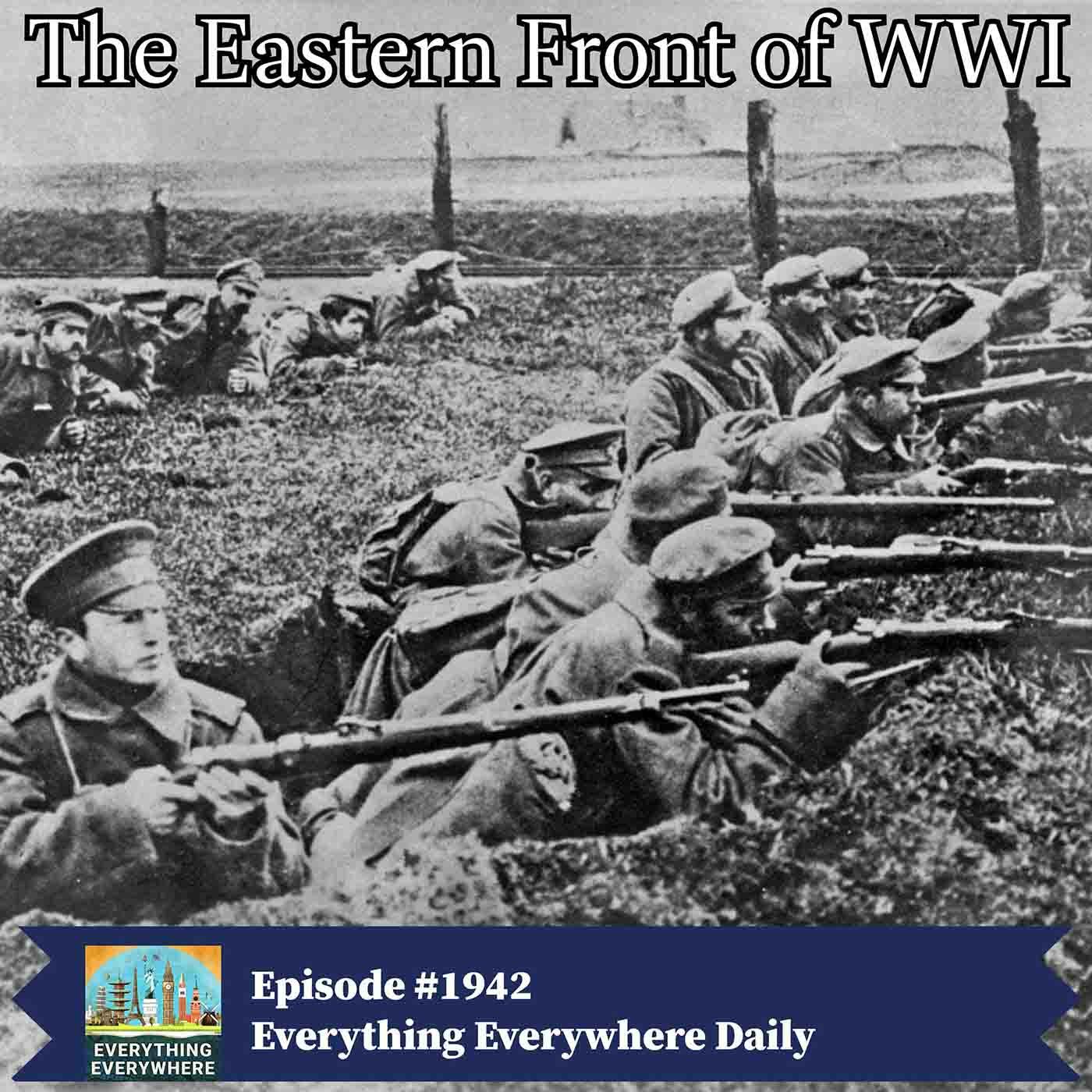
Everything Everywhere Daily: History, Science, Geography & More
The Eastern Front of World War I
00:15:08
Loading summary
Transcript11 lines
- [00:00]
Host
During the First World War, most of the attention, at least in the west, was focused on the Western Front. However, the Western Front was not the only front in the war. There were actually multiple fronts, including the Middle East, Africa, the Balkans and Italy. The largest of these non western fronts was in the East, a front that extended from the Baltic to the Black Sea. The war in the east was almost as brutal as in the west, with casualties almost as high. Learn more about the Eastern Front in World War I on this episode of Everything Everywhere Daily. This episode is sponsored by Mint Mobile. If you're a regular listener, you know that I spent over a decade traveling all over the world. During my travels, I would often get mobile plans from my phone, and I noticed that almost everywhere in the world had much, much cheaper phone plans than what we had in the United States. That all changed with Mint Mobile. With Mint, you can get monthly plans that start at just $15 a month. That's why I recommend Mint Mobile. All plans come with high speed data and unlimited talk and text delivered on the nation's largest 5G network. Use your own phone with any Mint Mobile plan and bring your own phone number along with your existing contacts. At Mint Mobile, their favorite word is no. No contracts, no monthly bills, no overages, no hidden fees, and no bs. Ready to say yes to saying no? Make the switch@mintmobile.comeed that's mintmobile.comeed upfront payment of $45 required, equivalent to $15 a month limited time. New customer offer for first three months only. Speeds may slow above 35 gigab unlimited plan tax and fees extra. See Mint Mobile for details.
- [01:56]
Ad Voice 1
All right, remember, the machine knows if you're lying. First statement Carvana will give you a real offer on your car. All online.
- [02:03]
Host
False. True.
- [02:04]
Ad Voice 1
Actually, you sell your car in minutes.
- [02:06]
Host
False.
- [02:07]
Ad Voice 2
That's gotta be true.
- [02:08]
Host
Again.
- [02:09]
Ad Voice 1
Carvana will pick up your car from your door, or you can drop it off at one of their car vending machines.
- [02:13]
Ad Voice 2
Sounds too good to be true. So true.
- [02:16]
Ad Voice 1
Finally caught on. Nice job. Honesty isn't just their policy, it's their entire model. Sell your car today too.
- [02:23]
Host
Carvana Pickup fees may apply when most people think of the First World War, they tend to picture the trench warfare that took place in France and Belgium. To be sure, the Western front was brutal and it was where many of the resources of both the Allies and Central Powers were put. However, that was not the whole war. There were fronts in Italy, the Balkans, the Middle east, and even limited fighting in Africa and Asia. My goal for this episode is to provide a high level overview of the events of the Eastern Front and how the war in the east eventually ended. In many ways, the Eastern Front was the forgotten front. Yet it suffered almost as many casualties as the Western Front and may have suffered even more if the war hadn't ended almost a year sooner. The Eastern Front extended from the Baltic Sea down to the Black Sea. Although the actual front moved considerably during the course of the war, the primary belligerents on the Eastern Front were the Russian Empire, Germany, Austria, Hungary, the Ottoman Empire and Romania. The length of the Eastern Front was more than double the length of the Western Front. The distances alone made the conflict in the Eastern Front fundamentally different from that in the west, as the forces were more dispersed. Russia entered World War I in August of 1914 in defense of its ally Serbia. And after Austria, Hungary declared war on Serbia following the assassination of the Archduke Franz Ferdinand. Bound by Pan Slavic sentiment and its alliance with France, Russia mobilized against Austria, Hungary and Germany. Germany then declared war on Russia on August 1, 1914, creating the Eastern Front. The Eastern Front in 1914 opened in a way that most people don't associate with the First World War. It was rapid. After Austria, Hungary declared war on Serbia, Russia mobilized faster than Berlin expected and struck on two axes. In East Prussia, Russian generals Paul von Rennenkampf's 1st army advanced in the northeast, while General Alexander Samsonov's 2nd army pushed from the south. Germany's 8th army, placed under Paul von Hindenburg with Erich Ludendorff as his chief of Staff, used intercepted Russian wireless and interior rail lines to defeat the two forces at Tannenberg in what is today eastern Poland. From August 26th to the 30th, the Germans encircled Samsonov's army, captured tens of thousands of prisoners and drove the survivors east. In September, during the First Battle of the Marsurian Lakes, the Germans also expelled Rennenkampf from East Prussia. Farther south, events ran the other way. In Austrian Galicia, Conrad von Hotzendorf launched offensives towards Lubin and Lviv, but ran into stronger Russian forces. The Russian victories along the Zolta Lipa and Ganila Lipa rivers culminated in the fall of Lemberg on September 3rd and the siege of the Habsburg fortress of Premezil. Beginning on September 16, Austria, Hungary ceded most of eastern Galicia and reeled back towards the Carpathians, suffering immense losses and taking many prisoners. Revealing its dependence on German support. In October, Germany formed a new 9th army in Silesia to relieve pressure on its ally and to threaten Russian forces in eastern Poland. An attack on Warsaw then followed. Russia's Concentrated forces and stubborn defense forced the Germans to withdraw from the outskirts of Warsaw by late October. November brought the Battle of Woach. German thrusts nearly closed a pocket on parts of the Russian front, then had to fight out of a counter circlement. The result was a bloody Russian withdrawal, but no decisive outcome. By December, winter weather and exhaustion produced more static lines along the Bazura and Raqqa rivers west of Warsaw, while the siege of Prysl continued and both sides consolidated, consolidated in Galatia and along the East Prussian frontier. In 1915. On the eastern Front, the tide changed from early Allied gains to decisive Central Powers dominance. Winter opened with two crises for Russia. In February, the Germans expelled Russian forces from East Prussia in the Winter Battle of the Mercerian Lakes, while in the south, the Russians pressed hard in the Carpathian Mountains to break into Hungary and to relieve the besieged Habsburg fortress of Premezel. The mountain fighting bled both sides in snow and mud. Premezel finally fell to Russia on March 22, yielding vast provisions and prisoners. Yet Austria Hungary managed to survive with growing help from the Germans. The strategic tide of the Eastern Front really turned in May. On May 2, General August von Mackensen launched the Gorlicha Tarnow offensive in western Galicia. With heavy artillery and carefully coordinated infantry, the Russian Third army collapsed, creating a breach that German and Austro Hungarian forces widened throughout the spring Summer. Lemberg was retaken in June and Pramazel was recaptured soon after. The breakthrough created the great Russian retreat. Throughout July and August, the Central Powers overran Poland and Lithuania, seizing Warsaw on August 5th and smashing the great ring of fortresses that anchored the old front. Kovno, Novo Georgesk and Brest Litovsk all fell as the Germans took enormous numbers of Russian prisoners. In the north, German armies pushed through the Courland region of western Latvia, while to the south, they advanced into the Volhynia region in what is today northwestern Ukraine. The Russians scorched the earth behind them. As they fell back to shorter lines. Shortages of shells and rifles began to deepen. In September, Tsar Nicholas II assumed personal command, a political gamble that tied the monarchy directly to the fortunes on the battlefield, which in hindsight was a horrible move. Autumn saw heavy fighting around Vilnius and along river barriers as the Central Powers tried to close encirclements that largely failed. By the end of 1915, the front had moved hundreds of kilometers to the east. The Central Powers now controlled Poland, Lithuania and much of Galicia, while Russian field armies remained battered but intact on their new, shorter defensive line in 1916. On the eastern Front, the pendulum swung from Russian resurgence To exhaustion, Russia opened with a diversionary attack on Lake Naroche in March in what is today Belarus, to attempt to relieve pressure on Verdun. In France, poor preparation, soft ground and strong German defenses produced heavy Russian losses with no gain. In June, General Oleksii Brusilov launched a vastly better prepared offensive across Volhynia and Galicia. He used short, intensive bombardments, surprise and dispersed forward assaults to infiltrate weak points rather than trying to telegraph a huge single blow. The Litusk breakthrough shattered the Austro Hungarian lines, yielding hundreds of thousands of prisoners, and forced Germany to rush reserves to the east. After this defeat, Austria Hungary never fully recovered its independent ability to fight. The Brusilov gains stalled near Kovel, where repeated Russian assaults met, reinforced German defenses and heavy counterfeit coordination broke down. As other Russian fronts failed to mount decisive attacks, supply and ammunition shortages reappeared, along with mounting casualties and officer losses. Nonetheless, Brusilov's offensive achieved strategic effects across Europe. It compelled Germany to divert forces from the west and helped convince Romania to enter the war on the Allied side. In late August, seeking to get Transylvania, Romania's entry into the war quickly turned into a disaster. The Germans entered Romania, crossed the Danube and overran Wallachia. Tirtukaya fell in September, Pulushti's oil region was seized, and Bucharest fell on December 6. A Romanian and Russian defensive stand in what is today Moldova prevented a total collapse, but most of Romania had now been occupied by Germany. Elsewhere, Russia won notable victories over the Ottomans in the Caucasus, capturing Aruzim in February and Trabazon in April, although operations slowed as manpower and supply issues grew. By the end of 1916, the front had moved somewhat west in the south, But Russia's armies were now drained. Morale eroded, inflation spiked at home, and Brusilov's tactical brilliance couldn't offset the strategic fatigue plaguing the entire Russian army. The Eastern Front in 1917 was defined by the gradual unraveling of Russia's war efforts. In February, the Romanov monarchy fell after strikes and mutinies in Petrograd, and a provisional government pledged to keep fighting while promising reforms. The Petrograd Soviet issued order number one, which democratized military life and encouraged the formation of soldiers committees. The result? Discipline and obedience eroded across the entire army, and desertions increased. Allied pressure for action led to the summer offensive, also known as the Kerensky offensive. General Brusilov, now commander in chief of the Russian army, planned a coordinated strike in Galicia for June. Russian armies achieved early gains around Zaborov and Lutsk, which provided A brief morale boost, however, German and Austro Hungarian reserves quickly counterattacked, restored the front and then drove the Russians into a general retreat that became chaotic as unit refused orders or completely dissolved by August. The Brusilov plan could not compensate for the broken logistics and falling cohesion of the Russian army. Germany exploited the collapse of the Russian army in the north. In September, troops under General von Hoyter crossed the Geneva river and captured Riga. In October, the German navy and army executed Operation Albion, an amphibious seizure of the Baltic islands in the Gulf of Riga, which tightened control over the approaches to Petrograd. On the Romanian front, joint Romanian and Russian forces fought hard in July and August, stopping German advances and preserving the region of Moldavia. But Romania remained militarily isolated and increasingly dependent on a disintegrating Russian ally. The big event occurred that November. The Bolsheviks overthrew the Provisional Russian Government. The new regime sought peace and the Eastern Front fell quiet as fraternization spread. An armistice took effect in December and negotiations opened at Brest Litovsk. In 1918, the Eastern Front completely collapsed as a conventional theater of the war. The armistice talks were going nowhere, so Germany launched operation Faustschlag on February 18. After negotiations stalled, Germany and Austro Hungarian forces advanced almost unopposed across Belarus, the Baltic and Ukraine, ceasing rail hubs, ports and compelling the Bolsheviks to sign the Treaty of Brest Litovsk on March 3. Russia ended up ceding control or influence over Poland. Lithuania, Latvia, Estonia recognized Ukrainian independence and yielded parts of the Caucasus to the Ottomans. The Central Powers installed occupation regimes from Finland to the Black Sea and then tried to extract food and raw materials, especially from Ukraine. The short term military effect was stark. With Russia out of the war, Germany could redeploy dozens of divisions to the west for the 1918 Spring Effect Offensives in France. Those extra troops helped produce the great breakthroughs of March to June. Yet the new Eastern order also imposed heavy costs on them. Garrisons, rail security and administration tied down several hundred thousand Central Power soldiers. The hoped for Ukraine grain never arrived at scale due to chaos, peasant resistance and logistics. German morale at home continued to sag under blockades and shortages and political strains worsened inside Austria, Hungary on the southeastern flank. Romania was forced to accept the Treaty of Bucharest in May, losing resources and transit rights, though it re entered the war on November 10, the day before the war ended in the Caucasus. The Ottomans pushed east under the Brest Litovsk terms, reaching Baku in September, but their position unraveled after defeats in Palestine by British and Arab forces. With Germany's surrender, the Brest Litovsk map was just swept aside. Newly independent Poland and Baltic states moved in to fill the vacuum, while Russia spiraled into civil war. Most important for the Western Front, Germany's spring gains had not delivered victory, and the occupational burdens in the west couldn't offset Allied manpower and material superiority. While it didn't directly affect the other fronts, the Eastern Front had an incredible impact on the rest of the war indirectly, by tying up so much manpower and resources in its own right, the Eastern Front saw an estimated 2.5 to 3.5 million people killed in combat in comparison to the 4 to 5 million killed on the Western Front. Had the war consisted of nothing but the Eastern Front, it still would have been the greatest war in human history at that point in time. The executive producer of Everything Everywhere Daily is Charles Daniel. The associate producers are Austin Otkin and Cameron Keefer. My big thanks go to everyone who supports the show over on Patreon. Your support helps make this podcast possible, and I also want to remind everyone about the community groups on Facebook and Discord. That's where everything happens that's outside the podcast, and links to those are available in the show Notes. As always, if you leave a review on any major podcast app or in the above community groups, you too can have it read in the show.