← Everything Everywhere Daily: History, Science, Geography & More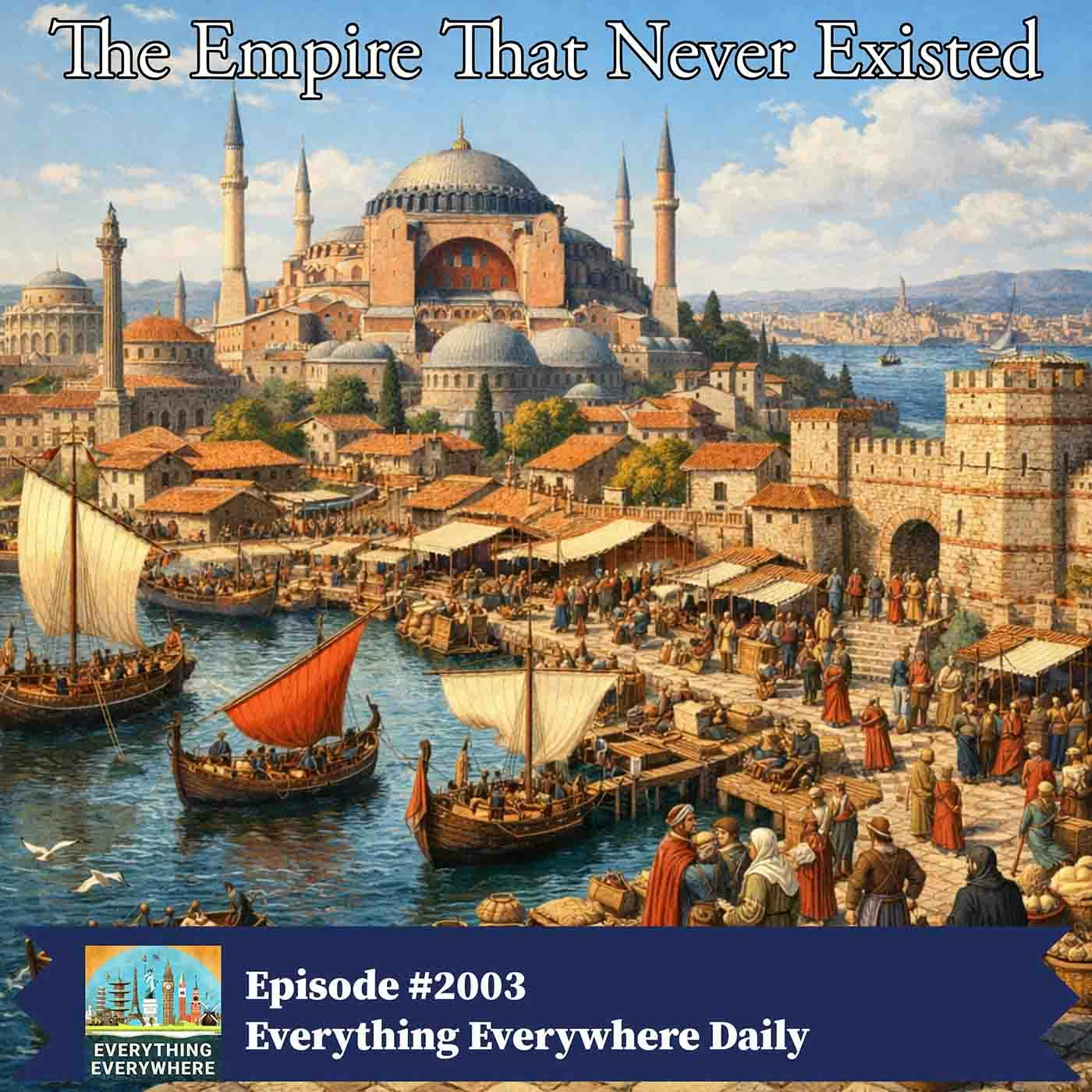
Everything Everywhere Daily: History, Science, Geography & More
The Empire That Never Existed
00:14:15
Loading summary
Transcript1 lines
- [00:00]
A
This is a remake of the very first episode of Everything Everywhere daily released on July 1, 2020. The script has been updated and expanded with greatly improved audio. You may have heard of many of the largest empires in world the Romans, the Mongols, the British, the Persians, the Ottomans, the Incas, and the Byzantines. But that last empire, however, the Byzantines, never actually existed. How is it that one of the world's greatest empires may never have existed? Learn more about the Byzantine Empire and why no one ever called it that during its existence on this episode of Everything Everywhere Daily. This episode is sponsored by Mint Mobile. You know you don't have to let big wireless in your overpriced phone bill. Suck the joy out of the holidays this year, because right now all of Mint Mobile's unlimited plans are 50% off. You can get three, six or 12 months of unlimited premium wireless for $15 a month. It's their best deal of the year and makes it really easy for you to give your expensive wireless bill the Scrooge treatment. All plans come with high speed data and unlimited talk and text delivered on the nation's largest 5G network. That's why I recommend Mint Mobile turn your expensive wireless present into a huge wireless savings future by switching to Mint Shop. Mint unlimited plans@mintmobile.comeed that's mintmobile.comeed Limited time offer Upfront payment of $45 for three month, $90 for six month or $180 for 12 month Plan required $15 a month Equivalent taxes and fees extra initial plan term Only greater than 35 GB may slow when network is busy capable device required availability, speed and coverage varies. See mintmobile.com this episode is sponsored by Dripdrop. When you're properly hydrated, everything functions better. Your energy, mood and focus all rise together. That's why Dripdrop was created. It's not only about quenching thirst, it's about keeping your body and brain operating at peak performance. Drip Drop is doctor developed and proven to hydrate fast, helping both your mind and body perform at their best. It uses an exact balance of electrolytes and glucose for quick absorption, delivering three times the electrolytes and half the sugar of leading sports drinks. You feel the difference quickly with sharper focus, stronger energy and even a better mood. And it genuinely tastes great. There are 16 original flavors and eight zero sugar options. I've been using the zero sugar lemon lime packets to start my day with a glass of water. Right now, Dripdrop is offering podcast listeners 20% off your first order. Go to dripdrop.com and use promo code everything. That's dripdrop.com, promo code everything. For 20% off, stock up now@dripdrop.com and use promo code everything. The Byzantine Empire had its capital in Constantinople, now modern day Istanbul. History books will tell you that the empire lasted a little over a thousand years under Emperor Justinian. In the year 555, the empire reached its greatest extent, encompassing territory around the Mediterranean, Egypt, North Africa, the Balkans and the Levant. Over its millennium of existence, it had 94 different emperors and was the center of Orthodox Christianity. Over time, the Empire shrank. By the time of its final defeat at the fall of Constantinople in 1453 to the Ottoman Turks, the Empire had dwindled to what is today parts of Eastern Turkey, a little bit of Greece and some of the Balkans. With all that history, how is it possible to say that the Byzantine Empire didn't exist? Well, it's actually pretty easy. At no point in their 1000 some odd year history did they or anyone else ever call them the Byzantines or refer to them as Byzantium. They considered themselves Roman. The Byzantine Empire was really nothing more than the continuation of the Eastern Roman Empire. After the Empire in the west fell. In every real sense of the word, the Byzantine Empire was the Roman Empire. You can draw a direct line from the Byzantine Emperors to the Emperor Augustus, Julius Caesar and the Roman Republic. So why don't we just call it the Roman Empire? To understand how the Roman Empire kept going until the Renaissance, we need to go back to the Roman Emperor, Diocletian. By the time Diocletian became Emperor in the late third century, the Roman Empire had become very large and difficult to administer centrally. Sending orders and getting updates from distant corners of the empire could take months. In the year 293, Diocletian devised a new system for the Roman Empire, dividing it into two parts, east and West. Each part of the empire would be led by a senior emperor called the Augustus and a junior emperor with the title of Caesar. This season was known as the Tetrarchy. Diocletian established himself as the Augustus in the east and his top general, Maximian, was the Augustus in the West. This system lasted for only 20 years as rivals and claimants fought for power. After the death of Diocletian in 312, the two parts of the empire were unified once again under Emperor Constantine I, AKA Constantine the Great, who established a new capital city for the empire, a city that he called Nova Roma or New Rome, but eventually just became known as Constantinople or the City of Constantine. After the death of Constantine the Great, the Empire once again split into two parts. And this is the first of the possible starting points for the Byzantine Empire. Constantine is considered by some to be the first Byzantine Emperor because he founded the city of Constantinople and legalized Christianity in the empire. But still he was, in every sense of the word, a Roman emperor. After Constantine, there were attempts to reunify the two halves of the empire. Emperor Theodosius successfully reconquered the Italian peninsula and was the last person to claim to be emperor of a unified Roman Empire. Upon his death in 395, he split the empire between his sons, Arcadius in the east and Honorius in the west, and the empire was never unified again. The year 395 and the final split of east and west is also sometimes used as the starting date of the Byzantine Empire. In the year 476, the last emperor of the Western Empire, Romulus Augustulus, was killed and replaced by the king of Italy, a barbarian by the name of Flavius Otoacer. 476 is the date usually given in most history books for the fall of the Roman Empire. In reality, it was anything but. If they had newspapers back then, there never would have been a headline saying Roman Empire Falls. To the average person living in Italy, it was just one ruler replacing another, a pattern that had gone on for centuries. As you can guess, with a name like Flavius, Odoacer was very Romanized. Even though he was considered a barbarian, while he stylized himself as king, he considered himself subservient to the Roman Emperor. Back in Constantinople, the Emperor Zeno, he sent the robes of Romulus Augustulus to Zeno. And Zeno even had coins minted showing Odoacer ruling Italy under the name of Zeno. Odoacer sent the robes of Romulus Augustulus to Zeno. And Zeno even had coins minted showing Odoacer ruling Italy on under the name of Zeno. I mention this because even after historians say the Roman Empire ended, the people who took over still considered it to be an ongoing concern. 476 is also sometimes used as the starting date of the Byzantine Empire as it coincides with the Empire's end in the West. The reason it's so hard to pin down a starting date for the Byzantine Empire is that there was never a single event you could point to as the starting point. It could be considered the founding of Constantinople, the death of Theodosius, or the fall of the Western Empire. Either way, it was just the Roman Empire chugging along like it always had, but just a bit different. While we can't put a date on when it started, we can definitely put a hard date on when it ended. And that was May 29, 1453, when the legendary Theodosian walls of Constantinople were breached for the first and only time. The last emperor, Constantine xi, was killed and the Ottoman Sultan Mehmet II conquered the city. So if this empire was really just the Roman Empire, why do we call it the Byzantine Empire? The name originates from Byzantium, the ancient Greek colony on the Bosphorus that Constantine the Great enlarged and refounded in 330 as Constantinople. Humanist scholars in Western Europe first began using words derived from byzantium in the 16th century, primarily Latin, to distinguish the medieval Roman Empire of the east from the ancient Roman Empire of antiquity. The most cited moment for the formalization of the term is in the 1557 publication of the book Corpus Historiae Byzantaniae by the German historian Hieronymus Wolff, who used Byzantine as a categorical label for the history and literature of the Eastern Empire. The term gained traction in European scholarship over the course of the next two centuries, becoming standard in academic writing by the Enlightenment. Its use was strengthened by negative Western perceptions, particularly in French and English histories, which depicted the Eastern Romans as either decadent or excessively complex. The historical portrayal subsequently attached lasting connotations of intrigue and excessive bureaucracy to the modern adjective Byzantine. However, those who lived in the Byzantine Empire called themselves Romans. Greek was the dominant language from the seventh century onward, but the linguistic shift didn't change their political identity. Their preferred self designation was Romai, meaning Romans, and their state was called Basilia ton Romion, meaning Empire of the Romans. In everyday speech, the term Roman simply referred to their national identity, regardless of whether they were ethnically Greek, Armenian, Slavic or of any other background. The emperor's title was Basilius Tan Romion, meaning Emperor of the Romans. Orthodox Christian religious identity fused with Roman political legitimacy rather than simply replacing it. Even in the empire's final centuries, when Constantinople ruled only a fragment of its former territory, its population still viewed itself as Roman rather than Greek in the modern national sense. Foreign powers reflected this Roman identity in most of their terminology. The Islamic caliphates referred to the empire as the Land of the Rum, meaning Romans, and this term continued in Ottoman usage long after they conquered Constantinople in 1453. Ottoman tax records referred to local Orthodox Christians as Rum Millet, meaning the Roman religious community. In the Slavic world, the empire was often remembered as Tsargrad, literally Caesar city in reference to Constantinople's imperial stature. And the Russians adopted the concept of Moscow as the Third Rome on the grounds that they inherited legitimacy from the Roman emperors through Orthodox Christianity. The medieval kingdoms of Western Europe were more inconsistent with their naming. Early Latin documents frequently called the rulers of Constantinople Imperator ranger Romanorum, or Emperor of the Romans. But the Holy Roman Empire disputed the title after the year 800, when Charlemagne was crowned in Rome, and Western writers began drawing distinctions between the Romans of antiquity and the Eastern Greeks to justify their own claims. After the crowning of Charlemagne, you'll often find it called Imperium Constantinopolitanum for Empire of Constantinople, or Imperium Graecorum or Empire of the Greeks. This was especially true after the great schism of 1054 and particularly after the Fourth Crusade of 1204. By the 19th century, as Greek nationalism grew and after the Greek War of Independence, many educated Greeks began emphasizing their Hellenistic identity rather than their Roman one. Although the older term Romy persisted in popular culture in the early 20th century, many Greek speaking people, especially in places like Crete, the Aegean Islands and the Dodecanese, and even some rural parts of the Greek mainland, still called themselves Romans because that identity had been the dominant one throughout the centuries of the Eastern Roman Empire and the Ottoman period. This wasn't a confusion about nationality so much as the continuation of the medieval Roman identity of the Byzantine world, where Orthodox Christians were the Roman people. Regardless of ethnic background. Modern Greeks will still sometimes use the word Romeo sini in poetic contexts to describe Greekness, showing how deeply rooted the Roman identity once was. Today, the name Byzantine Empire is universally accepted in scholarship as a convenient label, but it's understood as an external construct. Specialists stress that it was a medieval Roman state, that it was Greek in culture and language, Orthodox in religion, and heir to imperial institutions that stretched all the way back to Augustus. This Roman heritage can still be seen today in the name of the country, which uses the exact name the Byzantines used to describe their land, Romania or Romania. The term Byzantine is helpful because it distinguishes the earlier Roman Empire, which was based in Italy, though not always in Rome, from the later empire, which was based in Constantinople. However, whenever you hear the terms Byzantium or Byzantine, you should always be thinking Rome 2.0 or Rome 2 electric boogaloo, because it wasn't an independent empire, it was just the continuation of what started in Rome. The executive producer of Everything Everywhere Daily is Charles Daniel. The associate producers are Austin Otkin and Cameron Kiefer. Today's review comes from listener Ferrier Noir on Apple podcasts in the United States. They write my new favorite podcast. Absolutely incredible. The amount of research they do for each episode is astounding. Host Gary Arndt is the perfect person to deliver such profound facts. I check Apple podcasts every day in excitement to hear the new episode. Highly recommended. Well, thanks, Ferrier Noir. I'm glad that you're excited to get a new episode every day. I don't know if I'm the perfect person to deliver such profound facts, but I'm probably good enough. Remember, if you leave a review or send me a boostogram, you too can have it read on the show.