← Everything Everywhere Daily: History, Science, Geography & More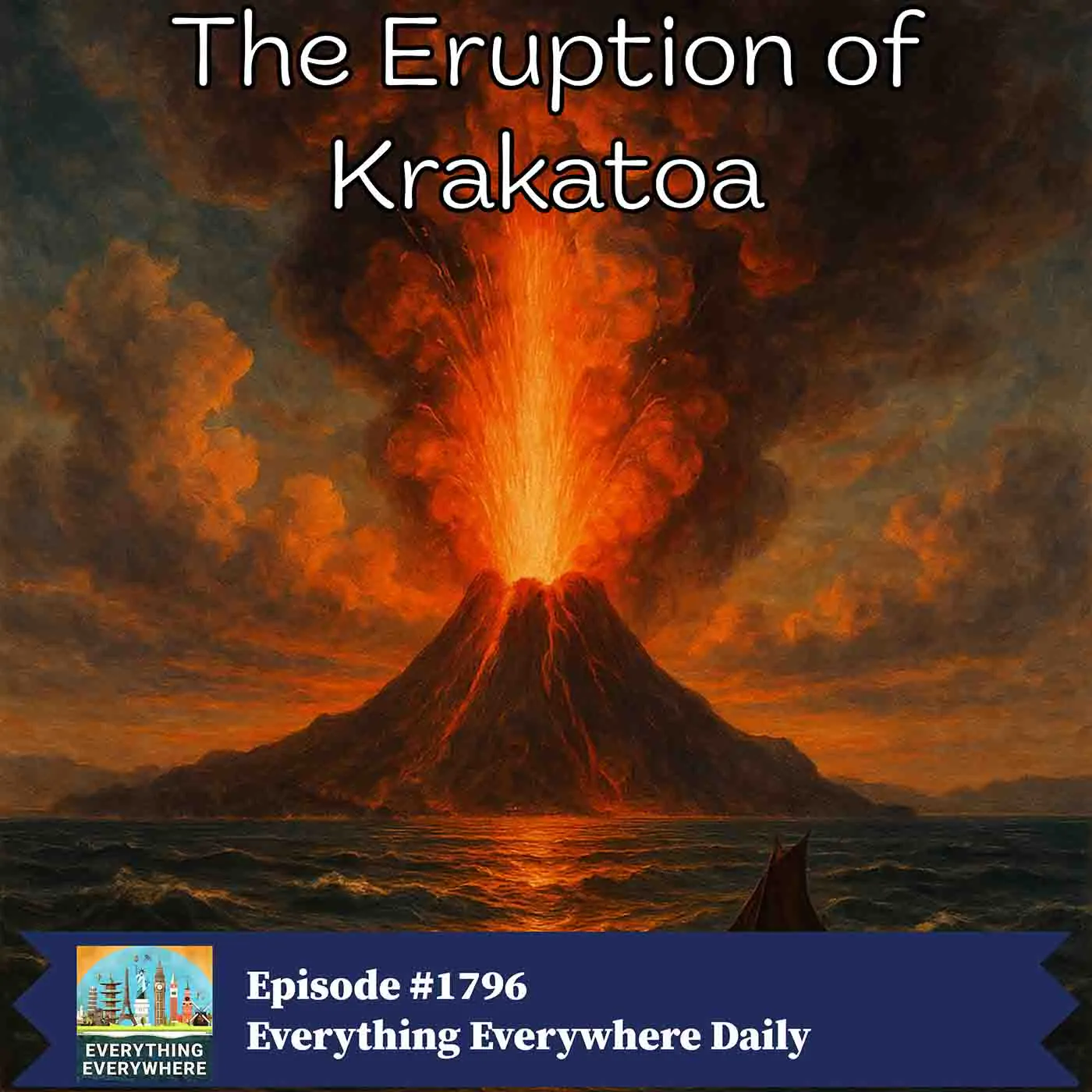
Everything Everywhere Daily: History, Science, Geography & More
The Eruption of Krakatoa (Encore)
00:15:06
Loading summary
Transcript1 lines
- [00:00]
Gary Arndt
The following is an encore presentation of Everything Everywhere Daily on The morning of August 27, 1883, one of the most destructive natural disasters of the 19th century occurred between the islands of Java and Sumatra in what is today the nation of Indonesia. After weeks of low level rumbling, a volcanic eruption totally obliterated the mountain that it had formed. The devastation wasn't just limited to the immediate area around the volcano. The blast's effect literally affected the entire planet. Learn more about the 1883 eruption of Krakatoa and its devastating impact on this episode of Everything Everywhere Daily. This episode is sponsored by Quince. It's summertime, and that means it's time to bring out the summer clothes. If you're looking to update your wardrobe this summer, I suggest you check out Quint's. Quint's has all the things you actually want to wear this summer, like organic cotton silk polos, European linen beach shorts, and comfortable pants that work for everything from hanging out in the backyard to nice dinners. And the best part? Everything with Quint's is half the cost of similar brands. By working directly with top artisans and cutting out the middleman, Quint's gives you luxury pieces with without the markups. I recently needed a new duvet and I went to Quince and picked up a great one that looked much better than what I had before, and all at a fraction of the price I'd pay elsewhere. Stick to the staples that last with elevated essentials from quince. Go to quince.com daily for free shipping on your order and 365 day returns. That's Quincy to get free shipping and 365 day returns. Quints.com daily this episode is sponsored by Mint Mobile. Do you know what doesn't belong in your summer plans? Getting burned by your old wireless bill. While you're planning beach trips, barbecues and three day weekends, your wireless bill should be the last thing holding you back. And that's why I use Mint Mobile. With plans starting at $15 a month, Mint Mint Mobile gives you premium wireless service on the nation's largest 5G network. The coverage and speeds you're used to, but just less money. So while your friends are sweating over data usages and surprise charges, you'll be chilling, literally and financially. With Mint Mobile, you can use your same phone, same phone number and contact list, and even connect to the exact same towers and cellular networks. The only difference is the price. This year, skip breaking a sweat and breaking the bank, get your summer savings and shop premium wireless plans@mintmobile.comeed that's mintmobile.com ED upfront payment of $45 for 3 month 5GB plan required equivalent to $15 a month new customer offer for first 3 months only, then full price plan options available, taxes and fees extra. See Mint Mobile for details. Volcanoes are arguably the most devastating natural event on the planet. Hurricanes and earthquakes can certainly do a lot of damage, but for the most part, their effects, as bad as they can be, are mostly localized. A volcano has the ability to affect the entire planet. If you remember back to my episode on the Mount Tambora eruption of 1815, it spewed enough particulate matter into the atmosphere that it was called the year without a Summer. Global temperatures dropped so much that crops failed around the world. The Tambora eruption was the largest volcanic eruption in the last 10,000 years. Yet as massive as the eruption was given communications at the time, most people didn't even know about it outside of what is today Indonesia, there was no rapid communication at that point in the 19th century. The eruption of Krakatoa, on the other hand, was known around the world just moments after it happened. The story of the eruption of Krakatoa begins in the Sunda Strait, the waterway between the islands of Java and Sumatra, the two largest islands in Indonesia. Krakatoa was located on an island located in the strait. In the local Bahasa language, the island is known as Krakatau. Krakatau, along with the rest of Indonesia, is located in what is known as the Ring of Fire. If you remember back to several of my previous episodes, the Ring of Fire is the ring that loops around most of the Pacific Ocean and it has the world's largest collection of volcanoes. All of the volcanism and earthquakes in this region are due to tectonic activity. Along with much of Indonesia, the primary mechanism that was responsible for the creation of Krakatoa was the Australian plate subducting under the Eurasian Plate. When you have a subduction zone, the subducting plate will melt below the surface under extreme pressures and temperatures. And when the melt percolates up, you get volcanoes. That's a very short version of how subduction zones cause volcanoes in general. Because of its location and of these conditions, Indonesia has 130 active volcanoes, the most of any country in the world. Krakatoa had been active for centuries before the 1883 eruption. There may have been an eruption in the year 416, but the only evidence is second hand documentation and no real geologic evidence. There were seven recorded eruptions between the 9th and 16th centuries and another well documented eruption took place in 1680. In the years just before the 1883 eruption, there was increased activity on Krakatoa. There were minor earthquakes and steam started to vent. However, it was nothing that would have indicated that something major was about to happen. Krakatoa had three peaks at this time. Rakata was 820 meters tall and was to the south. Da Nang was 450 meters tall and was in the middle. And Perbol Watan was 120 meters tall. To the north. Things began to change. On May 20, 1883, the Steam Emissions increased and ash began being expelled. The ash plumes that came out of the northernmost Parabolatan Peak were significant. The ash was reaching a height of 6 km or 20,000ft. And explosions were heard over 160 km away in what is now Jakarta. By early August, the activity had increased to a point where the island couldn't even be seen by ships. And when a research team landed on the island to investigate, they found all the vegetation was dead, with a half meter of ash covering the island. By August 25th, explosions were occurring approximately every 10 minutes. Ash columns were now rising as high as 27 kilometers into the sky. The day for which Krakatoa is remembered, however, and the reason I'm even doing a podcast on it, took place on August 27, 1883. Three explosions took place that morning. The first erupted at 5:30am local time. The second took place at 6:40am and the third, final and by far the greatest explosion, took place at 10:02am this explosion was a monster. It was arguably the greatest explosion ever recorded in human history. It was heard as far away as Perth, Australia, 3100 km, or 1900 miles away, as well as on the island of Rodriguez in the Indian Ocean, 4800 km or 3000 miles away. Sailors on the RMS Norham Castle, which was off the coast of the island of Sumatra at the time, had their eardrums burst from the sound. A gas pressure gauge was broken in Jakarta, then known as Batavia, 100 miles away. It was estimated to have had a loudness of 180 decibels. And the thing to remember is that decibels is a logarithmic scale. 140 DM is the point where sound can start to cause injury. The pressure wave from the blast literally went around the world. It traveled from Krakatoa to its antipodal point on the other side of the Earth. And over the course of five days, the pressure wave was measured seven times Going around the world and back again. The explosion sent 25 cubic kilometers, or 6 cubic miles of rock and ash into the atmosphere, creating a massive ash cloud that darkened the skies and reduced temperatures worldwide. In that moment of the explosion, the island ceased to exist. All three of the peaks on the island were vaporized and sent into the atmosphere. Here I should note the differences between the Tambora eruption of 1815 and the Krakatoa eruption of 1883. The Tambora eruption was a larger eruption in terms of the total volume of ejecta discharged from the volcano. However, the eruption took place over several days. The Krakatoa eruption was mostly one massive explosion, larger than any other that we know of. The explosion, however, was only the beginning of the problems. A later pyroclastic surge from the mountain crossed the strait and fell upon the town of Kedembang. Everyone in the community was killed. The small island of Cebsi nearby had a population of 3,000 people. The explosion completely wiped it out. There were parts of the island of Sumatra that were hit with pyroclastic flows that were 40 kilometers or 25 miles away. If you remember back to my episode on Pompeii, a pyroclastic flow is one of the most terrifying things in nature. It's an incredibly fast moving cloud of superheated ash that you cannot outrun. The pyroclastic flows off Krakatoa went over the water, creating a mist of superheated steam that covered the sea. However, the explosion itself was not the most devastating aspect of the eruption. The thing that killed the most people was the tsunami that it created. The tsunami destroyed many communities along the coast. The city of Merak on the island of Java was hit by a tsunami that was 46 meters or or 150ft high. A steamship named the Burau was deposited nearly a mile inland in Sumatra, killing all of its crew members. Ships as far away as South Africa reported encountering the tsunami. Even tidal gauges in the English Channel measured a rise in sea levels from the tsunami, which meant that the wave had to go around the continent of Africa and then up the Atlantic Ocean to get there. While the major eruptions were over on August 27, there were continued eruptions for several months, but nothing close to what happened on the 27th. Unlike the Tambora eruption, the entire world quickly knew what had happened. Telegraph cables spread the word of the event quickly, allowing scientists to better track the eruption's results. It was one of the first global news events where people were able to follow what was happening. Across the globe in almost real time. News of the eruption went via telegraph cable from Batavia to Singapore and from Singapore to the rest of the world. London was aware of the eruption just a few hours after it happened. In comparison, when Abraham Lincoln was shot less than 20 years earlier, news of the event took two weeks to reach Europe. In comparison, the New York Times managed to publish a story. On August 28, the day after the eruption, the New York Times reported. Terrific detonations were heard yesterday evening from the volcanic island of Krakatoa. They were audible at Socrata on the island of Java. The ashes from the volcano fell as far as Cherry Bomb, and the flashes preceding it were visible in Batavia after the dust had literally settled. The Dutch, who controlled Indonesia at the time, conducted an investigation into the impact of what actually happened. They found that 70% of the island where Krakatoa had existed was now gone. Most of it either went into the atmosphere or wound up on the seafloor. The official death toll from the eruption was put at 36,417 people. However, many consider this number to be a very low estimate. For years afterwards, human remains were discovered, sometimes floating on rafts of pumice out in the ocean. Some estimates put the death toll as high as 120,000. The end of the eruptions, the tsunami and the pyroclastic flows was not the end of the story. However, all of the dust ejected into the sky remained suspended in the atmosphere for quite some time, and it ushered in what is known as a volcanic winter. In the year following the eruption, temperatures during the summer in the northern hemisphere dropped 0.4 degrees Celsius, or 0.72 degrees Fahrenheit. In addition to a decrease in temperature, the world also saw an extended period of dramatic red and orange sunrises and sunsets. The particles in the atmosphere allowed scientists to identify for the first time a phenomenon they dubbed the jet stream. The famous 1893 painting the Scream by Edvard Munch shows an orange sky in the background. It's believed to depict the type of sunsets that were seen in Norway during this period. Even the climatic changes weren't the end of the Krakatoa story. With almost the entire island having been obliterated, researchers had an excellent opportunity to witness how life can spread on an island that was totally devoid of it. The first team to set foot on the island after the eruption was in May 1884, and they found nothing but a spider. However, almost six months later, the first sprouts of grass began appearing on the island. Under the sea, a new lava dome had been forming and by 1927, for the first time, Anak Krakatoa peaked past the waterline, forming a brand new island. Anok Krakatoa has been erupting regularly since 2020, with the most recent eruption as the time of this recording in September20. In 1921, the crater that was left of Krakatoa was named a nature reserve, and in 1991 the Ujung Kulong national park and Krakato Nature Reserve was named a UNESCO World Heritage Site. The eruption of Krakatoa in 1883 was one of the biggest natural disasters of the past 200 years and the biggest explosion in sound ever recorded in human history. It was also one of the first global news stories to be reported in real time via the Telegraph. And now, with the rise of Anak Krakatoa, it's not out of the question to say that future generations might experience something similar again. The Executive producer of Everything Everywhere Daily is Charles Daniel. The associate producers are Austin Oakton and Cameron Kiefer. I want to thank everyone who supports the show over on Patreon. Your support helps make this podcast possible. I'd also like to thank all the members of the Everything Everywhere community who are active on the Facebook group and the Discord server. If you'd like to join in the discussion, there are links to both in the show notes and as always, if you leave a review or send me a boostogram, you too can have it read on the show.