Loading summary
Transcript1 lines
- [00:01]
A
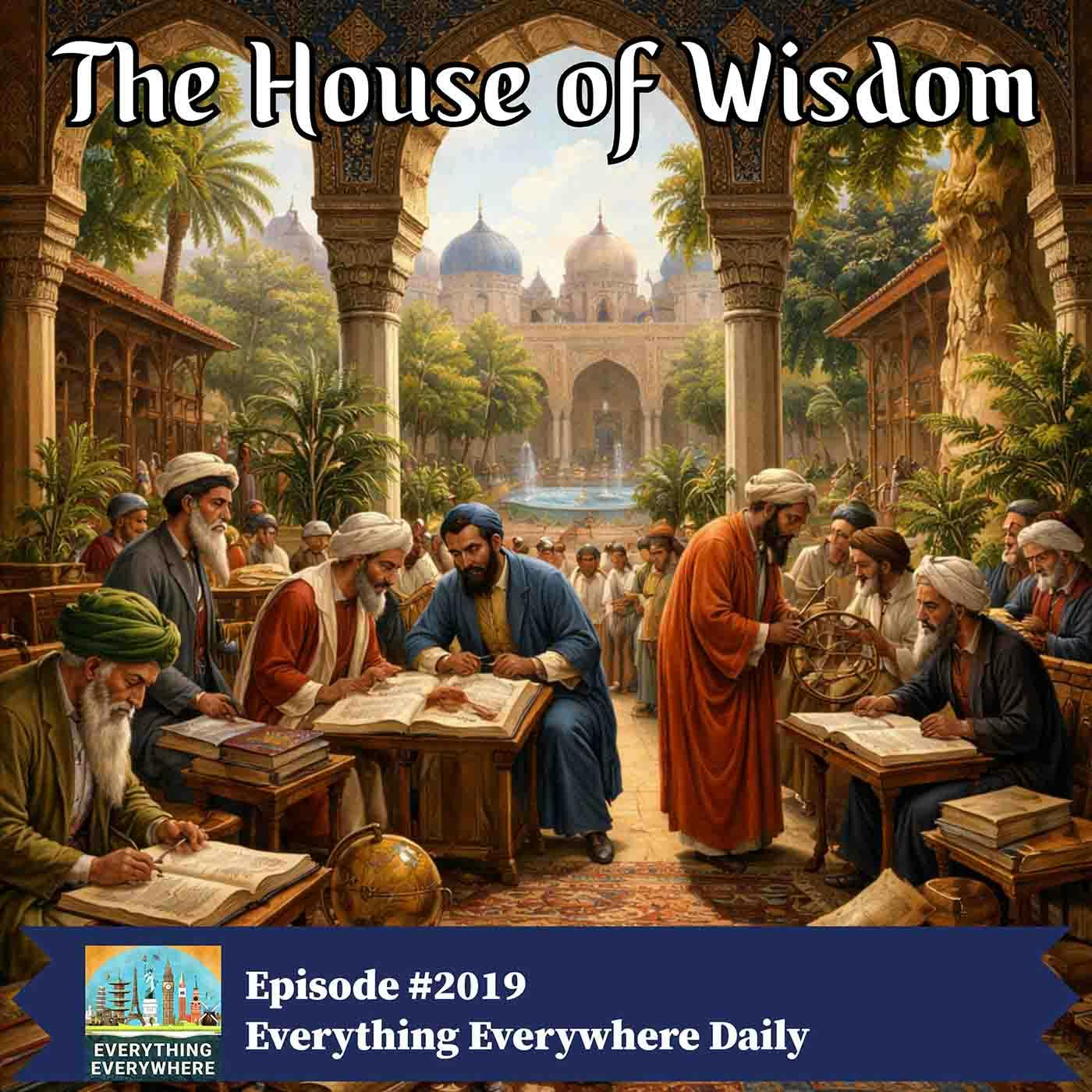
The Abbasid Caliphate stood as a vibrant center of commerce, technology and learning from the 8th to the 13th centuries, and at the heart of this Islamic dynasty was the House of Wisdom. It was an extraordinary institute that drew scholars from across the known world, which made Baghdad an unrivaled center of learning. They made advancements in mathematics, science and medicine, which are still used in the world today. Learn more about the House of Wisdom and how it shaped our world on this episode of Everything Everywhere Daily. This episode is sponsored by Mint Mobile. Now that the holidays are over, you might be feeling like you got a big spending hangover. The drinks, the holiday food, the gifts, it all adds up. Luckily, Mint Mobile is here to help you cut back on wireless spending this January, with 50% off Unlimited Premium Wireless, you can get 3, 6 or 12 months of Unlimited Premium Wireless for just $15 a month. All plans come with high speed data and unlimited talk and text delivered on the nation's largest 5G network. That's why I recommend Mint Mobile. You can get the same mobile experience you have now, but for less money. This January, quit overspending on Wireless with 50% off unlimited premium wireless plans start at $15 a month and at mintmobile.comeed that's mintmobile.comeed limited time offer upfront payment of $45 for three month, $90 for six month or $180 for 12 month plan required $15 a month equivalent taxes and fees extra initial plan term only greater than 50 gigabytes may slow when network is busy capable device required Availability, speed and coverage varies. See mintmobile.com this episode is sponsored by Quince. A new year is upon us, and that means new resolutions, new goals, and maybe a new wardrobe. If you're craving a winter reset, start with pieces truly made to last season after season. Quince brings together premium materials, thoughtful design and enduring quality so you stay warm, look sharp and feel your best all season long. One of the sweaters I recently got from Quince is something that I have been wearing almost every single day and I love it. By partnering directly with ethical factories and top artisans, Quints cuts out the middleman to deliver premium quality at half the cost of similar brands and often even bigger discounts. Moreover, those competitor prices are often listed right on the Quince website. Refresh your winter wardrobe with quince. Go to quince.com daily for free shipping on your order and 365 day returns now available in Canada too. That's Q U-I-N-E.com daily free shipping and 365 day returns quince.com daily. In the 8th century, Baghdad was on its way to becoming the largest and most important city in the world. Medieval Baghdad was a metropolis that would have astonished a modern visitor. Boasting a population of up to a million people, an impressive number for the period, the city was a hub of commerce, largely due to its thriving bazaars. These crowded marketplaces were a haven for trade, serving as the ultimate destination for the finest commodities of the Silk Road. The wide marketplaces were crammed with vendors selling everything from fruit, spices, and flowers to silken goods and baked items. Together, these vendors and bazaars infused the city with its unique and vibrant character. One observer in the 11th century remarked, Baghdad is like a hive of bees in which much honey is Produced. By the 11th century, Baghdad boasted nearly 37 lending libraries, far outstripping Europe, where even a wealthy community might only own a few dozen books. Baghdad's centerpiece was a circular walled core nearly a mile and a half wide. Shaped by concentric rings, the city featured zones, some designed for housing and shopping, while others served as places of religious worship or the Caliph's palace. Such an urban center demanded the greatest minds of its age, and it was here that the House of Wisdom began in the Caliph's library. Soon outgrowing its original space, the House of Wisdom scholars formed a diverse group drawn from across the world. No limitation existed for those who wanted to study and share Byzantine, Greek, Arab, Indian and Persian influences shaped the institution, which welcomed anyone capable of adding to the sum of human knowledge. To maintain and organize a city of 1 million people, thinkers from the House of Wisdom were absolutely indispensable. As a rapidly expanding city, Baghdad posed significant challenges for the scholars of the House of Wisdom, requiring innovative solutions. Addressing these problems became central to the city's continuing success. Foremost among these challenges was controlling the Tigris and Euphrates rivers, a task essential to the city's stability and survival. Flooding along the Tigris and Euphrates rivers challenged engineers since Mesopotamian times. Engineers from the House of Wisdom created a twin canal system to meet these needs. By diverting water from the rivers, they also created secondary waterways, expanding options for transportation, east irrigation and commerce. The Nar Isa, the largest of these canals, was wide enough for large commercial vessels. These vessels used the canal to connect to rivers and eventually the Persian Gulf. This gave Baghdad a key access point to the Indian Ocean trade networks, even though it wasn't located on the coast. Anchored by this success, Baghdad became a vital mercantile city. It thrived along the greatest Trade networks of its era, the Silk Road and the Indian Ocean sea roads. The canals also sustained Abbasid farmers outside the city. Farming in this region had always been challenging due to its arid climate and frequent flooding. Supporting Baghdad's huge population required innovations in food production. The canal system boosted regional farming. Historians often credit these innovations with the creation of a green belt around Baghdad. Engineers also updated the Qanat water system. A qanat was an underground water management system developed in ancient Persia that used gently sloping tunnels to bring groundwater from distant aquifers to the surface for irrigation and drinking without pumps. They improved on the Persian designs, using waterproof mortar to deliver fresh water city wide through underground pipes. This pioneer piping technology also improved waste removal. Islamic rituals and customs demanded frequent washing. So cities in the Islamic world, including Baghdad, became renowned for cleanliness. The House of Wisdom's engineers urban contributions made Baghdad at that time the most advanced city in the world. Improving the city's infrastructure wasn't the only legacy of the thinkers of the House of Wisdom. However, their intellectual achievements carried an impact far beyond that of the city's physical infrastructure. The scholars of the House of Wisdom set a lasting standard for intellectual inquiry. The movement began as an effort to translate all of the knowledge of the known world into Arabic. Islamic scientists enjoyed an advantage that their European peers lacked at that time. Scientific inquiry didn't conflict with their interpretation of the Quran. It actually encouraged the pursuit of knowledge. Early European thinkers found themselves limited by the early Christian church. These struggles would limit European scientists until after the arrest of Galileo and the emergence of Isaac Newton. Islamic scholars of the period had no such limitations because the Abbasid caliphate encouraged scientific inquiry. The qibla, or the point of prayer, is a good example. The Quran mandates that Muslims pray five times a day towards Mecca. And while there are apps for this today, a thousand years ago, Islamic scholars needed basic scientific literacy to locate the point of prayer using instruments like the compass and the astrolabe. This head start on scientific inquiry drove the progress at the House of Wisdom. A core role of the House of Wisdom was the translation of Greco Roman texts. Islamic scholars were puzzled by the reluctance of Greek thinkers to test their theories. Critiques of Greco Roman texts, such as Al Razi's critique of Galen's theories, led Islamic scientists to develop their own theories of the scientific process. These criticisms advanced by House of Wisdom scholars helped lay the foundation for the modern scientific method. The mathematical advances that came out of the House of Wisdom revolutionized mathematics. Al Khwarizmi, who has made many, many appearances on this podcast, was The House of Wisdom's leading scholar, he wrote Al Jabbar, a manual on solving and balancing equations. This became the foundation for algebra. In fact, Al Khwarizmi's name is so synonymous with mathematical acumen that his Latinized name is algoritmi, which translates to algorithm in English. The scholars of the House of Wisdom also researched and shared earlier Indian numeric systems. They presented them to the world as Arabic numerals. Among the numbers introduced to the world by mathematicians of the House of Wisdom stood perhaps the most important in advanced mathematics, Zero. Also to calculate the Qibla direction. Worldwide, they developed spherical trigonometry. Among the House of Wisdom's most famous contributors were the Banu Musa Brothers, a trio of Persian polymaths. The Banu Musa Brothers produced arguably the most interesting work from the House of Wisdom, the Book of Ingenious Devices. The book outlined more than 100 mechanical inventions, including automata, fountains and self regulating machines. Based on sophisticated hydraulic and pneumatic principles. The book inspired future engineers offering models for early automated machines. It planted a seed that eventually became the Industrial Revolution and modern robotics. Among Baghdad's enduring legacies is Ibn Al Haytham's work. He revolutionized optics and laid the foundations for innovations like the modern camera. His camera obscura, a dark box with a pinhole allowing light to enterprove. That light travels in a straight line. And if you remember back to the previous episode on the subject, the Dutch artist Vermeer probably used a camera obscura to create his paintings. And it's worth noting that his device was called the qumra in Arabic, which translates to camera in English. An astronomical observatory was built at the House of Wisdom in the Shamisiya district in the 9th century, which was run by Sanad bin Ali Alihudi. He was also the man who added the decimal point to the Hindu Arabic numeral system. Perhaps the most significant legacy of the scholars at the House of Wisdom was their incredible advancements in medicine. The translation movement facilitated the rediscovery of ancient Greek medical texts. While early Muslim scholars were intrigued by the theory of the four humors, they ultimately demonstrated that these humors were not the cause of illness. Under the leadership of the Arab Dr. El Razi, the Muslim doctors at the House of Wisdom developed a theory of contagion based illness. El Razi's contagion theory held that an external agent caused the illnesses centuries before the germ theory of disease was developed in the 19th century, El Razi's work in categorizing illness proved crucial for he was the one who identified the difference between smallpox and measles. The identification of distinct diseases caused by different contagions led to treatment plans unique to each disease. Among these treatments were a series of remedies derived from natural materials such as honey. Muslim doctors in Baghdad had built on and formalized herbal and natural remedies for specific maladies. In identifying specific illnesses, the doctors of Baghdad believed that keeping patients with similar symptoms together would prevent other patients who didn't share their illness from contracting it. So the modern hospital has its roots in Baghdad, right down to the different wings for different ailments. These care facilities were free and funded by religious endowments, part of the practice of almsgiving, which was an essential pillar of Islam. The Battle of Talas river was fought in 751 between the Chinese Tang Dynasty and the Abbasid Caliphate. The most significant outcome of this battle was the transmission of paper making technology between the two cultures. The House of Wisdom and its achievements would not have been possible without paper. Prior to the advent of paper, manuscripts were written on expensive animal skin parchment. This was part of the reason Europe languished so far behind Song China and the Abbasid Caliphate. Books in Europe were an expensive luxury. The first Abbasid paper mill was built in Baghdad in the 9th century, after which the price of books promptly plummeted and according to some estimates, dropped by as much as 90%. In societies where paper books were common, people owned books, particularly sacred texts such as the Koran, which led to higher levels of literacy and intellectual inquiry. Mathematical advancement was far easier in papered cultures. Mathematics and non papered cultures had to be on an abacus or in the mind of the mathematician. The Greeks would literally often just draw with sticks on the ground. Paper allowed for math to grow in complexity and for scholars to work on larger problems. In Abbasid Baghdad, paper making became a big business. Paper was subjected to the same scientific inquiry as math, astronomy and medicine. The process was improved by Islamic scientists, leading to smoother paper that could be written on both sides. Aside from cost and availability, the most significant outcome of paper was the transmission of knowledge. The House of Wisdom probably would have achieved incredible things without paper, so long as they had a spirit of inquiry and the support of an entire empire. Yet what they achieved with paper was nothing short of transformative. It was the House of Wisdom and paper that transmitted Greco Roman knowledge back to the west, eventually yielding the Renaissance. When printing arrived in Europe in the 15th century, it advanced quickly thanks to the inheritance of paper from the Abbasid Caliphate. The scholars of the House of Wisdom reintroduced to Europe its Greco Roman heritage. All thanks to paper. Sadly, all things have to come to an end. As I covered in a previous episode, Baghdad spectacularly fell to the Mongols in the year 1258. Estimates of the number of dead range from the hundreds of thousands up to a million, but this we do know. All of the libraries in Baghdad were destroyed. The trajectory of civilization was in no small part forged by the scholars of the House of Wisdom. It is simply not possible to overstate the significance of the House of Wisdom. Simply put, the work done by the scholars there was played an important part in the creation of the modern world. The executive producer of Everything Everywhere Daily is Charles Daniel. The associate producers are Austin Otkin and Cameron Kieffer. Research and writing for this episode was provided by Joel Hermanson. I have a bit of an announcement for everyone. As you may have noticed, I've recently hired a new writer for the show, Joel Hermanson, who some of you may recognize from the Respecting the Beer podcast. Joel also happens to be a high school teacher who teaches AP World History and has been using this podcast as a resource for his students. We've begun a project to create a list of all the applicable episodes of this podcast and match them to the corresponding units of the AP World History curriculum. We'll also eventually do this for AP American History and going forward, possibly other AP tests. We will also create new episodes that fill the gaps in the curriculum that haven't been recorded yet. This will probably take a while, but for those of you who have absolutely no interest in any of this, you probably won't even notice a thing. The resource we create will be available to everyone, including teachers, students, and homeschoolers who are studying for the AP World History test. More details on this will be provided when they become available. Remember, if you leave a review of the podcast on any of the major podcast apps, you too can have it read on the show.