← Everything Everywhere Daily: History, Science, Geography & More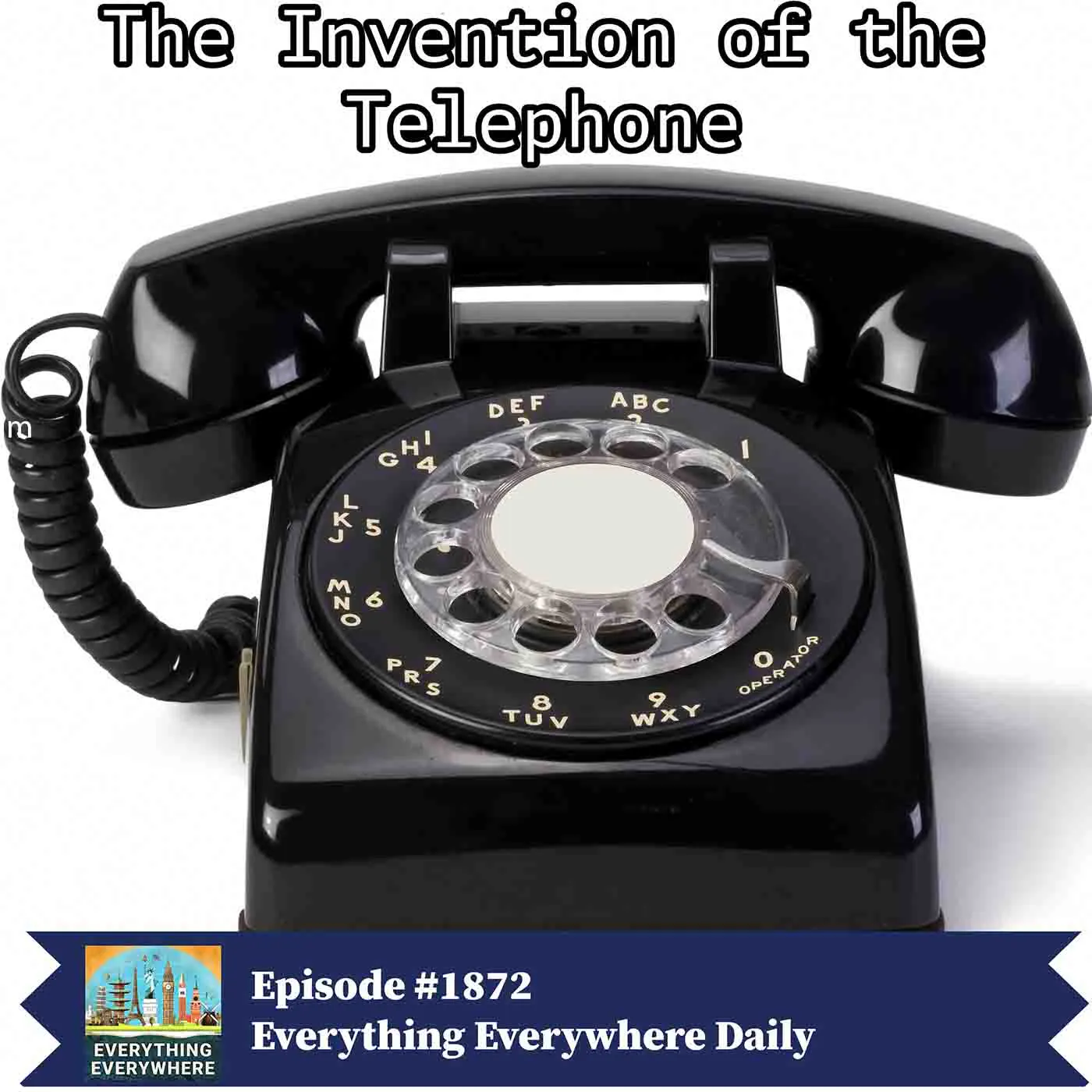
Everything Everywhere Daily: History, Science, Geography & More
The Invention of the Telephone (Encore)
00:15:30
Loading summary
Transcript1 lines
- [00:00]
A
The following is an encore presentation of Everything Everywhere Daily. The 19th century was one of rapid technological advancement. Of all the innovations to come out of this century, and there were many, perhaps none was more important than that of the telephone. The telephone radically changed communications, allowing personal communications over long distances. Despite what many people are often told, this invention wasn't simply the genius of one man, but rather was something developed over decades. Learn more about the invention of the telephone and the controversial story surrounding it on this episode of Everything Everywhere Daily. This episode is sponsored by Fiji Water. You've probably heard of Fiji Water and have seen it in stores. Well, Fiji Water really is from the islands of Fiji. Drop by drop, Fiji Water is filtered through volcanic rock 1,600 miles away from the nearest continent, and all its pollution protected and preserved naturally from external elements. In this process, it collects a unique profile of electrolytes and minerals, resulting in more than double the electrolytes as the other top two premium bottled water brands, giving Fiji Water its smooth taste. Fiji Water's electrolytes are 100% natural and this water even has a perfectly balanced pH of 7.7. I've recently been trying to reduce my consumption of diet soda and I've found Fiji Water to be a great alternative. Visit your local retailer to pick up some Fiji Water today for your next backyard party, beach day hike, or even your home office. Fiji Water is Earth's finest water. This episode is sponsored by Mint Mobile. According to recent data, approximately 98% of all Americans own a mobile phone, and that means a monthly phone bill is something that almost all of us share. With all the bills you have to pay, why pay more than you have to for your phone bill? With Mint Mobile you can start with plans as low as $15 per month, and with Mint Mobile you can keep your phone, your number and use the same towers and networks that you do now. All you do is save money and that's why I recommend Mint Mobile this year. Skip breaking a sweat and breaking the bank. Get this new customer offer and your three month unlimited wireless plan for just 15 bucks a month at mintmobile.comeed that's mintmobile.comeed upfront payment of $45 required equivalent to $15 a month limited time new customer offer for first three months only. Speeds may slow above 35 gigabits on unlimited plan. Taxes and fees extra. See Mint Mobile for details. This episode is one of those that turned out to be very different. Coming out from what I thought it was going to be going in, I was going to do A comprehensive overview of the telephone as a technology and how it evolved and changed over time. And the invention of the telephone would, of course, be an important part of that story. What I didn't realize was how different the invention of the telephone was from the story I always heard growing up. The basic story I was told was probably similar to the one that you might have heard. The telephone was invented by Alexander Graham Bell. To be sure, he is a part of the story, but he didn't invent the telephone in a vacuum, and to some people, he. He didn't invent it at all. Before discussing the telephone directly, it's important to understand the foundation upon which it was built. Long distance communications had been a challenge humans sought to solve for centuries. In ancient civilizations, communication systems like smoke signals, drumbeats, and messenger services allowed limited information exchange. However, for the most part, information could only travel as fast as a horse could run. By the 1790s, optical telegraph systems using semaphore signals emerged in France and elsewhere, creating the first telecommunications networks. One of these early systems in France was known as the CHAP telegraph, which was a system of towers several kilometers apart which used semaphore to send messages to each other. The first person to think about communications along a wire was the English physicist and biologist Robert hooke, who in 1667 demonstrated that sound could travel along a wire. What he demonstrated wasn't a modern telephone, but rather it was the principle behind a tin can telephone that you may have played with as a kid. The invention which made the telephone possible and really got people thinking about using electrical signals along wires to transmit voices was, of course, the telegraph. The telegraph was a revolutionary technology which I've covered in a previous episode. Its development got many people thinking that if you can send electrical pulses down a wire, then maybe you could do the same thing with sound. Perhaps the first person who conceptually proposed such a system was the French engineer Charles Boselle. In 1854, he figured out what such a system would look like to convert sound into electrical signals. But he never built anything. In 1856, the Italian American inventor Antonio Meucci created an early working telephone prototype, which he called the telotrophono. He made it primarily to communicate with his bedridden wife from his workshop. He demonstrated his invention multiple Times and in 1871, filed a patent caveat a preliminary notice of intent to file a full patent for his voice communication device. However, financial difficulties prevented him from securing a full patent, and his work was largely overshadowed. In 1861, the German inventor Johann Philipp Reiss established his claim to fame by creating the first device to carry the name telephone. He built an early telephone prototype capable of transmitting sound using electrical signals. His device, known as the Rice telephone, used a diaphragm that responded to sound waves and a make and break circuit to convert these vibrations into electrical impulses. However, Rice's telephone is primarily successful in transmitting musical tones and some speech sounds, but it struggled with continuous and clear speech transmission. Famously, the first audible words that he was able to transmit over his system were Das furd frist kleinen Girkensalat, which translated into English means the horse doesn't eat cucumber salad. The phrase was chosen because of its difficulty in being able to be heard clearly in German. Rice did not pursue commercial development, never filed for a patent, and his work remained relatively obscure outside of Germany. And I should note that I haven't even gotten to Alexander Graham Bell yet, and there have already been several telephone prototypes. Just like with the electrical incandescent light bulb, the development of the telephone didn't come out of nowhere. By the 1870s, many people were working on the problem of sending speech over wires via electrical signals, including Bell, as well as Thomas Edison and the founder of the Western Electric Company, Elijah Gray. Alexander Graham Bell's path to the telephone began with his work with the deaf. Born In Scotland in 1847, Bell came from a family deeply involved with elocution and speech education. His father developed visible speech, a phonetic system to help the deaf learn to speak. After moving to Canada and then to the United States, Bell became interested in transmitting speech electronically while teaching deaf students. His knowledge of acoustics and speech mechanics proved invaluable. He began experiments with Thomas Watson, a skilled electrical designer. As his assistant. Bell pursued the concept of undulating current, a continuous electrical current that varied in intensity like sound waves. Rather than the make and break approach that others had tried, this fundamental insight would eventually prove crucial. On March 10, 1876, Bell famously succeeded when he spilled acid on himself and called to Watson in the next room through his experimental dev. Mr. Watson, come here. I want to see you. Watson heard the words clearly through the receiver, marking the supposedly first documented transmission of intelligible human speech via electricity. Ignoring, of course, the horses not eating cucumber salad. That is the textbook description of Bell's invention of the telephone. However, there is more to the story. The other part of the story involves the previously mentioned Elijah Gray. Gray co founded the Western Electric Manufacturing Company, which became a major player in electrical communications. During the 1870s, Gray worked on harmonic telegraphy A system that allowed multiple messages to be sent over a single telegraph wire using different tones. By the mid-1870s, he had compiled over 30 patents related to telegraph technology. Gray's path to telephone development began with his work on the musical telegraph in the early 1870s. This device used electromagnets to create electrical oscillations at different audio frequencies. During his work on the musical telegraph, Gray discovered that he could control the sounds produced by electrical circuits. This led him to realize that variable resistance, rather than the make and break circuits, would be the key to transmitting voice, an insight very similar to that of Alexander Graham Bell. Around 1874, Gray began experimenting with methods to transmit vocal sounds electrically. He developed a liquid transmitter design that used water with an electrical contact that could be immersed to varying depths by sound vibrations. The liquid transmitter is really the key to this entire story. The idea of the liquid transmitter was actually a revolutionary idea. A diaphragm or membrane consisting of a thin, flexible material was placed over a chamber. A needle or conducting rod was attached to the diaphragm and dipped into a container with a conductive liquid, such as water mixed with acid or or salt to improve conductivity. When sound waves hit the diaphragm, it would vibrate in response to the sound. The needle then moved up and down in the liquid, changing the depth of the immersion, which in turn varied the electrical resistance in the circuit. These changes in resistance were converted into electrical signals, which were then sent through wires to a receiver. And a similar mechanism at the receiving end reconverted the electrical signals back into sound. And here is where the controversy comes into play. On February 14, 1876, Gray filed a patent caveat, which again is a notice of intent to file a patent describing a telephone using a water transmitter. Remarkably, Alexander Graham Bell filed his patent application for the telephone on the exact same day. This was still several weeks before the famous Watson, come here, I want you. Meaning Bell hadn't yet actually developed a working prototype when he filed his patent. The controversy centers on several key points. Bell's lawyer filed his patent application, supposedly just hours before Gray filed his caveat. This narrow time difference has raised questions about whether Bell had legitimate priority. Gray's caveat described a liquid transmitter design using variable resistance. Bell's original patent did not contain this specific design. And this is where things get really fishy. The patent examiner at the patent office who handled both applications that day was Zenisk Fiske Wilbur. Years later, when this entire issue was brought out in court, Wilbur testified that that he was an alcoholic and owed money to his friend who served with him in the Civil War, Marcellus Bailey. Who is Marcellus Bailey? None other than the attorney for Alexander Graham Bell. On March 7, 1876, Alexander Graham Bell was officially granted patent number 174465. The patent was issued for the method of an apparatus for transmitting vocal and other sounds telegraphically by causing electrical undulations similar in form to the vibrations of the air accompanying the said vocal or other sound. Three days later, Bell makes his famous Watson, come here, I want you transmission. And he did it using a liquid transmitter. And there is a lot more that was fishy about the entire process. On February 19, Bell's patent application was suspended for three months because the two similar patents were submitted on the same day. This was not unusual for the patent office as they would normally conduct an investigation to see which invention was developed first. It was also not uncommon at that time for patent applications to take years and to have public hearings. So the awarding of Bell's patent so quickly was highly unusual. Moreover, in another highly unusual move, Bell later testified that he had spoken to Zenis Wilbur about Elijah Gray's patent, which may be how he got the idea of the liquid transmitter. To be fair, Gray and Bell knew about each other for years before they both filed their patents and were vaguely aware that they were both working on the problem of the telephone. Each was concerned that the other may have been spying on them. However, the very odd circumstances surrounding the issuing of the patent have for almost 150 years led some people to think that Alexander Graham Bell stole the idea of the telephone from Gray. And if he didn't steal it, he at least used some questionable methods to get his patent approved. So why is this so important? Part of this is just a matter of giving credit to the right people. I'm guessing that most of you who have heard of Alexander Graham Bell have never heard of Elijah Gray. However, the much bigger issue has to do with Money. Patent number 174465 has been called the most valuable patent in history. Alexander Graham Bell and his father in law went on to form the Bell Telephone Company which was created to be a holding company for the Bell patents. It later became the American Telephone and Telegraph Company, which you might know better as at&t. At&t had a monopoly over the entire telephone system in the United States until it was broken up in the 1980s. Until its breakup, it was the world's largest company with over a million employees. The liquid transmitter didn't actually play that much of a role in the development of the telephone in 1877, Bell was granted patent number 186787 for a telephone using a permanent magnet. Instead, there were over 600 lawsuits challenging Bell's patents. The Bell Telephone Company won most of the cases, including a U.S. supreme Court decision in 1888 that upheld Bell's patents. Despite all the controversies, by the time the Bell patent expired, they had a huge advantage in the market and purchased most of the small telephone companies that sprung up. And they also ended up buying Western Electric, Elijah Gray's company. There's a whole lot more to the story of the telephone. The telephone itself was only one part of a much larger, more complex system that eventually spanned the entire earth. While Alexander Graham Bell was awarded the patent and is largely given credit for the invention of the telephone, he was only one of many people who helped develop the technology that made the telephone possible. The executive producer of Everything Everywhere Daily is Charles Daniel. The associate producers are Austin Otkin and Cameron Keefer. My big thanks go to everyone who supports the show over on Patreon. Your support helps make this podcast possible, and I also want to remind everyone about the community groups on Facebook and Discord. That's where everything happens that's outside the podcast, and links to those are available in the show Notes. As always, if you leave a review on any major podcast app or in the above community groups, you too can have it read on the show.