Loading summary
Transcript1 lines
- [00:00]
A
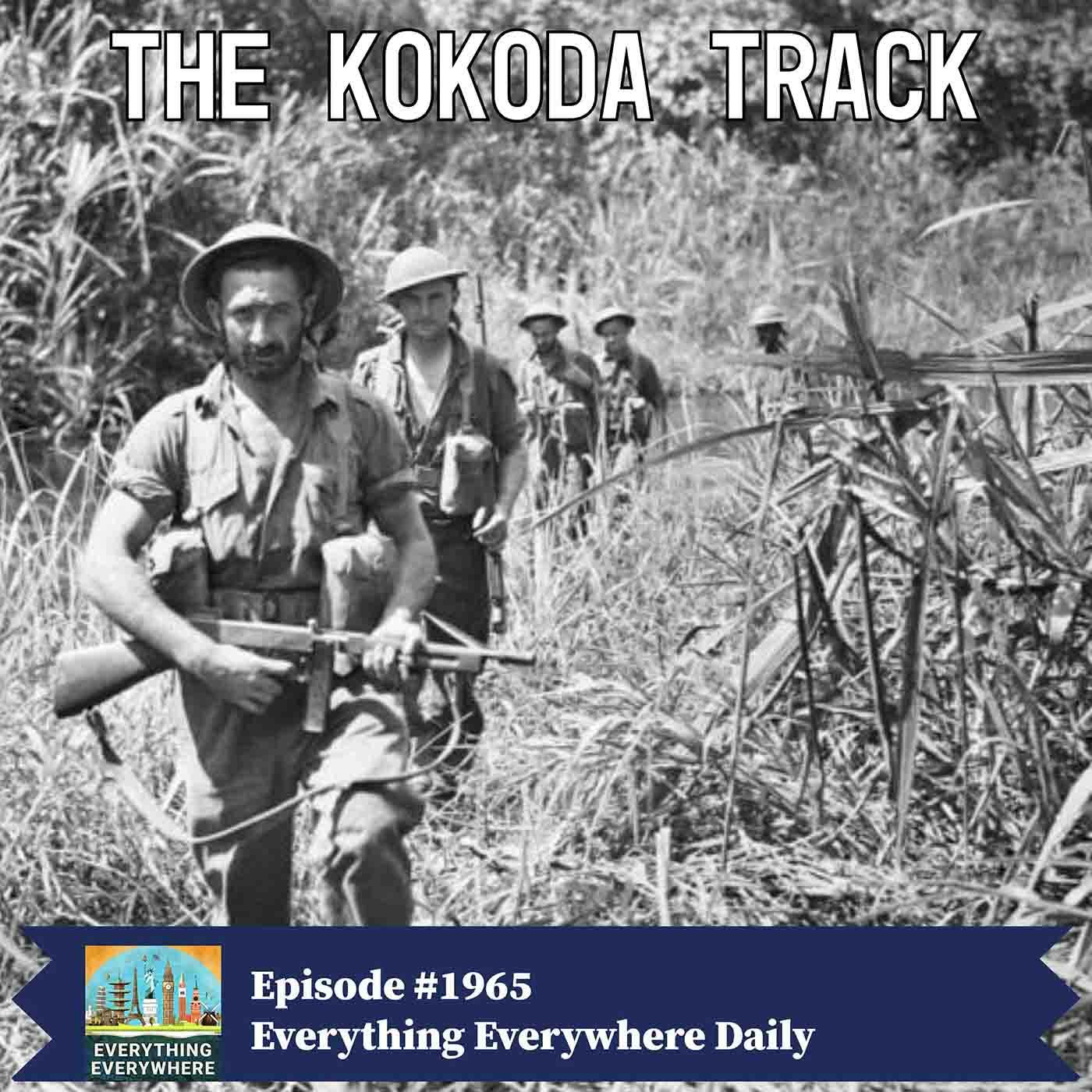
In July 1942, Japanese forces landed on the north shore of the island of New Guinea. Their goal was to cross the island by land and take the strategic city of Port Moresby. If they had been successful, the entire fate of the war in the Pacific would have been altered. But they didn't take it, thanks to the tenacious resistance put up by Australian forces. Learn more about the Kokoda Track and how it turned the war in the Pacific on this episode of Everything Everywhere Daily. This episode is brought to you in part by Stash. What if you could start investing without ever picking a single stock? With Stash, the experts handle the hard part for you. Stash just isn't another investing app. It's a registered investment advisor that combines automated investing with expert guidance so you don't have to worry about figuring it out on your own. You can choose from personalized investments or let Stash's award winning smart portfolio do the work for you. With Stash, investing doesn't feel like gambling. It's simple, smart and stress free so your money can finally start working as hard as you do. Get access to world class financial advice with personalized guidance for just a $3 monthly subscription. Stash has already helped millions of Americans reach their financial goals. Don't let your money sit around. Put it to work with stash. Go to git.stash.com everything to see how you can receive $25 towards your first stock purchase and to view important disclosures, that's git.stash.com everything paid non client endorsement, not representative of all clients and not a guarantee. Investment advisory services offered by Stash Investments LLC and SEC Registered Investment Advisor Investing involved risk offer is subject to T's and C's. This episode is sponsored by Uncommon Goods. The holiday shopping season is officially here. Uncommon Goods takes the stress out of gifting with thousands of unique, high quality finds you won't see anywhere else. Don't wait because the most meaningful gifts get scooped up fast and now is the perfect time to cross names off your list. Uncommon Goods looks for high quality, unique products, often handmade or made in the United States. Many are crafted by independent artists and small businesses, making every gift feel meaningful and truly one of a kind. I've already told you about the cheese board I got on Uncommon Goods, but another cool item I found was a wall hanging made from wood that reproduces the sound wave of your favorite song or podcast. So don't wait. Cross those names off your list before the rush to get 15% off your next gift, go to UncommonGoods.com daily that's UncommonGoods.com daily for 15% off. Uncommon Goods were all out of the ordinary. Before we get into the Kokoda Track itself and the conflicts surrounding it, we need to understand the broader significance of the territory of Papua during the Second World War. At the time, Papua and New guinea were two different territories administered by Australia. Papua was roughly the southern half of the modern country and the territory of New guinea was the northern half, along with the Bismarck Archipelago. Very early in the war, the Dutch occupied the western half of the island known as Dutch New guinea and much of the territory of New guinea in the northeastern part of the island. The territory of Papua in the southeastern part of the island was relatively untouched. And this was the location of Port Moresby. Port Moresby lies on the south coast of Papua New guinea, facing the Coral Sea and looking directly at northern Australia. It was the closest significant anchorage and airfield complex to Australia that was not under Japanese control. If Japan controlled Port Moresby, northern Australian cities such as Cairns and Townsville and even industrial centers further south would be within easy reach of land based bombers. This wouldn't have necessarily enabled an invasion of Australia, which Japanese planners never really seriously considered, but it would have created pressure on Japanese sea lanes, disrupted military reinforcement routes and forced major diversions of Allied resources to defend the continent. Simply put, Japan holding Port Moresby would have made Australia far more vulnerable. Likewise, the Coral Sea was a critical maritime zone for the Allies. Shipping between the United States, Australia and the South Pacific passed through it and the campaign to support and reinforce the Solomon Islands, particularly Guadalcanal, depended upon these routes. From Port Moresby, land based Allied aircraft could launch strikes against Japanese positions on the North Papuan coast and even reach parts of the island of New Britain, including the massive Japanese base at Rabaul. This made it a vital staging area for Allied offensive plans. By mid-1942, Japan had taken Rabaul, most of New Guinea's northern coastline, and had started to move into the Solomon Islands. The Japanese positions formed a broad arc pointing right at Australia, and Port Moresby was the one major base that was breaking that arc. Japan needed to take Port Moresby. Their first attempt was by sea in May of 1942. This resulted in the Battle of the Coral Sea, the first naval battle in history fought entirely from aircraft carriers. It was an Allied victory and their first major victory of the war in the Pacific and forced Japan to abandon its amphibious landing. When the sea option was out, Japan attempted to take Port Moresby by land. The plan was relatively Straightforward land on the north coast of the island and march across the island and take Port Moresby by land. Sounds easy, but there was a lot more to it. The path that they would have to traverse was known as the Kokoda Track or the Kokoda Trail. The Kokoda Track itself was a treacherous 96 kilometer or 60 mile footpath crossing some of the world's most challenging terrain. Steep mountains rising to over 2000 meters, dense jungle, deep ravines and fast flowing rivers. The climate was equally punishing with torrential rain, oppressive heat and disease ridden conditions. It was one of many paths that were used by native people on the island. European interest in the route emerged only in the late 19th century, mainly in connection with gold fields discovered near the town of Kokoda. On July 21 and 22, 1942, Japanese forces of the South Seas Detachment commanded by General Tomohiro Horii landed at Buna and Gona on Papua's northeast coast. The force initially numbered around 13,000 troops, comprising battle hardened veterans from previous campaigns. The defense of the track initially fell to the 39th Australian Battalion, a militia unit composed mainly of young, inexperienced soldiers with minimal training under Lt. Col. William Owen. These troops were outnumbered and outgunned, but fought a determined delaying action on July 23. The Battle of Awalla marked the first significant engagement where Australian forces were pushed back. The small frontier town of Kokoda, with its vital airfield, fell to the Japanese on July 29 after fierce fighting, and the loss was a severe blow to the Australians as it deprived them of their forward supply base and airstrip. Throughout August, the Australians conducted a fighting withdrawal southward down the track. Key defensive stands occurred at Daniki, Isurava, Brigade Hill and Eora Creek. At Isurava, from August 26th to the 31st, the Reinforced Australian force, now including experienced troops from the 21st Brig, fought one of the campaign's bloodiest battles. Despite inflicting heavy casualties on the Japanese, the Australians were forced to withdraw due to overwhelming enemy numbers and the threat of encirclement. The withdrawal continued through increasingly desperate circumstances. Supplies were scarce, casualties mounted and both sides suffered terribly from tropical diseases including malaria, dysentery and scrub typhus. The terrain made the evacuation of wounded men extraordinarily difficult. Stretcher bears, primarily Papuan carriers known as fuzzy wuzzy angels, performed heroic work carrying injured soldiers across the mountains. The contribution of the 2 to 3,000 Papuans was indispensable. Without their labor and local knowledge, the Australians could not have maintained forces along the track. In recent decades, both Australia and Papua New guinea have emphasized recognizing their service and sacrifice in memorials and commemorations. By mid September, Japanese forces had advanced to within 50 kilometers, or 31 miles of port Moresby. This represented the high water mark of their advance and in some respects of the entire war. However, several things were now working against them. Their supply lines were dangerously overextended, they had suffered significant casualties, and most crucially, the Japanese strategic situation had now changed. The decisive turning point came with the Battle of Milne Bay, which took place from August 25 to September 7, 1942. Fought at Papua's eastern tip, Australian and American forces decisively defeated a Japanese amphibious landing, marking the first outright defeat of Japanese land forces in the Pacific War. This victory proved that Japanese forces were not invincible and boosted Allied morale significantly. But perhaps more importantly, the desperate struggle at Guadalcanal in the Solomon Islands demanded Japanese reinforcements, forcing them to abandon plans to reinforce their kokoda forces. On December 24, General Horii received orders to withdraw to the north coast to establish a defensive position. With Japanese forces in retreat, Australian forces now included fresh units from the experienced seventh Division, who were veterans of the medieval campaign in Syria and Lebanon. Under the leadership of Major General Arthur Allen and later Lieutenant General Edmund Herring, they began pushing the Japanese northward. The retreat reversed the campaign's direction, but maintained its brutal character. The Australians recaptured key positions, and on November 2 they retook Kokoda village. The Japanese fought skilled rear guard actions, but their deteriorating supply situation and mounting casualties weakened their resistance. The pursuit was grueling. The fresh Australian soldiers faced the same terrible conditions their predecessors had endured, with the added challenge of maintaining momentum. While stretched supply lines struggled to keep pace, the Papuan carriers continued their invaluable work, carrying supplies forward and wounded men back. Reaching the north coast in early November, Australian forces faced the final phase, reducing the well fortified Japanese positions at Buna, Gona and Santa Nanda. These battles proved among the most difficult in the entire campaign. The Japanese had constructive, strong defensive positions with interlocking fields of fire, and they defended with characteristic tenacity. Gona fell on December 9, 1942, after savage fighting. Buna was captured on January 2, 1943, and Santananda, the last stronghold, fell on January 22, 1943. American forces, including elements of the 32nd Infantry Division, participated in these coastal battles alongside Australian troops. The campaign exacted a terrible toll on both sides. Australian casualties totaled approximately 625 killed and 1,055 wounded, with thousands more incapacitated by disease. Japanese losses were far heavier, estimated at 6 to 10,000 killed, with relatively few prisoners taken due to the Japanese reluctance to surrender. The Kokoda Track campaign held immense strategic significance. It protected Port Moresby and prevented Japanese forces from threatening Australia's northern coasts. Along with Guadalcanal and Milne Bay, it marked the limit of Japanese expansion in the Pacific and the beginning of the Allied counteroffensive. The courage and endurance displayed by Australian soldiers, particularly the young militiamen of the 39th Battalion who held the line until reinforcements arrived, became legendary. The campaign also highlighted the importance of jungle warfare, training, logistics in rugged terrain, and close air support, lessons that would prove valuable throughout the Pacific War. The role of Papuan carriers established the principles of cooperation with indigenous peoples that influenced later operations. After the war, the track largely fell into disuse and in some places disappeared entirely back into the jungle. In the 1950s and 60s, occasional crossings by runners and hikers, such as long distance runner John Landy and later school teacher Ang Henry and his students who set notable crossing records, kept the route alive, but it was far from the major trekking destination it is today. From the 1980s onward, interest in Kokoda surged as Australians in particular sought to reconnect with the wartime experiences of earlier generations. Trekking companies began guiding groups along the reconstructed track, and commemorative sites, plaques and museums were established at key battle locations. The Australian and Papua New Guinean governments have since worked to manage the track as both a heritage site and an important source of local income, while also trying to protect fragile environments and respect village communities along the route. In Australian national memory, Kokoda has taken on a symbolic weight comparable to Gallipoli, where Gallipoli is often seen as the birth of the nation that occurred in 1915. Kokoda is remembered as the moment when Australia's own territory insecurity seemed directly on the line. In 1942, wartime newsreel footage, especially the Academy Award winning documentary Kokoda Frontline, shape powerful images of exhausted young diggers sloshing through the mud, supported by Papuan carriers. Today, walking the Kokoda Track is as much a pilgrimage as an adventure, a way to experience, at least in part, the train and hardship that defined one of the hardest fought campaigns in the Pacific War and to remember the Australians, Papuans and Japanese who suffered and died along the narrow jungle path that became famous far beyond New Guinea. The Kokoda Track campaign was not the largest in the Pacific theater, but it was one of the most important. It marked the beginning of a shift in the momentum of the war. The Japanese retreat on the Kokoda Track was the start of a retreat that ended with the Declaration of Unconditional Surrender signed on the deck of the USS Missouri on September 2, 1945. The executive producer of Everything Everywhere Daily is Charles Daniel. The associate producers are Austin Otkin and Cameron Kiefer. My big thanks go to everyone who supports the show over on Patreon. Your support helps make this podcast possible, and I also want to remind everyone about the community groups on Facebook and Discord. That's where everything happens that's outside the podcast, and links to those are available in the show Notes. As always, if you leave a review on any major podcast app or in the above community groups, you too can have it read on the show.