Loading summary
Transcript1 lines
- [00:00]
Charles Daniel
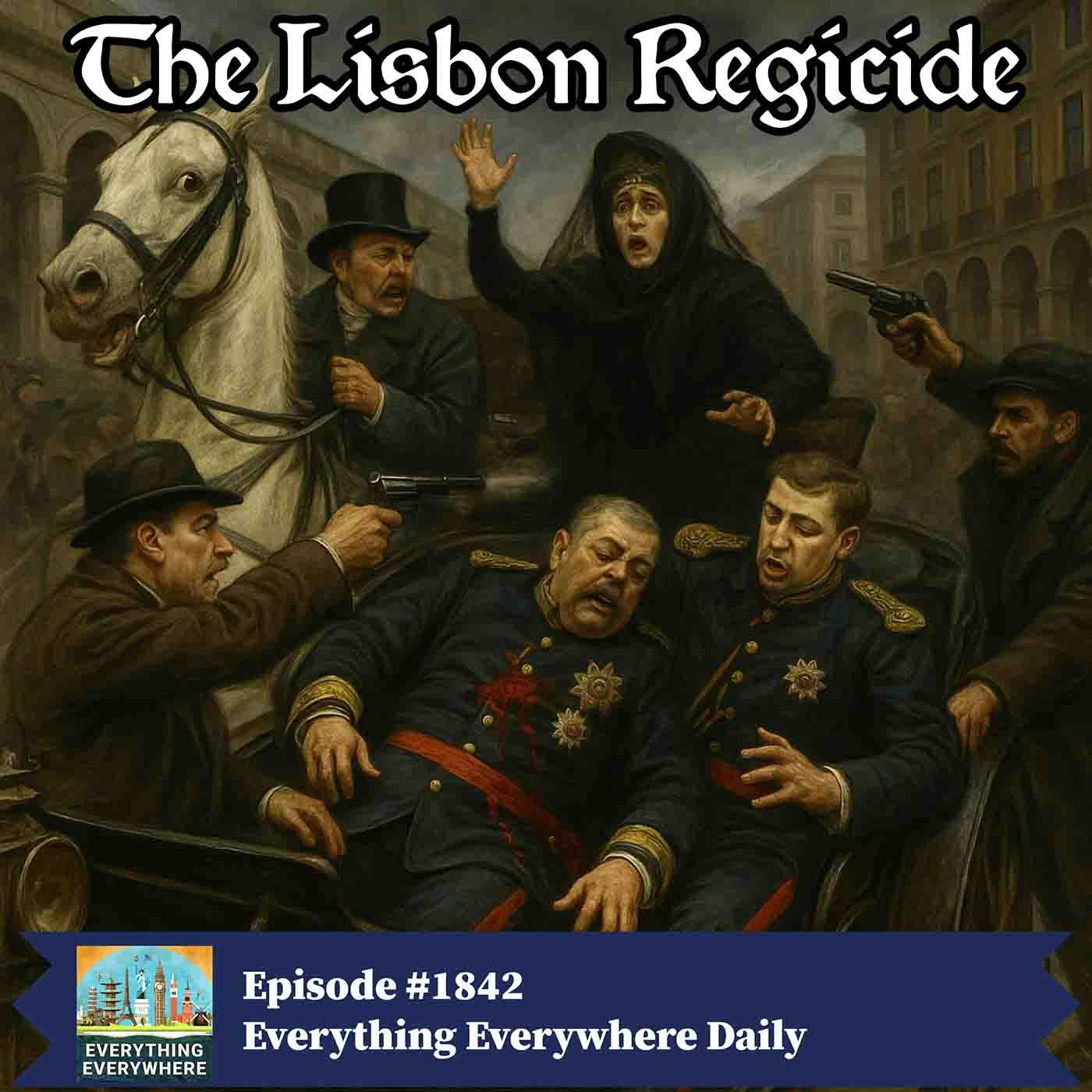
On February 1, 1908, the political fortunes of Portugal changed forever. The royal family was returning to Lisbon, traveling in an open horse drawn carriage. While they were traveling in broad daylight in front of dozens of witnesses, two radicals gunned down both the king and the heir apparent, throwing the Portuguese monarchy into chaos. The effect of what happened almost 120 years ago can still be felt today. Learn more about the Lisbon regicide How, how it happened, why it happened, and its repercussions on this episode of Everything Everywhere Daily. This episode is sponsored by Fiji Water. You've probably heard of Fiji Water and have seen it in stores. Well, Fiji Water really is from the islands of Fiji. Drop by drop, Fiji Water is filtered through volcanic rock 1,600 miles away from the nearest continent and all its pollution protected and preserved naturally from external elements. In this process, it collects a unique profile of electrolytes and minerals, resulting in more than double the electrolytes as the other top two premium bottled water brands, giving Fiji Water its smooth taste. Fiji Water's electrolytes are 100% natural and this water even has a perfectly balanced pH of 7.7. I've recently been trying to reduce my consumption of diet soda and I've found Fiji Water to be a great alternative. Visit your local retailer to pick up some Fiji Water today for your next backyard party, beach day hike, or even your home office. Fiji Water is Earth's finest water. This episode is sponsored by Mint Mobile. There are numerous subscriptions that you pay for every month. If you want to reduce your monthly spending, your only option is usually to cancel and go without. But in case of your phone, you can significantly reduce your costs while still enjoying almost the exact same service by switching to Mint Mobile. With plans Starting at just $15 a month, Mint Mobile gives you premium wireless service on the nation's largest 5G network. With Mint Mobile, you can use your same phone, phone number, contact list, and even connect to the exact same towers and cellular network. The only difference is price and that's why I recommend Mint Mobile this year. Skip breaking a sweat and breaking the bank. Get your summer savings and shop premium wireless plans@mintmobile.comeed that's mintmobile.comeed upfront payment of $45 required equivalent to $15 a month limited time new customer offer for first three months only. Speeds may slow above 35 GB on unlimited plan, taxes and fees extra. See Mint Mobile for details. It is astonishing how the fortunes of an entire country can change in an instant. And this is precisely what happened to Portugal on February 1, 1908 to understand the events of that day, we need to know what the situation was in Portugal leading up to it. Portugal was in bad shape in the early 20th century. Once a great maritime empire, it was struggling with crushing debt, political instability, and growing public discontent. Portugal had been living beyond its mean for decades, borrowing heavily from foreign creditors, particularly the United Kingdom. The country's finances were in such shambles that it had to partially declare bankruptcy in 1892. King Carlos I, who had ruled since 1889, found himself caught between impossible pressures. On one hand, he faced demands from creditors and the need for fiscal responsibility. On the other hand, he confronted growing opposition from republicans who blamed the monarchy for Portugal's decline, and from various political factions that disagreed on how to solve the crisis. The situation became even more volatile when Carlos appointed Joo Franco as prime minister in 1906. Franco, believing that a strong centralized authority was needed to save the country, essentially established a dictatorship with the king's support. Prior to the rise of Franco and his prime minister in 1906, Portugal was formally a constitutional monarchy, governed by the constitutional charter of 1826, a moderately liberal document that established a bicameral legislature and defined the powers of the king and government. However, in practice, the political system was deeply flawed, unstable, and increasingly disconnected from the needs of the broader population. Franco dissolved parliament, censored the press, and ruled by decree. While some of his financial reforms were actually sensible and necessary, the authoritarian methods created a powder keg of opposition. Republicans, progressive liberals, and even some traditional conservatives united in their hatred of what they saw as royal despotism. Another factor in the cause of the assassination was a group known as the Carbonaria. The Carbonaria was originally an anti clerical, revolutionary conspiratorial society established in Portugal in 1822, but it soon disbanded. A new organization, using the same name and claiming to be the continuation of the previous organization, was founded in 1896. This secret society became the organizational backbone that channeled republican opposition into direct action. The Portuguese Carbonaria drew inspiration from its Italian predecessor, the Carbonare, which had been active in the struggle for Italian unification and constitutional government. The Carbonaria was dedicated to achieving political reform through clandestine means, often involving acts of sabotage and violence. This organization was not a debating club. It had operational units structured into a hierarchy and received military training. Today we'd call them a guerrilla or terrorist group. It was the Carbonaria that joined the fates of the two men central to this story. Alfredo Luis da Costa and Manuel Buisa. Da Costa was a Portuguese publicist, editor, journalist, shop assistant, and salesman. Who was part of the carbonaria as well as being a freemason. At just 24 years old, Da Costa represented the younger generation of Portuguese republicans who had grown up witnessing their country' decline and humiliation. His involvement in journalism meant that he was intimately familiar with Portugal's financial crisis, the growing debt that the country had accumulated, as well as the perceived failures of the monarchy. For someone of his generation and political views, King Carlos I and his authoritarian prime minister represented everything wrong with the old incompetence, despotism and national humiliation. Buisa was a former soldier and school teacher. His motivations appear to have been even more deeply philosophical and idealistic. There was a belief in republican circles that Buis assassination of the king and Prince Royal was seen by him as a form of justice and a duty to the fatherland. In his final will, dated January 28, 1908, just four days before the assassination, he actually articulated his motivations in writing. The assassination didn't occur in a vacuum. It followed a failed republican uprising just days earlier. On the evening of January 28, the disastrous municipal library elevator coup took place. Da Costa led a group of 20 men, including Buisa, to assault the royal palace at Necessitads, but at the last minute modified their strategy and instead attacked the military barracks at Cuartel dos Loyos. The goal of the uprising was to dismiss the prime minister Franco and restore parliamentary rule by occupying government buildings and compelling the king to act. However, the coup was poorly coordinated and swiftly suppressed by loyalist forces. Most conspirators were arrested or fled, further increasing tensions in the capital. And ironically, the failed coup created the perfect pretext for Franco to intensify his repression. When their original plans to attack the royal buildings proved unfeasible, they adapted their strategy and decided to kill the king himself. February 1st was a cold afternoon. The royal family was returning to Lisbon from their country residence at Vila Visosa. As their open carriage rolled through the Tiero do Passu, now called Commerce Square, one of Lisbon's most prominent public spaces, they were completely exposed to crowds. The family was riding in an open horse drawn carriage. As the carriage rolled through the square around 5pm the two assassins positioned themselves strategically amongst the crowd of onlookers who had gathered to see the royal family's return. There were a few police officers in the crowd, and only one was on the carriage. The assassins came well prepared for their deadly mission. Buisa, an army sergeant and former sniper, fired the fatal shots from a rifle hidden under his longcoat. Da Costa was equipped with a pistol. King Carlos was shot and killed instantly with shots striking his neck and face. Buisa fired them from a kneeling position about 8 meters in front of the carriage. Da Costa jumped into the carriage and fired a shot into the shoulder of the already dead king. Crown Prince Louis Philippe, the heir to the throne, got up and drew a hidden pistol that he had and managed to fire four shots at Da Costa. However, standing up made him a target of Buisa, who then shot him in the head. Queen Amelie was injured but survived, as did the younger son, the 18 year old prince Manuel. Multiple bystanders and police were wounded, but they managed to kill the two assassins within a minute of the attack. Another bystander was actually mistaken for a third assassin and also killed. The regicide sent shockwaves throughout Portuguese society and all of Europe. The monarchy, which had ruled Portugal for over 750 years, suddenly appeared vulnerable and mortal. This was arguably the most significant political assassination in Europe until it was surpassed by the assassination of Archduke Franz Ferdinand in 1914. The 18 year old Manuel II now ascended to the throne, but he was inexperienced and lacked his father's political acumen. The new king faced an impossible situation. The republicans, now emboldened by their successful strike against the monarchy, intensified their campaign. Meanwhile, the monarchist cause was severely weakened, not just by the loss of leadership, but by the symbolic power of the regicide itself. It demonstrated that kings could be killed and that the monarchy was not divinely protected or politically untouchable. Joao Franco was immediately dismissed as prime minister. But this concession came too late to restore stability. The political system lurched from crisis to crisis, with governments changing frequently and unable to address the underlying problems that had caused the crisis in the first place. As bad as the assassination was, the problems for Portugal were just getting started. Over the next two years, Portugal experienced what could best be described as a slow motion collapse of the monarchy. The young King Manuel made genuine attempts at reconciliation and reform, but he was fighting against historical forces that were much more powerful than himself. The republicans, organized under the Portuguese Republican Party, methodically built their strength. They controlled much of the urban press, had significant support from amongst the military, especially junior officers, and appealed to a growing middle class that blamed the monarchy for Portugal's international humiliation and economic stagnation. Several factors made revolution almost inevitable. Portugal's financial situation remained dire, with the country still heavily dependent on foreign loans and unable to modernize its economy effectively. The monarchy had lost much of its legitimacy, not just because of the assassination, but because it had become associated with dictatorship, incompetence and national decline. The end of the monarchy came with surprising swiftness. On October 5, 1910, Republican forces launched a coordinated uprising in Lisbon. The revolution was primarily a military affair. Republican officers and sympathizers seized key points in the capitol, while loyalist forces melted away or just switched sides. King Manuel ii, recognizing that his cause was hopeless, chose exile over civil war. He fled to Britain, where he would live until his death in 1932. This peaceful transition, while dramatic, helped spare Portugal the kind of violent civil conflict that might have torn the country apart. However, the peaceful transition to a republic didn't solve Portugal's problems. The Republicans, now known as the First Portuguese Republic, was incredibly unstable. In just 16 years, Portugal had 45 governments and eight presidents. And this wasn't just a string of bad luck. The regicide had demonstrated that political violence could be effective, and various factions continued to use or threaten violence to achieve their goals. The Republicans were strongly anti clerical, and they used their victory to attack the Catholic Church's traditional role in Portuguese society. They separated church and state, expelled religious orders, and secularized education. While these reforms were welcomed by urbanites, they alienated much of rural Portugal, creating lasting social and cultural divisions. The republican revolution also relied heavily on military support, establishing a pattern in which the army saw itself as a legitimate political actor, which. Which is never a good idea for a young republic. But perhaps most importantly, the political revolution didn't solve the fundamental economic problems that had contributed to the Monarchy's downfall in the first place. Portugal remained a relatively poor agricultural country, struggling to compete in an increasingly industrialized world. Political instability actually exacerbated these problems by preventing the implementation of a consistent economic policy. The irony of the events that took place, starting with the assassination, was that the Republicans had overthrown the monarchy partly in the name of democracy and progress. But the chronic instability of the First Republic created conditions that many Portuguese found intolerable. The end result was that on May 28, 1926, the First Republic came to an end in a military coup. It was initially welcomed by many Portuguese who hoped for stability. This coup eventually brought Antonio Salazar to power in 1932, whose authoritarian Estado Novo regime would rule Portugal for nearly half a century until his death in 1974. So, in a very real sense, the regicide of 1908 set in motion a chain of events that led not to the liberal democracy that the Republicans initially envisioned, but to one of Europe's longest lasting dictatorships. Salazar actually used the chaos of the Republican period to justify his authoritarian rule, arguing that the Portuguese weren't ready for democracy. The lesson of the Lisbon regicide is that violence doesn't often achieve the result that you think it will. The grievances of the Portuguese Republicans were actually pretty legitimate. However, the assassination sent events spiraling in a way that that the assassins never intended. The executive producer of Everything Everywhere Daily is Charles Daniel. The associate producers are Austin Oakton and Cameron Kieffer. I want to thank everyone who supports the show over on Patreon. Your support helps make this podcast possible. I'd also like to thank all the members of the Everything Everywhere community who are active on the Facebook group and the Discord server. If you'd like to join in the discussion, there are links to both in the show notes and as always, if you leave a review or send me a boostogram, you too can have it read on the show.