← Everything Everywhere Daily: History, Science, Geography & More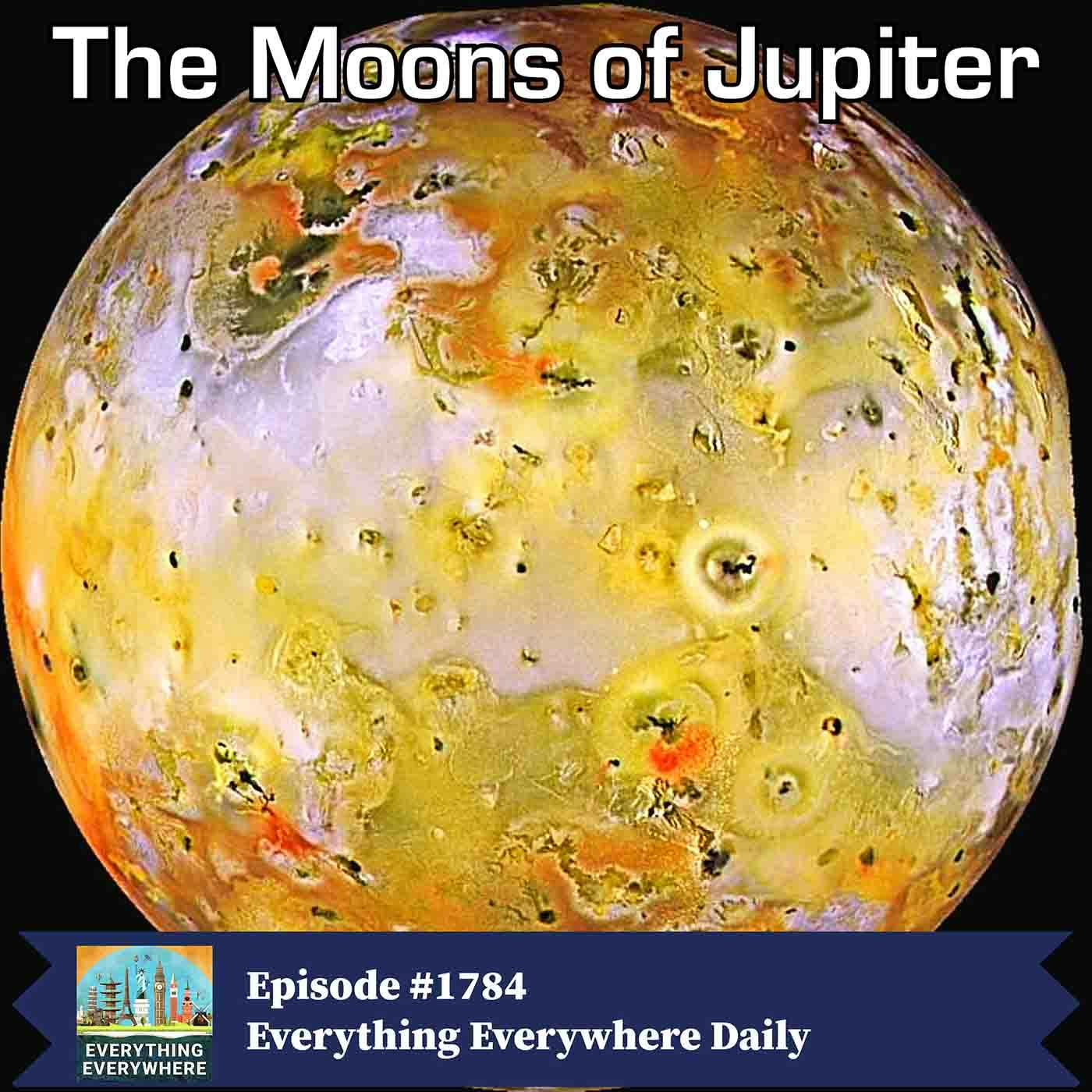
Everything Everywhere Daily: History, Science, Geography & More
The Moons of Jupiter
00:17:08
Learn more about the moons of Jupiter
Loading summary
Transcript1 lines
- [00:01]
Host of Everything Everywhere Daily
In the year 1610, Galileo Galilei used a new invention called the telescope to observe the planet Jupiter. What he found revolutionized the science of astronomy and our entire understanding of the universe. He discovered four moons in orbit around the planet, the first objects in the solar system to have been discovered since antiquity. Today, astronomers are hoping that some of these moons of Jupiter may have the best hope of harboring life outside of Earth in our solar system. Learn more about the moons of Jupiter, their discovery, and why they're so important on this episode of Everything Everywhere Daily this episode is sponsored by Quince. If you've been listening to the show for even a little while, you've heard me talk about Quince. The reason why I have such good things to say about them is because Quince has hit the trifecta by offering products that are low cost, high quality and easy to purchase and return online. They can do this because they work directly with top artisans and cut out the middleman. This is how Quince gives you luxury pieces without the crazy markups. I had someone over at my place the other day and they asked me, where's that Quince blanket you talk about? And I said it, it's right there. And they checked it out and said, wow, that's really a nice blanket. And I was like, yeah, it is. If you're looking for men's or women's clothing, home goods or travel accessories, you owe it to yourself to check out quince. Go to quince.com daily for 365 day returns plus free shipping on your order. That's Q U I N-E.com daily to get free shipping and 365 day returns. Quince.com daily this episode is sponsored by newspapers.com break down genealogy brick walls with a subscription to the largest online newspaper archive. Did you know that newspapers.com has over a billion pages of digitized newspapers going back to the year 1690? Their growing collection includes papers from the United States, United Kingdom, Canada, Australia and more. Discover birth and marriage announcements, obituaries and everyday stories about your ancestors. In seconds, Newspapers.com can help you fill in the gaps between vital records and reveal details about your ancestors lives that you can't find anywhere else. Their easy to use search feature will let you filter your results by date, location, specific paper, and more. When you find something interesting, newspapers.com makes it a snap to share it with your family and friends and you can even save it directly to your ancestry Tree. Come explore one billion pages and make infinite discoveries. Today on Newspapers.com use promo code Everything Everywhere for a 20% discount on your subscription. As of the recording of this podcast, Jupiter has 97 known moons. The vast majority of those moons, 93 to be exact, are rather tiny and so small that they don't have enough gravity to even turn themselves into spheres. They are technically moons, but with their irregular shapes, they're closer to asteroids in appearance. So my focus in this episode will be on the four major moons, which are known as the Galilean moons. There is a major difference between these four moons and everything else that orbits Jupiter. For example, the largest moon, Ganymede, is about three times more massive than the fourth largest moon, Europa. Europa. However, the difference between Europa and the fifth most massive moon, Himalaya, is enormous. Europa is over 11,000 times greater than the next largest moon. So for all practical purposes, scientifically and historically, only the four Galilean moons matter. So that will be the focus of this episode. For most of human history, only seven planets were known to ancient people. And by planet, I mean anything in the night sky that moved on a regular basis. There was the sun, the moon, Mercury, Venus, Mars, Jupiter and Saturn. Almost every civilization had a geocentric view of the universe. According to this view, everything in the sky rotated around the Earth. In December of 1609, or possibly January of 1610, Galileo Galilei made his first direct observation of the planet Jupiter using a telescope that he had made himself. And he noticed something odd about Jupiter. There were three stars in very close proximity to the planet. At first, he just assumed that these lights were just regular stars that happened to be next to Jupiter. However, as he kept observing Jupiter, he noticed that another star appeared and that the stars that he saw were were constantly moving around the planet. After following the location of the lights, he eventually realized that these weren't distant stars, but instead were orbiting around Jupiter. In other words, Jupiter had moons. This might not sound like a big deal, but for the time, it was actually revolutionary. For starters, these were the first objects that were discovered in our solar system. And outside of those seven ancient planets. Even more importantly, they were the first objects ever found that could be proven not to rotate around the Earth. This confirmed that the geocentric view of the universe was wrong. Galileo published his findings in a treatise titled Sidereus Nuncius, or the Starry Messenger. In March of 1610, he dedicated the work to Cosmo II de Medici, the Grand Duke of Tuscany, in hopes of securing patronage. Although Galileo had discovered the moons, he did not name the moons individually. He called them the Medicean Stars, after the Medici family. The Names we use today, IO, Europa, Ganymede and Callisto were proposed by the German astronomer Simon Marius, who claimed to have observed the moons independently around the same time as Galileo. In his 1614 work, Martin Mundus Jovialis, Marius suggested naming the moons after four mythological lovers of Zeus, the Greek counterpart of Jupiter. These names were largely ignored for centuries in favor of numerical designations 1 through 4, but eventually gained acceptance in the 20th century, especially with the rise of space exploration and planetary science, which required distinct names for clarity and classification. The other reason the number system was abandoned was that they were numbered based on their distance from Jupiter. However, spacecraft found some tiny moons that were actually closer than IO, which threw the numbering system out the window. There was a controversy surrounding who should be credited with discovering the moons. Most historians think that Galileo did in fact observe them first. And even if he didn't, he published his findings first, which is what really matters. For centuries, astronomers knew almost nothing about the moons other than that they existed. Improvements in telescopes allowed them to detect changes in surface light, which was reflected by the moons. And with spectroscopy, they were able to crudely determine the composition of the surface. However, to really learn more, it was necessary to go there. In the 20th century, that became possible. The Pioneer 1 and 2 missions did a flyby of Jupiter in the 1970s, and Voyager 1 and 2 flew by in the 1980s. The Galileo spacecraft went into orbit around Jupiter in 1995, and the Juno spacecraft has been in orbit around Jupiter since 2016. Rather than discuss each mission, I'm going to discuss each of the four moons to cover what we know about them and how they're different from each other. We'll start with the moon closest to Jupiter, IO. IO is one of the most extraordinary objects in the solar system, named after a mortal priestess of Hera who Zeus loved. In Greek mythology. IO is slightly larger than the Earth's moon, measuring about 3,643 kilometers, or 2,263 miles in diameter. What makes IO truly unique is its intense geological activity. It is the most volcanically active body in the solar system, with over 400 active volcanoes, some of which erupt with lava fountains reaching up to 500km into space. These plumes have been photographed by spacecraft as they flew past IO this extreme activity is driven by a process called tidal heating. As IO orbits Jupiter, it experiences powerful gravitational tugs, not just from the giant planet itself, but also from its neighboring moons, including Europa and Ganymede. These gravitational interactions flex IO's interior, generating immense frictional heat that keeps its mantle Partially molten. The result is a world that is constantly resurfaced by the eruption of silicate magma, leaving virtually no impact craters on its surface and making it one of the youngest landscapes in the solar system. IO's surface is a mosaic of sulfur compounds that create brilliant yellows, oranges, reds, and whites, making it one of the most colorful planetary bodies in the solar system. It's often been described as having a surface that looks like a cheese pizza. Sulfur dioxide frost coats much of the moon, while volcanic pits, lava lakes, and enormous calderas dot its terrain. One of the most prominent volcanic features is Loki Patera, a massive, constantly active lava lake of about 200km across that undergoes periodic brightening events as part of its surface crust sink and are replaced by fresh lava. Unlike Europa or Ganymede, IO has almost no water. Any water it may have once had was likely lost due to intense heating and Jupiter's powerful magnetosphere, which constantly bombards IO with energetic particles. Despite lacking an atmosphere in the traditional sense, IO has a tenacious envelope of sulfur dioxide gas that is constantly being replenished by volcanic activity. The thin atmosphere of IO is only temporary and collapses when the moon passes into Jupiter's shadow, freezing the gas onto the surface, only to be revived again with the return of sunlight. The next major moon is Europa. Europa is totally different than IO and is the subject of profound scientific intrigue. It's slightly smaller than the Earth's moon, with a diameter of about 3,121 km, or 1940 miles. It was named after the Phoenician princess Europa, who, according to Greek mythology, was abducted by Zeus in the guise of a bull. Of all the bodies in the solar system, Europa is considered one of the most promising candidates in the search for extraterrestrial life. Due to its vast subsurface ocean, Europa's most distinguishing feature is its smooth, bright surface, which is composed almost entirely of water ice. Unlike the cratered, rugged terrains of many other moons, Europa's surface is relatively young and geologically active, estimated to be no more than 60 to 180 million years old. These features are believed to have resulted from tidal flexing caused by gravitational interactions with Jupiter and the other Galilean moons. As Europa is pulled and stretched during its elliptical orbit, the ice shell fractures and shifts, allowing warmer material from beneath to to rise and refreeze at the surface. Beneath Europa's icy crust, which is estimated to be between 15-25km thick, is believed to lie a global saltwater ocean that could be up to 100-150km deep, far deeper than any ocean on the Earth. This hidden sea contains more than twice the amount of water found in all of the Earth's oceans combined. Evidence for this ocean comes from several sources, including measurements of Europa's magnetic field taken by NASA's Galileo spacecraft, which detected changes consistent with an electrically conductive fluid beneath the surface. In recent years, the Hubble Space Telescope and the James Webb Space Telescope have provided tantalizing evidence of plumes of water vapor erupting from Europa's surface, possibly from cracks that connect to the subsurface ocean. If confirmed, these geysers would allow future spacecraft to sample Europa's internal chemistry without having to drill through the ice. The possibility of life on Europa arises from the combination of liquid water, chemical nutrients possibly supplied by hydrothermal activity in the ocean floor, and an energy source in the form of tidal heating. NASA's upcoming Europa Clipper mission will arrive in the early2030s and will perform dozens of close flybys of Europa. It'll use a suite of instruments to study the moon's surface, measuring the thickness of ice, analyzing the composition of any plumes, and search for signs of habitability. The third moon from Jupiter is Ganymede. Ganymede is the largest moon in the solar system and is a world so vast that it surpasses even the planet Mercury in size. With a diameter of approximately 5,268 kilometers, or 3,273 miles, it was named after the mythical Trojan princess, Ganymede, cupbearer to the gods and lover of Zeus. Ganymede is unique amongst all the moons in the solar system for possessing a magnetic field of its own, a feature unheard of in any other natural satellite. This internal magnetic field is generated by convection in a liquid iron or iron sulfide core, indicating that Ganymede, like Earth, has a layered interior composed of a metallic core, a rocky mantle, and an outer shell of ice and silicate rock. The existence of this magnetic field was confirmed by NASA's Galileo spacecraft and its interactions with Jupiter's own vast magnetosphere producing auroras at Ganymede's poles. Roughly two thirds of the moon is covered in bright, grooved terrain, crisscrossing ridges and furrows created by tectonic stretching and faulting of the icy crust, possibly caused by subsurface convection or past heating events. The remaining one third of the surface consists of darker, heavily cratered regions that are believed to be the older original crust. Beneath Ganymede's crust lies a vast subsurface ocean, possibly more than 100km deep, sandwiched between layers of ice. Unlike Europa, Ganymede's ocean might be stratified with multiple layers of ice and liquid, stacked like a geological layer cake. The last of the Galilean moons is Callisto. Callisto is the third largest moon in the solar system, measuring about 4,821 kilometers, or 2,995 miles in diameter, only slightly smaller than Mercury. What makes Callisto particularly fascinating is the ancient and heavily cratered state of its surface. Unlike its sibling moons, Callisto displays no signs of internal geological activity. Its exterior is pockmarked by billions of years of impacts, making it the oldest and most heavily cratered surface in the solar system. This dense concentration of impact scars suggests that Callisto has not undergone the same level of resurfacing or or tectonic processes as IO, Europa Organymede Callisto's lack of geological activity is largely due to its internal structure and distance from Jupiter. It does not experience significant tidal heating because it lies beyond the gravitational tug of war experienced by the inner Galilean moons, which are locked in orbital resonances that generate internal friction and heat. As a result, Callisto is believed to be composed of a mixture of rock and water ice in roughly equal proportions that extends from the surface or all the way down to the core. The lack of geological activity makes Callisto the least interesting moon for future exploration. Jupiter's Galilean moons are like a mini solar system. They are personally my favorite parts of the solar system, and the fact that the moons are all so different means that they will remain an object of study by astronomers for decades to come. The executive producer of Everything Everywhere Daily is Charles Daniel. The associate producers are Austin Oakton and Cameron Kiefer. I want to thank everyone who supports the show over on Patreon. Your support helps make this podcast possible. I'd also like to thank all the members of the Everything Everywhere community who are active on the Facebook group and the Discord server. If you'd like to join in the discussion, there are links to both in the show notes and as always, if you leave a review or send me a boostogram, you too can have it read on the show.