← Everything Everywhere Daily: History, Science, Geography & More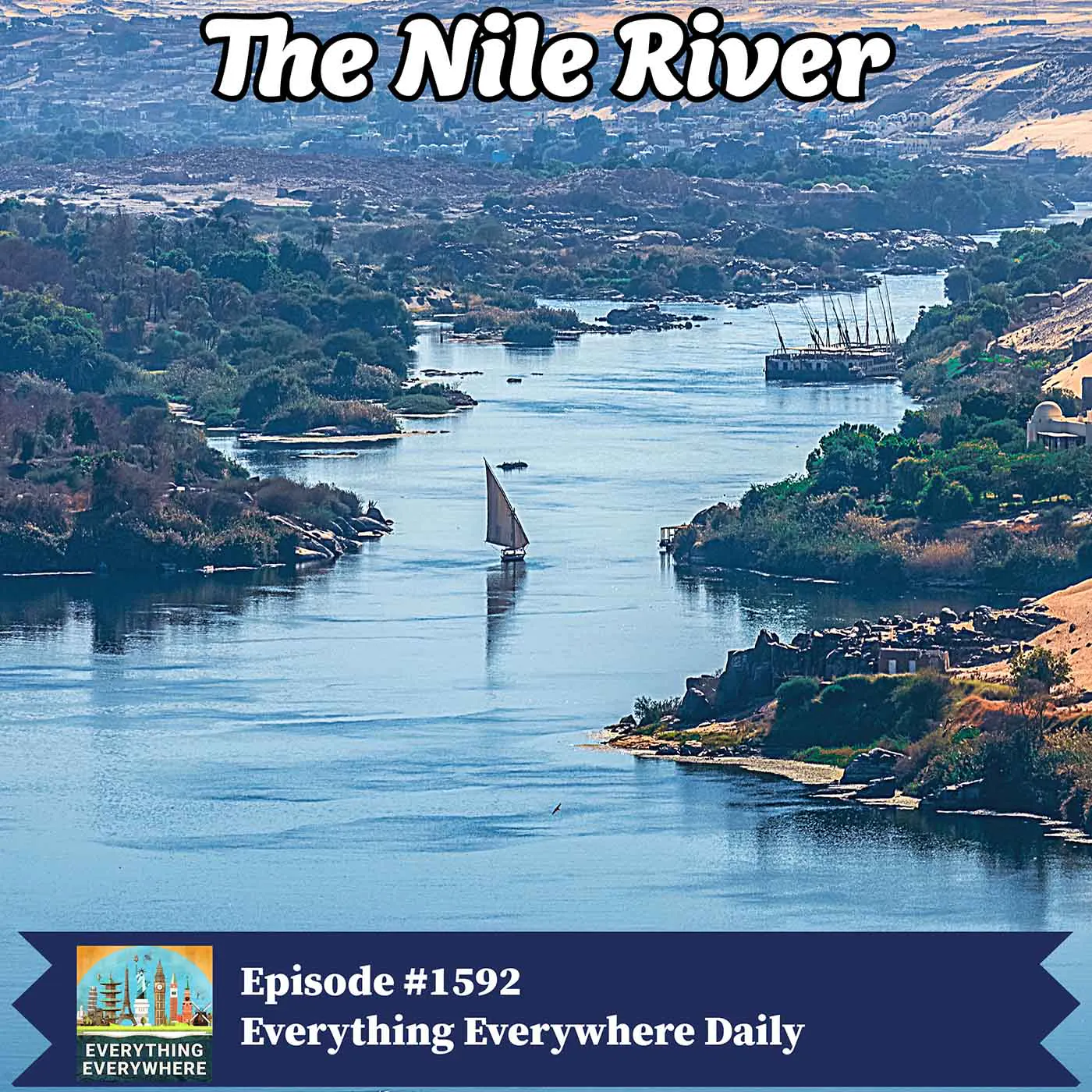
Everything Everywhere Daily: History, Science, Geography & More
The Nile River (Encore)
00:12:15
Learn more about the longest river in the world
Loading summary
Transcript20 lines
- [00:01]
Gary Arndt
The following is an encore presentation of Everything Everywhere Daily. There's an old saying that denial isn't just a river in Egypt, and that's true. It's also a river in Sudan, South Sudan, Ethiopia, and Uganda. The Nile is the longest river in the world, yet it's one of the smallest major rivers in the world as well. Historically, some of the world's greatest civilizations have depended on it, and today it is still a source of conflict between countries that depend on it for water and power. Learn more about the Nile river and how its geography has and continues to shape history on this episode of Everything Everywhere Daily.
- [00:48]
Charles Daniel
This episode is sponsored by ButcherBox. Thanksgiving is right around the corner and that means Thanksgiving dinner for friends and family. A Thanksgiving dinner can be a massive ordeal and a nerve wracking affair. You have to buy all the food and spend the better part of the day preparing everything before serving it. So why not take one thing off your plate by letting Butcherbox take care of the centerpiece of your Thanksgiving meal. The turkey. Not only will Butcherbox deliver the turkey directly to your door, but they will also offer some of the highest quality turkeys that you can find. Their turkeys are never given antibiotics or hormones, and they're all certified to be raised humanely. And in addition to turkey, they also have ham, beef and seafood, if that's what you prefer. New Butcherbox members that sign up using my link will receive their choice between a whole turkey turkey breast or a spiral ham plus $20 off when they visit butcherbox.com daily and enter code daily at checkout. Once again, that's butcherbox.com daily code daily at checkout.
- [01:53]
Friend 1
Bada bada Boom. Sold.
- [01:55]
Friend 2
Huh?
- [01:56]
Friend 1
Just sold my car on Carvana. Dropping it off and getting paid today already. What? You still haven't sold yours? You told me about it months ago.
- [02:04]
Friend 2
I just.
- [02:04]
Friend 1
Is the offer good?
- [02:05]
Friend 2
Oh, the offer's great.
- [02:06]
Friend 1
Don't have another car yet.
- [02:08]
Friend 2
I could trade it in for this car I love.
- [02:11]
Friend 1
Come on, what are we waiting for?
- [02:12]
Friend 2
Ah, you're right.
- [02:14]
Friend 1
Let's go.
- [02:15]
Friend 2
Whether you're looking to sell your car right now or just whenever feels right, go to Carvana.com and sell your car the convenient way and conditions apply.
- [02:26]
Gary Arndt
Before I get into anything else, I should address the issue of the length of the Nile River. Many of you might have heard that the Amazon is the longest river in the world, and others might have heard that the Nile is the longest river. Measuring the length of a river is difficult because a very large river will have many tributaries which feed into the river. Whichever tributary you pick will determine the length of the river. That being said, the Nile is usually considered to be the longest river, with a total length of 6,693 kilometers, or 4,100, 159 miles, or about 250 kilometers longer than the Amazon. While the Nile is undoubtedly one of the world's great rivers, it actually doesn't transport nearly as much water as other great rivers. It's number one in length, but only number 97 in terms of average discharge of water, which is measured in terms of cubic meters per second. The Amazon has almost 70 times more water flowing through it as the Nile does. In fact, if you look at the list of the greatest rivers in the world by discharge, you'll encounter dozens of rivers you've probably never heard of before you ever get to the Nile. The reason why the Nile is so long, yet transports comparatively so little water, and nonetheless has been the cradle of some of the world's earliest civilizations is what makes the story of the Nile so interesting. I'm going to go through the Nile by going upstream. And here I should note, if you don't know this already, that the Nile is one of the few rivers that flows north. So when I talk about going upstream, I'm actually going south. And this is also the reason why in ancient Egypt, Upper Egypt was south of Lower Egypt. Going upstream. We start in the Nile Delta. The Nile Delta is one of the largest river deltas in the world. Going from the Mediterranean coast, it goes down to about the city of Cairo, which is where you can consider the Delta to begin. The largest city in the Delta is Alexandria, which I've talked about in other episodes, so I won't belabor it here. The entire Delta has been a rich agricultural region for thousands of years. If you take a look at a satellite image of Egypt, the green Delta jumps out at you in contrast to the beige desert surrounding it. Historically, there were seven major river branches that formed the Delta. Today, however, there are only two, due to silting and flood control. Much of this is due to the removal of the annual flooding of the Nile, which I will get to in a bit. Today, about 40% of the population of Egypt lives in the Nile Delta. As we go further upstream, we're hit with the feature that really makes the Nile such a weird river. For thousands of miles, the Nile has no tributaries. If you look at pretty much any other river in the world, you'll see a network of smaller rivers and streams that feed into it. The Nile from the Mediterranean Sea all the way through Egypt and well into Sudan has no rivers feeding into it. It just runs right through the world's largest desert with no water coming in and evaporation from the desert. It's one of the reasons why the flow of the Nile is so low. It's estimated that 2 billion cubic meters of water are lost to evaporation in Egypt alone every year. Because there are no tributaries, Egypt has depended solely on the Nile. In ancient times, for all practical purposes, Egypt and the Nile were synonymous. Today, not much has really changed. 95% of the population in Egypt lives along the Nile River. If you want to see something interesting, look at a nighttime satellite image of Egypt. You'll see the entire country is dark, except for a string of lights following the river. The wealth and power of the ancient Egyptians came from the agricultural productivity in the Nile. And that productivity came from its annual flooding. The flooding of the Nile was so important to the ancient Egyptians that they had a God dedicated to it, and their calendar was based around it. They had three seasons which corresponded to flooding, growth and harvest. Nile floods would take place in the summer, often starting around the beginning of June and reaching its peak around August. The average height of a flood would be 13.7 meters in Aswan, 11.6 meters in Luxor, and 7.6 meters in Cairo. The floodplains on either side of the river would usually be about 1.5 meters below water. The floods would deposit silt along the banks of the Nile that was drenched in water. And it was this annual deposition of rich soil, which is why Egypt was so productive and wealthy. There could be large variations in floods. A year with a small flood could mean famine. A year with a large flood could destroy villages. The annual flooding of the Nile is a thing of the past. However, the flooding cycle ended with the creation of the Aswan High Damage. The Aswan High Dam was built in the 1960s under the order of Egyptian President Gamal Abdel Nasser. It would remove the annual cycle of flooding, which wasn't as necessary with modern irrigation techniques and fertilizer. It also provided half of the electricity in Egypt when it first opened, although it provides a much smaller percentage now just because Egypt has grown so much. Just as an aside, if you've ever heard of the Aswan High Dam, you might have wondered if there's an Aswan Low Dam. And the answer is yes. It's located just downstream from the High Dam, and the construction on it actually began in 1899. I'll probably do a future episode dedicated just to The Aswan High Dam, because the story behind its construction is really unique and it has many implications. I will note that all the silt which would normally have been deposited during the Nile floods has been building up behind the dam in Lake Nasser for decades now. And it's starting to become a huge problem. The reason why the Aswan dams were built where they were is that it was the location of the first of the Nile cataracts. The cataracts are regions of the river where there are shallow rapids, they aren't wild Class 5 rapids, and they aren't waterfalls. They did, however, provide enough of a barrier to prevent large barges from traveling through the cataracts. Once you get south of the Egyptian border and continue to go upstream, the Nile makes a U turn and goes north before making another U turn to go south. And if you look at a map, this region with the N shaped curve is called the Cataract Nile. The cataracts were the natural barrier between Egypt and Nubia. There are six cataracts in total. They weren't a hard barrier between Egypt and Nubia, but it was more like a speed bump in the river, which made trade and conquest much more difficult than it would have been otherwise. There was a period where the kingdom of Cush and Nubia conquered Egypt for about 100 years. And there were periods where the Egyptians conquered the Nubians. There was a great deal of cultural exchange between Egypt and Nubia as well. Nubians had pyramids, used hieroglyphics, and also worshiped some of the Egyptian gods. Nubian civilization will also deserve its own future episode because it's too big of a subject to address here. Further upstream, we reach our first tributary, which is actually the last one to empty into the Nile because we're going upstream, the Atabarath river, also known as the Black Nile or sometimes the Red Nile. After that, we reach one of the most important cities on the Nile and the place where the river splits in two. Khartoum. Khartoum, Sudan, is where the Blue Nile and the White Nile merge. It's a quirk in naming that neither river is known as just the Nile, which is how it would work in most rivers. The Blue Nile heads southwest and the White Nile heads almost due south. The Blue Nile goes into the Ethiopian highlands and it is responsible for about 80% of the water that ends up flowing into the Nile. Although the ancient Egyptians didn't know it, it's the monsoon rains that fall in Ethiopia which are responsible for the annual flooding of the Nile. The source of the Blue Nile is considered to be Lake Tana in Ethiopia. And the Blue Nile has the largest waterfall in the Nile, Blue nile Falls. It's 42 meters, or 138ft high. Unquestionably, the biggest thing happening right now on the Nile is happening on the Blue Nile. And it's the development of the Grand Ethiopian Renaissance Dam, built very close to the border of Sudan. It began construction in 2011 and started filling up with water in 2020. When it's fully operational sometime between 2025 and 2027, it will be the largest hydroelectric plant in Africa and the seventh largest in the world. It has been a politically contentious project as water rights are a major issue in the region, given how arid it is. The White Nile, while only responsible for 20% of the Nile's water flow, is the longer of the two tributaries. It continues to flow south through Sudan, through the nation of South Sudan and into Uganda. The main source of the White Nile is considered to be Lake Victoria. However, there are other rivers that flow into Lake Victoria, so there is debate as to where the ultimate source of the Nile is. Both the Nyaburongo river that flows from Rwanda, and the Ruviaranza river, which comes from Burundi, can be considered the ultimate sources of the Nile. In Uganda, the Nile is usually split into the Victoria Nile, which is the stretch from Lake Victoria to Lake Albert, and the Albert Nile, which goes from Lake Albert to the border of South Sudan. The Nile has been a literal lifeline for the people and civilizations which have lived alongside it for over 5,000 years. During that time, Egyptians, Nubians, Ethiopians, Greeks, Romans, Arabs, French, British, Sudanese and Ugandans have all relied on the Nile River. Whatever civilizations may rise and fall over the next 5,000 years, whoever they are, they will still probably depend on the Nile.
- [11:16]
Charles Daniel
The executive producer of Everything Everywhere Daily is Charles Daniel. The associate producers are Benji Long and Cameron Keever.
- [11:22]
Gary Arndt
I want to give a big shout.
- [11:23]
Charles Daniel
Out to everyone who supports the show over on Patreon, including the show's producers. Your support helps me put out a show every single day and also Patreon is currently the only place where Everything Everywhere Daily merchandise is available to the.
- [11:37]
Gary Arndt
Top tier of supporters.
- [11:38]
Charles Daniel
If you'd like to talk to other listeners of the show and members of the Completionist Club, you can join the Everything Everywhere Daily Facebook group or Discord server. Links to Everything are in the show notes.