← Everything Everywhere Daily: History, Science, Geography & More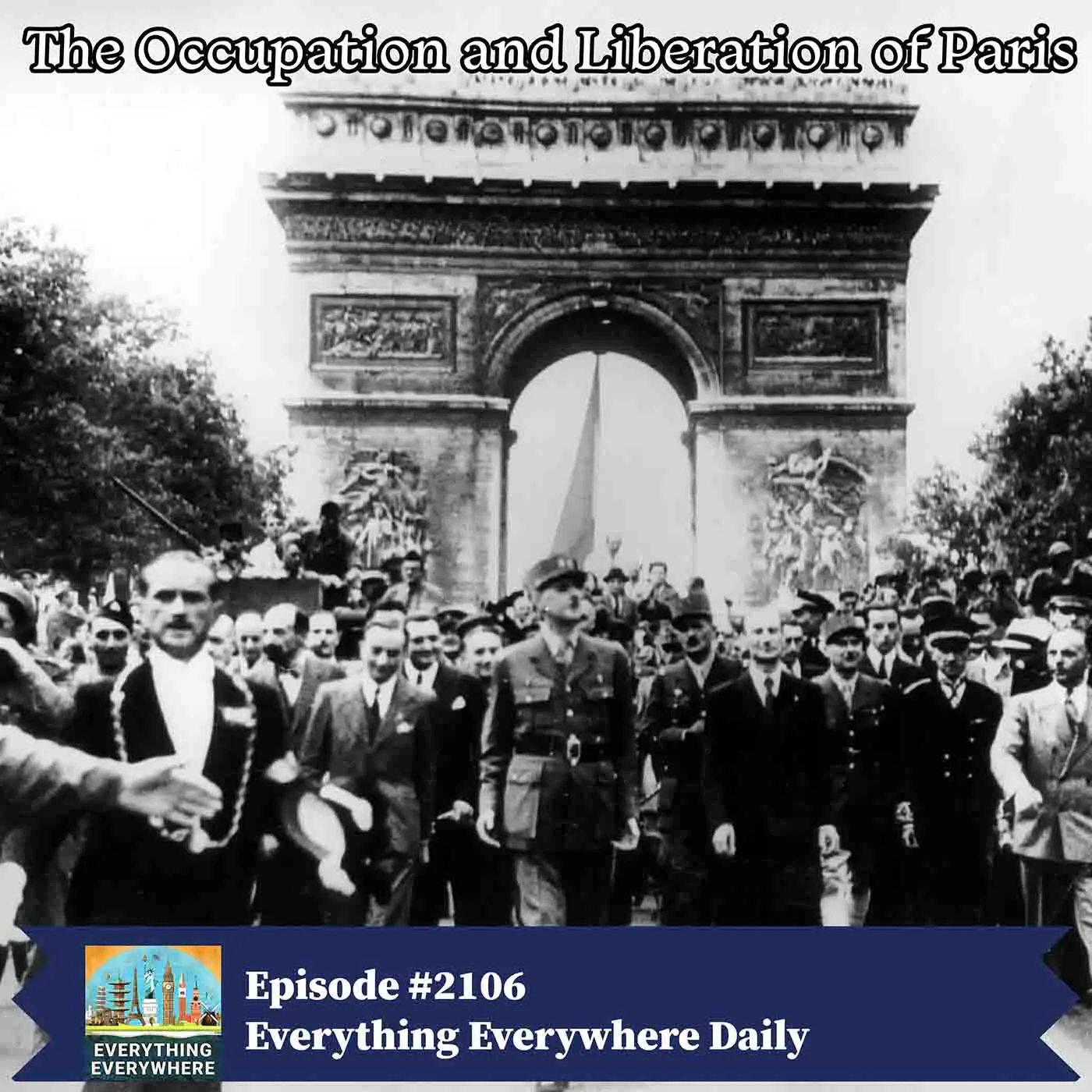
Everything Everywhere Daily: History, Science, Geography & More
The Occupation and Liberation of Paris (Encore)
00:14:34
Loading summary
Transcript1 lines
- [00:00]
A
The following is an encore presentation of Everything Everywhere Daily. Of all the cities that experienced the Second World War, one of the most interesting stories is that of Paris. Paris was not the scene of major fighting like Warsaw, which was all but destroyed. It was occupied for over four years, during which time it saw acts of resistance and collaboration. When the city was liberated after the invasion of Normandy, it was supposed to be destroyed but survived due to one man's act of disobedience. And after liberation, the city witnessed incredible acts of reprisal and vengeance. Learn more about the occupation and liberation of Paris on this episode of Everything Everywhere Daily. This episode is sponsored by Audible. It's time to Believe in the Hail Mary, One of the most talked about science fiction adventures of the decade. Project Hail Mary by Andy Weir is now on the big screen, and there's never been a better moment to experience the audiobook that started it all. Ryland Grace is humanity's last hope. Alone in space with no memory of how he got there, he must solve an impossible scientific mystery before the Earth is wiped out forever. What follows is a smart, thrilling and surprisingly emotional journey that blends hard science with non stop suspense fans. Favorite narrator Ray Porter delivers an unforgettable performance, balancing humor, heart and escalating tension as the stakes grow higher with every chapter. Part scientific puzzle, part interstellar adventure, Project Hail Mary is a story about curiosity, ingenuity and survival against impossible odds. Now that the blockbuster movie has finally arrived in theaters, there's never been a better time to start listening to the universally acclaimed audiobook Project Hail Mary. Listen. Watch. Save the World. Start listening today@audible.com Hailmary this episode is sponsored by True Work. Working outside in the springtime means you're dealing with chilly mornings, hot afternoons, and everything in between. Not to mention the mud, rain and whatever else the weather decides to throw at you. You need workwear that can keep up with the challenging conditions, and Tru work has you covered. Most workwear is made from cotton blends, which restrict your movement and get soaked after just a few raindrops. Truewerk uses advanced performance fabrics to build products designed specifically for work on the job site. They've been tested and validated for over 10 years by Real trade pros working in real job site conditions. With over 15,000 5 star reviews and I have a pair and I wish I had them years ago when I was traveling because they would have made the perfect travel pants. The work doesn't stop just because the weather changes. Upgrade to the T2 work pant and stay comfortable no Matter what the day brings. Get 15% off your first order at truwerk.com with code everything that's T R U E W-E-R-K.com code everything TrueWerk built like it matters, because it does. The story of Paris during the Second World War is one that was different than any other city during the war. While it avoided the massive destruction of, say, Warsaw and Leningrad, it suffered through years of Nazi occupation and was almost destroyed during its liberation. After the start of the European war in September 1939 with the German invasion of Poland, Britain and France both declared war on Germany. Having declared war, pretty much nothing happened between France and Germany for months. This period of inactivity on the Western Front became known as the the phoney war. This state of affairs couldn't last forever. The phoney war became quite real in May of 1940 when Germany launched a blitzkrieg invasion into Belgium and the Netherlands before pivoting south into France, completely bypassing France's Maginot Line. France at the time had the largest military in Europe, after Germany, and everyone, including the Germans, assumed that the invasion of France would be a long, drawn out affair. It was not. In just six weeks, in a surprise to everyone, including the Germans, France was conquered. The German army almost destroyed the British army at Dunkirk and would have if it was not for the dramatic rescue by a flotilla of civilian ships. In early June of 1940, the Germans approached the outskirts of Paris. Given the almost complete collapse of the French and British armies, the conquest of Paris seemed inevitable. It was just a matter of how much of the city would be destroyed and how many people would be killed. Rather than fight, Paris was declared an open city. The idea of an open city was developed in the 20th century with the advent of mechanized warfare. An open city is a city that has been declared demilitarized during wartime to avoid destruction and civilian casualties. The declaration is typically made by the defending side, which agrees not to resist an advancing enemy force and removes all military presence or fortifications from the city. This status is meant to spare the city from bombing, shelling or urban combat under the laws of war, as attacking an undefended city is considered a violation of international convention. Paris was declared an open city by the French government on June 12, 1940, in hopes of preserving its cultural heritage and civilian population from the devastation of a battle. As the German forces approached, the British had actually recommended that the Parisians fight the Germans street to street, but they rejected the idea. The French government fled the city. On June 14, 1940, German troops entered Paris through the northern and eastern suburbs, the Nazi flag was raised over iconic landmarks including the Arc de Triomphe and the Eiffel Tower. The images of German soldiers marching down the Champs Elysees became one of the most potent symbols of European defeat during the war. Remarkably, about 60% of Parisians had already fled the city, creating a massive exodus that clogged the roads leading south. The Nazi occupation of Paris was designed to maintain a facade of normalcy while systematically exploiting the city and its inhabitants. The Germans established their headquarters at the Hotel Maurice on the Rue de Rivoli, and the swastika flew prominently from many public buildings. Paris was governed by a German military administration led by General Otto von Stuppnagel, who worked alongside French collaborationist authorities. Daily life changed dramatically for Parisians. Food rationing was imposed immediately, leading to severe shortages. By 1942, Parisians were limited to approximately 1,200 calories per day, less than half the pre war average. Basic goods like coal, clothing and coffee became scarce. A thriving black market emerged with inflated prices that only the wealthy could afford. The Occupiers enforced a strict curfew from 9pm to 5am Public gatherings were restricted. German authorities tightly controlled newspapers, radio broadcasts and cultural institutions. The press became a mouthpiece for Nazi ideology. Many French writers and artists, such as Jean Paul Sartre, continued working in Paris, while others, such as Andre Melrot and Pablo Picasso, became associated with resistance or withdrew from public life. German propaganda films replaced many French productions in cinemas. Paris famous cultural life continued in a diminished form under German censorship and supervision. The Occupiers attempted to create the illusion of a normal Paris, encouraging tourism from German soldiers and civilians. For Jewish Parisians, the occupation brought systematic persecution. In October 1940, the first anti Jewish laws were enacted excluding Jews from public service and certain professions. In May 1942, Jews were required to wear the yellow star. The most infamous roundup occurred on July 16 and 17, 1942, known as the Vel d' if Roundup, when French police, following German orders, arrested over 13,000 Jewish men, women and children. Most were held in appalling conditions at the Velodrome d' wer sports arena before being sent to transit camps and eventually to Auschwitz. Of the approximately 76,000 Jews deported from France during the war, fewer than 3,000 ever returned. Resistance to German occupation began gradually. Initially it consisted primarily of small acts of defiance. Distributing underground newspapers, painting V for Victory signs or placing flowers at the tomb of the Unknown Soldier, Charles de Gaulle's famous call to resistance From London on June 18, 1940 inspired many, but organized resistance networks took time to develop. By 1942, several major resistance movements operated in Paris. Groups like Liberation Nord, Combat and the communist led Front Nationale established cells throughout the city. These groups gathered intelligence for the Allies, sabotaged German installations, helped downed Allied airmen, escape, and assassinated German officers and French collaborators. The Resistance faced constant danger from the Gestapo and the French collaborationist police, particularly the Milsi, which was a Vichy paramilitary force. Thousands of resisters were arrested, tortured at facilities like the Gestapo headquarters, and either executed or deported to concentration camps. Despite these dangers, the Parisian resistance grew stronger, particularly after the German occupation of vichy France in November 1942 and the implementation of forced labor service in February 1943. Following the Allied landings in Normandy on June 6, 1944, the liberation of Paris became increasingly possible. The initial Allied plan was to actually bypass Paris to avoid urban combat and potential destruction, focusing instead on pursuing retreating German forces. On August 7th, General Dietrich von Koltitz was appointed the German military governor of Paris. He received instructions directly from Hitler to prevent Paris from falling into Allied hands at all costs. Events forced a change in the Allied plans to bypass Paris. On August 15, 1944, a strike by Paris police was followed by an uprising of railway workers. By August 19, the resistance had seized control of police headquarters and other municipal buildings. Barricades appeared throughout the city, reminiscent of previous revolutions in Paris. As fighting intensified, General Dwight Eisenhower, the supreme Allied commander, reconsidered the decision to bypass Paris. French General Philippe Leclerc's 2nd Armored Division was ordered to liberate the capital, supported by the US 4th Infantry Division. On August 23, Hitler gave the order to von Coltitz to destroy Paris. This included demolishing key infrastructure such as bridges, monuments, and cultural landmarks. However, von Koltitz, a seasoned Wehrmacht officer, ultimately chose to defy these orders. Hitler's exact words to von Coltitz, paris must not pass into the enemy's hands except as a field of ruins. Recognizing both the military futility of defending the city and the immense cultural and human cost of its destruction, Von Koltitz instead opened communications with the French Resistance through the Swedish embassy and delayed aggressive responses to the uprising. On August 25, he formally surrendered Paris to General Leclerc and the American forces. His decision is widely credited with sparing Paris from devastation, although historians continue to debate whether his actions were motivated by moral conviction, military pragmatism, or desire to distance himself from Hitler's increasingly irrational directives. When Hitler found out that von Koltitz had disobeyed his orders, he went ballistic. The next day, he launched V2 rockets at Paris, but the damage was minimal compared to what could have happened. The liberation of Paris culminated on August 26 with a victory parade down the Champs Elysees led by General Charles de Gaulle. In a famous speech at the Hotel de Ville, AKA the City hall, de Gaulle declared, Paris Paris outraged. Paris broken. Paris martyred. But Paris liberated. Liberated by itself, liberated by its people. With the help of the armies of France, with the support and help of all of France, of the France that fights, of only France, of the real France, of the eternal France, end quote. He did not mention the small role that the United States, Britain and Canada played in its liberation. The celebration was tempered by the reality that snipers still threatened from rooftops in Paris, leading to firefights during the victory parade itself. Approximately 1,000 resistance fighters and 3,200 civilians were killed during the week long last gas battle for Paris. However, that was not the end of the story. Thousands of Parisians had collaborated with the Nazis, both officially and unofficially, and now the people of Paris wanted payback. A wave of retribution swept throughout the city as the French people and the Provisional Government sought to punish those who had collaborated with the German occupiers. This period, known as the Epuration or purification, took two main the Epuration sauvage, or wild purge, and the Epuration legale, or the legal purge. The wild purge occurred immediately, often violently, involving spontaneous acts of vengeance. Collaborators ranging from those who worked with the Gestapo to those accused of profiting from the occupation, were beaten, executed without trial or publicly humiliated. One of the most infamous acts was the public head shaving of women accused of horizontal collaboration with German soldiers. Soldiers often paraded through the streets as a spectacle of shame. In the months that followed, the Provisional Government under Charles de Gaulle established legal proceedings to restore order and ensure due process. Special courts tried tens of thousands of suspects. Sentences ranged from imprisonment and forced labor to execution. High profile collaborators such as Vichy officials and pro Nazi journalists were among those prosecuted. Today, visitors to Paris can find numerous memorials commemorating both the victims of Nazi persecution and the heroes of the Resistance. The Showa Memorial honors Holocaust victims, while the memorial to the martyrs of the Deportation remembers those sent to concentration camps. The Mont Valerian Fortress, where over a thousand Resistance members were executed, serves as a national memorial. The story of occupied Paris reveals both the darkest and and most inspiring aspects of humanity. Collaboration and resistance, betrayal and heroism, despair and hope. Perhaps most importantly, it demonstrates how both ordinary citizens and a single person in a position of power, when faced with extraordinary circumstances, can make profound moral choices that echo throughout history. The executive producer of Everything Everywhere Daily is Charles Daniel. The associate producers are Austin Otkin and Cameron Kiefer. My big thanks go to everyone who supports the show over on Patreon. Your support helps make this podcast possible, and I also want to remind everyone about the community groups on Facebook and Discord. That's where everything happens that's outside the podcast, and links to those are available in the show Notes. As always, if you leave a review on any major podcast app or in the above community groups, you too can have it read on the show.