Loading summary
Transcript1 lines
- [00:01]
A
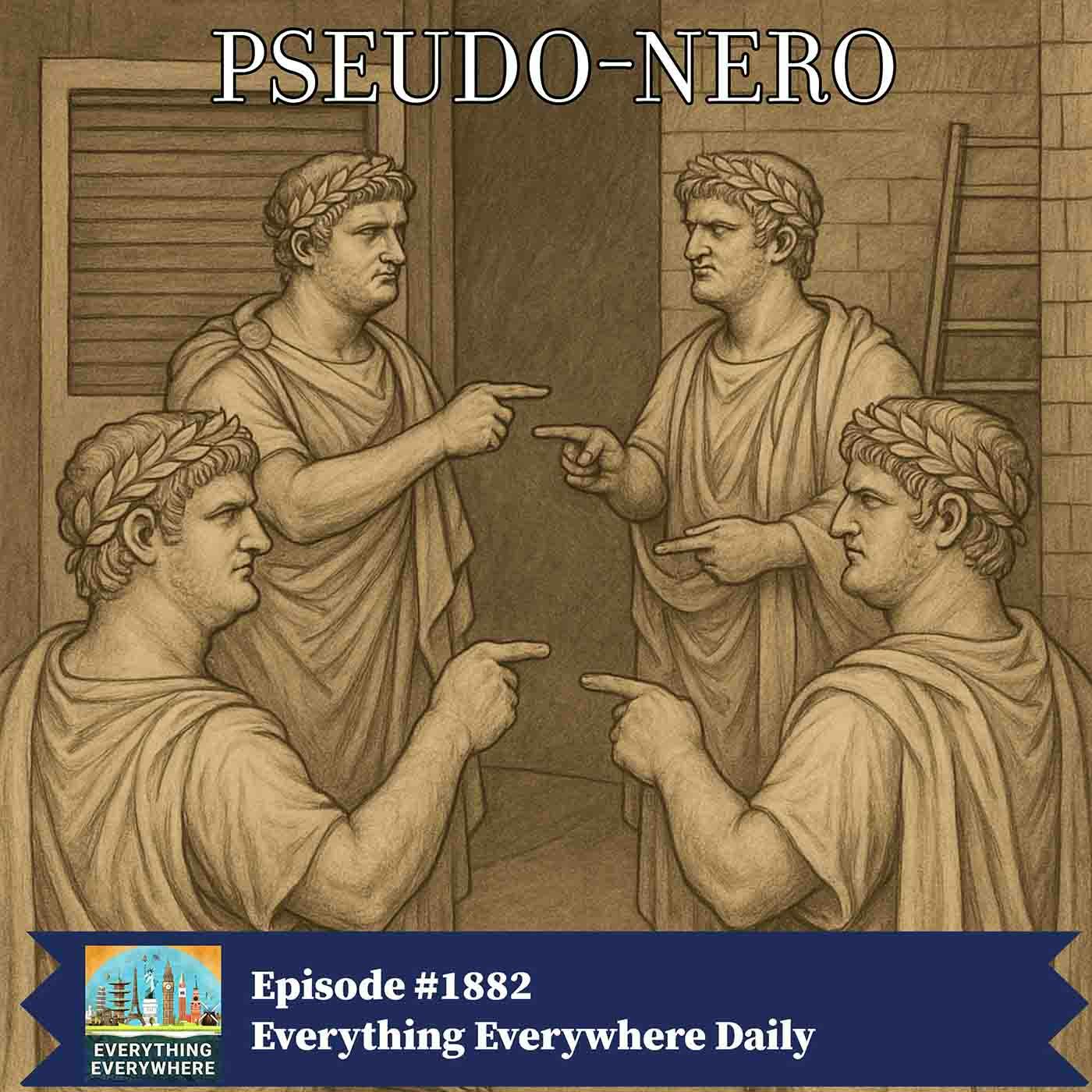
In the first century, Rome underwent a major political transition when the Emperor Nero died after being declared an enemy of Rome by the Senate. With his death, the Julio Claudian dynasty came to an end, ushering in a period known as the Year of the Four Emperors. But for the common people, many of them simply didn't believe that Nero was dead. In fact, many of them thought that he would one day return. Learn more about the Nero Redivivivas phenomenon, pseudo Neros and how the death of Nero was felt for centuries on this episode of Everything Everywhere Daily. This podcast is brought to you in part by Stash. Here's a secret the best time to start building your financial future is always now. With Stash, you can grow with confidence no matter the market. Stash isn't just another investing app. It's a registered investment advisor that combines automated investing with expert guidance so you don't have to worry about figuring it out on your own. You can choose from personalized investments or let Stash's award winning smart portfolio do the work for you. With Stash, investing doesn't feel like gambling. It's simple, smart and stress free so your money can finally start working as hard as you do. Get access to world class financial advice with personalized guidance for just a $3 monthly subscription. Stash has already helped millions of Americans reach their financial goals. Don't let your money sit around Put it to work with stash. Go to git.stash.com everything to see how you can receive $25 towards your first stock purchase and to view important disclosures. That's git.stash.com everything paid non client endorsement, not representative of all clients and not a guarantee. Investment Advisory Services offered by Stash Investments LLC and SEC Registered Investment Advisor Investing involves risk or offers subject to T's and C's. This episode is sponsored by Fiji Water. You've probably heard of Fiji Water and have seen it in stores. Well, Fiji Water really is from the islands of Fiji. Drop by drop, Fiji Water is filtered through volcanic rock 1,600 miles away from the nearest continent and all its pollution protected and preserved naturally from external elements. In this process, it collects a unique profile of electrolytes and minerals, resulting in more than double the electrolytes as the other top two print premium bottled water brands, giving Fiji Water its smooth taste. Fiji Water's electrolytes are 100% natural and this water even has a perfectly balanced pH of 7.7. I've recently been trying to reduce my consumption of diet soda and I've Found Fiji Water to be a great alternative. Visit your local retailer to pick up some Fiji Water today for your next backyard party, beach day hike, or even your home office. Fiji Water is is earth's finest water. The Emperor Nero has earned a bad reputation over the last 2000 years and in my opinion, it's well deserved. He killed his mother, he kicked his wife to death with his unborn child, he killed many senators, persecuted Christians, and generally behaved in a very un emperor like way for the elite in Rome. They eventually had enough and turned on him, which resulted in him committing suicide while he was on the run. However, for the average Roman, they probably didn't even know about most of this or they really didn't care. Generally speaking, Nero was well liked by the lower class Romans. His decision to construct his massive Domus Aureus palace after Rome's great fire didn't go over well. But beyond that, most Romans didn't have a problem with Nero. This was especially true as you got outside of Rome and didn't have to deal with the fire in its aftermath. Nero had invested heavily in a kind of mass politics that created emotional loyalty. He staged spectacles, sang and raced before crowds, and made himself visible not only as a ruler, but as a performer. His performing as an artist was the very thing that the Roman elite abhorred, but the ordinary people loved it. Many ordinary plebs experienced him as the emperor who fed and entertained them, who kept grain moving, capped prices in emergencies, and even opened the imperial garden for fire victims. In Greece. He toured the festivals and proclaimed the freedom of the Hellenes, Remitted taxes and scattered favors that created a perception of generosity. Sure, he entered the Olympics and won every event, but no other emperor had taken the time to visit Greece. Even if the elites mocked all of his acts as just vanity, they were still well received by the general populace. When Nero died, no one alive could recall the Roman Republic anymore. They had become accustomed to the pomp and pageantry that was the empire. With respect to Nero, his death was unlike that of all of his predecessors. He didn't die in Rome. He didn't have a state funeral. His ashes weren't interred in the mausoleum of Augustus. Even Caligula, who was assassinated by his own guards and was no paragon of Roman virtue, was accorded this honor. After Nero's death, what began spreading almost immediately amongst the common people was what became known as Nero Redivivus. Nero Redivivus was the idea that Emperor Nero didn't truly perish, but would return from the east to Reclaim his power now. Lest you think that this idea is crazy, consider how many times similar stories have been shared in the modern world. Almost every time a celebrity dies unexpectedly and at a young age, there will eventually be rumors spread about how they're really still alive and that they faked their own death. Elvis, Princess Diana, Tupac Shakur, Biggie Smalls, Jim Morrison, John F. Kennedy Jr. And others have all had conspiracy theories surrounding their deaths. These rumors typically begin almost immediately after their death, and they all appear to be the same variants of the same story. The Nero conspiracy was arguably the first of its kind, and it might be the first known modern conspiracy theory in history. The rumor soon fused with prophetic and apocalyptic traditions that already interpreted imperial history through the lens of divine fate. In the years following Nero's death, Jewish Sibylline writers, primarily based in Egypt, portrayed Nero as a persecuting tyrant who had escaped beyond the Euphrates and would return with Eastern allies, most commonly explained to be the Parthians. The story's attraction was enhanced by the language of astrology and fate that circulated in the ancient world, which allowed soothsayers to place Nero's expected return under a scheme of a heavenly, ordained cycle of loss and recovery. The early Christian movement inherited the rumor and reshaped it within its own apocalyptic worldview. The book of Revelation, usually dated to the last decade of the first century, depicts a beast that has received a mortal wound and yet lives, was, is not, and is to come, and that returns from the abyss to persecute the saints. Many early readers connected this to Nero's reported death and rumored survival. If you remember back to my episode on the Mark of the Beast, Nero played a major part in early interpretations. The number of the beast 666, reinforced this link through numerology. If one transliterates Neron Caesar into Hebrew letters, the values add up to 666. A well attested variant of Revelations reads the number as 616, which fits Nero Caesar. In other words, the textbook's notorious number worked like a code that pointed to Nero for audiences who knew both rumor and Hebrew numerals. And it did so with a flexibility that matched manuscript variation. So it shouldn't come as a surprise that with all the rumors of Nero returning, somebody would actually take advantage of it. Impostors came forward claiming to be the return Nero, and they were known as Pseudo Neros. The historian Tacitus provides the earliest and most detailed account of the first impostor. In the winter of 68 69, just months after the death of Nero. The Roman provinces of Achaia and Asia, now modern Turkey and Greece, were terrified by a false rumor of Nero's arrival. A man who was either a slave from Pontus or a freedman from Italy and who could sing and play the kithara like Nero and look the part, gathered deserters and took to sea, appealing to soldiers and merchants. A storm drove him to the island of Kithnos, where he tried to recruit troops going home on leave and arm slaves captured from merchantmen. This all took place during the reign of Galba, the first emperor after Nero. During the Year of the Four Emperors, Galba's appointee, Calpurnius Asparanus, reached the island with two trimarines, tricked the pretender's emissaries, stormed their ship and and had the impostor killed. The body of the impostor, Tacitus says, was striking for its eyes, hair and grim expression, and it was later displayed in Asia and then in Rome to quash the rumor that Nero had returned. While this was the first such Nero impostor and it was handled rather easily, it would not be the last. The second major imposter surfaced during the short reign of Titus about 10 years later. The Roman historian Cassius Dio named him Terentius Maximus. An Asiatic who resembled Nero, played the liar and gathered followers as he moved towards the Euphrates. He crossed into Parthia seeking help, claiming Rome owed him for the settlement of Armenia under Nero. Dio reports that the Parthian leader Artabanus received him and even prepared to restore him to power in Rome before the deception was exposed and the pretender was executed. Later scholarship has linked this episode to a brief Parthian civil conflict and to coins bearing the name of Artabanus, who ruled around 80 to 81, which helps explain how a Parthian ruler could support the impostor, while Pacorus II also held power in Parthia. The story illustrates how geopolitical rivalry on Rome's eastern frontier, combined with Nero's earlier diplomacy in Armenia, created the opportunity where a Nero could be beneficial to another country. A third imposter appeared roughly two decades after Nero's death, during Domitian's reign. The historian Suetonius reports that a man of obscure origin announced himself as Nero and won such favor among the Parthians that they supported him vigorously. However, they eventually surrendered him to Rome, albeit with great reluctance. Suetonius notes that the memory of Nero's name still held such sway with the Parthians that they were willing to strain relations with Rome over a pretender. The episode almost provoked a war before the claimant was eventually handed over. Details are sparse, but Seutonius dating and his emphasis on Parthian reluctance underscores how long Nero's shadow fell across the eastern frontier. Around the same time, some Roman and Christian authors began to speak of Domitian himself as a kind of Nero come again, not literally resurrected, but morally reanimated in a new tyrant. This moral use of the legend let the idea survive even when literal pretenders were absent. The rumor that Nero lives somewhere in concealment became a common saying in Christian circles, and writers even mentioned people who still expected his reappearance as part of the last trials of history. From the 2nd through the 4th centuries, the legend hardened into Christian eschatology. Commentators on revelations may have debated the meaning of what 666 meantime, but they always kept Nero in view. Latin poets such as Camodian and Christians such as Victorinus pictured a final tyrant that was in the mold of Nero, while chroniclers like Sulpicius, Severus and theologians like Augustine reported that many people still believed Nero had not actually died and would emerge at the proper time as the great Enemy. The old geological themes also persisted, since the east, and especially the lands beyond the Euphrates, remained the imagined place of hiding and the source of the last invasion. Invasion. Even when the authors rejected a literal return, they used Nero's name as a cipher for the persecuting state in its final demonic phase, which kept the association alive across multiple generations. Medieval Christians continue to mention Nero in preaching and commentary. The figure of a tyrant who once ruled seemed to fall and would return to deceive. The world proved durable because it served several needs at once. Nero gave a concrete name to the abstract imagery of revelation, explaining why evil rulers kept appearing by casting them as Nero's second coming in spirit. And it kept alive the hope that the final crisis had a recognizable face. The legend also speaks to a familiar human reflex in times of upheaval, the belief that a charismatic ruler cannot truly be gone and will return to redress grievances or wreak vengeance. And that's why it found an audience among both those who admired Nero and those who feared him. While the name and legend of Nero endured for centuries, the pseudo Nero phenomenon eventually faded away as the Flavian dynasty consolidated its power and the memory of Nero's actual reign grew dimmer. By the time of Trajan's reign in the early second century, no more significant pseudo Neros appeared. The phenomenon had run its course, but it left an important legacy in demonstrating how imperial legends could transcend the death of an individual emperor. The Nero Redivivus legend and the case of pseudo Neros was a very odd one in history. Some took the legend quite literally, believing that Nero would return in the flesh, while others interpreted it as just a metaphor. Some thought that Nero's return would be a good thing, bringing peace and prosperity to the empire, while others were terrified at the prospect. Part of the early rumors were steeped in pagan mysticism, yet the legend was also co opted by Christians when it benefited them. When the Senate and Roman elites rose up against Nero, they could never have guessed that removing him from power would establish a legend that would last for centuries. The executive producer of Everything Everywhere Daily is Charles Daniel. The associate producers are Austin Otkin and Cameron Kiefer. My big thanks go to everyone who supports the show over on Patreon. Your support helps make this podcast possible, and I also want to remind everyone about the community groups on Facebook and Discord. That's where everything happens that's outside the podcast, and links to those are available in the show Notes. As always, if you leave a review on any major podcast app or in the above community groups, you too can have it read on the show.