← Everything Everywhere Daily: History, Science, Geography & More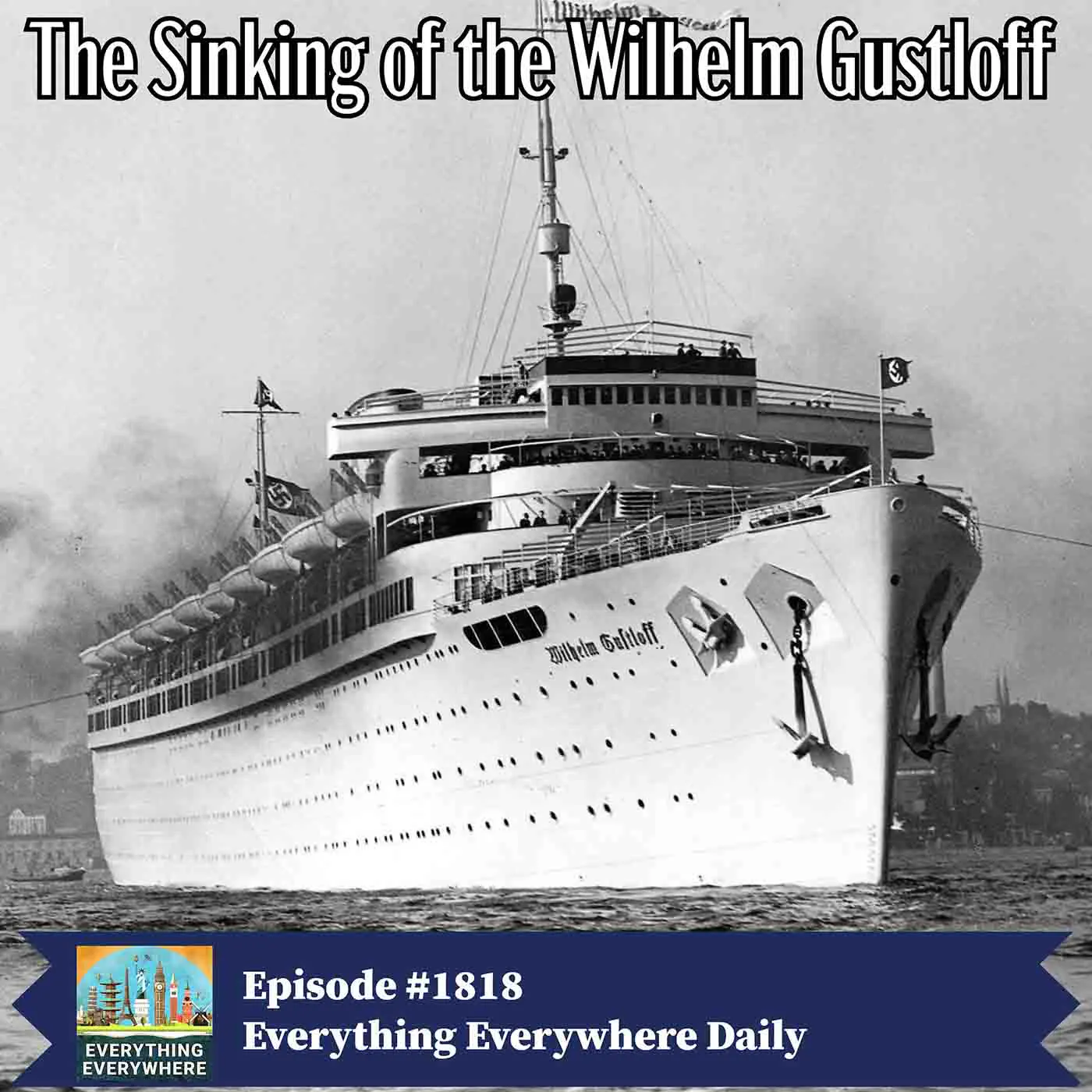
Everything Everywhere Daily: History, Science, Geography & More
The Sinking of the MV Wilhelm Gustloff
00:15:39
Loading summary
Transcript9 lines
- [00:01]
Gary
On the evening of January 30, 1945, the deadliest shipwreck in human history occurred. Most of you might be aware of the sinking of the Titanic or the Lusitania, yet you've probably never heard of the MV Wilhelm Gustloff. With a death toll about six times greater than the Titanic, the Wilhelm Gustav disaster has been all but forgotten today. Why has history forgotten about the world's greatest maritime disaster? Learn more about the sinking of the Wilhelm Gusteloff, why it happened, and why it's been largely forgotten on this episode of Everything Everywhere Daily. This episode is sponsored by Quinn's. It's summertime, and that means it's time to bring out the summer clothes. If you're looking to update your wardrobe this summer, I suggest you check out Quince. Quince has all the things you actually want to wear this summer, like organic cotton silk polos, European linen beach shorts, and comfortable pants that work for everything from hanging out in the backyard to nice dinners. And the best part, everything with Quint's is half the cost of similar brands. By working directly with top artisans and cutting out the middleman, Quintz gives you luxury pieces without the markups. I recently needed a new duvet and I went to Quince and picked up a great one that looked much better than what I had before. And all at a fraction of the price I'd pay elsewhere. Stick to the staples that last with elevated essentials from quince. Go to quince.com daily for free shipping on your order and 365 day returns. That's Q U I-n c-e.com daily to get free shipping and 365 day returns. Quints.com daily hey Kristen, how's it tracking.
- [01:58]
Kristen
With Carvana Value Tracker?
- [02:00]
Gary
What else?
- [02:01]
Kristen
Oh, it's tracking, in fact. Value surge alert trucks up 2.5%, vans.
- [02:07]
Gary
Down 1.7, just as predicted. So we gonna I don't know, could.
- [02:13]
Kristen
Sell, could hold the power to always.
- [02:16]
Gary
Know our car's worth.
- [02:17]
Kristen
Exhilarating, isn't it? Tracking Always know your car's worth with Carvana Value Tracker.
- [02:29]
Gary
To understand why the greatest shipwreck in history has been largely forgotten, it's essential to describe the events that led up to the disaster. The MV Wilhelm Gustloff was a German civilian cruise ship prior to World War II. Designed for and used by the Third Reich, the ship was designed to be a cruise liner built under the Nazi Strength for Joy Leisure program. It was initially supposed to be named the Adolf Hitler, but the name was changed to Honor A lesser known Nazi, Wilhelm Gustav Gustloff, was the leader of the Nazi party. Switzerland branch. Gustloff was assassinated in 1936. Hitler. Wanting to honor the dead, Gustloff changed the name of the ship after his funeral. Measuring 208.5 meters, or 684ft in length and 23.5 meters, or 77ft in width, the ship was designed to accommodate approximately 1900 people. Before World War II, the ship was used for trips across the North Atlantic and around the Mediterranean. The vessel was designed to provide recreational and cultural activities for German civilians, providing entertainment in the form of concerts and cruises for workers and officials. The ship was also a valuable propaganda tool as it sailed across the North Atlantic. It was used to showcase the supposed advantages of Nazism. When World War II began, the ship was converted by the regime to serve as a medical ship and later became a floating barracks. However, in early 1945, the ship took on a new role, which is where this story really starts. On January 23, 1945, the Gustloff was soon repurposed as an evacuation vessel in Operation Hannibal. Operation Hannibal was a massive German naval evacuation conducted in early 1945 to rescue civilians and military personnel from East Prussia, which is today Poland, and other Baltic regions. As the Soviet Red army advanced, it became one of the largest maritime evacuations in history, involving over 1,000 ships and rescuing an estimated 800,000 to a million people. It's often been called the German version of Dunkirk. After the failure of the German invasion of Russia, the Soviets were now advancing at full speed towards Germany. Many refugees were desperate to escape the war on the Eastern Front. As the Red army began to overrun their homes, rumors began to circulate amongst the refugees that the port of Gotenhafen, now known as Gdania, Poland, was evacuating to the west, causing hundreds of thousands of men, women and children to travel to the Prussian coast. The trek for the refugees was brutal. The temperatures were below freezing and they were subject to Soviet air attacks. And when they would arrive at the ports, they would often find a chaotic scene. None of the refugees knew who was in charge and even the Nazi officials would argue amongst themselves over who was in charge of Operation Hannibal. The officials were also fearful about appearing weak, which meant that the evacuation was postponed later than needed. While it's impossible to know whether or not a more timely departure would have prevented the Wilhelm Gustav sinking, this certainly could have been a factor in why the tragedy unfolded. The voyage from Gotenhofen to Kiel was already dangerous, as the Allies had deployed mines in the Baltic Sea along the coastlines. Even though the Wilhelm Gustloff was not a military ship, sailing too close to the shoreline could result in the vessel being destroyed, which forced the ship out into deeper waters in the Baltic. On midday, January 30, 1945, the Wilhelm Gustloff sailed out from the port of Gotenhafen. The ship was filled far beyond its capacity with refugees. The ship set sail with an estimated 10,600 people on board. Of that number, about half were children. The actual number of people aboard the Gustloff is impossible to determine, but the ship's capacity was holding roughly 8,000 people, more than it was ever designed for. Because it was January, the water was freezing cold with lots of snow and wind. These conditions could have worked in the Germans favor as the potential for the Allies to see the ship was lower due to the lack of visibility. And it's for this reason that the Germans decided to set sail straight across the Baltic Sea. However, the ship's captain Friedrich Petersen, was warned of a minesweeper convoy and turned on the ship's navigation lights, completely negating the COVID of winter that they had hoped to have. It's suspected that the message that was sent may have been a misunderstanding or perhaps a deliberate act of sabotage. For further protection, the ship was escorted by a pair of torpedo boats as it set sail back to Germany. One ended up breaking down and the other took a different route, leaving the ship entirely undefended. What the crew of the Gustlov didn't know was that a Soviet submarine, the S13, was following the ship under the waters of the Baltic Sea. After having spotted them sail out of port. Led by Captain Alexander Marinesco, they shadowed the Gusta Law for hours until 9pm now in fairness to Captain Marinesco, the ship did look like a legitimate military target. The paint that had formerly marked it as a non combatant ship had been removed. Additionally, there were troops and anti aircraft guns on the deck, causing Captain Marinesco to perceive it as a military vessel. Marinesco fired four torpedoes at the Gustloff, three striking the ship's side, hitting the ship's bow, stern and midship. The torpedoes fired had Soviet messages for vengeance written on them. The first was for the motherland, the second was for the Soviet people and the third was for Leningrad. The fourth torpedo failed to launch. After the impact, the people on board rushed for the lifeboats. But the ship barely had enough to fit its normal capacity of 1,900 people, let alone the over 10,000 that it was currently carrying. As panic ensued. People were crushed to death as people ran to the lifeboats while others fell into the sea. Compounding the disaster was how the ship sank. The Gustloffs started listing towards its port side, which meant that half the lightboats couldn't be used. As the boat sank, people began to jump into the icy cold water. Those who did not die on impact would quickly freeze to death. The rescue and evacuation efforts were heavily impeded due to the ship's location in the Baltic Sea. There were large amounts of ice making lifeboats essentially useless. Those on the lifeboats almost died due to the freezing temperatures. German rescue boats did arrive shortly after receiving the SOS signal, but the rescuers were also in imminent danger. Soviet submarines were still in the area, making it so the rescue boats would need to be extremely careful in how they came home if they didn't want to meet the same fate. This led to many of the lifeboats containing the Wilhelm Gustlov survivors being left behind. The entire shipwreck took approximately one hour and there was only one survivor of those who were found in the water. Of the approximately 10,600 people aboard the ship, only 1200 survived. The total number of dead can never be known, but it's estimated to be around 9,400. Despite the massive death toll, the tragedy received little attention and there are several reasons why this particular disaster has been overlooked. Historically, World War II was coming to an end and the death toll in Europe was staggering, with new disasters seemingly happening every day. Additionally, it served little purpose for the Soviets or the Germans to admit the loss of so many civilian lives. For the Nazis it would make the regime look weaker and worsen the refugees morale. And for the Soviets it would add to the sheer brutality of the war effort and potentially be negative propaganda. Because of this, initial information was heavily suppressed, especially by the Nazi party. Though reports of the shipwreck did eventually reach Nazi officials. Now you might be thinking that there were over 1,000 survivors, so surely news of the disaster would have come out from them. And you'd be partially right. When survivors reached safety, some did try to talk about the shipwreck, but they were often downplayed or silenced by Nazi authorities. It wasn't until weeks after the shipwreck that much of the world learned of what happened. Much of the information that went out was limited, with many countries only receiving wire stories about the disaster. Most of what the world heard was through Finnish radio broadcasting and even then it was barely mentioned. It's likely that even if the Allies had learned of the disaster earlier, there wouldn't have been much sympathy. As the war was viewed in very black and white terms, any sympathy for the Germans would be viewed as sympathy towards the enemy. And for many it was perceived as a military victory. Despite the overwhelmingly majority of victims being civilians and a large number of them being children, this state of affairs persisted long after the war had ended. There was a lot of hesitancy in discussing any tragedy that the German people faced, namely due to having started the war and the number of war crimes that the Nazis committed. According to Eduard Petrushkevich, the curator at the Wilhelm Gustlov Museum, the Gustloff was just another casualty of war. Alongside the countless other large ships sunk on the German side, the Germans were viewed as the aggressor, and anything that fell into the idea of German victimhood really couldn't be mentioned until decades after the war. Even within Germany, it became distasteful to claim victimhood. So the general population largely forgot about the disaster. And this is very similar to the millions of Germans who died at the end of the war, which I covered in a previous episode. The Wilhelm Gustloff was not the only German evacuation ship to be sunk by the Russians. Two others, the Stubin and the Goya, were also torpedoed by the Soviets and also forgotten. The death toll of the two ships was also massive, with an estimated combined 11,000 casualties. There's been a shift that has made it more socially acceptable to now talk about this tragedy. A survivor by the name of Heinz Schon can be credited with most of this shift. Just 18 years old when the ship sank, he spent the vast majority of his life compiling witness accounts of the shipwreck and collecting as much information as possible about. Wasn't until about 20 years ago that modern historians began to openly discuss the Wilhelm Gustav disaster. With this shift, Germans were allowed to discuss their own victimhood, admittedly within specific circumstances, allowing for more information and discussion on the Wilhelm Gustelauf to be explored. The sinking of the Wilhelm Gustloff is an important example of how framing influences history. We hear about tragedies like the Titanic and Lusitania quite often. Yet history's deadliest maritime disaster is today essentially unknown. And it shows the impact that perspective and propaganda can have on collective memory. After more than 80 years have passed, historians and the public can now take a more nuanced and objective look at this horrific maritime disaster. Yes, the Germans were the aggressors in the war, but the thousands of children who died played no part in the horrors of that war. Given the improved safety standards aboard ships today, it's likely that the MV Wilhelm Gustloff might hold the distinction of being the world's worst ship disaster for a very long time. The executive producer of Everything Everywhere Daily is Charles Daniel. The associate producers are Austin Okun and Cameron Kiefer. Research and writing for this episode was provided by Olivia Ashe. Today's review comes from listener Dayak Davik over on Apple Podcasts in the United States. They write Greatest podcast I've ever heard. This is an absolute masterpiece. Gary has created his own type of podcast, a daily short overview of a completely random topic. You never know what you'll be learning about today. It could be geography, history, science, math, tech, or any topic you can think of. I have severe ADHD but can listen to these without getting bored. But please stop pronouncing Rio Grand. It's pronounced Rio Grande. Well, thanks Dyaktovic. That is the Spanish pronunciation. I am speaking English. Hence I say Texas, not Tejas. I say Paris, not Paree. Rio Grande is a very common English pronunciation of the river and what most English speakers are probably familiar with. Watch any Western film and it will be referred to as the Rio Grande. The capital of Mexico in Spanish is Ciudad de Mexico, but in English we say Mexico City. Likewise, Spanish speakers refer to New York City as Ciudad de Nueva York. So I don't have a problem with Rio Grande. Different languages have different pronunciations of different terms and in this case Rio Grande has become Rio Grande. Remember, if you leave a review or send me a boostagram, you too can have it right on the show.