Loading summary
Transcript1 lines
- [00:00]
A
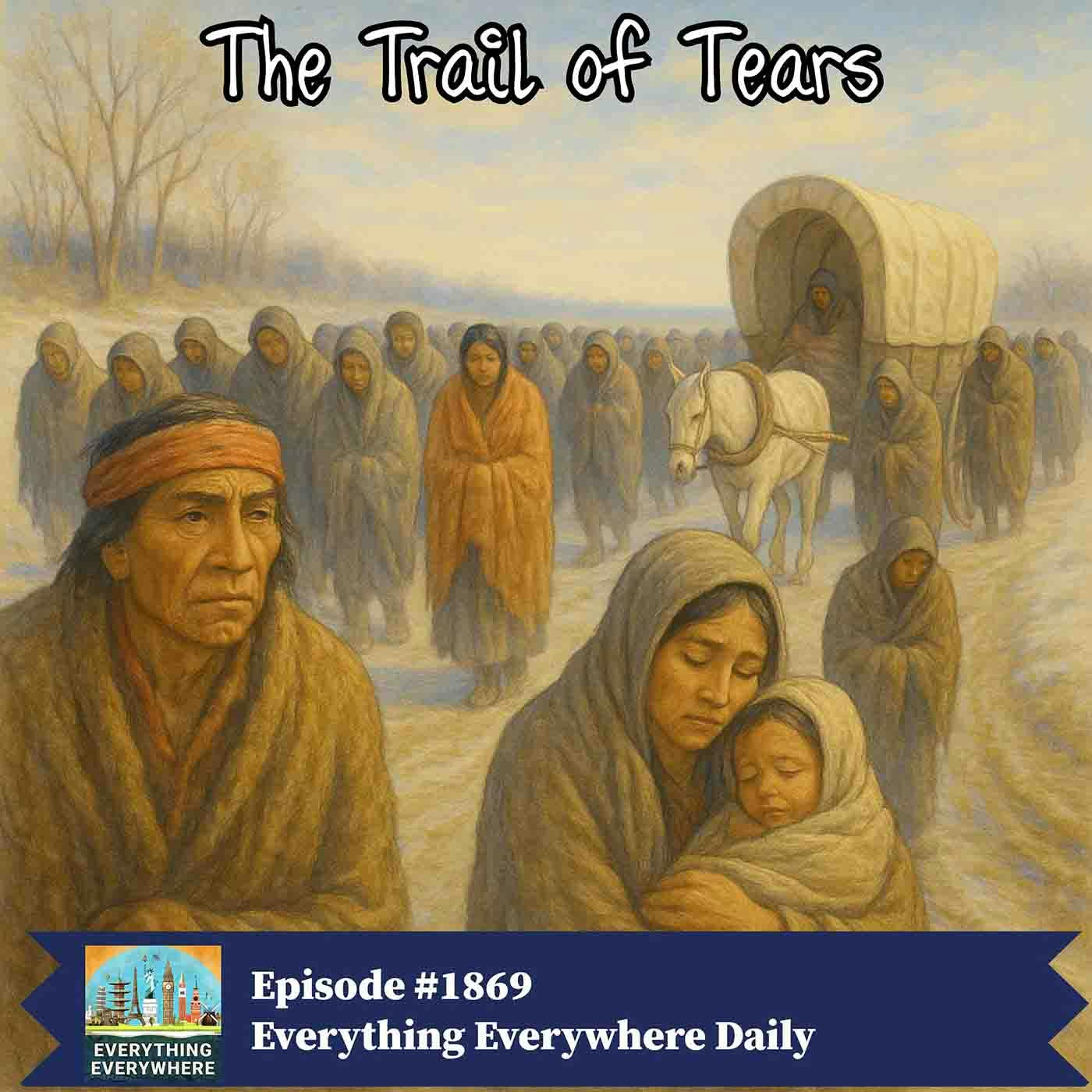
Between 1830 and 1850, the United States forcibly displaced 60,000 Native Americans living in the southern United States under the Indian Removal Act. While being moved, thousands would die due to starvation, disease and exposure. Its impact has led some scholars to classify the event as a genocide, but regardless of how it's classified, it remains one of the greatest tragedies in American history. Learn more about the Trail of Tears, why it happened, and why it was so deadly on this episode of Everything Everywhere Daily. This episode is sponsored by Fiji Water. You've probably heard of Fiji Water and have seen it in stores. Well, Fiji Water really is from the islands of Fiji. Drop by drop, Fiji Water is filtered through volcanic rock 1,600 miles away from the nearest continent and all its pollution protected and preserved naturally from external elements. In this process, it collects a unique profile of electrolytes and minerals, resulting in more than double the electrolytes as the other top two premium bottled water brands, giving Fiji Water its smooth taste. Fiji Water's electrolytes are 100% natural and this water even has a perfectly balanced pH of 7.7. I've recently been trying to reduce my consumption of diet soda and I've found Fiji Water to be a great alternative. Visit your local retailer to pick up some Fiji Water today for your next backyard party, beach day hike, or even your home office. Fiji Water is Earth's finest water. This episode is sponsored by Newspapers.com Break Down Genealogy brick walls with a subscription to the largest online newspaper archive. Did you know that newspapers.com has over a billion pages of digitized newspapers going back to the year 1690? Their growing collection includes papers from the United States, United Kingdom, Canada, Australia and more. Discover birth and marriage announcements, obituaries, and everyday stories about your ancestors. In seconds, Newspapers.com can help you fill in the gaps between vital records and reveal details about your ancestors lives that you can't find anywhere else. Their easy to use search feature will let you filter your results by date, location, specific paper and more. When you find something interesting, newspapers.com makes it a snap to share it with your family and friends and you can even save it directly to your ancestry Tree. Come explore one billion pages and make infinite discoveries. Today on Newspapers.com use promo code Everything Everywhere for a 20% discount on your subscription. The event known as the Trail of Tears was one of the largest, but certainly not last, mass forcible removals of native peoples in North America. In the United States in the early 1830s, there was a group of Native American nations referred to as the Five Civilized Tribes they were the Cherokee, Choctaw, Seminole, Muscogee, Creek and Chickasaw, all of which lived in what is today America's Deep South. Ever since European settlement began in the Americas, there had been pressure to remove Native American tribes from areas settled by Europeans, specifically in the Southeast. And we can trace some of this back to the British Proclamation of 1763. This proclamation stated that the region between the Appalachian Mountains and the Mississippi river would remain Native American territory before and especially after the American Revolution. This treaty was ignored as white Americans began to settle the region. This was accelerated in 1829 when gold was discovered in Georgia on Cherokee land. The mines within Georgia were producing over 300 ounces of gold per day at their peak. Settlers who had already been pushing for indigenous resettlement now began to campaign even harder for removal. Two of the most notable advocates for relocation were Congressman Davy Crockett of Tennessee and President Andrew Jackson. With a push by settlers, land speculators, members of Congress and President Jackson, the Indian Removal act was passed in 1830. This act was the first major case of the United States officially violating Native Americans legal and political rights as government policy. The Indian Removal act allowed President Jackson to nullify Native American land claims in the region and to remove them from the territory. In some cases there would be compensation or aid provided for transportation, but for all intents and purposes, it was a forced removal. The initial reaction by the five nations differed and most approached the circumstances by negotiating for reimbursement and protection of their assets. The first nation to be relocated was the Choctaw. The Choctaw were located within parts of Alabama, Mississippi and Louisiana and for years had their land chipped away under multiple treaties. They had finalized their negotiations with the government and had agreed to give the government their land if they were given logistical support by the government to transport themselves and their belongings. They also requested a few of the Choctaw be allowed to stay in the territory. Jackson and the government were surprised by the cooperation of the Choctaw and began moving forward with the removal. The plan was that they would be moved over three different phases. However, things did not go according to plan. Though the government had agreed to provide aid, it had absolutely no experience in moving large numbers of people, not to mention that they had to transport livestock, household items and farming equipment. Due to ill prepared bureaucratic ineptitude, this first journey saw massive numbers of Choctaw deaths. The first group was subject to flooding, famine and and a harsh winter. Of the 17,000 people forcibly relocated into Indian Territory of what is today Oklahoma, somewhere between 2,000, 500 and 6,000 of them died. Of those who remained on their land in Mississippi, they faced harassment, intimidation, and legal conflicts. 1832 saw the removal of the Chickasaw and the Muscogee. The Chickasaw held land located within what is today Alabama, Mississippi, Tennessee, and Kentucky. They were hesitant to trust the federal government's assurances that they would be reimbursed for their property. As such, many of the Chickasaw sold their land holdings to finance their own transportation. Initially, the Chickasaw attempted to buy the Choctaw land inside the Indian Territory in Oklahoma. The debate between the Chickasaw and the Choctaw lasted for five years, with the Jackson administration struggling to mediate the negotiations. Eventually, a deal was achieved with the Choctaw leasing the territory from the Chickasaw. Another part of the agreement was that the Chickasaw would have representation on the Choctaw councils. Many of the moves made by the Chickasaw resulted in significantly fewer losses than those of the Choctaw. They kept most of their money, and most of them survived the relocation. However, they ended up losing their national identity and faced new external threats. After the move, many of the Chickasaw were forced to relocate to towns and were stuck in temporary camps. They ended up becoming reliant on government supply drops, and their leadership fell apart. 1832 was also the start of relocation for the Muscogee, who are also sometimes known as the Creek or the Muscogee Creek. The Muscogee lived in Tennessee, Alabama, Georgia, and Florida, and they had been having issues with the United States government for years. Though the Muskogee had been friendly, making deals to maintain a peaceful relationship, they were mostly met with hostility. One issue was ignoring previous treaties that had maintained Native American sovereignty. These issues became so severe that the Muscogee leadership made it illegal for them to cede any more land, and to do so would be a capital offense. This tribal law was changed in 1825 when the Muscogee gave up the vast majority of their remaining land in Georgia. By the 1830s, the majority of the Muskogee population was now living in Alabama, and the Alabama state government sought to control Muskogee land. The Muskogee reached out to the Jackson administration and were ignored. The Muskogee land was then divided into allotments that were owned by individual members of the tribe. However, they were then given an ultimatum to either sell this land and move to the Indian Territory or they would be forced to follow Alabama state laws. The deals that were made were highly fraudulent, with many of the allotments simply being settled by white people with little to no punishment. This, unsurprisingly, led to conflict with the Muscogee raiding farms and committing violence in what became known as the Creek War of 1836. The war ended quickly and the Muskogee were forced to move to the Indian territory. 15,000 Muscogee were forced to relocate with approximately 3,500 of them died dying on the voyage there. The fourth tribe to be relocated were the Seminoles. The Seminoles were located entirely within the State of Florida which was Spanish territory until the United States acquired it in 1821. After acquiring the land, the United States and the Seminole began to make treaties when the Indian Removal act was passed. The previous Seminole treaty with the government stipulated that the Seminoles would agree to be relocated to the west if the land was suitable. The plan was that they would be relocated to the Muscogee Nation within the Indian Territory. Due to their past connections, the Seminole used to be part of the Muscogee. However, this relationship had become severely strained due to the Seminoles being viewed by the Muscogee as deserters. Many of the Seminole were worried about rejoining the Muscogee Nation because they would likely be met with extreme hostility. When the Seminoles studied the land of the Indian Territory and talked with Muscogee leaders, they deemed the move acceptable and signed a statement saying that they were willing to relocate. However, when the leadership returned to their homes in Florida they claimed that they were forced into signing the statement and renounced it. As some of the Seminoles began to be relocated, others resisted. A group of Seminoles and Black Seminoles who were the descendants of Seminoles and freed African slaves would ambush and kill 110 soldiers who were marching near their territory in what became known as the Dade Massacre. Florida, understanding that Seminoles would be resisting relocation, began to prepare for war which ended up lasting for a decade. During the war, the Seminoles would capture, supply trains and often destroy plantations. The resistance cost the US government approximately $20 million, which is equivalent to over $650 million today. The war ended with most of the Seminole being exiled to Muskegoe lands in the Indian Territory with a small group remaining in the Everglades. In the end, the Seminole resistance was actually one of the most successful ones in American history. Though there were only about 500 Seminoles left in Florida after the Seminole wars, the survivors became the only recognized tribe that never relinquished their sovereignty or signed a peace treaty with the United States government. The final tribe is the Cherokee, who are perhaps the best known victims of the Trail of Tears. The Cherokee were located in Georgia, Tennessee, North Carolina and Alabama. They resisted the Indian Removal act through legal action. The two best known cases were the Cherokee Nation v. Georgia in 1831 and Worcester v. Georgia in 1832. These cases claimed that the United States and Georgia were violating previously ratified treaties. In Cherokee Nation v. Georgia, the Supreme Court ruled that the Cherokee Nation was not a foreign state, but rather domestic and dependent on the US Government. This case didn't determine if Georgia's relocation policies were lawful but instead defined the legal status of Native Americans. In Worcester v. Georgia, the Supreme Court decided that Georgia was breaking the law and that moving into Cherokee land was unconstitutional. With that decision, many of the Cherokee felt that their legal rights and the Supreme Court ruling would be respected. And that was not the case. Andrew Jackson famously said, john Marshall has made his decision. Let him enforce it now if he can. By 1835, a minority of the Cherokee believed it was worthless to fight the government and opted to sign the Treaty of New Echota. This treaty was signed by none of the elected officials of the Cherokee Nation, yet it claimed to cede all Cherokee territory. The vast majority of the Cherokee protested the agreement. About 15,000 Cherokee were against the treaty versus just three to 500 people who were for it. But it was nonetheless ratified by the U.S. senate. In 1838, the Cherokee were forced from their homes by the U.S. military. Typically, they were awoken at gunpoint and brought to internment camps. From there, they were held anywhere from a few days to a few weeks before being forced on the grueling trip to the Indian Territory. While waiting at the camps, many of them fell ill, similar to the Choctaw. The plan was to move them in three different groups. The first group traveled overland and faced horrible conditions of drought and disease. To prevent further deaths, the Cherokee asked for the next relocation to be postponed until the fall, which was granted. The second group consisted of 12,000 Cherokee and they would also be relocated overland. This March was roughly 1,000 miles and was brutal. Those on the march were not in proper clothing and many did not even have shoes. Many of the Cherokee fell ill or were forced to march longer distances to avoid spreading diseases in towns. When crossing the Ohio river, the Cherokee were charged for ferrying across the river. They were charged $1 per person versus the normal $0.12, which was an enormous amount of money at that time. Many of them died while waiting for the ferry and the local population murdered others. As the Cherokee crossed into Illinois, the winter temperatures were brutal with soldiers writing that it was the coldest winter they had ever experienced. As the trek continued, the conditions continued to expose them to starvation and illness. Thousands of Cherokee died. The final group went over water, which also faced terrible conditions on the boats, with disease running rampant. The remaining Cherokee were eventually settled in the Indian Territory, but the impact of the relocation was brutal. The Cherokee dubbed the journey the Trail of Tears due to the large number of lives that were lost on the Track. Of the 16,000 Cherokee that were forcibly relocated, an estimated 4,000 died. The total number of deaths between the five nations is estimated to be somewhere between 13 and 17,000 people. The trail of Tears saw a blatant rejection of the United States Supreme Court, multiple violations of Native American sovereignty, and also overturning previously signed treaties. These actions led to the deaths of over 10,000 people, creating one of the darkest chapters in American history. The executive producer of Everything Everywhere Daily is Charles Daniel. The associate producers are Austin Otkin and Cameron Kiefer. Research and writing for this episode was provided by Olivia Ashe. Today's review comes from listener BKIT 1805 over on podcast Addiction. They write, this is one of my favorite podcasts. If you love finding out about the world, you will love this. Every day you get a new shot of knowledge about any topic you could imagine, and many you probably can't get into it. Well, thanks bkit. Your review is a good reminder that you can leave reviews on apps other than Apple and Spotify, and that this podcast can be listened to on a wide variety of independent podcast players. And as always, if you leave a review on any major podcast, Apple, Facebook or Discord, you too can have it right on the show.