← Everything Everywhere Daily: History, Science, Geography & More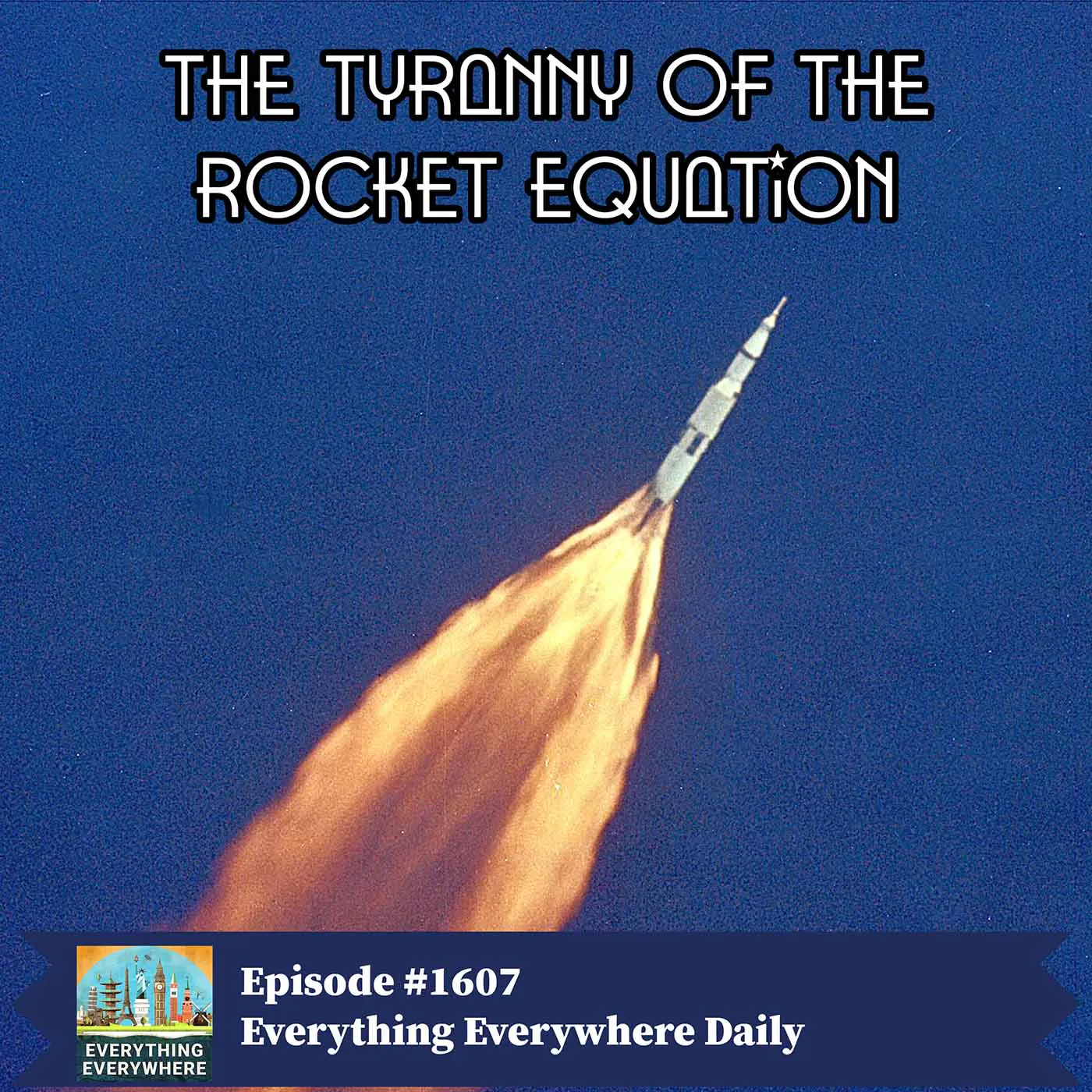
Everything Everywhere Daily: History, Science, Geography & More
The Tyranny of the Rocket Equation (Encore)
00:14:15
Learn why rocket science is hard
Loading summary
Transcript154 lines
- [00:01]
Host
The following is an encore presentation of Everything everywhere daily. In 1897, the visionary Russian rocket scientist.
- [00:11]
Co-Host
Konstantin Tsiolkovsky discovered an equation that governed how rockets worked. His equation, which was independently discovered by.
- [00:18]
Host
Several other rocket scientists, immutably governs how we can send rockets into space.
- [00:24]
Co-Host
The variables in his equation have determined.
- [00:26]
Host
Everything surrounding spaceflight and rocketry since its.
- [00:29]
Co-Host
Inception and will for the foreseeable future. Learn more about the tyranny of the.
- [00:34]
Host
Rocket equation on this episode of Everything Everywhere Daily.
- [00:51]
Advertiser
Imagine a world class graduate education that's accessible, flexible and designed for career impact. That's Harvard Extension School. Build actionable knowledge and skills in challenging online classes taught by Harvard faculty and industry experts. Explore new opportunities and expand your network with high achieving professionals from around the world. Part time learning real world impact. This is Harvard on your terms. Learn more at extension harvard.edu Spotify.
- [01:22]
Where.
- [01:22]
To Eat a tea? You're listening to an app at PC Game Pass. Want new games on day one? Like Indiana Jones and the Great Circle? How about living out your SIMS Life with EA Play? We talking high quality PC games all for one low monthly price? We got you. Learn more at Xbox.com PCGame Pass or click the banner Indiana Jones and the Great Circle. Available December 9, 2024. Game catalog varies by region and over time okay, that's the ad. You can go back to doing whatever you were doing now.
- [01:54]
Host
Rockets have been around in some form for centuries. If you remember back to my episode.
- [01:58]
Co-Host
On Gunpowder, the Chinese were using rockets.
- [02:00]
Host
And warfare and for fireworks for about a thousand years.
- [02:03]
Co-Host
While rockets were a known thing, they.
- [02:05]
Host
Left scientists baffled as to how they worked.
- [02:08]
Co-Host
They weren't being pushed like a sailboat, and they weren't using friction with the.
- [02:11]
Host
Ground like walking or a horse pulling a wagon.
- [02:14]
Co-Host
The late 19th and early 20th centuries saw several people around the world independently tackle the problem. The first person recognized to have solved the physics behind rockets and therefore would get credit as the first rocket scientist, is Konstantin Tsiolkovsky.
- [02:30]
Host
Tsiolkovsky realized that rockets worked because Newton's.
- [02:33]
Co-Host
Third law stipulated that for every action there is an equal and opposite reaction.
- [02:38]
Host
Rockets moved forward because they were expelling.
- [02:41]
Co-Host
Something else from behind. The principle by which rockets moved was.
- [02:45]
Host
Demonstrated by Tsiolkovsky with a simple thought experiment.
- [02:48]
Co-Host
Suppose that you were in a boat in the middle of a pond. The boat had no sail or no oars to paddle. You were basically stuck in the middle.
- [02:55]
Host
Of a pond with no way to move.
- [02:57]
Co-Host
However, on the boat you did have.
- [02:59]
Host
A pile of heavy rocks.
- [03:01]
Co-Host
You could get yourself to shore by throwing the Rocks off the back of.
- [03:05]
Host
The boat, not dropping them into the water, but throwing them horizontally.
- [03:09]
Co-Host
This would give the boat momentum, which in theory, could get your boat to the shore. This is the same principle behind a rocket. Instead of rocks, however, you are expelling molecules of gas at very high speeds. Tsiolkovsky created an equation that explained everything, which is today known as the Tsiolkovsky equation, or more generally as the rocket equation. Without getting into the math too much, the equation is as DeltaV, or the.
- [03:39]
Host
Change in the rocket speed equals the.
- [03:42]
Co-Host
Exhaust velocity of the rocket engines times the natural logarithm of the final mass.
- [03:47]
Host
Of the rocket over the initial mass of the rocket.
- [03:50]
Co-Host
Tsiolkovsky recorded the date of his discovery of the equation as May 10, 1897. Other people, such as the English mathematician.
- [03:58]
Host
William Moore, the American rocket pioneer Robert Goddard, and the German physicist Hermann Oberth, independently discovered the rocket equation as well.
- [04:06]
Co-Host
And just as an aside, Konstantin Tsiolkovsky, the man who helped usher in the.
- [04:12]
Host
Modern world of spaceflight, lived for most of his life in a log cabin.
- [04:17]
Co-Host
Now, you might look at the equation and not think much of it, but it has several profound implications, implications that.
- [04:24]
Host
Govern everything to do with rockets and spaceflight.
- [04:27]
Co-Host
One has to do with mass.
- [04:30]
Host
Suppose you wanted to put a 100.
- [04:31]
Co-Host
Kilogram object into orbit. You would need a certain amount of.
- [04:35]
Host
Fuel to do this.
- [04:36]
Co-Host
However, the fuel you use also has mass. And that mass would need fuel to launch it, and that fuel would need fuel to launch it, and so on and so on. The amount of fuel isn't infinite, but it does mean that you need an enormous amount of fuel to launch something even quite small, because you're launching the fuel as well as the payload. And that's why rockets are so big.
- [05:00]
Host
And why there are no small rockets.
- [05:02]
Co-Host
There are no shoulder mounted or backyard.
- [05:04]
Host
Rockets that could conceivably fly into orbit.
- [05:08]
Co-Host
Moreover, the more mass you try to fly into space increases the size of a rocket exponentially. The Apollo program launched something smaller than.
- [05:17]
Host
The size of a truck trailer into space, but required a rocket, the Saturn.
- [05:21]
Co-Host
Vastly larger than one just carrying a small space capsule. So long as we're using chemical reactions, the exponential growth in the amount of fuel needed means that there is a limit to how large of something we can launch into orbit using conventional rockets.
- [05:36]
Host
You couldn't, for all practical purposes, launch.
- [05:39]
Co-Host
Something as large as a cruise ship.
- [05:41]
Host
Into orbit all at once.
- [05:43]
Co-Host
Another implication is the amount of fuel.
- [05:45]
Host
That is part of any rocket.
- [05:47]
Co-Host
Rockets are almost all fuel.
- [05:49]
Host
It is common for the mass of.
- [05:51]
Co-Host
A rocket sitting on a Launch pad to consist of 85 to 95% fuel. The actual amount of payload for a.
- [05:58]
Host
Rocket is usually around 2 to 4%.
- [06:01]
Co-Host
To put this into perspective, the mass of a large cargo ship may only be 3% fuel, and your car is.
- [06:08]
Host
Around 4 to 5% fuel.
- [06:10]
Co-Host
A freight locomotive may be 11%. And a commercial airliner might be as high as 35%. A rocket is not dissimilar to a can of soda. An aluminum can of soda is about 94% soda and 6% can. The external fuel tank on the space shuttle was 96% fuel, making it even more efficient than a soda can.
- [06:31]
Host
So to use the soda can model, all of the soda is rocket fuel.
- [06:36]
Co-Host
And the can is the apparatus of.
- [06:38]
Host
The rocket, which is all necessary to put the pull tab into orbit.
- [06:43]
Co-Host
This is why engineers have to worry so much about mass and efficiency when.
- [06:47]
Host
Designing anything that's going into space.
- [06:49]
Co-Host
Every kilogram has to be accounted for because it results in significantly more rocket fuel.
- [06:55]
Host
And it's also why rockets are built in stages.
- [06:58]
Co-Host
You want to shed as much mass.
- [06:59]
Host
As you can in order to increase your velocity.
- [07:02]
Co-Host
Getting rid of the lower stages of a rocket, when they aren't needed anymore, will help increase velocity. This is just dealing with the mass.
- [07:10]
Host
Part of the equation. The other parts of the equation have limits as well.
- [07:14]
Co-Host
In terms of the exhaust velocity of.
- [07:16]
Host
The rocket, there are several different rocket fuels that can be used.
- [07:20]
Co-Host
Solid rocket fuel can have an exhaust.
- [07:21]
Host
Velocity of 3 kilometers per second, and a methane oxygen rocket can have an exhaust velocity of 4.5 kilometers per second.
- [07:29]
Co-Host
All other rocket fuels are pretty much.
- [07:31]
Host
Somewhere between those values.
- [07:34]
Co-Host
So long as we're using rockets that are providing thrust from a chemical reaction, there's a limit to just how much.
- [07:40]
Host
Exhaust velocity there can be.
- [07:42]
Co-Host
You can't arbitrarily make it any larger.
- [07:45]
Host
The final variable is Delta V. Delta V is one of the biggest factors in any orbital flight. And as far as launching from the ground is concerned, the initial point of DeltaV is 0.
- [07:55]
Co-Host
In the case of launching something into space, it is indicative just how much.
- [07:59]
Host
Velocity you need to get anywhere. Just to use approximate numbers, something has.
- [08:04]
Co-Host
To go about 8km per second to get into low Earth orbit, which is only about 250 miles or 400 kilometers away.
- [08:12]
Host
If you remember back to my episode.
- [08:13]
Co-Host
On how satellites work, getting into orbit is more about speed than it is about altitude.
- [08:19]
Host
We have to go that high to avoid atmospheric drag.
- [08:22]
Co-Host
Without drag, you could orbit as high.
- [08:24]
Host
As 1 meter off the surface.
- [08:26]
Co-Host
Once you get into the Earth's Orbit, the hard part is done from there. The extra velocity needed to get to the Moon is only an additional 6 kilometers per second, and to Mars, an additional 8. This is why there has been talk of building a base on the Moon. The velocity necessary to escape the gravity of the Moon is much less than.
- [08:43]
Host
That to escape the Earth.
- [08:45]
Co-Host
If you want to explore the rest.
- [08:46]
Host
Of the solar system, it's much easier.
- [08:48]
Co-Host
To do from the Moon than it.
- [08:50]
Host
Is from the Earth.
- [08:51]
Co-Host
From an energy standpoint, the biggest leap in spaceflight wasn't landing on the Moon.
- [08:55]
Host
It was just getting into orbit in the first place.
- [08:59]
Co-Host
All of these constraints I've mentioned have led to engineers and physicists to coin.
- [09:03]
Host
The term the tyranny of the rocket equation. The rocket equation rules everything when it comes to spaceflight. The design of rockets, spacecraft, satellites, and.
- [09:12]
Co-Host
Everything else has to take the rocket equation into consideration. Even something novel like Starship by SpaceX.
- [09:19]
Host
On which I did a previous episode.
- [09:21]
Co-Host
And which just had its first test.
- [09:23]
Host
Launch, is subject to the rocket equation.
- [09:26]
Co-Host
Starship is more focused on reducing costs, but still doing so within the confines.
- [09:30]
Host
Of the rocket equation. If the rocket equation has a tyrannical hold on travel by rockets, is there any way to break this tyranny? And the answer is sort of you can't break the laws of physics, but you can break the constraints around how rockets function today.
- [09:48]
Co-Host
The first way would be to get.
- [09:49]
Host
Rid of chemical reactions to provide thrust.
- [09:52]
Co-Host
Chemical reactions have a maximum exhaust velocity.
- [09:55]
Host
Of about 4.5 km per second, which is close to what some rockets are doing already.
- [10:01]
Co-Host
A far more efficient rocket would be.
- [10:03]
Host
A nuclear thermal rocket.
- [10:05]
Co-Host
Uranium has an energy density a million.
- [10:08]
Host
Times greater than hydrogen.
- [10:09]
Co-Host
A nuclear rocket would work by exposing.
- [10:12]
Host
Gas, most probably hydrogen, to an extremely hot nuclear reactor.
- [10:17]
Co-Host
If the gas were heated to about.
- [10:18]
Host
3,000 degrees Kelvin, it could have an exhaust velocity of 10 kilometers per second, more than twice that of a chemical reaction.
- [10:27]
Co-Host
However, that's just the beginning. The theoretical maximum exhaust velocity for a.
- [10:32]
Host
Nuclear thermal reactor is 5,000 kilometers per second.
- [10:37]
Co-Host
The mere doubling of the exhaust velocity from a nuclear rocket would change everything, turning the fuel to mass ratio from.
- [10:44]
Host
Something like a soda can to something perhaps more like an airliner.
- [10:48]
Co-Host
NASA is already investigating nuclear rockets for.
- [10:51]
Host
Use outside of the Earth's orbit. The other way around the rocket equation.
- [10:55]
Co-Host
Is to cheat on the delta V. Earlier I said that going into orbit.
- [10:59]
Host
Was an issue of speed, not altitude. And this is true mostly.
- [11:05]
Co-Host
The higher the orbit, the longer it.
- [11:07]
Host
Takes to go around the Earth.
- [11:08]
Co-Host
In low Earth orbit, it takes about 90 minutes. However, if you keep going up, you.
- [11:13]
Host
Will eventually reach a point where it.
- [11:14]
Co-Host
Takes one day to go around the.
- [11:16]
Host
Earth exactly the same as the Earth's rotation. This is known as geostationary orbit, a subject on which I've done a previous episode.
- [11:25]
Co-Host
If you can get 22,236 miles or 35,786 kilometers above the surface of the.
- [11:32]
Host
Earth, then you are traveling at orbital speeds.
- [11:36]
Co-Host
Even though you just went straight up, it wouldn't even matter how long it took you to get to that altitude. The idea proposed to do this would.
- [11:45]
Host
Be a space elevator.
- [11:46]
Co-Host
A space elevator would be a long.
- [11:48]
Host
Cable which extended from geostationary orbit down to the surface of the Earth.
- [11:53]
Co-Host
A vehicle would then just need to climb the cable, which could be done.
- [11:57]
Host
With significantly less energy than with a rocket.
- [12:00]
Co-Host
A final way around the equation would.
- [12:02]
Host
Just be the discovery of some form of physics that we currently don't know. If we learned of some way to nullify the effects of gravity, we could make the rocket equation moot. But as of now, that is only the realm of science fiction.
- [12:14]
Co-Host
Understanding the rocket equation isn't rocket science.
- [12:17]
Host
Well, ok, actually, I guess in this case it technically is rocket science, but.
- [12:21]
Co-Host
It isn't difficult to grasp.
- [12:23]
Host
The next time you watch a rocket.
- [12:25]
Co-Host
Blast off into space, keep in mind.
- [12:27]
Host
The rules that govern that rocket.
- [12:29]
Co-Host
It was engineered to perform within the laws of physics, which were outlined in the late 19th century by a Russian who lived in a log cabin. The executive producer of Everything Everywhere Daily is Charles Daniel. The associate producers are Benji Long and Cameron Keever. I want to give a big shout out to everyone who supports the show over on Patreon, including the show's producers. Your support helps me put out a show every single day and also Patreon is currently the only place where Everything Everywhere Daily merchandise is available to the.
- [13:01]
Host
Top tier of supporters.
- [13:03]
Co-Host
If you'd like to talk to other.
- [13:04]
Host
Listeners of the show and members of.
- [13:06]
Co-Host
The Completionist Club, you can join the Everything Everywhere Daily Facebook group or Discord server. Links to Everything are in the show Notes.