Loading summary
Transcript1 lines
- [00:00]
A
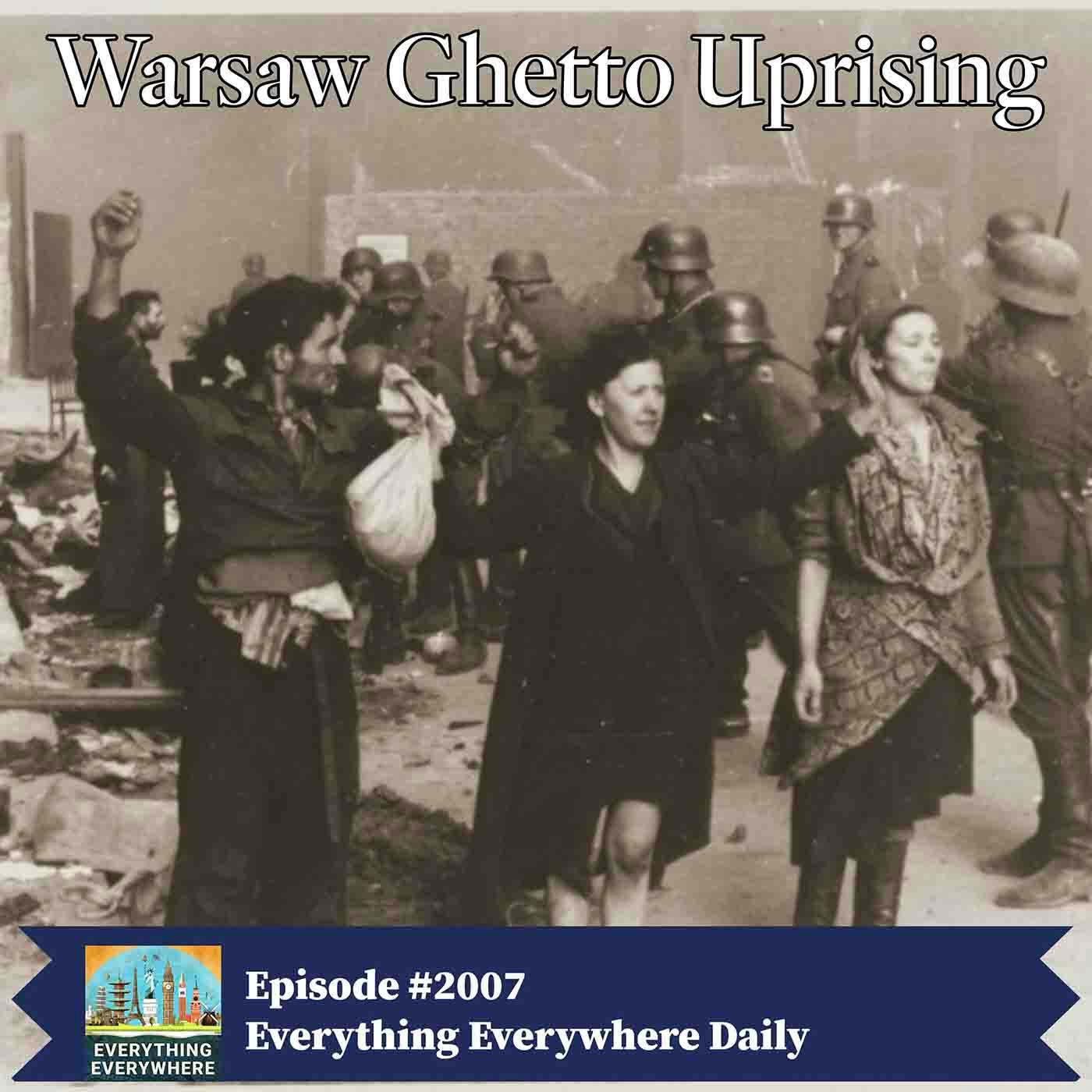
In 1943, one of the most notable acts of Jewish resistance during World War II took place. For nearly one month, residents of the Warsaw Ghetto fought against Nazi soldiers who were attempting to transport the residents to concentration camps. The Warsaw Ghetto Uprising, the largest single Jewish revolt during the war, was well organized, hard fought, and became a symbol of Jewish resistance. Learn more about the Warsaw Ghetto Uprising and how it happened on this episode of Everything Everywhere Daily. This episode is sponsored by Mint Mobile. Now that the holidays are over, you might be feeling like you got a big spending hangover. The drinks, the holiday food, the gifts, it all adds up. Luckily, Mint Mobile is here to help you cut back on wireless spending this January, with 50% off Unlimited Premium Wireless, you can get 3, 6 or 12 months of Unlimited Premium Wireless for just $15 a month. All plans come with high speed data and unlimited talk and text delivered on the nation's largest 5G network. That's why I recommend Mint Mobile. You can get the same mobile experience you have now, but for less money. This January, quit overspending on Wireless with 50% off unlimited premium wireless plans start at $15 a month and at mintmobile.comeed that's mintmobile.comeed limited time offer upfront payment of $45 for three month, $90 for six month or $180 for 12 month plan required $15 a month equivalent taxes and fees Extra initial plan term only greater than 50 gigabytes may slow when network is busy capable device required availability, speed and coverage varies. See mintmobile.com this episode is sponsored by Quince. A new year is upon us, and that means new resolutions, new goals, and maybe a new wardrobe. If you're craving a winter reset, start with pieces truly made to last season after season. Quince brings together premium materials, thoughtful design and enduring quality so you stay warm, look sharp and feel your best all season long. One of the sweaters I recently got from Quince is something that I have been wearing almost every single day and I love it. By partnering directly with ethical factories and top artisans, Quints cuts out the middleman to deliver premium quality at half the cost of similar brands and often even bigger discounts. Moreover, those competitor prices are often listed right on the Quince website. Refresh your winter wardrobe with quince. Go to quince.com daily for free shipping on your order and 365 day returns. Now available in Canada too. That's Q U-N-E.com daily free shipping and 365 day returns. Quince.com daily. Before the start of World War II. Poland was a newly independent, diverse state known as the Second Polish Republic. The country was reformed in 1918 during the interwar period, combining areas previously under Russian, German and Austro Hungarian control. This change was required by the Treaty of Versailles. After World War I, 1/3 of the residents of the new Polish Republic identified as Jewish, German, Ukrainian, Belarussian or Lithuanian minorities in Poland were alienated. Ethnic tensions were high, Germans were considered disloyal, Ukrainians resented Polonization and Jews faced anti Semitism. Poland had a population of 35 million people and a very weak industrial base. This weakness worried many Polish leaders because the nation was sandwiched between the Soviet Union and Nazi Germany, both of whom were aggressive foreign powers. These fears were realized when Germany invaded Poland on September 1, 1939, followed by the Soviet Union on September 17. These combined forces quickly defeated Poland in just 35 days, splitting the country. Germany controlled the west, including Warsaw, and the Soviets held the east until 1941 and the start of Operation Barbarossa. As covered in a previous episode, the Nazi invasion of Poland was motivated by the policy of Lebensraum, meaning living space aimed at expanding the German population. However, acquiring new territory meant inheriting its non German population. The Nazi takeover of Poland added 3 million Jews to its control, which was a problem for an anti Semitic regime. When the Nazis took over, they quickly enacted anti Semitic policies. Jews had to wear armbands with a blue star. Jewish schools closed, properties were confiscated and they were forced into manual labor. Ghettos were formed by the order of Reinhard Heinrich, a high ranking Nazi official and one of the architects of the Final Solution. The Nazis ordered all Jews to be rounded up and brought to cities in large towns on or near railway lines. As there were no instructions for where the relocated Jews would live, Jewish councils were created. These councils, led by locally influential Jews willing to cooperate with Nazis, worked on practical solutions to these issues. Each community addressed its problems in ways unique to its own situation. The first ghetto was opened on October 8, 1939 in the Polish city of Piotrkow. But over the next two years, hundreds of ghettos were established throughout Poland. A ghetto was simply a forcefully segregated location where the Nazis held the Jewish population. The appalling conditions deliberately imposed in these ghettos served the Nazi propaganda machine. By showcasing the ghetto's internal state, the Nazi propagated the false and malicious idea that Jews were inherently dirty and spreaders of disease. The Warsaw Ghetto was established roughly one year after the invasion of Poland in October of 1940. Once Warsaw's Jews were brought to the Ghetto. They were forcibly enclosed in the location with 10 foot walls, topped with barbed wire and heavily guarded, Effectively sealing the Jewish population off from the rest of Warsaw. The Warsaw Ghetto was incredibly overcrowded, holding 400,000 Jews in the space of 1.3 square miles. On average, 7.2 people lived in a single room. The Jewish Council was located in the southern part of the Ghetto. The Council faced ongoing challenges such as overcrowding, starvation, disease and exposure, as many people suffered under harsh conditions. The Germans didn't provide enough food for the Jews. On average, residents received only 1,125 calories per day. Between 1940 and mid-1942, 83,000 people died from these harsh conditions. The only reason this number wasn't even higher was due to the brave efforts of smugglers who brought food and medicine into the Ghetto. However, these efforts only partially mitigated the desperate conditions inside. The Nazis began to deport Jews from Warsaw in July of 1942. Jews within the Ghetto were vaguely aware of the atrocities being committed by the Nazis. There were rumors regarding what happened when deportations occurred in the east, including mass killings in the woods, concentration camps and extermination camps. The Jewish Council denied these reports and the Nazis covered up the facts. But some eyewitnesses who had seen the gassing of Jews delivered credible warnings. When deportation orders were posted, Jewish Resistance members put up flyers warning that deportation meant death. Many people still doubted these warnings because it was hard to imagine that the Germans would try to kill an entire category of people. To carry out the deportations, the Nazis asked for the head of Warsaw's Jewish Council, Adam Chernyakov, to compile a list of Jewish names and addresses within the Ghetto. Chernyakov, realizing the rumors of mass killings were probably true, attempted to negotiate with the Nazis. He was found dead the following day, and the Jewish Councils were dissolved. After this, deportations were carried out brutally and efficiently. Between July and September 1942, more than half of the people in the Ghetto were sent to Treblinka, which became one of the deadliest Nazi death camps. That is where most of the people deported from Warsaw perished. After seeing how dire the situation was becoming in the Warsaw Ghetto, community leaders met to discuss a course of action. The question of which action to take was based on the leader's age. The younger generation favored a violent plan to take direct action against the Germans. The older generation was more cautious, preferring a safer, less bold course of action. Eventually, the younger group, composed of members of two youth movements, banded together to make the Jewish Fighting Organization, or as the acronym became known in Polish, zhapp. Members of ZAPP immediately took action, targeting other political groups inside the ghetto, including members of Communist and socialist Jewish groups. Additionally, there was a second resistance group formed by Jews on the political right, known as the Jewish Military Union, or zzw. Once formed, both groups began taking action, creating connections with Polish underground resistance groups. One crucial connection was to Jan Karski, a courier for the Polish Home Army. He was smuggled into the ghetto so that he could report accurate information to the exiled Polish government. They sought arms and support from the Home army and the People's Guard. Early efforts failed. The cost of arms for Jews was about three times the normal black market price. So they collected money from Jews inside the ghetto. In the meantime, other acts of resistance began occurring. Members of the resistance began to light fires in storerooms where Nazis kept their equipment, smuggled Jews outside of the ghetto, and made assassination plans for the chief of the Jewish police. These efforts were only exacerbated by the visit of Heinrich Himmler, the Reich Commissar who gained complete control over the population policy in Poland. His leadership was part of a reign of terror where he made laws forcing Poles into positions of forced labor and making them victims of discriminatory laws. This position also placed him as the head of enacting the Final Solution within Poland. So his visit to the Warsaw ghetto on January 9, 1943, was taken as a sign that more deportations were going to occur. Giap began planning a resistance effort for January 22, the day they expected the deportations to take place. Unfortunately, they were incorrect in their assumption, and the Nazis began deportations on January 18. Despite the change in plans, acts of resistance were carried out against the Nazis. When some of the resistance fighters were brought to the deportation holding areas, they jumped out of line and began to fire at the guards. Simultaneously, other armed resistance fighters fired at Germans from homes and shops. Others fled the deportation area and hid. Ultimately, this resistance lasted until January 22nd and resulted in 1,000 Jews killed and 4,500 deported. Yet this operation was still considered to be a major success. SS officers were now fearful of entering Jewish apartments and relied on scouting parties. Additionally, the resistance was only beaten after the Germans drove into the ghetto with small tanks, machine guns and field artillery. This only encouraged resistance groups outside of the ghetto to send yet more supplies. With rumors of more deportations, the resistance groups began taking further steps to prepare. They tightened ranks, carried out public executions for those who collaborated with the Nazis, and threatened anyone who could have informed on their plans. Although Joppen ZZW numbered only a thousand of the 50,000 people remaining, the groups were feared and respected, with the overwhelming majority of the population in the ghetto favoring an uprising despite not even being official members. Their preparations proved not to be in vain as the new SS and police leader, Jurgen Stoop, planned to liquidate the entire ghetto on April 19, 1943. The Warsaw ghetto was chosen because of its unruly reputation and because it was the largest Jewish ghetto in Europe. The date was significant for two reasons. It fell on the day before the Jewish holiday of Passover, and it was the day before Hitler's birthday. Having been prepared for months, the resistance fighters went to their posts, ready to defend the ghetto's residence. When the Nazis entered. They were accompanied by cannons, tanks, armored vehicles and hundreds of SS units. In comparison, the resistance held far less, with each person being equipped with only a pistol, five Molotov cocktails and five grenades. Anyone without a weapon was forced to barricade themselves in basements or attics for safety. The first battles took place in the northern part of the Ghetto early in the morning of April 19. The resistance struck the Nazis by surprise as they expected the reception to be more subdued and were forced to retreat. The Germans then returned around 2pm on April 20. When they re entered, they passed by a brushmaker's shop. The shop's entrance was rigged with a mine placed just below the entrance gate. When the Nazis went towards the shop, it exploded and once again the Germans left. The Germans regrouped outside the ghetto and made a plan to approach more carefully. This time they fired artillery shells at shops, which also hit some resistance fighters. Simultaneously, the Germans were searching houses in other parts of the Ghetto. This was a tedious and dangerous task as it forced the Nazis to separate, allowing the resistance fighters to pick off some of the troops. Additionally, after a building was cleared and its occupants forcibly removed, a guard then had to be left at the door. In another part of the ghetto, SS fighters attempted to negotiate a ceasefire to collect their dead and wounded, but this was refused by the resistance. Instead, the fighters fired at them as they tried to retreat. The Nazis responded that night by setting buildings on fire where they expected Jews to be hiding. Over the next few weeks, fighting between the Nazis and resistance fighters continued. The Nazis continued their tactics of attempting to smoke Jews out of buildings and added new tactics, including using gas against people hiding in bunkers and gassing sewer lines to block escape routes. When Jews were caught by Nazis, they were rounded up, strip searched and either put on deportation trains or murdered immediately. The members of GIAP were eventually surrounded on May 8, 19 days after the uprising began at the ZHAPP headquarters, the resistance leaders and roughly 100 others were hiding in a bunker below the building. The resistance was quelled after the Nazis pumped gas into the bunker, causing the leadership either to die of asphyxiation or to commit suicide. Despite the loss, they reportedly felt proud of the defense that they put up. The uprising officially lasted for another eight days, ending on May 16, 1943. The remaining fighting during this period was completed by small insurgent groups who were acting independently to celebrate their victory. The Nazis detonated the Great Synagogue of Warsaw, one of the few buildings that remained undestroyed. By the end of their uprising, 13,000 Jews were killed in the chaos, roughly half of them dying from either smoke inhalation or from being burnt alive. 42,000 people were deported to concentration camps, with the majority of them either going to Treblinka or Majdanek. As for the Germans, they claim to have suffered only 110 casualties, including 17 killed, although the figure is highly disputed. The Warsaw Ghetto uprising was the first large scale armed resistance by Jews against Nazi Germany. It demonstrated that the victims of genocide were not passive but were willing to fight despite overwhelming odds. Its importance lies in its enduring symbolic power as an assertion of human dignity and resistance in the face of almost certain destruction. The executive producer of Everything Everywhere Daily is Charles Daniel. The associate producers are Austin Otkin and Cameron Kiefer. Research and writing for this episode was provided by Olivia Ashe. My big thanks go to everyone who supports the show over on Patreon. Your support helps make this podcast possible, and I also want to remind everyone about the community groups on Facebook and Discord. This is where everything happens that's outside of the show. As always, if you leave a review on any major podcast app or in the above community groups, you too can have it read on the show.