← Everything Everywhere Daily: History, Science, Geography & More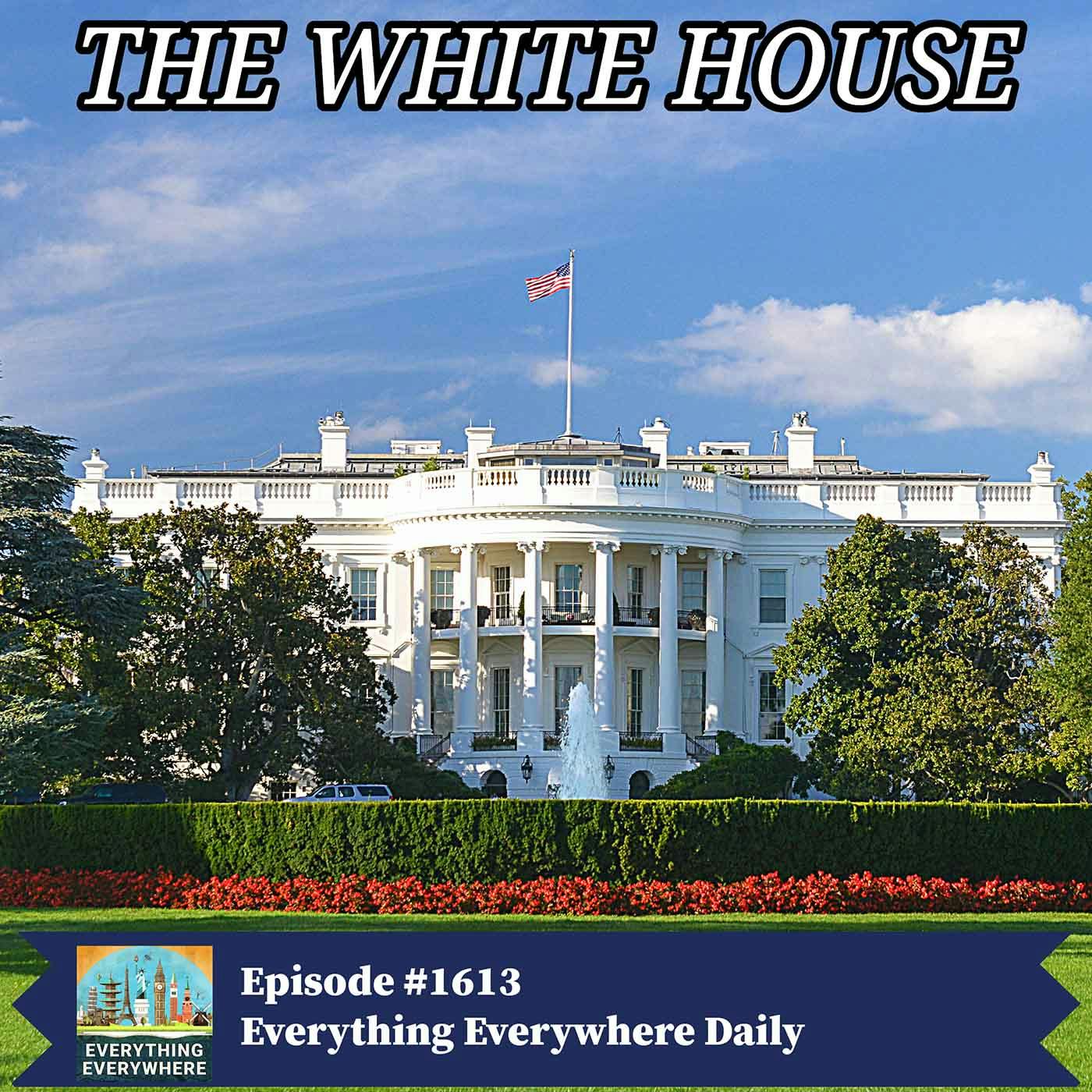
Everything Everywhere Daily: History, Science, Geography & More
The White House
00:17:08
Learn more about the building formerly known as the Executive Mansion
Loading summary
Transcript1 lines
- [00:01]
Charles Daniel
Located at 1600 Pennsylvania Avenue Northwest in Washington, D.C. is the home of the President of the United States. The idea of a home for the President dates back to the very first President, and ever since the second President, every single one has lived in the same house while they were in office, at least temporarily. While the house appears to be the same as the one built in the late 18th century, the interior has been radically transformed over the years. Learn more about the White House, how and why it was built, and how it's changed over time on this episode of Everything Everywhere Daily. This episode is sponsored by Masterclass. If you're listening to this podcast, then you are someone who is curious about the world and loves to learn. And if you want to give the gift of learning and knowledge this Christmas, you can't do better than Masterclass. Masterclass offers online classes from some of the most successful instructors in the world. In their fields, you can learn cooking from Gordon ramsay, conservation from Dr. Jane Goodall, disruptive entrepreneurship from Sir Richard Branson, mathematical thinking from Fields Medal winner Terence Tao, and diplomacy from former Secretaries of State Madeleine Albright and Condoleezza Rice. You can access over 200 classes across 11 different categories. Masterclass always has great offers during the holidays, sometimes up to as much as 50% off. Head over to masterclass.com everywhere for the current offer that's up to 50% off@masterclass.com everywhere. Once again, that's masterclass.com everywhere. This episode is sponsored by Quince. Finding the perfect gift can be pretty overwhelming. This year I found the perfect spot for timeless gifts made from premium materials. So you gotta check out Quince. Quince lets you treat your loved ones and yourself to true quality at an affordable price. I got a cotton fisherman throw blanket from Quince and I literally use it when I am writing many of the episodes for this podcast. I also have some Turkish cotton bath towels from Quince that I absolutely love. By partnering directly with top factories and cutting out the cost of the middleman, Quince passes the savings on to you. Quince is also on the nice list. They only work with factories that use safe, ethical and responsible manufacturing practices and they use premium fabrics and finishes for that luxury feel in every piece. Gift Luxury this holiday season without the luxury price tag. Go to quince.com daily for 365 day returns plus free shipping on your order. That's quinc.com daily to get free shipping and 365 day returns. Quince.com daily the White House is more than just the home of the President of the United States. For better or worse, it is a symbol of American democracy in power. Yet despite its functional role as a house and its power as a symbol, the White House is fundamentally just a building. A building with a very rich history that would surprise most people, including most Americans. It is arguably one of, if not the most important buildings in the United States, not only for its history, but also for its significance. The idea of a residence for the President can be traced back to the constitutional convention of 1787. Article 1, Section 8 of the Constitution gave Congress the authority to create a federal district to serve as the capital of the new country. Where this district would be and what it would look like was still up in the air. But they at least agreed in principle that such a district should be created and that it would be the seat of all three branches of federal government. When George Washington became president in 1889, he and his wife lived at the home owned by treasury official Samuel Osgood. In 1790, he moved to the Alexander McComb House on Broadway from February to August. In May of 1790, a new building called Government House began construction, but Washington never lived there as the capital was moved to Philadelphia later that year. In Philadelphia, the government rented the home of Robert Morris, a Founding father who signed the Declaration of Independence, the Articles of Confederation and the United States Constitution. Washington's house was located at 190 High street, which is now 524-530 Market street in Philadelphia, just a block north of Independence Hall. Washington expanded the house to accommodate the presidential entourage and he lived there for the rest of his presidency through March of 1797. When John Adams became president, he lived there until 1800. In 1790, the First Congress had to address the clause in the Constitution calling for a federal district. They passed the Residence act of 1790, or its more formal name, a act for establishing the temporary and permanent seat of the Government of the United States. The act granted President George Washington the authority to select the exact site within a 100 square mile area, and it also provided for the construction of federal buildings, including the Capitol and the President's house. There was much debate surrounding exactly what the house of the President should be. The debates reflected the tensions between republican simplicity and the need for grandeur. Some leaders, including Thomas Jefferson, favored a modest structure, while others argued for a more imposing residence to convey the prestige of the presidency. These debates were a microcosm of the debates surrounding the direction of the young country. In 1791, Pierre Charles L'Enfant, a French born engineer who George Washington hired to Design the Federal city began to work on a plan that incorporated a space for the President's House in his vision for Washington, D.C. in 1792, a public competition was announced to select the design for the President's House. Applicants were encouraged to create a structure that balanced elegance with functionality, reflecting the ideals of the new republic. Irish born architect James Hoban won the competition with a design inspired by Leinster House, a government building in Dublin, Ireland. Hoban's design combined neoclassical elements, such as symmetry, columns and pediments with a dignified simplicity. If you look at photos of Leinster House, you can kind of see the resemblance, but it's far from a simple cut and paste of the design. The cornerstone of the Presidential House was laid on October 13, 1792, marking the start of construction. Enslaved laborers, free African Americans, European immigrants, and local workers were all employed in the construction. Enslaved laborers, free African Americans, European immigrants, and local workers were all employed in the construction. Both Maryland and Virginia, the states where land was taken to create the Federal District, were slave states. The exterior walls of the building were made out of sandstone sourced from Achia Creek in Virginia. The sandstone walls were painted white to protect them from weathering and were lined inside with cheaper brick. The house was completed in 1800, costing $232,372, or approximately $5 million today, adjusted for inflation. Even though the house was complete, there was still a lot of significant internal work that had to be done. The first president to occupy the building was John Adams, who moved in during the very last months of his administration. There is a great scene in the HBO miniseries John Adams where Adams is in the building and there's basically nothing inside. Thomas Jefferson was the first President to live in the house full time, and he did so for the full eight years of his administration. During this period, the building was not known as the White House. It was referred to as the President's palace, the Presidential Mansion, or the President's House. The first use of the term White House in print was actually in 1811, but the building was still formally referred to in all official documents as simply the Executive Mansion. One of the most famous episodes in the history of the White House took place on August 24, 1814. During the War of 1812, British forces set the White House ablaze, leaving only the exterior wall standing. First Lady Dolly Madison famously saved a portrait of George Washington before fleeing after the fire. The original architect, James Hoban, returned to supervise the rebuilding. The White House was ready for President James Monroe in 1817. Although the South Portico was added in 1824 and the North Portico in 1829. Andrew Jackson's inaugural party at the White House on March 4, 1829, became one of the most chaotic and infamous events in the building's history. After his swearing in, Jackson invited the public to celebrate and thousands of ordinary citizens just flooded the White House grounds and interior. The jubilant crowd, many of whom were Jackson supporters from the frontier, overwhelmed the space, climbing on furniture, tracking mud through the rooms, and even breaking items like china and glassware. To manage the chaos, the White House staff strategically placed tubs of punch out on the lawn to lure the crowds outside. Throughout the 19th century, presidents adapted the building to their needs. The East Room, used for receptions and ceremonies, became a focus of renovations. Gas lighting was used during the 1840s and central heating followed in the 1850s. During the Civil War, President Abraham Lincoln used the White House as a command center, and it was there that he signed the Emancipation Proclamation. Changes to the house were rather minor throughout the rest of the 19th century. However, it should be noted that in 1881, President Chester Arthur hired the famous decorator Louis Comfort Tiffany to reimagine the interiors. Tiffany introduced vibrant stained glass windows, including a grand screen in the entrance hall, and modernized the decor with elaborate Victorian styles. In total, over 20 wagon loads of furniture and household items were taken out and sold at auction to fund the renovation. The next major change took place in 1902 during the Theodore Roosevelt administration. Roosevelt's 1902 renovations of the White House were transformative, reshaping it into the modern executive residence that we know today. To accommodate his large family and the growing number of demands of the presidency, Roosevelt hired the architect Charles McKim to overhaul the building. McKim removed the Victorian era decorations added during the earlier administrations and returned the White House to a more classical and stately style. The West Wing was constructed to make a separate president's office from the family's living quarters, marking a pivotal shift in how the building was used. The State Dining Room was also enlarged and new fixtures and furniture were also installed to reflect a simpler, yet dignified design. Here I should address some confusion that may arise about the White House. The West Wing is not part of the original building and the iconic image you see in most photos, it's a separate building connected to the main building. If you see an aerial photo of the White House, you can clearly see the wings on either side of the main original building. This is why there are public tours of the White House. They aren't going where the President or any of his staff actually Work. It was also during the Roosevelt administration that the building began to be formally referred to as the White House, not simply the Executive Mansion. President William Howard Taft expanded the west wing in 1909, adding what is today the most famous room in all the White the oval office. In 1941, a 761 foot tunnel was constructed between the White House and the Treasury Building. It was designed as a secure passageway to provide the President and key personnel a safe evacuation route to the secure vaults inside the Treasury Building in the event of an emergency. As far as is known, this is the only tunnel connecting the White House to any other building in Washington. However, there have been rumors for years of tunnels being built to allow the President and the first family the ability to escape or evacuate the White House if necessary. The most extensive renovation in the history of the White House took place during the administration of Harry Truman. By the late 1940s, the White House was found to be on the brink of collapse with sagging floors and deteriorating walls. Truman ordered the entire interior of the building to be gutted and rebuilt with a steel frame, while still preserving the original sandstone exterior. During this renovation, a substantial sub basement was also added to the building. There are photos you can see online showing the interior of the White House during this period, and it's quite remarkable. Literally everything was removed, save for the walls. The renovation included modern updates like central air conditioning, improved heating and plumbing systems, and a bomb shelter to address Cold War concerns. When completed, the White House maintained its historic appearance while being structurally reinforced and technologically modernized, ensuring its longevity as the President's residence and workplace. The White House Situation Room was created during the Kennedy administration. In 1961, following the Bay of Pigs invasion. President Kennedy recognized the need for a secure, centralized location for managing real time intelligence in crises. As communication delays had hampered decision making during the incident, the Situation Room was established in the basement of the West Wing. It was equipped with advanced technology for its time, including secure communications and real time data feeds, allowing the President and advisors to monitor and respond effectively to global events. The latter half of the 20th century saw continual improvements in communications technology deployed throughout the White House. Each President has made some sort of lasting impression on the building. Richard Nixon installed a bowling alley. Jimmy Carter installed solar water heating panels, which Ronald Reagan then removed, but they were then brought back by George W. Bush. The modern White House is a very odd mix. On the one hand, it is a Museum. In 1961, Congress declared it to be a museum, which means that the President can no longer just sell furniture or artifacts like they did in the past. Likewise, any changes to the staterooms of the building must be approved by the Committee for the Preservation of the White House. The First Family, however, can change their personal family rooms in the building at their discretion. Because of its museum status, there have been no major changes to the interior since the Truman renovations. The museum, however, is limited to just the central residential part of the building. The east and west wings are not considered a museum and are functioning work areas for the President and his staff. Beneath the White House is a bunker for use in an emergency. The bunker was originally built below the east wing during the Second World War. On 911 the first family was evacuated there and in the aftermath it was realized that the bunker was inadequate. Supposedly, and I have to say supposedly, because the entire process was kept secret. A modern bunker was installed beneath the North Lawn of the White house starting in 2010 during the Obama administration. It is staffed by the White House Military Office, which is an actual military detail which is dedicated to serve the White House. Most details about the bunker are classified, but many experts have guessed that it would have to be at least 1,000ft deep to avoid direct impact by nuclear weapons. Before I close, I'd like to note that if you search for the address of the White House on Zillow, there is actually an entry for it. It lists it as a 16 bedroom, 35 bathroom, 55,000 square foot home with an estimated value of $353,634,200. Unfortunately, the property is currently off the market. The White House, which is a living museum and a functioning government building, continues to evolve while honoring its storied past. And it's not just the home of the President, but also a symbol of the nation's history and its ideals. The executive producer of Everything Everywhere Daily is Charles Daniel. The associate producers are Benji Long and Cameron Keever. I want to give a big shout out to everyone who supports the show over on Patreon, including the show's producers. Your support helps me put out a show every single day and also Patreon is currently the only place where Everything Everywhere Daily merchandise is available to the top tier of supporters. If you'd like to talk to other listeners of the show and members of the Completionist Club, you can join the Everything Everywhere Daily Facebook group or Discord server. Links to Everything are in the show notes.