← Everything Everywhere Daily: History, Science, Geography & More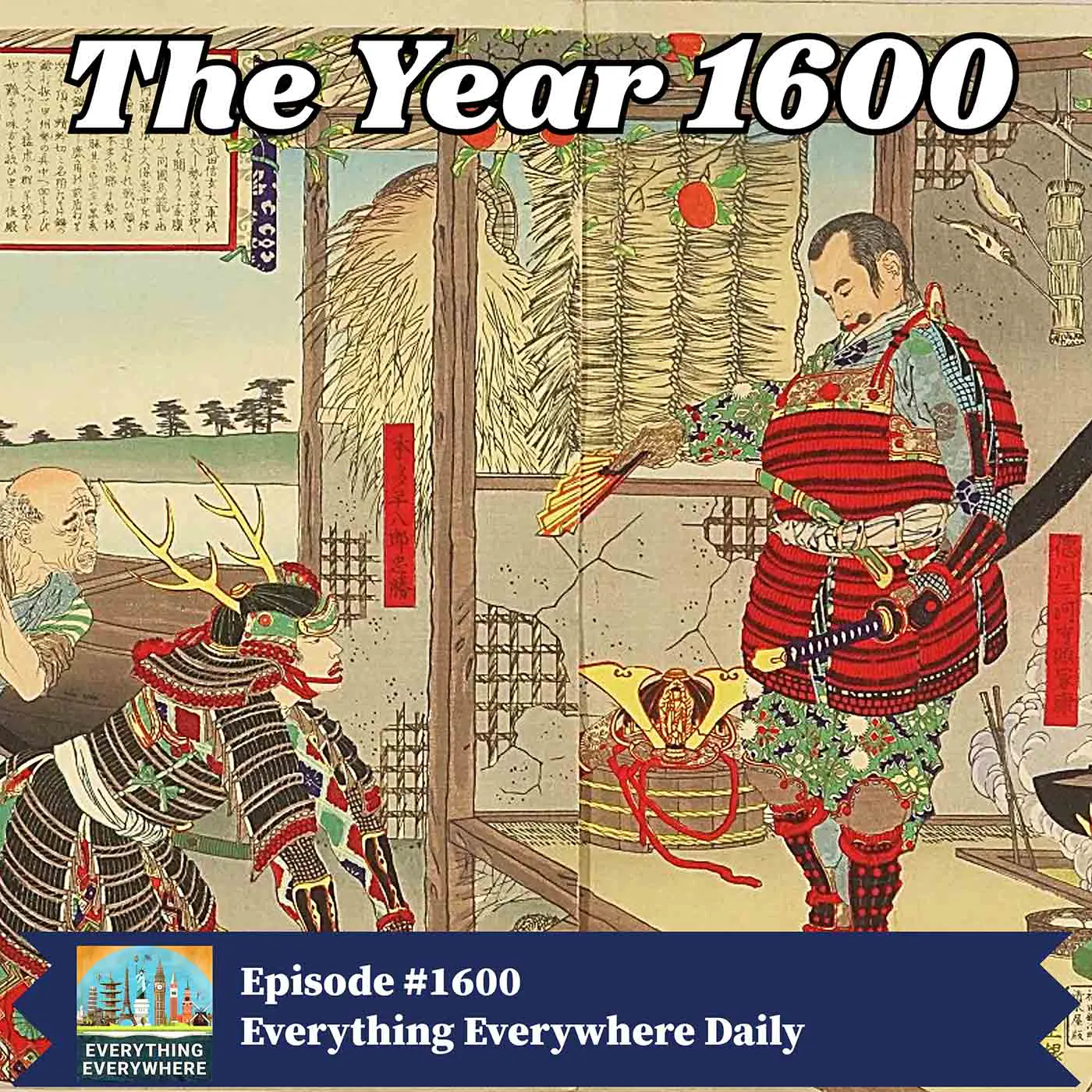
Everything Everywhere Daily: History, Science, Geography & More
The Year 1600
00:16:36
Learn more about what was happening in the world in the year 1600
Loading summary
Transcript5 lines
- [00:01]
A
A little over 400 years ago, the world was undergoing a revolution, although most of the people who lived at the time probably didn't know it. For better or worse, long and short term changes were underway almost everywhere. Parts of the earth that had never been in contact before started to make contact with each other, even if some parties weren't looking to do so. Learn more about the world during the year 1600 on the 1600th episode of Everything Everywhere Daily. This episode is sponsored by Butcherbox. If you're a regular listener to this podcast, you are probably well aware that I am a big fan of Butcherbox. I've been using Butcherbox products for quite a while now to make everything from meatloaf to meat cupcakes to the legendary meat donut and my world famous Scotch eggs. The Scotch eggs are the size of a softball and make an entire meal. However, when all is said and done, the things I love the most are steaks. Steaks not only taste great, but are relatively easy to prepare. Regardless if you're cooking out on the grill, in the oven, in an air fryer, or even in a frying pan, you can make great steaks and the best steaks you're going to find are from ButcherBox. 100% of their steaks are grass fed, grass finished. And if you love steaks, then you are in luck because Butcherbox has a special offer for you. Sign up@butcherbox.com daily and get a special deal. New users that sign up for Butcherbox will receive their choice of two 10 ounce ribeyes, two 6 ounce filet mignon or two 10 ounce New York strips free in every box for a year and use code daily at checkout to get an additional $20 off your first box.
- [01:55]
B
Ryan Reynolds here from Mint Mobile. With the price of just about everything going up during inflation, we thought we'd bring our prices down. So to help us, we brought in a reverse auctioneer, which is apparently a.
- [02:06]
A
Thing Mint Mobile Unlimited Premium Wireless 3030 bid to get 30 2020. Better to get 2020151515 15. Just 15 bucks a month. Sold.
- [02:15]
B
Give it a try at mintmobile.com Switch.
- [02:18]
A
$45 upfront payment equivalent to $15 per month. New customers on first 3 month plan only taxes and fees, extra speed slower above 40G detail. If you remember back exactly 100 episodes ago, I covered what the world was like in the year 1500. Now 100 years later, it's the year 1600 and it's the last year of the 16th century. Remember that there was no year zero so the first year of a century is the one that starts with a one, and the last year of the century is the one that ends in double zeros. So let's start by looking at the big picture. What was the world population in the year 1600? It's very hard to do an estimate for that far back, because there weren't a collection of censuses that we could just add up to get a number. But based on estimates, there were probably somewhere around 500 million people on Earth in the year 1600. About 60 to 65% of the world's population lived in Asia, with China and India being the most populous regions. Approximately 15 to 20% of the global population lived in Europe, growing steadily despite periodic plagues and wars. Around 15 to 20% of the population lived in Africa. An estimated 5 to 10% of the population lived in the New World in North and South America, significantly reduced from the pre Columbian levels due to disease and colonization. And here I'll refer you back to my episode on the Great Dying of the Americas. Estimates of the population of the Americas before European contact can vary widely. I've seen estimates between 10 and 100 million people, which obviously affected the estimates for the number of people who eventually died. Finally, in the year 1600, about 1% of humanity lived across the Pacific Isles and in Australia. If there had been an overall world population increase between 1500 and 1600, it probably would have been very small. The total global economic activity probably increased slightly from 1500 to 1600, if only because trade increased significantly during the 16th century. China, India, and Europe all probably had very similar levels of economic activity, with the per capita average being slightly higher in parts of Europe. But it was not radically different. Other notable hubs of economic activity would be found in Southeast Asia, Central Asia, the Middle east, and Persia. Technical innovations did occur in the 16th century, but few innovations would have affected the quality of life of the average person at this point. The home of a peasant in 1600 wouldn't have been radically different than that of one in 1500. There were many incremental innovations across the board in agriculture, navigation, scientific instruments, and printing. And there were also some major scientific advances, such as the heliocentric theory published by Nicholas Copernicus in 1453. Spoiler alert. The story for the year 1700 will be a radically different one with respect to innovations in technology, science, and philosophy. As we zoom in to see what's happening in different parts of the world, we should probably start in the Americas. The New World saw both the greatest changes over the 16th century, and also some of the least North America, that being what is today the United States and Canada, actually saw very little happen. There were European explorers that visited the region, such as the Italian Giovanni di Verrazzano and Jacques Cartier, who were both employed by France. The British attempted to establish a colony in roanoke, Virginia, in 1585, but the people living there mysteriously vanished. So by 1600, there was relatively little which changed by this point. And again, the next century would be radically different. In south and Central America, it was a whole different story. In 1500, the Spanish had just started exploring the region and had established its first outposts. Between 1500 and 1600, Spanish influence in the Americas expanded dramatically, establishing Spain as the dominant colonial power in the Western hemisphere. This period is often referred to as the Spanish Golden Age, and it saw conquest and colonization of vast territories, the extraction of wealth, and significant cultural and religious transformations. The Aztec and Inca empires had been conquered and were no longer a thing by the year 1600. The trading system known as the Manila galleons, which sent Mexican silver to the Philippines to be traded for Chinese goods, began in the 16th century and was to last all the way through the 19th century. The importation of African slaves began in the 16th century, which was to define the economic system of much of the New World until the end of the practice in the 19th century. During the 16th century, Portugal transformed Brazil from a relatively overlooked part of its empire into a major economic and colonial hub. Initially focused on the lucrative spice trade in Asia, Portugal turned its attention to Brazil after French incursions threatened their claims. The introduction of sugar cane plantations in the 1530s, particularly in the northeastern region of Brazil, marked a turning point, as sugar became a highly profitable export. One could spend a career just on this period in history in this part of the world, but suffice it to say that things changed more here than probably anywhere else on earth. As we turn our gaze now over to Asia, there were changes afoot here as well, Although not quite as dramatic as in South America. The year 1600 marked the battle of Sekigahara, a decisive conflict that established Tokugawa Ieyasu as Japan's de facto ruler. This victory led to the foundation of the Tokugawa shogunate in 1603, ushering in over two centuries of stability in Japan. The Battle of Sekigahara is arguably the most important event in world history that occurred in the year 1600. The Ming dynasty in China was in decline, struggling with internal corruption and external threats, such as the Manchus, who would eventually establish the qing dynasty in 1644. The decline had started over a century before, but by the 16th century, the decline had become terminal. In the 16th century, Southeast Asia was shaped by the rise of powerful kingdoms, increased trade, and, of course, European incursions. Key empires during this period, such as the Ayutthaya kingdom in Siam, the Burmese Tungu Empire and the sultanates of Malacca and Aceh dominated the region, often engaging in warfare and alliances to control strategic territories and trade routes. The spread of Islam continued, particularly in maritime Southeast Asia, where Theravada Buddhism solidified its influence on mainland states. The arrival of Europeans, particularly the Portuguese, Spanish, and later the Dutch, marked the beginning of significant foreign involvement, with the Portuguese capturing Malacca in 1511 to control the spice routes. The Spanish established a colonial foothold in the Philippines after magellan's expedition in 1521, bringing Christianity and Spanish influence to the archipelago. In 1600, the Mughal Empire in India was at the height of its power and prosperity under the reign of Emperor Akbar, who had expanded the empire to include much of northern and central India. Akbar's policies of religious tolerance and administrative reforms strengthened the empire, integrating the diverse population of Hindus, Muslims and other religious groups. Central Asia in 1600 was a region of political fragmentation, shaped by the leftovers of the Mongol Empire and the declining influence of the Timurid dynasty. The region was divided among various khanates, such as the Khanate of Bukhara, the Kievan Khanate, and the Kazakh Khanate, which all vied for dominance. These khanates were influenced by Islamic traditions and engaged in trade along the Silk Road. Although its significance had diminished due to the rise of maritime trade routes, these regions also faced increasing pressure from expanding powers around them, including the Safavid Empire to the south and the Russian Empire to the north, which was beginning to encroach on Siberia and Central Asia. In the Middle east, under Sultan Mehmed iii, the Ottoman Empire controlled vast territories spanning Southeast Europe, Western Asia and North Africa. While the Ottoman Empire had yet to achieve its peak, it was ascendant during this period and had become the dominant power in the eastern Mediterranean, the Levant and North Africa. Their holdings in North Africa extended all the way to Libya, Tunisia, and small parts of Al. The Safavid Empire in what is today Iran under Shah Abbas I was in a golden age marked by economic prosperity and cultural achievements, including the flourishing of Persian art and architecture. In 1600, Sub Saharan Africa was a region of diverse societies and kingdoms experienced significant transformations due to internal dynamics and external influences from expanding global trade. In West Africa, powerful states like the Kingdom of Benin and the Ashanti were thriving on trade in gold, ivory, and enslaved people, while the remnants of the Songhai Empire faced decline following the Moroccan invasion in 1591. In Central Africa, the Kingdom of the Congo was deeply involved in trade with Portuguese merchants. But the Atlantic slave trade was starting to cause profound social disruption within the kingdom. The Swahili coast in East Africa remained a hub of commerce, connecting the interior of Africa with the Indian Ocean trade networks dominated by Arab, Persian and Portuguese traders. In Southern Africa, the Zulu and other Bantu speaking peoples lived in smaller chiefdoms, while Dutch explorers and traders were starting to make inroads around the Cape of Good Hope. And we'll end our whirlwind tour of the world. In Europe. Europe was transitioning from the Renaissance to the Baroque period, with significant developments in art, music and science. Key figures of the period such as William Shakespeare and Galileo Galilei were active at this time. The 16th century was a profound one for England. It saw the rise of the Tudor dynasty. Henry VIII established himself as the head of the Church of England and turned England into a Protestant country after six wives in an attempt to get a son, which he did eventually get. It was his daughter Elizabeth who was to be the monarch that defined the later half of the century. Queen Elizabeth I was nearing the end of her reign in 1600. The English Renaissance was flourishing and England was beginning to assert its naval dominance following the defeat of the Spanish Armada in 1588. Spain was under the rule of King Philip III and the Iberian Union was still in place, linking Portugal and Spain under a single crown. However, the most significant events concerning both Spain and Portugal were all taking place in the new world. In 1600, France was emerging from a turbulent period of religious conflict and political instability caused by the French wars of Religion, which had pitted Catholics against Huguenots, AKA French Protestants. The Edict of Nantes, issued by King Henry IV in 1598 brought relative peace by granting limited religious tolerance to Protestants. Although tensions still remained high. Henry iv, a former Protestant himself who converted to Catholicism to secure the throne, focused on rebuilding the country after decades of war. He strengthened the monarchy, restored financial stability and promoted economic growth through infrastructure projects like roads and canals. In 1600, Germany was a fragmented region within the Holy Roman Empire, consisting of hundreds of semi independent states, free cities and principalities, each with its own rulers and laws. Religious tensions were very high as the Protestant Reformation, initiated by Martin Luther in the early 16th century, had divided the empire between Catholic and Protestant factions. The Peace of Augsburg in 1555 provided a temporary settlement allowing rulers to choose the religion of their territories, but the uneasy coexistence was starting to fray. The Protestant Reformation was certainly the most significant cultural event to take place in Europe during the 16th century. In 1600, the Polish Lithuanian Commonwealth was at its peak under the rule of Sigismund III Vasa, exerting its influence over large parts of Eastern Europe while engaging in conflicts with Sweden, Russia and the Ottoman Empire. Muscovy, AKA Russia under Tsar Boris Godunov, faced political instability in the beginnings of the Time of Troubles, a period of famine, internal strife and foreign intervention. The Ottoman Empire maintained dominance in the Balkans, but its power was starting to wane as local uprisings and external pressure challenged its control. The year 1600 was smack in the middle of what's been called the early modern period. While there had been significant changes since the year 1500, it was nothing compared to the changes that were going to come in the next century. But for that, you'll have to come back in 100 days the executive producer of Everything Everywhere Daily is Charles Daniel. The associate producers are Benji Long and Cameron Kiefer. I want to give a big shout out to everyone who supports the show over on Patreon, including the show's producers. Your support helps me put out a show every single day, and also Patreon is currently the only place where Everything Everywhere Daily merchandise is available to the top tier of supporters. If you'd like to talk to other listeners of the show and members of the Completionist Club, you can join the Everything Everywhere Daily Facebook group or Discord server. Links to Everything are in the show Notes.