← Everything Everywhere Daily: History, Science, Geography & More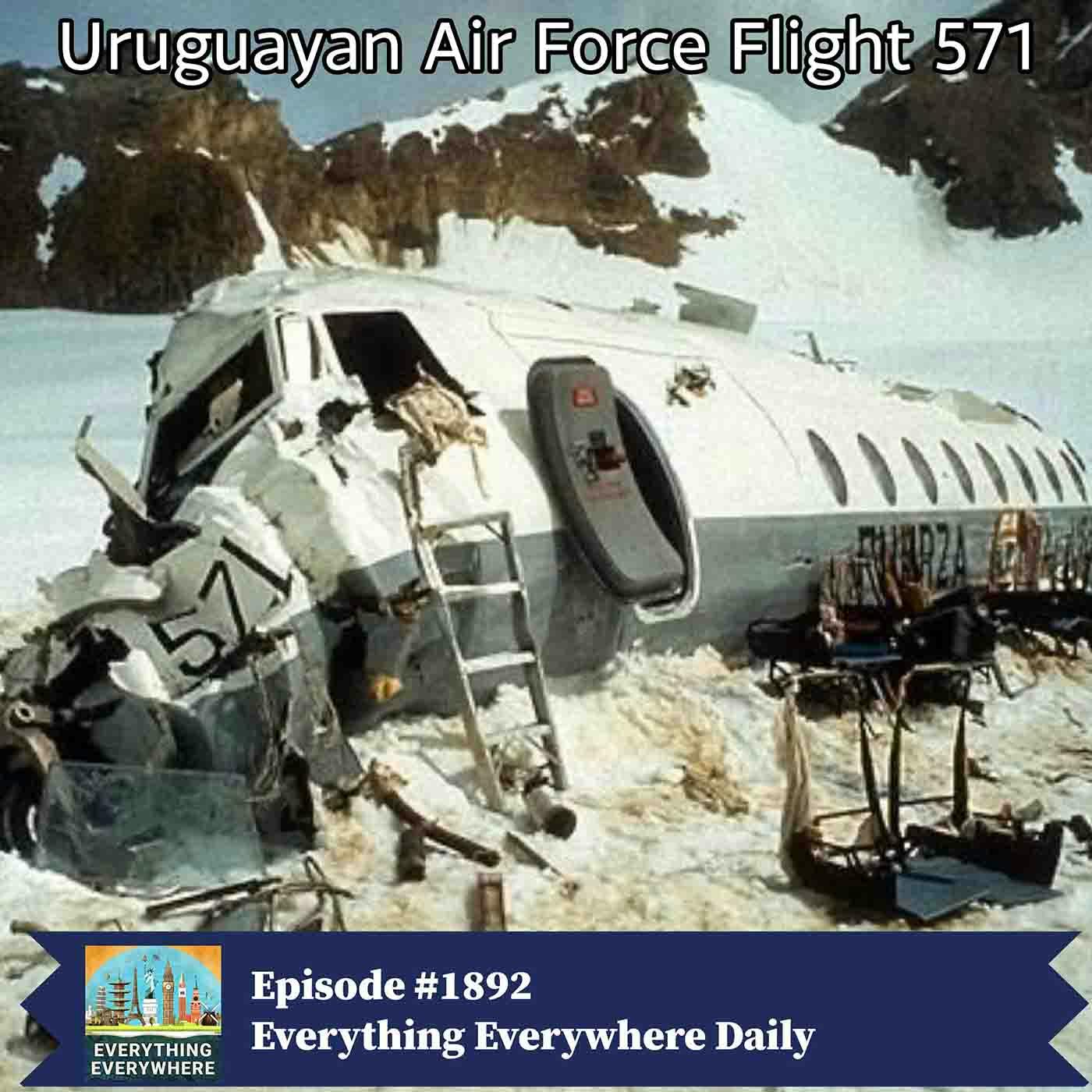
Everything Everywhere Daily: History, Science, Geography & More
Uruguayan Air Force Flight 571
00:15:27
Loading summary
Transcript1 lines
- [00:00]
A
On October 13, 1972, a plane carrying a Uruguayan rugby team crashed into the Andes Mountains. For the following 72 days, survivors of the crash were stranded in the ice and snow, forced to survive in sub zero temperatures, battling starvation and avalanches. Desperate to escape the mountains, two of the crash survivors trekked across the harsh terrain for 10 days, eventually finding rescue for the remaining survivors. Learn more about the survival of Uruguayan Air Force Flight 571 on this episode of Everything Everywhere Daily. This episode is sponsored by Fiji Water. You've probably heard of Fiji Water and have seen it in stores. Well, Fiji Water really is from the islands of Fiji. Drop by drop, Fiji Water is filtered through volcanic rock 1,600 miles away from the nearest continent. In all its pollution protected and preserved naturally from external elements. In this process, it collects a unique profile of electrolytes and minerals, resulting in more than double the electrolytes as the other top two premium bottled water brands, giving Fiji Water its smooth taste. Fiji Water's electrolytes are 100% natural and this water even has a perfectly balanced pH of 7.7. I've recently been trying to reduce my consumption of diet soda and I found Fiji Water to be a great alternative. Visit your local retailer to pick up some Fiji Water today for your next backyard party, beach day hike or even your home office. Fiji Water is Earth's finest water. This episode is sponsored by Quince. I've been telling you about Quince for quite a while now, but perhaps it still hasn't sunk in for some of you just how affordable Quince can be. I went to their website and checked out several prices. A woman's Mongolian cashmere tee, which cost up to $175 from other retailers is available for just $44.90 on Quince. A men's comfort stretch trench coat that goes as high as $498 on other sites costs only $99.90 on Quinn's. A European linen chambray fitted sheet set that will run you $270 at competitors can be purchased for only $85.90 on Quinn's. These are serious discounts on high end luxury items and they can do this by working directly with top artisans and cutting out the middlemen. Quinn's gives you luxury prices without the markup, passing the savings on to you. Keep it classic and cool this fall with long lasting staples from quince. Go to quince.com daily for free shipping on your order and 365 day returns. That's Q U I-e.com daily free shipping and 365 day returns. Quince.com daily on October 12, 1972, the the old Christian Rugby Club of Montevideo, Uruguay chartered a plane to San Diego, Chile for a match against the Old Boys Club. The plane departed from Carrasco International Airport in Montevideo with 45 people on board, including 40 passengers and five crew members. Despite a smooth departure, it was soon forced to make an early landing in Mendoza, Argentina due to poor weather. This delay caused the plane to take off from Mendoza at 2:18pm the following day. The plane was on an indirect course south through the Pass of Planchon, allowing it to clear the Andes Mountains. This was because the plane, a Fairchild Hiller FH227D, was not built to fly high enough to safely clear the mountain range, making it unsafe to fly the direct path to Santiago. Due to the weather conditions, cloud cover obscured the sky, preventing the pilots from confirming their location visually and forcing them to rely on their instruments. The inability to visually see their location led to the co pilot incorrectly identifying their location to Chilean air traffic control and getting clearance to start landing procedures despite still being over the Andes. As the plane started its descent, it encountered severe turbulence and rapidly fell hundreds of feet. From there, the passengers of the plane noticed that the aircraft was uncomfortably close to the mountains. The plane then struck a ridge of one of the mountains, causing it to lose both its wings and tail. From there, the front part of the plane slid down the side of the mountain before it finally stopped. The plane was stuck in a valley known as the Valley of Tears, which was at an altitude of 11,500ft or 3,005 meters, and located right in the heart of the Andes Mountains. The initial crash had killed 12 of the people on board and left most of the remaining injured. But their nightmare was just beginning. The Chilean Air Search and Rescue Service, or sars, had received notice that the plane never landed within an hour of the crash. In response, the SARS team sent out four aircraft towards the last reported location on the Kurico corridor. The SARS officials reported a few hours later that they were unable to locate the crash. Upon reviewing the radio messages, they concluded that the plane had likely crashed in the Andes, as they believed the crash was in one of the more inaccessible locations on the mountain range. They reached out to the Andes Rescue Group in Chile for assistance. Unfortunately for the search team, they too were looking in the incorrect area. Desperate for help, the survivors took action. Knowing that planes would be looking for them, they took lipstick out of luggage bags and attempted to write SOS on the roof of the remainder of the plane to grab the attention of potential rescuers. They also tried to fashion a cross on the snow with their luggage. Despite the rescuers flying over the crash site three times, they didn't notice the signs made by the survivors. The letters made on the plane were too small for the rescuers to see, and the cross was never noticed. Part of why they weren't seen was that the remainder of the plane was white, and this caused the wreckage to blend in with the snowy mountainside on which the survivors were stranded. The harsh conditions on the Andes mountains made the rescuers believe that the chances of surviving the crash and the elements were exceptionally low. This resulted in the search teams being called off after eight days. The plan was to resume the search after the snow melted. In two months, things moved from search and rescue to recovery. Surviving for two months would be incredibly difficult for the survivors. Their numbers were rapidly dropping, with six survivors dying in the next 10 days. Five. Five of whom died on the first night. The survivors remained hopeful that they would be rescued soon. But in the meantime, they had fashioned a shelter out of the wreckage and rationed the remaining food that they found in the luggage. To get water, they used metallic sheets found under the seats of the plane to make a water collector that was powered by the sun. The shelter was constructed using the remaining luggage, plane seats and snow, effectively closing off the back end of the plane to protect the occupants from the freezing temperatures. Around day 10, the survivors received devastating news. They had recovered a transistor radio from the plane and heard that their search had been called off and that they were believed to be dead. They now knew that no help was coming. If they wanted to survive, they would need to do so themselves. A massive problem was food. Where they had crashed, there was no vegetation or animals, as they were far above the tree line on a glacier. To combat hunger, they initially ate cotton from inside the seats and leather from their shoes and belts. But that only made them sick. They soon had to make a hard decision if they didn't want to starve to death. Their friends and relatives who had died had their bodies preserved in the snow outside. After having multiple lengthy discussions, there was no alternative. They would need to resort to cannibalism. One of the survivors, Roberto Canessa, described this experience in an interview with Time magazine. He stated that eating the bodies was a humiliating experience, but that there was no other option. Canessa cut into a body with a piece of broken windshield glass and ate part of the flesh. His actions then prompted others over the next few days to join. Not surprisingly, the survivors initially struggled with cannibalism. Some downright refused, while others could only eat skin, fat or muscle. To make the situation more bearable, they tried to dry out the meat in the sun. Eventually though, all parts of the body, including the brain and heart would need to be eaten in the name of survival. As all of the survivors were Roman Catholic, this decision was not made lightly. Many feared that they would be eternally damned by the act. But others justified it by comparing the cannibalism to eating the body and blood of Christ in the form of bread and wine at communion. Many would eat the flesh, but only the minimum required to survive. A little over two weeks after the crash, the next trial for the survivors occurred. On the evening of October 29, an avalanche struck the survivors shelter. This avalanche entered the structure of the remaining plane and almost filled it completely with snow and ice. The avalanche smothered eight people to death, including the survivors leader, Marcello Perez and the final surviving woman of the flight, Liliana Methal. Methol had become a motherly figure for many on the flight and and it also helped nurse many of the survivors back to health. So her death was particularly hard. To honor her memory, the survivors decided not to eat her body and to leave it untouched. A massive problem caused by the avalanche was that the survivors were trapped inside the plane with only about 3ft of space left between the floor and the ceiling. If they were to stay on the plane they would run out of oxygen and suffocate. So using a pole and luggage rack, survivors managed to pry open the windscreens of the cockpit and made a hole through the snow for fresh air to enter the plane. After two days of digging, they managed to make a tunnel from the cockpit to the surface, but were immediately forced to re enter the plane after they encountered a blizzard. Some survivors have cited this avalanche as the worst part of their 72 day experience, which is saying a lot considering they had to eat human flesh. The blizzard would last for three days, trapping the survivors with those who had died from the avalanche. On the third day, the group would be forced into cannibalizing those who had died from the avalanche. After a few days the temperature rose and some of the snow began to melt away, allowing the remaining survivors to leave the plane. The survivors now knew that they would need to get help if they wanted to live. The survivors believed that they were in Chile because of the co pilot's earlier incorrect statements. Using that information, they believed that civilization would be closest in the west. They were also under the impression that they were only at an elevation of about 2,100 meters. Both of these assumptions turned out to be incorrect. They had never reached Chile and were actually in Argentina. Additionally, the altimeter of the aircraft was broken and they were at an elevation of 3,664 meters. Survivors initially began to make brief expeditions into the areas surrounding the aircraft, but quickly realized their malnourishment and dehydration, mixed with snow blindness and extreme temperatures would make traveling basically impossible. A team consisting of Canessa, Antonio Visentin and Nando Parrado was selected to be the expedition team and was given larger rations of flesh and the warmest possible clothes for their expedition. To help preserve their strength, they were excused from their daily duties and focused on training to survive the journey. The team wanted to head west, but a giant mountain prevented them from taking that route. This made them travel east instead, hoping that the valley would eventually turn in that direction. While traveling, they actually found the tail of the aircraft, which was still mostly intact. They scavenged the tail and found luggage with some food supplies and batteries. The tail gave them shelter for a night and helped keep them warm. They ultimately decided to return to the crash site to disconnect the radio and bring it to the tail of the plane in the hope that the batteries would power the radio. But after days of trying to start the radio, they realized that it wouldn't work. The expedition group then returned to the main crash site once more, knowing that if they wanted to survive, they would need to make the journey down the mountain, While back at the main camp, three more survivors would die. They needed to leave now if anyone was to have a hope of surviving. To survive the nights, the remaining survivors made a sleeping bag out of insulation, electrical wire, and waterproof fabric from the AC unit for the expedition crew. They then gave the journeymen enough supplies for three days, and with that set them off. They had no gear, no map, no compass, and no experience. And to make matters worse, they quickly realized that the expedition would take longer than they thought. So Byzantine was sent back so the other two would have a better chance to survive. Parrado and Canessa descended through the valley, fighting the harsh landscape and cold temperatures. They hiked for another seven days and eventually reaching Chile and a river. They continued to descend down the river, getting past the snow line, and they started to see random signs of life, like empty soup cans and cows. They eventually stumbled across three men on horseback on the other side of a raging river. They called for help, but the men were unable to hear them and said they would come back the next day. When they returned, the men threw a rock with a piece of paper and a pencil to the survivors. On the paper, Parrado said that they had come from a plane crash in the mountains, had been walking for 10 days, and had friends left on the mountain and needed the men to come get them. The Chileans motioned that they understood and threw a loaf of bread across the river before riding west for the next 10 hours to get help. While traveling, the Chileans encountered another man on horseback and directed him towards the survivors to escort them to a nearby village. He did so and took the survivors on horseback to the village of Los Mountaines. When the initial rider arrived at a police station, they reported that they were the survivors of the plane crash. With the report that there were survivors, the Chilean Air Force used three helicopters and Parrado's guidance to search for and find the wreckage of the aircraft. They arrived at the plane on December 22, 1972, but were only able to take half the survivors, leaving eight survivors and four rescuers behind for a night. The next day, December 23, all the remaining survivors had been rescued. The survivors initially lied to the public about how they managed to survive for the grueling 72 days, claiming that they ate cheese and other items until they ran out before switching to vegetation. However, reports of cannibalism were published in the media almost immediately, and this led the survivors needing to make a press conference five days after the rescue ended explaining their actions. There was initially some controversy, but most people understood. Additionally, a priest cleared them of their actions and even Pope Paul VI sent the survivors a telegram indicating that their actions were acceptable given the circumstances. Reducing the backlash, those who didn't survive were buried in a common grave at the crash site. The families of those who died and the survivors built a black obelisk at Las Lagrimas Glacier, the location of the crash, in 2006, and they opened the Andes Museum in Montevideo in 2013. The site is now accessible by multi day guided treks from the small settlement of El Sosniado, Argentina, where visitors are asked to treat the area with solemn respect. Only 16 of the initial 45 people aboard the plane survived the crash. In the end, the story of Flight 571 endures as more than a lurid tale of cannibalism. It is a study in human resolve, cooperation and survival under overwhelming odds. The executive producer of Everything Everywhere Daily is Charles Daniel. The associate producers are Austin Otkin and Cameron Kiefer. Research and writing for this episode was provided by Olivia Ashe. My big thanks go to everyone who supports the show over on Patreon. Your support helps make this podcast possible, and I also want to remind everyone about the community groups on Facebook and Discord. This is where everything happens that's outside of the show. As always, if you leave a review on any major podcast app or in the above community groups, you too can have it read in the show.