← Facts Matter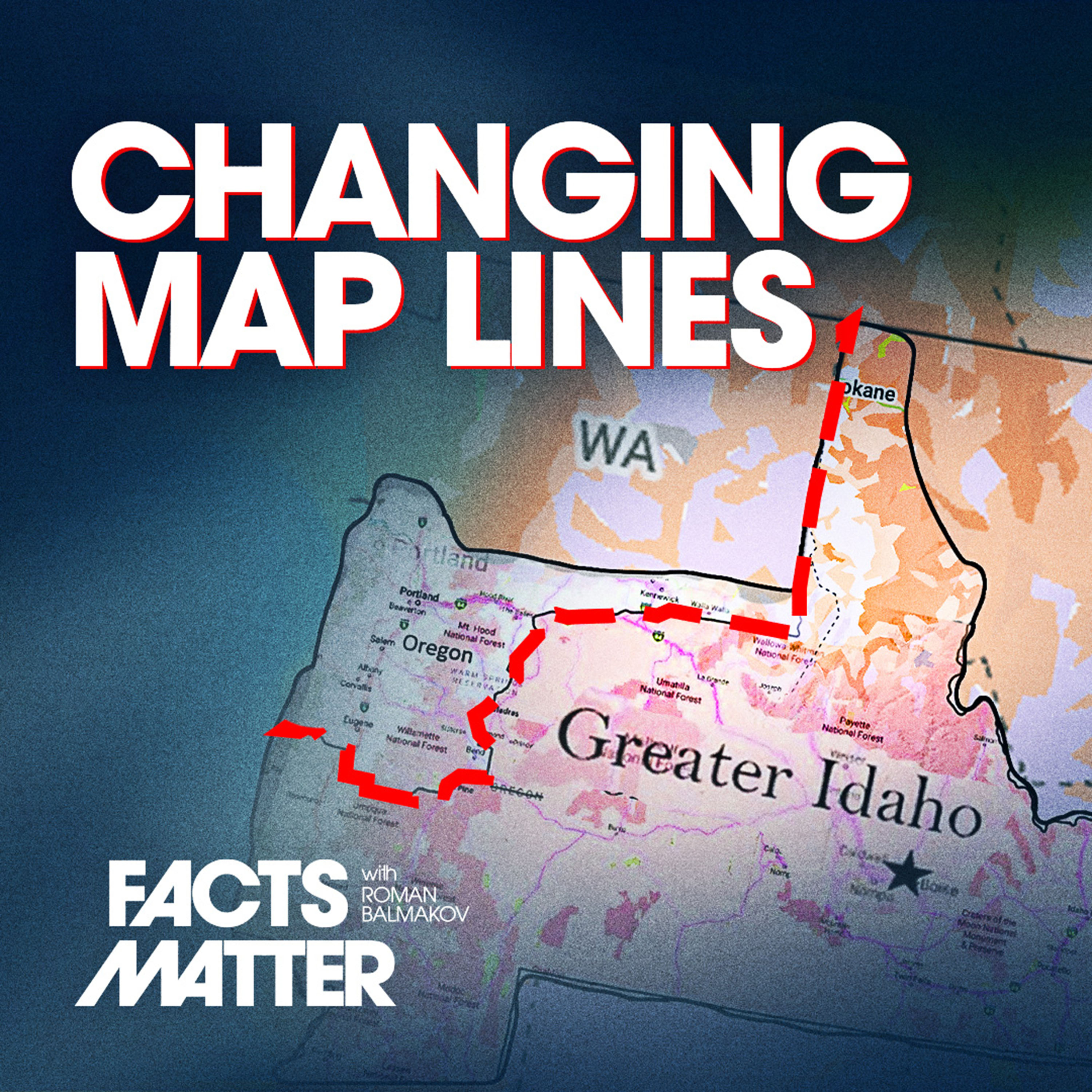
Facts Matter
13 Counties in Oregon Vote to Secede and Join Idaho as Part of 'Greater Idaho' Movement
00:12:29
Loading summary
Transcript1 lines
- [00:00]
A
Unbeknownst to most people, the eastern part of Oregon is in the process of slowly breaking away from the rest of the state. Now, we first covered this movement about a year ago in our program, but since then there's actually been a lot of development. And so let's go through it together. To start with, let me set up the background for you. You see, after many years of being essentially fed up with the policies that are coming out of Portland, over a third of the counties of Oregon have just voted to secede sp. Specifically, they voted to leave Oregon and instead to join the growing state of Idaho. This is called the Greater Idaho Movement. Out of the 36 total counties in Oregon, 13 of them have already voted in favor of secession. Because by and large, the people living in those counties believe that their own values are no longer being represented by their state legislature, which, as you would imagine, is dominated by the extremely liberal politicians coming out of Portland. And what's truly interesting about this particular movement is that it might actually succeed, just like you will succeed in life, if you smash that subscribe button right below this video. And that way you'll get notified of any new videos as soon as we publish them. And that way you'll stay informed about what's truly happening in this country. Also, please smash that like button as well. Thank you. Now getting back to it. Just like most liberal blue states, the majority of the counties in Oregon are actually conservative leaning, similar to states like New York, California and Illinois. And so, for instance, if we look at a county by county results map of the 2024 election, we'll see that the majority of the counties in the state of Oregon voted for Trump, whereas a minority of heavily populated counties voted for Harris. This same disparity also translates to the state legislature, because again, despite the vast geographic swath of the country voting red, you have both the state Senate as well as the State assembly being heavily controlled by by Democrats. And so, in order to understand the desire to secede, just put yourself in the shoes of a farmer or a rancher living somewhere over in rural Oregon, a five hour drive from Portland. Realistically, you have almost nothing in common, politically speaking, with the people of Portland. Even though the politicians from Portland are the ones who are making the actual decisions that impact your life. You might not support their policies, you might not support their positions, you, you don't support what they're doing with your tax dollars. But basically, no matter what you do, the geography and the demographics of the state make it such that your voice over in the eastern part of the state will just never be heard, at least electorally. And that's really true. Both the Oregon State Senate as well as the Oregon State assembly, they're both currently held with a super majority by the Democrats, meaning that the Democrats can pass any piece of legislation without needing bipartisan support or needing to compromise on anything they can railroad it through. And so this is where the Greater Idaho Movement comes in with its plan to take the eastern counties of Oregon and have them join the very conservative state of Idaho. As you can see by the map on your screen, this would effectively move the state line of Idaho several hundred miles west. And as I mentioned at the top of the episode, this movement is really picking up steam with more and more counties in the eastern part of Oregon getting on board. As of today, 13 different counties have approved various measures which require their local officials to begin the process of of breaking away from the state. Quote, the Greater Idaho Movement has won non binding elections in 13 counties. Supporters have been holding town halls, selling hats and T shirts, and erecting billboards with messages such as Release Eastern Oregon. For your general reference, the 13 counties are as follows. You have Sherman County, Morrow County, Union County, Walova County, Jefferson County, Wheeler County, Crook County, Grant County, Baker County, Mallard County, Arney County, Lake county, as well as Klamath County. And just for your reference, by the way, in case you're wondering, when we first reported on this movement about a year ago, only 11 counties had done this. Now it's 13, leaving just two counties as the holdouts, Gilliam and Umatilla counties. And the reason that these two counties have yet to hold a vote is because the county clerks there are refusing to allow the movement to start gathering signatures. And so they are essentially stalling the process. However, given the, you can say, overwhelming support that these ballot initiatives are having in the nearby counties, it might just only be a matter of time until these two holdouts join the movement as well. But the big question here is whether this prospect of secession is actually going to go anywhere. Is it really the case that if all 15 of these counties vote for it, then the transfer can just happen? Well, not exactly. That's because According to Article 4, Section 3 of the US Constitution, no new state can be formed within the jurisdiction of another state or by joining other states without the consent of the legislatures of the states concerned as well as of the Congress. Meaning in order for this to actually happen, it will require a formal vote in the Oregon State Legislature, a formal vote in the Idaho State Legislature, and then once the two sides come to an amicable agreement. It would require ratification by the US Congress, which sounds like a long shot, but it might actually not be. To start with, the lawmakers as well as the Governor of Idaho are actually embracing this proposal. For instance, you had the Governor of Idaho, Mr. Brad Little, he recently went on to Fox News and said this regarding the plan, quote, they're looking at Idaho fondly because of our regulatory atmosphere, our values. That doesn't surprise me one bit. What they're interested in is they would like to have a little more autonomy, a little more control, little more freedom. And I can understand that also atop the supportive position coming from the governor. In February of 2023, the Idaho House of Representatives passed a non Biden memorial which quote, resolves that the Idaho Legislature stands ready to begin discussions with the Oregon legislature regarding the potential to relocate the Oregon Idaho state boundary. And so you take that into account and it appears that this plan has good buy in on the Idaho side. Then in terms of the Oregon side, you might assume that they would not go for it. As we mentioned earlier, the Oregon State Legislature is heavily controlled by the Democrats. They have a super majority. And so why would they agree to this type of a plan? Well, there are actually two reasons which were laid out in a bill that was introduced to the Oregon State Legislature. The first reason is financial. Because of the income disparity between the east and west people in the western part of the state, including Portland, they effectively subsidize the rural part of the state quite quote, Eastern Oregon is an economic drain on Oregon's state budget because of the high income taxes paid by the Portland area. According to a poll. It found that only 3% of the voters of northwestern Oregon are willing to pay what it costs to have rural regions of Oregon included in the Oregon state budget. The movement estimates that the cost is over $500 per Northwestern Oregonian wage earner annually. Meaning in a practical sense, by removing the eastern part of the state, the remaining Oregon will actually be saving tens of millions of dollars in tax re per year that they can use for whatever they want. Which actually perfectly then ties into the second reason that the bill lays out that they might actually go for it. Which has to do with the fact that once the conservative part of the state is gone, the state legislature of Oregon would be overwhelmingly progressive. Meaning that by getting rid of the conservative county holdouts, Oregon might be a smaller state, but they will have more money and they will have a progressive Democrat super super majority that they can use to push forward any project that they wish and so it would seem like a win win. The conservative counties get to leave and join a state that they more align with ideologically, while the remainder of Oregon can be left to be as progressive as they wish. However, that bill never made it out of committee. Regardless, that's where we're currently at with the Greater Idaho movement. You have buy in from the Idaho side. You have several good reasons, at least on the Oregonian side, why they might go for it in the near future. And and you have 13 out of the 15 counties already voting in favor of secession. They are now just missing two counties. And if those two counties pass similar resolutions, the project can begin to lobby the Oregon State Legislature that much harder to at least have a full vote on the measure. Also, as just a total aside, it's worth noting that there's a similar project right now unfolding in the state of Illinois, where you have their conservative counties looking to secede and and join the more conservative state of Indiana. In the last five years, voters in 33 Illinois counties have been asked if they want to consider separating from Chicago's Cook county to form a new state. Each time, a majority said yes. Some politicians in neighboring Indiana seem up for the idea. The state's House of Representatives recently advanced legislation that would welcome Illinois counties into Indiana's fold. Also, it's perhaps worth mentioning that throughout the history of the United States, changing state lines like this has been a pretty rare occurrence. But it does occasionally happen, although all of the known examples of it happening up until today have taken place before the 20th century. A few notable examples they include how in 1792, the state of Kentucky was created from territory out of Virginia. In 1820, the state of Maine was created from Massachusetts. And then, of course, in 1863, West Virginia was admitted into the Union, and after breaking away from Virginia proper during the Civil War. And so we'll just have to wait and see whether these Oregon counties in the east are successful, and they can become the first to change state lines in the 21st century. Now, lastly, as we wrap this up, I actually want to leave you with something that's a bit thematically relevant to the topic at hand. I want to read to you the opening excerpt from one of America's most famous documents, our founding document, the Declaration of Independence. Here's what it when, in the course of human events, it becomes necessary for one people to dissolve the political bands which have connected them with another, and to assume among the powers of the earth the separate and equal station to which the laws of nature and of nature's God entitle them. A decent respect to the opinions of mankind requires that they should declare the causes which impel them to the separation. We hold these truths to be self evident, that all men are created equal, and that they are endowed by their Creator with certain unalienable rights that among these are life, Liberty, and the pursuit of happiness that to secure these rights, Governments are instituted among men, deriving their just powers from the consent of the governed that whenever any form of government becomes destructive of these ends, it is the right of the people to alter or to abolish it, and to institute new government, laying its foundation on such principles, and organizing its powers in such form as as to them shall seem most likely to affect their safety and happiness. If you would like to learn more about either the Greater Idaho Project or the Corollary movement happening in the State of Illinois, I'll throw my research notes down into the description box below. And also, what do you think about these counties trying to break away from their state? Do you think that what they're doing embodies the ethos that I just read to you in the Declaration of Independence? Or do you think something else? Leave your thoughts in the comments. I'll be reading them tonight as well as into the week. And also I'll quickly mention that if you are looking for an honest source of news, the Epoch Times is that source of news, in my opinion, and we're running a phenomenal promotional sale. It's a trial subscription. You can give it a shot, you can try it, you can even cancel anytime. So there's no risk. But by trying, you'll get access to everything. All of our articles, our infographics, our shows, our videos, our documentaries, our analysis pieces, basically everything that we publish. And so if you're indeed tired of the legacy news outlets sort of spinning the news and pushing whatever narrative of the whatever flavor of the month narrative they happen to be pushing that month. If you're looking for an alternative to that, try the Epic Times. It's a news source that actually respects your intelligence as a human being. And all the reporters, including myself, I tried to do it as well. We present to you the facts and then let you make up your own mind and as to what you believe those facts mean in the broader context of what you believe the world to mean. So in my opinion, that's what a news organization should do, and in my opinion, that is what the Epoch Times is doing. So if you're looking for a source of news, check it out. I'll throw the link It'll be right there at the top of the description box below. Just click on that link. It'll take you to the sale page. You can subscribe, get that offer, the trial subscription, and check it out. Barely costs anything, but you might get addicted to the epic times. And hopefully you'll be a subscriber for decades. So again, check it out. The link will be right there in the description box below. And then, until next time, I'm your host, Roman from the Epoch Times. Stay informed and most importantly, stay free.