← Facts Matter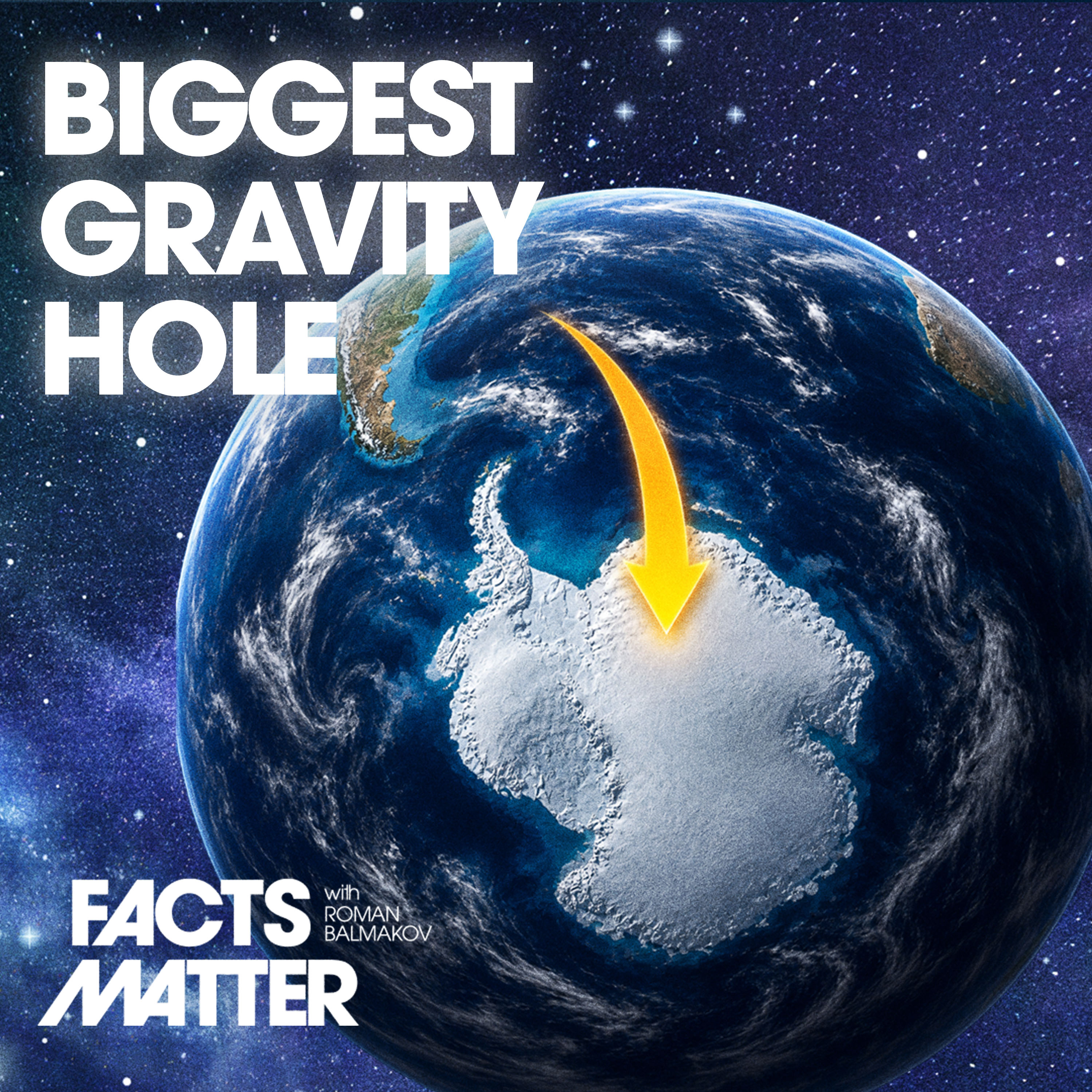
Facts Matter
Cause of Gravity Hole Underneath Antarctica's Ice Sheet Gets Mapped Out in New Study
00:14:06
Loading summary
Transcript3 lines
- [00:00]
A
The story that I'm going to bring you today is one that you've probably never heard of before for a multitude of factors, because for one, it involves a continent that very few people have been on, Antarctica. And secondly, it involves a concept that very few people are familiar with, that of gravity holes. And right off the bat, I'll mention that this is not science fiction, nor is it some sort of a conspiracy theory. Gravity holes really do exist, basically because the Earth's outer layers have different densities in different places. Because the distribution of mass beneath the crust and the mantle of the Earth isn't exactly perfect. The effect of gravity is not perfectly uniform across the whole planet. It's weaker in some places that are less dense underground. In those places you get what are known as gravity anomalies, where the gravitational pull is measurably weaker than the global average. Colloquially, these are known as gravity holes. These gravity holes can affect a person's weight. You would literally weigh a little bit less if you were standing there and on a scale in one of those regions. And then secondly, it can also affect sea levels. Weaker gravity means that the ocean surface sits a little bit lower in those particular places. And interestingly, the largest gravity hole on the entire planet happens to be located beneath the most sparsely populated continent on the entire planet, Antarctica. And just earlier this year, a new study published in Nature magazine worked to map out not only the mantle layer of the Earth beneath Antarctica and why exactly this gravity hole is being caused, but also the process, the 70 million year long process through which it was formed. Let's go through it all together, starting with two pieces of housekeeping, as usual. Please do smash those like and subscribe buttons so this video can be picked up by the algorithm and reach ever more people. Thank you so much for that. And then secondly, I'll mention it again. Over on EpicTV, we just published a phenomenal new documentary called Final Hours. It's a really unique film because in it we interview a bunch of people who had previously died. Either they were clinically dead or they were brain dead. But then regardless of which one it was, they came back to life, they got resuscitated, and they happen to remember everything that they saw on the other side. And the stories they tell are amazing. Traveling to different worlds, seeing all of life from outside the constraints of time and space. There was one woman in the film who was dying. She was on the death's door. She had stage four cancer. The doctors even told her family to just say their final goodbyes. Her organs were shutting down and she slipped into a coma. And so obviously, you look at that objectively and it's like, well, that's unfortunately the end of her life. However, she wound up coming back to life and not only remembering everything that she saw on the other side, but. But also she came back with complete certainty that her tumors would soon disappear. And they did. Within a few weeks, they were gone. A few months after that, her hair even grew back. If you want to hear her story and learn what she learned on the other side that allowed her to come back and her body to heal, check out the film. The link to it will be right there at the top of the description box below. I highly recommend it, and I hope you check it out. Now, getting back to the main topic of today's episode, gravity holes. These are areas where the gravitational pull is a lot weaker. To understand them, think about what's inside of our planet. It's not just a massive ball of uniform rock. I mean, of course, some parts of the Earth's interior are very hard, just like rock, but others are a lot more squishy. And it's these different densities that create different gravitational field strengths on the surface of the Earth. And so, for instance, a mountain range rising up out of dense rock makes the pull of gravity stronger in that spot. But something less dense, like water ice or a porous region in the mantle layer of the Earth creates a weaker gravitational field, or what's known as a gravity hole. Standing inside one of those regions, you would weigh several grams less than in the global average, which isn't a lot, of course, but it is a measurable amount. And if you look at a map of Earth's gravity, which is strangely called the Potsdam gravity potato, you will see hundreds of dips and bulges caused by mountain ranges, ocean trenches, and tectonic plates. But only two gravity holes are so colossal that they changed our collective understanding of what's actually inside the Earth. The biggest and deepest is over a million square miles in the middle of the Indian Ocean. The gravity there is so weak that the ocean surface dips down, creating a huge valley in sea level that's over 100 meters below the global average. So that is the biggest geographically. The strongest gravity hole, however, is located in the western part of Antarctica. Now, this. That's been known for a little while now. But just earlier this year in 2026, a study was published, helping to answer the question of why, what is exactly causing this strong gravity hole to appear? And so what these geophysicists did was that they mapped out the region by pairing global earthquake recordings with modeling software to create a 3D density map of Earth's mantle. And if you remember those diagrams that I'm sure you saw in middle school, the mantle is the layer between the crust and the outer core. And here's what the scientists were able to create. As you can see up on your screen, the spinning image shows us the distribution of densities below the surface of the Earth, at least according to the method that these physicists believe allow them to paint an accurate picture of reality. One of the study co authors from the Univers co authors from the University of Florida describe the method as being like, quote, doing a CT scan of the whole Earth, but instead of X rays, they use earthquakes to see what's going on inside, which is a very creative method. All right, just to pause here for a super quick moment, a lot of parents right now are waking up to the fact that the one size fits all education that's available in public schools is not really working for kids anymore. As reading and math scores are plummeting across the whole country, parents are realizing that their children need something that brings back the old school ways, if you will. Which is where today's sponsor comes in. For the past 16 years, Freedom Project Academy has delivered a fully accredited classical online education for students in Pre K all the way up through high school. Rooted firmly in Judeo Christian values, FPA brings education back to what matters most, truth, tradition, academic excellence, as well as biblical character. With Live Anytime and homeschool courses available, Freedom Project Academy gives families flexible options while helping the students learn with purpose, grow in wisdom, and stand firmly in truth. Awarded Christian School of the Year by Education Insider, FPA is committed to developing students into strong readers, confident learners, as well as patriotic leaders who are grounded in faith. Visit freedom4school.com and you can save 10% off of tuition when you use promo code EPIC10. That's Epoch 10. And you can see all the incredible classes that Freedom Project Academy is offering this upcoming fall. And all their details will be down in the description box below. And down there you can click on the link, you can go over to their website, see all their class offerings, see student testimonials, see what they're doing, and decide whether it's actually the right decision for you and your children. So check them out. They're a great program. And now back to the program. Now, one of the aims of this study was to try and reconstruct the evolutionary process of this portion of the Earth's mantle in order to understand how the gravity hole formed, as well as for how long it existed, and to that second question, the physicists behind this latest study, they believed that this gravity hole has been in existence for at least 70 million years. However, it changed locations and became STRONGER Sometime between 50 and 30 million years ago, which coincided with the wandering of the true North Pole. Here is directly from the study and for your reference in the study and agl, when they write agl, that stands for Antarctic Geoid Low, which is what geophysicists call this gravitational depression, otherwise known as the gravity hole. Quote Using a back and forth nudging technique for time reversed mantle convection modeling, we leverage 3D mantle density structures derived from seismic tomography and geodynamic constraints. Our results show that the AGL has persisted for at least 70 million years, undergoing a major transition in amplitude and position between 50 and 30 million years ago. This transition coincides with an abrupt lateral shift in Earth's rotation axis at 50 million years ago, independently validated through paleomagnetic constraints on true polar wander. They then go on to describe the specifics of the physical properties of the mantle that make the gravity weaker there in the western portion of Antarctica. Quote Initially the AGL was supported by stable lower mantle density anomalies, but over the past 40 million years or so, an increasing contribution from upper mantle buoyancy, particularly above 1300 kilometers depth, amplified the AGL magnitude. This shift reflects the interplay between long term deep subduction beneath the northwest Antarctic margin and a broad thermally driven upwelling of buoyant material source from the lowermost mantle. Now, I read that a few times and thought about it, and to the best of my understanding, in plain English, what I believe they wrote was that the AGL was at first mainly caused by heavy dense rock sitting deep in the Earth mantle, but then later on hot material like hot lava rock from even deeper inside of the Earth began to rise up into the mantle, causing the gravity anomaly to be that much stronger. If you'd like to go through the actual entire study for yourself, it's available online for free and I'll throw a link to it down in the description box below. It's interesting, but as you could tell just from those two excerpts, it's very dense and technical, so you might have better luck understanding and following it than I did. But it's very interesting to read because they included a lot of graphs and charts and things like that. So again, it'll be linked down in the description box below. And then also while we're on the general topic of what's below the ice in Antarctica, There was another study I want to briefly mention. This one was published in 2023 and it was titled An Ancient River Landscape Preserved Beneath the East Antarctic Ice Sheet. In this research, a plane flew over the Antarctic landmass and they shot off an ice penetrating radar in order to map out 32,000 square kilometers beneath the ice in the eastern part of the continent. And what they found actually surprised them. A lost world with a river system that that flowed across the entirety of the continent, stretching almost 1,000 miles. They nicknamed their new discovery Highland A, and the land consisted of valleys and ridges that were carved by prehistoric river system before the continent froze over. Now, the reason that this discovery surprised them was because initially the geologists expected that the sheer immense weight of the ice would have eroded the ridges and valleys beneath it away. But no, instead what they found was that underneath miles of ice, the landscape has been, to the best of their knowledge, perfectly preserved for the past 14 million years or so. According to their analysis, as they describe it, it's like a time capsule offering us a rare glimpse into the Earth's distant past. And so there you have it. A lot of exciting new research on our loneliest continent. And actually, I will mention that if the polar ice caps are truly melting, as the people on TV constantly tell us, then the thing I would be most excited about would be finally getting to see what Antarctica really looks like. Not the ice that's on top of it, but the land mass beneath. And according to the latest study, it might be likely a very beautifully perfectly preserved place that's been there for millions of years, just waiting for us to go there. It's the size of Russia, perfectly preserved. It would be quite exciting to go visit if you want to check out the study in Nature magazine, either one of these from 2023 or 2026. The one from 2023 actually includes a lot of images and graphics of what the landmass looks like based on their discovery underneath the ice sheet. If you want to check either one of those out, though, I will link both down in the description box below, which is that description box right below those like and subscribe buttons, both of which I hope you already smashed, but if not, now's the time. And then lastly, if you are so inclined, check out that film, Final Hours. Great movie. Going into depth on this new scientific field of, I guess, what would you call them, near death experiences or sometimes even post death, post clinical death experiences where people came back and talked about their experiences and how just amazing it is that you can have people in Peru, Argentina, Russia, Iceland, the US Basically all across the world. Not all in the documentary, but, you know, there's many of these accounts even outside the ones in the documentary. And they all speak a very similar phenomena. Seeing beings, heavenly realms, being able to see things from the. From outside the constraints of time. One young man in the documentary talked about how he was able to see his entire life. He was dead. He was able to see his entire life from the vantage point of the other people in his life, the people he was either hurting or the people who loved him. And so it really, I mean, it opened up my mind. I'm sure it'll open up your mind. A lot of people after watching it have told us that it sort of changed the. Their view on what they thought life was, which was kind of an amazing thing for a documentary to do. And so, yeah, I can't recommend it enough. Final hours Check it out. The link is right there at the top of the description box below.
- [13:22]
B
From this life, it's more just like a light, the light of God. I was so happy. I just felt like more and more of the pain of this world was just floating away.
- [13:34]
A
What do these human experiences mean for our collective soul? The more we come into harmony, love and kindness, the more we're aligned with the essence of the universe. And then, until next time, I'm your host, Roman from the Epoch Times. Stay informed and most importantly, stay free.