← Facts Matter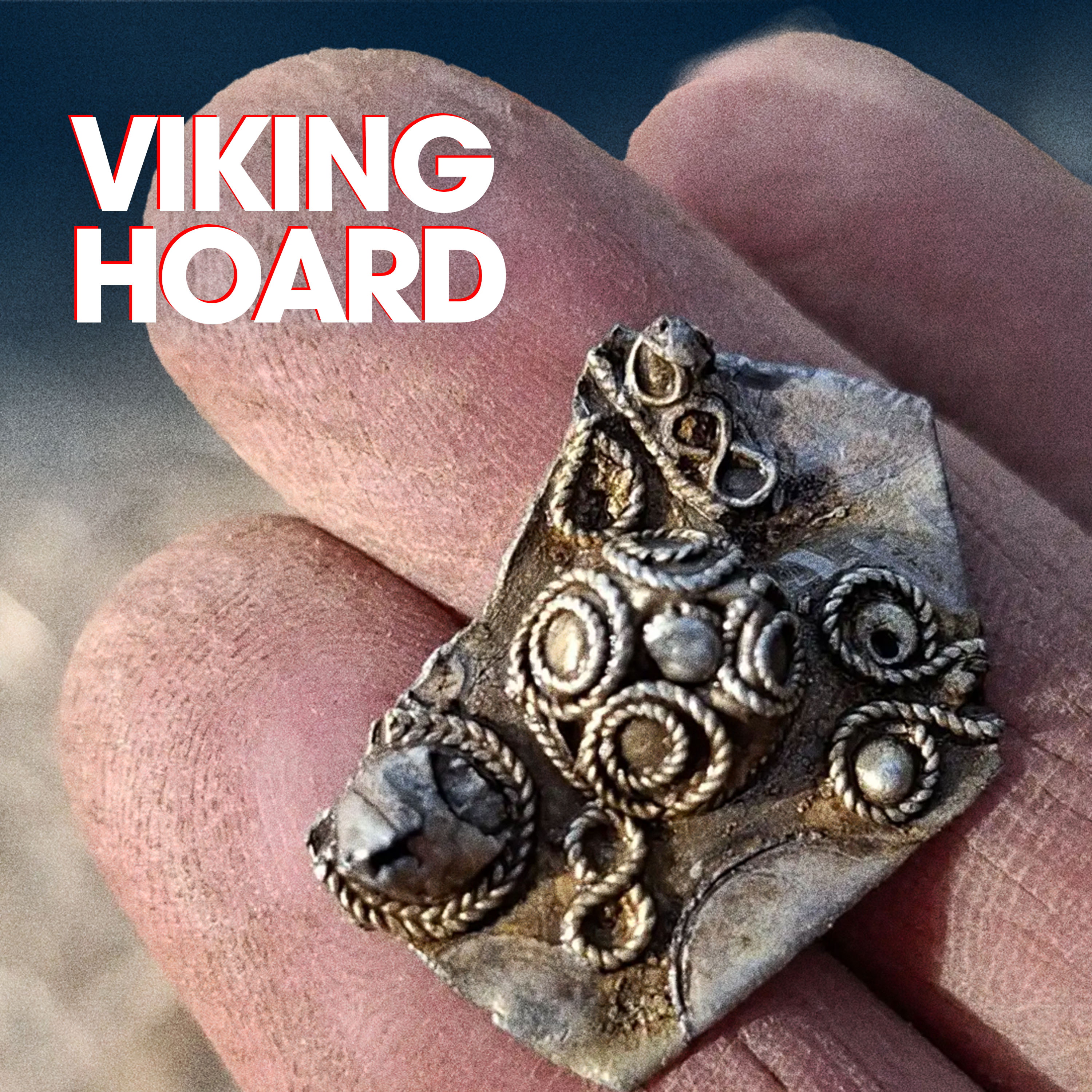
Facts Matter
Norway Discovers Largest Viking-Era Treasure, With Over 4,000 Silver Coins Unearthed
00:11:56
Loading summary
Transcript1 lines
- [00:00]
A
Every so often, an archaeological discovery is made that fundamentally challenges our timeline of human history. And right now, the country of Norway is experiencing something like that. Not exactly rewriting human history, but at the very least, giving us a much higher resolution photograph of a very pivotal time, basically the transition from the end of the Viking Age into what's colloquially called the Medieval Age. And this discovery was basically made by accident. The whole. The whole thing dates back to April last month, when you had two metal detector enthusiasts doing a routine sweep, only to discover something of truly unprecedented scale. They were sweeping a field at the Morstadt Farm near Renne in southeastern Norway. That was when they uncovered 19 silver coins, which is already amazing. I mean, if I discovered 19 silver Viking Age coins, I would be thrilled with myself. They were thrilled as well. And assuming that this find of theirs could be quite historically important, they put down their tools and they contacted the local government. Archaeological teams from Norway's Museum of Cultural History arrived on site. And the scale of this finding of theirs just wound up getting bigger and bigger and bigger. The 19 coins that they initially discovered soon became hundreds, and then soon it became thousands. The discovery team soon brought in heavy machinery to start peeling back layers of dense topsoil. And as of right now, they're still working on the site. But as of last week, the treasure tally has skyrocketed to 4,772 silver coins. And I will mention that as we're filming this program right now, the archaeologists who are still on site, they're pulling up upwards of 100 coins per day out of the ground. And to put that into perspective, this Morad Horde, as it's being called because it was found in the Morad Farm, it's larger than Norway's next four large Viking coin hoards combined, and it is the most significant finding of its kind since the year 1950, when they pulled up the last significant hoard. And the researchers on site, they're not only stunned by the size of the hoard, but also the pristine condition that the silver is in, which is just the result of lucky nature. The soil at Morstadt Farm contains no stones. And so the coins, they've been basically shielded from the crushing friction for hundreds of years. And they're, in fact, so well preserved that the profiles of the medieval kings are. Are still sharply defined on them. They're probably the best coins of their kind, and to find them in such large quantity is amazing. Now, speaking to that point, the lead archaeologist on site at the Morstadt site said the following quote, this is a truly Unique discovery that you may only expect once in your career. It has been absolutely unbelievable to stand there and watch these coins be lifted out of the ground and to see the quality of the coins. They are so beautiful. They have been preserved so well that they almost look newly minted. Now, these coins that have been discovered, they are a thousand to a thousand plus years old. And the archaeologists on site believe that the entire fortune was originally buried inside of a leather pouch or some kind of a wooden container. But that leather pouch or container decayed over the centuries. And after it decayed, modern mechanical plows basically scattered the silver across the whole field without the farmers even realizing what was happening. Quote they were never noticed by those who work here. People don't walk the fields anymore. They sit higher up in the machines, which is really wild to consider that for decades you would be a farmer on this field, sitting just a few feet above the ground in your machine and you're tilling the ground and unbeknownst to you, you're hitting coins that are quite literally a millennia old. And then in terms of why these coins were buried there in the first place, the archaeologists say that it was likely buried for the very same reason that you bury your coins in your backyard, to save them for a rainy day. Quote One interpretation sees Viking Age hordes as practical savings, wealth hidden for safekeeping during uncertain times. Another theory suggests that some hoards may have had ritual or religious significance, functioning as offerings or goods intended for the afterlife. Now, aside from the sheer monetary value of finding nearly 5,000 silver coins, which, for your reference, depending on the size of the coins, it didn't say the weight of the coins, but and the silver content of each coin, which I would imagine is probably 100%, that horde, the melt value of it will run anywhere between 100,000 to, let's say, $400,000 in value. So it's not astronomical, but the true value of this hoard is the story behind it and what it reveals to us about the later stage of the Viking Age. Quote Researchers believe the hoard may provide important new evidence about Norway's role in long distance trade during the late Viking Age. Over 95% of the coins in this hoard come from kingdoms in what is now England and Germany. These were the most widespread currencies in international trade at the time and thus link Osterdalen to an international trade network. For your reference, Oster Dalen, which I hope I'm pronouncing that correct, but that's the Norwegian district that these coins were found in. And it's an inland district. It's not near the coast. Which becomes significant because, as it was mentioned here, 95% of the coins that were discovered were foreign to Norway. They were mostly English and German pennies. And the significance of these coins being found in the more inland area of the country, it suggests that the iron smelting industry there was fairly lucrative around the year 1000 AD. Quote this may be the key to Osterdelin's international trade network. We have long known that there was extensive iron production and export of iron to countries further south. But until now, we have not known what value came back in return for this trade. This hoard is a testimony to payment on a large scale. This smells like money. The coins are not clipped or damaged in any way. Archaeological work carried out in Osterdalen and other parts of inland Norway has revealed extensive iron production sites dating to the Viking Age. Researchers now believe the region was producing iron on an industrial scale, creating a substantial surplus for export. The Morstadt hoard provides a striking picture of the wealth that iron production created. Now, according to the archaeologists, the sheer scale of this hoard, it suggests that it wasn't just the personal stash of one wealthy individual, but it was actually something much more sophisticated. At the time, the city of Renna was a massive industrial center for bog iron production, and they were exporting these resources across Norway, but also across all of Europe. And so the sheer volume of the amount of money found suggests that it belonged to something like a ruling body or maybe even the state itself. Essentially, they believe that this was the discovery of the sovereign treasury of that region. And also it shows a turning point in the economic system as a whole of Norway. Quote, what we're seeing here is the beginning of a radical transformation in how people paid for goods in Norway. Society moved away from viewing silver itself, itself as the source of value and towards accepting a nominal value, meaning that the coin is worth what we say it's worth. That's a major shift. And the evidence for this transformation basically came in the form of four coins that were discovered in this hoard. They, I guess you can say, were the four most important coins that were shown here because they show the exact moment that Norwegian civilization transformed. And they sort of mark the ending of the Viking Age and the beginning of the Medieval Age. The four incredibly rare coins, they were minted under King Harald Hardrada around the year 1046, and they represent Norway's very first national currency. And basically the situation as it stood was that at the time, Norway did not have a national currency and they use silver by weight to use as barter and exchange. And so a lot of those coins, like the German and the English coins, they were used internationally, sort of like the way the euro and the USD and the US dollar is used right now. But inside of Norway, from my understanding, they were still being used by their weight. And also included in this hoard, besides those coins, there were also hack silver. So they were like pieces of jewelry cut into certain weights to be used as exchange. But King Harald, he went to the Byzantine Empire and he came back in the year 1045 A.D. and then by the next year, 1046, he began to mint Norway's own national currency. So it would be silver minted by the state. And whatever the mint says it was valued at is what it was valued at. They no longer used the weight of silver, they instead transformed it into, I guess, a more modern version of an economy. And the beauty of this hoard is because it was buried in the year 1050, it came just as that shift was happening. So it's almost like a perfect photograph of the shift happening where something like 95% of the coins are still these German and English coins and the hack silver, but four of these coins are these king herald minted new silver coins. So it basically is a perfect snapshot of the system as it was, where you still have 95% of these old coins, but the new coins are beginning to enter into circulation and eventually the whole country move in that direction. And this was really the beginning of Norway's rise to become one of the wealthiest countries in the world, which a thousand years later, they still are. Norway is number eight in terms of GDP per capita. So this hoard is just an amazing snapshot of the time period. And from, I guess, a coin hoard perspective, you literally couldn't get a better snapshot where it's like, it's a snapshot where one system transitions to the other and you, you get the perfect balance of the new coins and the old coins. And it's beautiful. The, the other part of it is the fact that it was found inland. It sort of shows the dynamics because the iron was smelted inland, but then it was moved down to the shore and at the ports, they were exported to the other, to the other countries and regions. And so it sort of shows how the money was circulating within the country as well. So it really is a fascinating find. And in terms of the next steps, the excavation site itself, it remains locked down, as you would imagine. Security has been increased around the site to keep the treasure trove safe, safe from any entrepreneurial individuals. And most of the coins themselves, though they have already been collected and sent to the Museum of Cultural History in Oslo, which is Norway's capital. And then in terms of the like practical next steps, quote each coin will now undergo a lengthy process of identification, conservation, photography and cataloging. Researchers will record where each coin was minted, under which ruler it was issued, and when it entered circulation. Every coin will also be entered into the museum's digital database and linked to its precise find location. And then in terms of the treasure hunters who found the initial 19 coins, the enthusiasts who were using the metal detectors, they will not be getting rich from this. Norway has a cultural heritage law on the books which says that any archaeological findings that Predate the year 1537 automatically belong to the state. And so I guess those two treasure hunters can get the fame associated with the discovery, but none of the monetary benefits. And so there you have it. A phenomenal find, probably the best in at least the, what, last hundred years, and a perfect snapshot of the transition between the Viking Age towards the Medieval Age. If you'd like to read more about this finding, and if you'd like to take a picture, a look at the picture of the coins themselves, I'll throw some resources down into the description box below this video for you to peruse at your own leisure. And then I'll also smash those like and subscribe buttons so this video can reach ever more people via the YouTube algorithm, if the algorithm is so nice enough to share it out. And then, until next time, I'm your host, Roman from the epic times. Stay informed and most importantly, stay free.