Loading summary
Transcript7 lines
- [00:00]
A
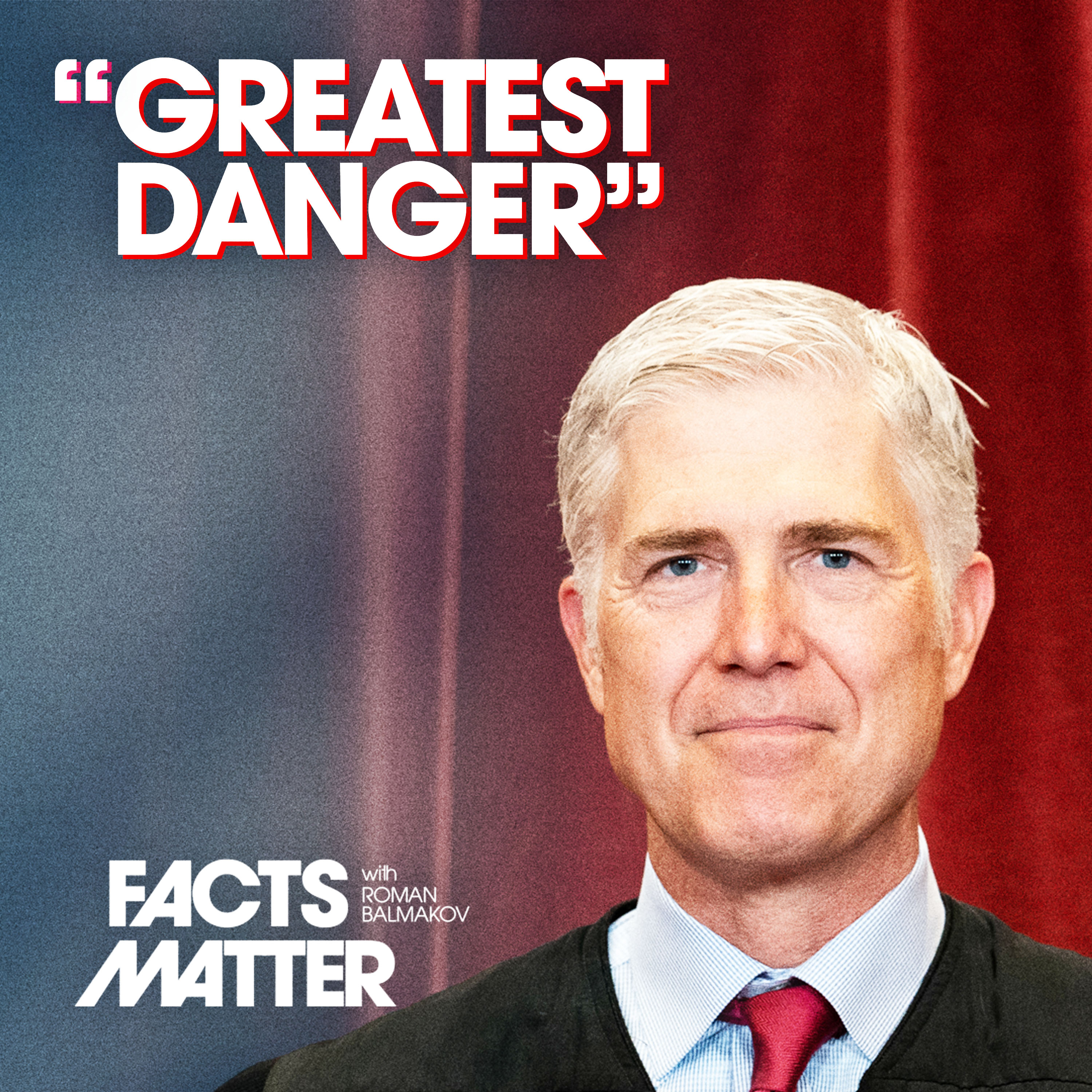
There have been a lot of developments recently on the Supreme Court front in regards to, for instance, mail in ballots and whether or not they can legally be received after election day, in regards to gay marriage, in regards to whether transgender passports are legally a thing or not, as well as what the Supreme Court justices themselves believe is the greatest threat facing America today. And so let's go through all that together after, as always, you smash those like and subscribe buttons so that this video can reach ever more people via the YouTube algorithm. Thank you. Thank you so much for doing that. Now, to start with, on Thursday, November 12th, you had supreme Court Justice Neil Gorsuch give a rare media interview wherein he laid out how, in his opinion, the greatest danger to America is not, for instance, a foreign adversary or a new technology, but rather it's a lack of civics education in regards to the populace. While speaking to Fox News, here's how Neil Gorsuch himself laid the matter out.
- [00:57]
B
Over half of Americans can't pass the citizenship exam. We expect people who come to this country to pass. Most Americans cannot name the three branches of government. And if you ask me what the greatest danger America faces today, it's itself.
- [01:12]
A
He then went on to add that Americans need to know about our shared history, which is why he was there to plug his book, a children's book that he recently wrote, which teaches kids about the Declaration of Independence as well as Revolutionary War heroes, men like Thomas Jefferson, Paul Revere, Cesar Rodney, Thomas Paine, and so on. That book of his will publish in May of next year, the coinciding with the 250th anniversary of the signing of the Declaration of Independence, a point to which Neil Gorsuch said the following during that interview.
- [01:41]
B
Well, I think over the next year we're going to be celebrating a lot of dates and events with fireworks. And I just wanted to share with children some stories about the courage and sacrifice of the heroes behind 1776 who gave us our Constitution and our liberties.
- [01:56]
A
Also, the idea that a lack of a civics education is the great threat to facing America today is shared by most, if not all, of the current Supreme Court justices.
- [02:05]
B
This is one thing my colleagues and I really agree on is the importance of bringing civic education to our children.
- [02:13]
A
And indeed, to that end, over the last several years, you had several of the current Supreme Court justices on the bench publish books to educate the public. You had Neil Gorsuch himself publish a book last year in 2024, called the Human Toll of Too Much Law. You had Justice Sonia Sotomayor, who who has written several children's book as well since her appointment to the US Supreme Court. All the way back in the Barack Obama administration. Earlier this year, you had Justice Amy Coney Barrett released a memoir called Listening to the Reflections on the Court and Constitution. And then also last year you had Justice Ketanji Brown Jackson also publish a memoir titled Lovely One. And so good on them for both getting the bag and also educating the public about civics. Moving along. Now, let's talk about gay marriage. You might remember how in 2015, at the very tail end of the Obama administration, the U.S. supreme Court issued a landmark ruling that required all states to grant marriage licenses to same sex couples. Essentially, the Supreme Court back then found that the 14th Amendment to the US Constitution, it for one, required all states to grant licenses for same sex marriages. But then also all states had to recognize same sex marriages that were carried out in other states. Basically, the court ruled that same sex marriages have to be treated the same as regular marriages. However, not all local officials were on board with that decision. Case in point, in 2015, just a few days after that Supreme Court ruling was issued, a same sex couple over in Rowan County, Kentucky tried to get a marriage license. However, the county clerk there, Ms. Kim Davis, she, she refused to issue them. One quote, Kim Davis was a former clerk in Rowan County, Kentucky who a decade ago would not sign marriage licenses for same sex couples. Days after the Supreme Court decision, David Moore and David Aramold sought a marriage license from Davis. She declined, saying she was acting under God's authority and advised the couple to seek a marriage license in another county. The men sued for civil rights violations, seeking damages. Now, I will mention that since 2015, this case has taken more twists and turns than a Six Flags roller coaster. You had the governor get involved. The state legislature actually changed how marriage licenses are processed in the state of Kentucky. And then eventually a federal jury ruled against Ms. Kim Davis and they awarded $100,000 in damages to that gay couple, meaning Ms. Kim Davis was on the hook to pay that couple $100,000 in damages. And so Ms. Davis appealed her case on all the way up to the US Supreme Court. Specifically, she was asking the court to overTurn the earlier 2015 ruling regarding gay marriage. Now, this was a long shot, but the composition on the court had changed significantly since the year 2015. In 2015, the Obergefell case was a split 54 decision, with Justices Anthony Kennedy, Ruth Bader Ginsburg, Stephen Breyer, Sonia Sotomayor and Elena Kagan all voting for gay marriage, while Justices John Roberts, Antonin Scalia, Clarence Thomas, and Sam Alito voted against it. But now, 10 years later, in 2015, the US Supreme Court bench is significantly different, with Justices Kennedy and Ginsburg having been replaced by Trump appointees. Furthermore, three years ago, in a 2022 opinion, you had Justice Clarence Thomas write that the Court should go ahead and reconsider their gay marriage ruling, just like they did with the abortion ruling. Meaning that, at least in theory, even though it was a long shot, there was a real chance for Ms. Kim Davis to get the Supreme Court on her side. However, that did not happen. On Monday, November 10, the US Supreme Court rejected to hear the case, but without citing any reasons, they simply wrote that the petition was denied, meaning that despite the change in makeup, as well as what Clarence Thomas wrote back in 2022, there was not enough support on the Court to go ahead and revisit that earlier decision. However, they did take up another case that the U.S. supreme Court did agree to take up, a case involving mail in ballots. That particular case came out of Mississippi and here was the basic outline of what was taking place. Quote In July 2020, during the COVID 19 pandemic, Mississippi passed an emergency law allowing mail in ballots to be counted as long as they were postmarked on or before the date of the election and received by the registrar no more than five business days after the election. The law was eventually made permanent in January of 2024. The Republican National Committee, the Mississippi Republican Party and GOP election officials sued to overturn the law. The Libertarian Party of Mississippi sued in February and the cases were combined. Now their argument was threefold. Firstly, the plaintiffs argued that Mississippi's law was in violation of the elections clause of Article 1 of the U.S. constitution. That clause says that Congress can override state election laws and 1845 federal law requires the election for members of Congress and presidential elect to take place on the Tuesday following the first Monday in November. The RNC said that by establishing Election Day, Congress superseded Mississippi's decision to continue receiving ballots after the allotted time. Then the second point they were making was that by allowing these late votes to count, the state was essentially diluting the votes of those who actually followed the rules and voted on time. Quote the late votes dilute ballots that were cast on time and forced the party to expend extra resources on post election day poll watching. And then thirdly, there was what I call the partisan argument, which was that late ballots, for one reason or another, overwhelmingly break towards the Democrat party. Quote for example, according to the MIT Election Lab 46% of Democratic voters in 2022 general election mailed in their ballots compared to only 27% of Republicans. That means the late arriving mail in ballots that are counted for five additional days disproportionately break for Democrats. And so these were the three reasons that the Republican and Libertarian plaintiffs were citing that by accepting mail in ballots after the day of the election, it violated the U.S. constitution, it diluted the weight of the voters who followed the rules and voted on time, and then for one reason or another, the late votes overwhelmingly favored one party over another. Now, disregarding the last two points, the state the argued back that Mississippi state law does actually harmonize with federal election law because they claim that the election is the casting of the ballot, not the counting of the ballot, and that the ballot is actually cast when the voter takes it and drops it into the mailbox on or before election day, regardless of when that ballot is counted. And by the way, just as an aside, what's really interesting about this case to me is that normally these election integrity cases, they tend to be viewed strictly along political lines. You have the Republicans on one side and then you have the Democrats on the other side. But in this case it's the GOP suing the state of Mississippi over their election laws, which they claim hurts Republicans. But Mississippi is a huge Republican stronghold. In Mississippi, their Governor, their Secretary of State, their Attorney General, their state Senate and their state assembly are all in Republican control. And actually the Republicans have held a trifecta control of the state government there since the year 2012. And so make of that situation what you will now the case regarding these mail in ballots, it bounced around the court system for a while before finally making it all the way up before the US Supreme Court, who on Monday, November 10th of this month, they agreed to actually go ahead and hear the case. Quote, the U.S. supreme Court on November 10th agreed to take up a case that asks if states can legally count ballots received after Election Day. The Justices have not set a date for oral arguments, but a decision is expected by the end of June 2026, just ahead of the midterm elections. Over a dozen states and the District of Columbia accept mail ballots after Election Day. If the Supreme Court sides with the rnc, it may require those states to change their election procedures. So obviously the stakes are quite high ahead of the midterms. Now moving along to another case, the US Supreme Court also recently issued an actual decision regarding US Passports, or specifically whether US Passports can require your gender on there to be written as it was assigned to you at birth. Or put another way, can a US Passport holder go ahead and change the gender on their document? And the answer is no. The US Supreme Court ruled on Thursday, November 6 that the Trump administration can go ahead and continue to enforce their policy requiring the sex designation on a US Passport to be consistent with the passport holders separate sex at birth. Now, the specifics of this particular case are a little bit technical, but basically, after suing office, the Trump administration, they attempted to restore the State Department's ability to go ahead and list your proper gender on your passport, something that was actually changed under the prior Biden administration. However, the Trump administration was sued over their new policy and eventually a judge over in Massachusetts, she issued a nationwide injunction in basically preventing the policy from going into effect. The Trump administration appealed that decision, but that appeal was denied by the First Circuit Court of Appeals. And so the Trump administration, they then filed an emergency application with the US Supreme Court, urgently asking them to allow the administration to, quote, reinstate its policy that prevents individuals from opting for sex markers on their passports that do not match their birth sexes. Now, representing the Trump administration, you had the US Solicitor General, Mr. Dean John Sauer. And he laid out the argument for the government as follows. Quote, the district court injunction blocking the policy has no basis in law or logic. Private citizens may not compel the government to use inaccurate sex designations on identification documents that fail to reflect a person's biological sex, especially not on identification documents that are government property. And and an exercise of the President's constitutional and statutory power to communicate with foreign governments. The injunction harms the government by forcing it to speak to foreign governments in contravention of both the President's foreign policy and scientific reality. A policy does not discriminate on the basis of sex if it applies equally to each sex without treating any member of one sex worse than a similarly situated member of the other. The passport policy applies equally to everyone by defining sex for everyone in terms of biology rather than self identification. On the flip side, however, you had the ACLU represent the plaintiffs in the case and the premise of their argument was that, quote, the Trump administration's policy was unconstitutional and that forcing someone to use a passport that differs from his or her self identified sex could expose him or her to psychological harm. An individual might be physically harmed as well if that person visited a country where transgenderism was frowned upon and his or her appearance did not match his or her passport sex marker. However, that argument did not prevail given that on Thursday, November 6, you had the U.S. supreme Court go ahead and side with the government, meaning the Trump administration. Now, the decision was split along typically ideological divides. You had Justices Ketanji Brown, Jackson, Alina Kagan and Sonia Sotomayor all dissenting from the majority ruling. Regardless of that, though, the court order was as follows, quote, displaying passport holder sex at birth no more offends equal protection principles than displaying their country of birth. In both cases, the government is merely attesting to a historical fact without subjecting anyone to differential treatment. Now, I'll mention that technically the case is still playing itself out in the lower courts, but as a practical matter, with this new U.S. supreme Court decision now in place, the Trump administration can go ahead and restore their policy moving forward. Forward. And so that's it. An overall breakdown of what the Supreme Court has been up to. I'll throw my research notes down into the description box below if you want to dig deeper into any story. And I will also mention that during last year's Supreme Court session, there were over two dozen cases that directly impact your life. That's why we here at the Epoch Times, we put together a 35 page full special magazine going through all the most relevant Supreme Court decisions from the past year and breaking down all what each one of them actually means for you and your family. Things related to the Second Amendment, your right to not be searched without a warrant, what does and doesn't count as being religious work, what parents can and cannot do with their kids, and even how the map can be drawn up for choosing your state representative. These are things that are normally clouded in legalese, but our team spent weeks combing through all the relevant documents and distilling down the essence of of what those decisions mean for you and your family in a real practical sense. And the best part is that we're giving this magazine away for free. When you try the Epic Times, I'll throw a link down into the description box below. You can click on that link and it'll take you to a special sale page. We can not only try the Epic Times for a super discounted trial period, basically it costs, I shouldn't say nothing, but it costs almost nothing. It's a super discounted rate. But also, not only will you be given access to everything on the Epic Times, all the documentaries, the videos, the infographics, the articles, the analysis pieces, you'll be given access to everything. But on top of that, we'll throw in the free magazine so you can get an idea of what the Supreme Court has been up to in the last session and how all those cases affect you and your family. So check it out to know. We try to make it a no brainer so that it's a super low cost to try the Epoch Times. And also you get the free magazine. So you'll get both informed right away, but then you'll get informed moving forward. And the hope is that after the trial period ends, you'll continue to be a subscriber for decades to come. So join the over 1 million people who are already subscribed to the Epoch Time. And then until next time, I'm your host Roman from the Epoch Times. Stay informed. Most importantly, stay free.