← Facts Matter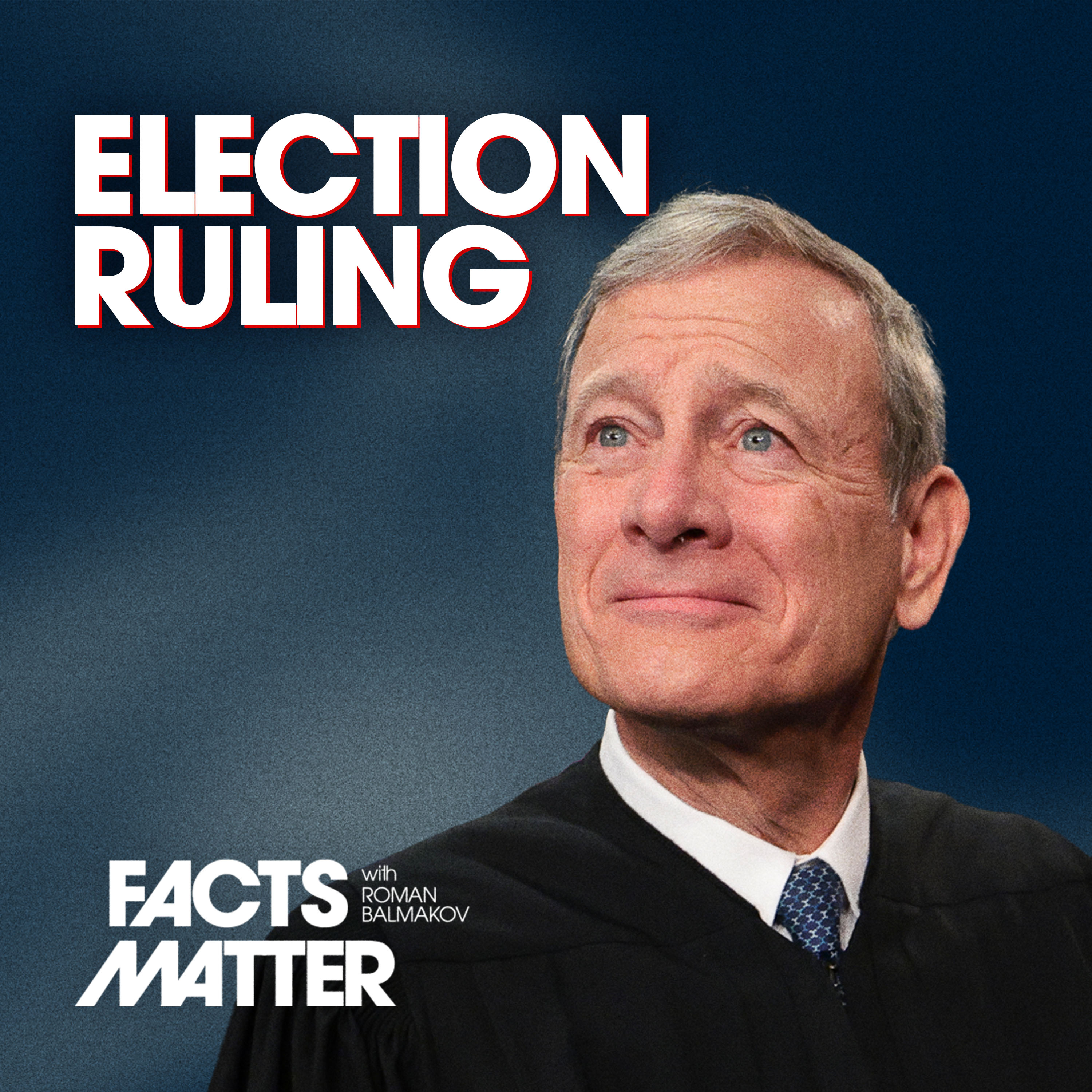
Facts Matter
Supreme Court Rules in Favor of GOP Congressman in Election Law Case, Gives Candidates Standing to Sue
00:12:20
Loading summary
Transcript1 lines
- [00:00]
A
In a new and very consequential ruling, the US Supreme Court just voted to allow a Republican member of Congress to challenge legally a state election law. Now, I'll of course, get into the details of this particular case in a moment. But the reason that this Supreme Court decision matters so much is not necessarily because of the details of this particular case with this particular member of Congress. Instead, it's the precedent that it sets with this ruling from the U.S. supreme Court. They have decided that a candidate for office does, in fact, have the legal standing to sue over an election policy that he or she believes is illegal. And the consequences of this ruling, again, will truly be significant, especially if you think back and remember to what happened in the 2020 election, where many of those legal challenges, they were dismissed not because of the merits of the case, but because, but rather due to a lack of standing of the people who brought the case forward. And so today, let's go through the details of this particular case, what the ruling is, as well as what this ruling means for the future of American elections. And of course, if you appreciate content like this, please do smash those like and subscribe buttons so this video can be picked up by the YouTube algorithm and shared with ever more people. Thank you very much. So to start with, let's rewind the clock back to May of 2022. That was when Republican member of Congress Michael Bost, alongside two other plaintiffs, they were women who were both 2020 and 2024, Republican presidential elector nominees, and they jointly filed the case in federal court against the Illinois State Board of Elections. Their claim was that the Illinois state law, which allowed mail in ballots postmarked by or before Election Day to be received and counted up to 14 days after election Day, was illegal. Their claim was that that particular state law, it violated several federal statutes which established a single election Day for federal elections, and therefore it basically diluted the votes. Meaning their claim was that it diluted the votes of those people who voted, quote, unquote, legally by Election Day, by having those votes compete with the quote, unquote, illegally cast votes which were received after Election Day. Now, since getting filed in Federal Court in 2022, the case has been all throughout the system. Within about a year you had. U.S. district Judge John Ness dismissed the case altogether, saying that the plaintiffs in this case, they lack the necessary legal standing to be able to bring the suit. Forward. Specifically that judge, he said that both the congressmen as well as the two presidential elector nominees, they lacked standing as per Article 3 of the US Constitution, because they could not show a concrete particularized injury from that state law. Now, the congressman, he appealed that decision from the US District Court saying that among other things, the fact that he had to pay campaign staff salaries for an additional two weeks in order to continue counting votes was a concrete injury. Because of that state law, if Illinois did not allow votes to be counted 14 days after election Day, then the Congressman would not need to have to pay staff for an additional two weeks after Election Day. Additionally, he also made the claim that that his votes were diluted because of this whole setup. Quote, Congressman Bose said he has standing in the case because he incurs the expenses in running his campaigns for an extra two weeks to keep an eye on the receipt and counting of ballots. He also argued that as a candidate, he has an interest in ensuring that validly received ballots are accurately counted. However, within just about a month, you had the U.S. court of Appeals for the 7th Circuit rule against him. Again, in a split 2 to 1 decision which came down in August of 2023, the appeals court ruled that the plaintiffs did lack standing. They basically said that the vote dilution claim was too speculative and that the additional costs that the campaign incurred were self inflicted and therefore the Congressman could not sue the state in court. Here was the language that the Court of Appeals used. Quote, Congressman Bose had presented a generalized grievance affecting all Illinois voters that was not a sufficiently concrete and particularized injury to the to support standing. And so, with two losses under his belt, the Congressman appealed the case once again, this time all the way up to the US Supreme Court, asking the highest court in the land to review the standing issue, the issue of whether or not an election candidate has standing to sue the State Election Board in a case like this. In his petition he mentioned the following rationale for his lawsuit. Quote, for over 130 years, this court has heard claims brought by federal candidates challenging state time, place or manner regulations affecting their federal elections. Until recently, it was axiomatic that candidates had standing to challenge these regulations. Now, it took a while, as these things do, for the U.S. supreme Court, but in June of 2025, they did take up the case. In October of 2025, they heard oral arguments from both sides. And then just earlier this month, on January 14th of 2026, they issued a 7:2 decision in favor of the plaintiffs. Specifically, you had Justices John Roberts, Clarence Thomas, Sam Alito, Neil Gorsuch, Brett Kavanaugh, Amy Coney Barrett, as well as Alina Kagan, all rule in favor of Congressman Boast. Now, writing for the majority of the Court, you had Chief Justice John Roberts say the following. Quote, candidates have a concrete and particularized interest in the rules that govern the counting of votes in their elections. Regardless whether those rules harm their electoral prospects or, or increase the cost of their campaigns, their interest extends to the integrity of the election and the democratic process by which they earn or lose the support of the people they seek to represent. As a candidate for office, Congressman Bose has standing to challenge the rules that govern the counting of votes in his election. And so that was pretty unequivocal. However, I will mention that this was a 7:2 decision with Justices Ketanji, Brown, Jackson, as well as Sonia Sotomayor, the dissenting from the majority. And in their dissenting opinion, they basically issued a warning that this type of a ruling could open the door to a lot more election related lawsuits. Quote, by carving out a bespoke rule for candidate plaintiffs, granting them standing to challenge the rules that govern the counting of votes simply and solely because they are candidates for office, the Court now complicates and destabilizes both our standing law and America's electoral processes. Also, by the way, just as an aside, even though Justice Amy Coney Barrett, she concurred with the end result of the majority opinion, Amy Coney Barrett actually did write her own separate opinion saying that the Court, they should have ruled in a much more narrow way, much more narrowly in terms of the issue at hand. Quote, rather than take this straightforward path, the Court charts a novel one. I cannot join the Court's creation of a bespoke standing rule for candidates. Elections are important, but. But so are many things in life. We have always held candidates to the same standards as any other litigant. Regardless of this nuance, though, the end result is the same. The Congressman, Congressman Bose, does have standing in his particular case. Now, very notably, the US Supreme Court did not rule on the underlying question of whether allowing mail in ballots to be counted after Election Day is constitutional or not. That issue will have to be decided in the future, when which it actually now will. Since the Congressman has standing, the case has been remanded down to the lower court, where it can, four years later, actually begin to proceed. Meaning the Congressman can now move forward with the challenge against the Illinois State Board of Elections. And as you would assume, the Congressman's legal team was quite thrilled with this decision. He was actually being represented by Judicial Watch, which is a legal watchdog group. And when we here at the Epoch Times reached out to them for a comment, here's what they got back to us with. Quote, this is the most important Supreme Court election law ruling in a generation. Too many courts have denied candidates the standing to challenge unlawful election rules, such as the outrageous ballots that arrive after Election Day. American citizens concerned about election integrity should celebrate the Supreme Court victory. Likewise, the Congressman himself got back to us with a statement saying the following, quote, this ruling was a critically important step forward in the fight for election integrity and fair elections. I look forward to continuing to pursue this case as we navigate the next stages of the legal process. It's vitally important that we restore the people's trust in our elections. We also did reach out to the lawyers for the Illinois State Board of Elections, but they have yet to get back to us. Regardless, in terms of the results of this case, for the Congressman, it means that he can finally get his real lawsuit to continue. It means that he can go back down to the federal district court and challenge the Illinois State election law, which allows mail in ballots to be counted 14 days after election Day. For the rest of us, though, it means that we can all expect to see a lot more election related lawsuits to be successfully filed in the near future. That's because if you just think about it, before this ruling, many of the challenges against things like mail in ballots, things like grace periods for ballots that were received late, things like drop boxes and so on, many of those challenges, they were thrown out of the courts because the courts claimed that the people bringing forward those cases lacked the legal standing to do so. Up until now, the courts have basically said that the person suing could not prove that they were personally and concretely harmed by the law in question. However, Moving forward after January 14, any candidate running for federal office, like for Congress, the Senate, or even the presidency, they can a lot more easily file a lawsuit just by saying, hey, I'm running for this election, I'm running in this election, and I have a personal stake in how these votes will be counted. And so, again, look forward to a lot more lawsuits being filed in the near future. And one obvious benefit of this is that it will allow Americans to challenge the laws that appear to be unconstitutional both before as well as after an election. And therefore, people as a whole can have a lot more confidence and faith in the system overall. On the flip side, though, the downside, as mentioned by those two Supreme Court justices who dissented, is that there might be a lot more lawsuits. Since pretty much anyone in the country can run for federal office, it might really just open the floodgates in a negative way, clogging up the system and perhaps disrupting elections with continuous, ongoing litigation. But let me ask you, is that a bad thing? Or is that or if it is a bad thing, is that a price worth paying to allow citizens to challenge election rules that they believe are unconstitutional? Leave your thoughts in the comments section below. I'll be reading through them tonight after the video publishes as well as into the week. And if you want to read the Supreme Court decision for yourself, I'll throw a link to it down in the description box below. Also, if you haven't already, please do smash those like and subscribe buttons. That way you can get informed of any new videos as soon as I publish them. And then lastly, if you would like a primer on all of the major US Supreme Court decisions from the previous term from the 2025 term, you're in luck. We here at the Epoch Times put together a phenomenal full magazine detailing all the decisions from the prior term and we basically stripped out all the legalese. We explained what the case is, what the issue at question was, and what the Supreme Court ruling is, and then how it actually will apply to you, your family, your neighborhood, your community moving forward. It basically strips out all the legalese and explains the previous Supreme Court term in an easy to understand way. If you want to check it out, you can get it for free by trying the Epoch Times. I'll throw a link to Try the Epoch Times. It'll be right there at the top of the description box below. You can try it. It's a trial offer, so it basically hardly costs anything, but with that trial subscription, you'll get access to everything. Articles, documentaries, videos, infographics, all the great stuff we publish. Plus that magazine detailing the previous Supreme Court term. It's a no brainer. We kind of built it to like really get you in, get you hooked and then you'll be a subscriber for decades to come, hopefully. But you can of course cancel anytime. Regardless, the link will be down there at the top of the description box below. Hope you click on it. Subscribe to the Epoch Times and get your free magazine. And then until next time, I'm your host Roman from the Epoch Times. Stay informed and most importantly, stay free.