Loading summary
Transcript1 lines
- [00:00]
A
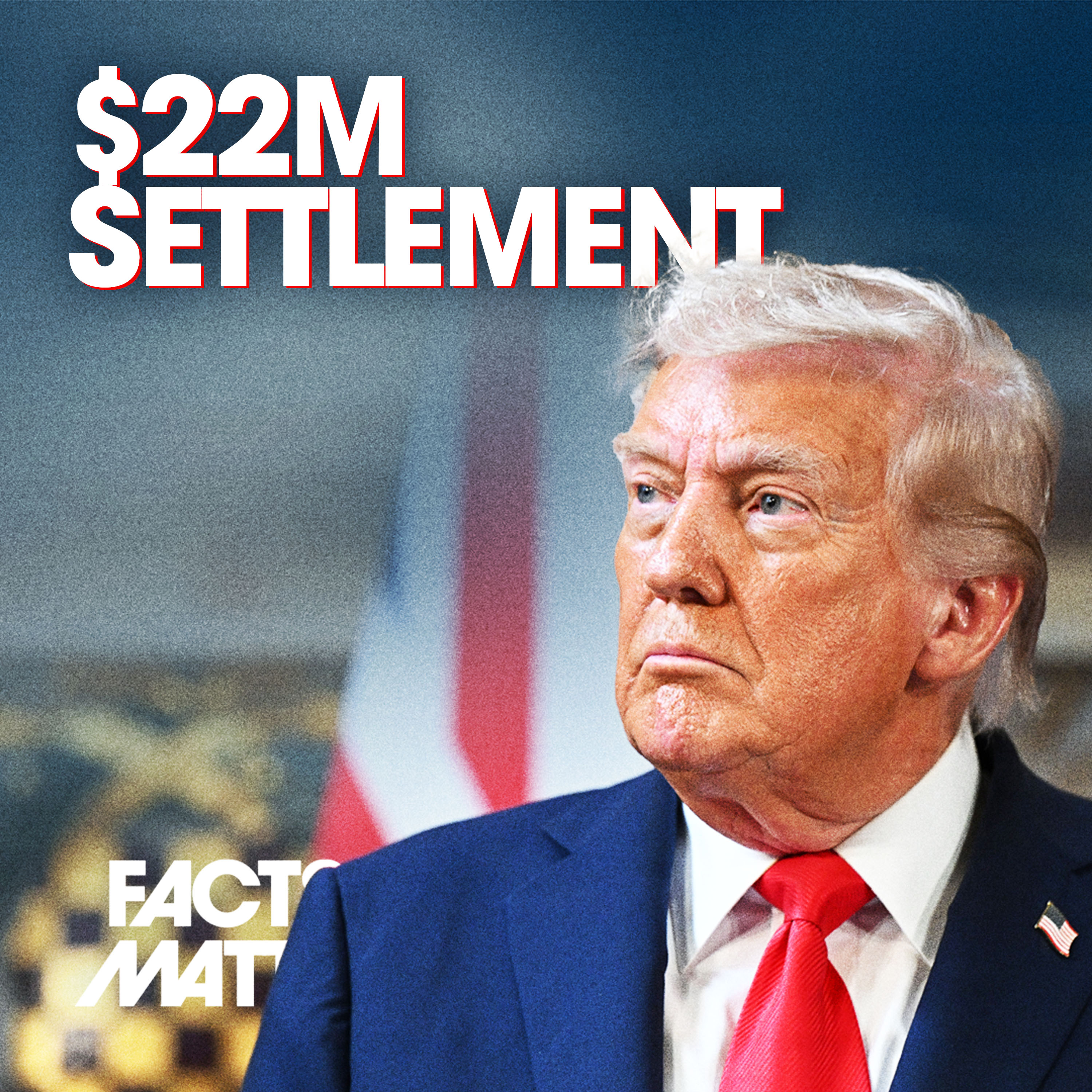
On Monday, September 29, court documents were filed. You can see them up on your screen showing that YouTube had agreed to pay nearly $25 million in order to settle their lawsuit with President Trump. Now, I'm sure that everyone already knows at least the basic outline of the story behind that particular lawsuit. Immediately after the events of January 6, 2021, you had several social media platforms almost simultaneously, literally on the same day. Deplatform President Trump included Among them were YouTube, owned by Google. You had Twitter at that time still controlled by Mr. Jack Dorsey, as well as Facebook, which also controlled Instagram. And so essentially overnight, President Trump's accounts were suspended on those three major platforms. While I should mention he was still actively the President of the United States of America. And, and just to remind you of the rationale that these three companies gave for their actions back in 2021. Quote, the company said in January of 2021 that they had banned Trump over his allegations that the November 2020 election was stolen, which they allege contributed to January 6th related violence. Twitter said that Trump's ban would be permanent. Facebook imposed a two year ban on Trump. And YouTube said that his suspension would continue until it determined that the risk of violence has decreased. And so again, all that was in the beginning part of 2021, in January of 2021. Seven months later, in July of 2021, President Trump filed a major class action lawsuit against those three companies, Twitter, Facebook and Google, arguing that his and others First Amendment rights were violated when these companies did what they did. Quote, speaking from his property in Bedminster, New Jersey, Trump and his team said that the lawsuits are about protecting the First Amendment right to free speech. And they argued that his rights were denied when the three big tech companies banned him. Trump described the major lawsuit as a very beautiful development to protect free speech in the United States. The suits will be filed in the US District Court in the Southern District of Florida and will ask a judge to order an immediate halt to social media companies alleged shadow banning, censoring, blacklisting and canceling of people who express political viewpoints outside the mainstream. Interestingly, it's perhaps worth mentioning that Trump's lawyer in this particular case was a Ms. Pam Bondi, who of course later went on to become the Attorney General of the United States, a position that she holds to this very day. And so that perhaps alongside with the fact more broadly that President Trump regained the White House back in November, was among the confluence of factors that pushed Google to settle the lawsuit. Also, it's perhaps also worth noting that the class action lawsuit was also targeting the very foundational protections that these social media companies, such as Google, enjoy, namely, Section 230 protections. Quote, Trump argued that social media companies have ceased to be private companies and cited the Section 230 protection shield that such firms employ to protect themselves from liability. Republicans have argued that the federal rule has allowed big tech firms to censor their political opponents, while some have gone further over, arguing that social media giants should be regulated as utilities. Section 230 of the 1996 Communications Decency act allows Internet companies to be generally exempt from liability for the material that users post. The federal statute, which provides a legal safe harbor for Internet companies, also allows social media platforms to moderate content by removing posts that, for example, are obscene or violated the service's own standards, so long as they are acting in, quote, unquote, good faith. And so you combine the legal arguments that Trump's legal team was making in this case and the implications that it would have to question section 230 in court with the other fact that Trump retook power in the last election. And perhaps it's no surprise that Google decided to settle. Now, in terms of the dollar amount, according to the actual court docs, which you can see up on your screen, $22 million will be given to President Trump, while another $2.5 million will be given to the seven other plaintiffs in the case of which include, among others, the American Conservative Union, which is the organization behind CPAC. You have Mr. Austin Fletcher, the host of the Fleckus Talks podcast. You have Frank Valentine, kelly victory, and Ms. Naomi Wolf, among several others. And interestingly, in terms of President Trump's own cash payout, the money is actually not going to go to him directly, but instead to a nonprofit called the Trust for the National Mall. Quote, in the YouTube settlement, $22 million will be sent on Trump's behalf to the Trust for the National Mall, a nonprofit that is involved in building a $200 million ballroom at the White House. And so, essentially, this settlement with Google will pay for roughly 10% of the new ballroom that's being built over in the White House. And if you want to see a mock up of what it looks like, President Trump actually showed that off a few weeks ago. And if you're just listening to the show, you can't see it. Basically, if you're looking at the White House from the front, I on the left side of the building, there's gonna be a large addition that will just be kind of a large classical style building that will act as basically a Mar a Lago style ballroom. According to estimates. We can look forward to that building being operational by the end of Trump's second term. Also, I think it's worth mentioning here that this settlement with Google and Trump, it comes on the heels of a letter that we discussed in a previous episode that Google's lawyers sent to the House Judiciary Committee. And in that letter, they admitted that the Biden administration was pressuring them to censor content creators, American content creators, even if that content didn't actually break the terms of service. But if that content went against the government narrative regarding either Covid or the 2020 election, well, white House officials were putting pressure on Google to have that content taken down and the users kicked off. Which of course we all knew was happening for a while now. But it was only earlier this month that Google's lawyers came out with an official letter admitting to that fact, many years removed. Now, they also said in that letter that the affected content creators will be allowed back on the platform, and we'll have to wait and see if that holds true in terms of their promise. In the meantime, we as a country can all look forward to that new White House ballroom, paid in part by this Google settlement. If you'd like to read the details of the settlement, I'll throw a link to the PDF version of it. You'll be able to find it down in the description box below. And then, until next time, I'm your host, Roman from the Epoch Times. Stay informed. Most importantly, stay free.