
Podcast
Feedstuffs Pork Nation
Hosted by Feedstuffs · EN
On Feedstuffs Pork Nation Podcast, we strive to get to the heart of the issues affecting the pork industry. Our focus is that of keeping those in the industry informed and up-to-date on those things that impact their bottom line and the industry overall.
12episodes
Episodes
Newest firstAll episodes

New cuts move pork beyond the chop
Jun 2600:21:02Tap to summarizePork demand doesn’t rise because we produce more pork, it rises because shoppers can picture dinner. Lori Stevermer sits down with Dr David Newman and Neal Hull of the National Pork Board to unpack what has changed in the American consumer and why that change has the pork industry evolving at retail and foodservice. Their north star is simple: more people eating more pork more often, powered by a better eating experience.In this podcast, we get specific about what buyers want right now: nutrition, convenience, and flavor. That leads straight into fabrication and innovation cuts that fit modern kitchens where meal plans start an hour ahead and the air fryer is always on. You’ll hear the story of how new cuts can create new value by offering smaller portions, better fit, and a steak-like experience without steak prices.Then we go deep on ground pork as a growth engine, from expanding retail availability to offering choices like 80/20, 90/10, and attributed products such as no antibiotics ever. We also connect pork demand to culture and global food trends, from tacos al pastor to Korean dishes, and explain how the “Taste What Pork Can Do” campaign aims to market the whole hog one pound at a time. If you care about pork marketing, consumer insights, and practical ways to drive demand, this conversation delivers. Subscribe, share it with a friend in the industry, and leave us a review with your favorite underrated pork cut.
Transcribe →Stop calling my bacon a cookie
Jun 1900:26:28Tap to summarizeThe rules that decide what shows up on a lunch tray are written far from any cafeteria. In this episode, hosts Mark Hulsebus and Lori Stevermer sit down with Dr. Ashley Johnson, director of food policy for America’s pork producers, to unpack how the Dietary Guidelines for Americans steer everything from SNAP and WIC to K-12 school meals, dietitian recommendations, and even international nutrition standards.We talk about the biggest shift she sees coming: protein moving back to the center of the plate. That change has real downstream impact, especially for kids, teens, and older adults who often fall short on quality protein. We dig into why pork is positioned as an affordable, versatile, nutrient-dense option, and how institutional purchasing could expand as the guidance filters into upcoming USDA school meal rules.Then we get into the fine print. “Ultra-processed foods” is a powerful phrase with no single definition, and classification systems tend to group pork sausage with chips and cookies by focusing on processing instead of nutrition. We also explore the risk of a patchwork of state and local policies, including ingredient bans and procurement restrictions, and why food safety, GRAS ingredients, and credible nutrition research matter when policy gets political.If you care about evidence-based nutrition, school meal reform, and how food policy shapes real diets, this conversation connects the dots. Subscribe, share this with someone who cares about school nutrition, and leave us a review with your take: should school breakfast always include a real protein?Feedstuffs Pork Nation is brought to you by Alltech. Alltech delivers smarter, more sustainable solutions for agriculture through a diverse portfolio of products and services. Contact the Alltech Pork Team or visit go.alltech.com/swine-research to learn more.
Transcribe →
Pig livability: Metric that drives everything else
Jun 1600:15:26Tap to summarizeKeeping pigs alive sounds basic, but it may be the most powerful strategy you have for improving swine profitability and sustainability at the same time. From World Pork Expo, we sit down with Alltech’s Dr. Jose Soto to unpack why livability is the metric that quietly drives everything else: feed efficiency, growth performance, cost of production, and the stability of your whole pork production system.We dig into Olerix, Alltech’s new proprietary blend of essential oils, and what the team is seeing around repeatable improvements in performance and, most importantly, survivability. Then we zoom out to the “Planet of Plenty” idea and ask what it looks like when you stop managing pork production as a set of isolated KPIs and start managing for throughput. When more pigs make it to market, the same labor and the same high-priced inputs generate more pounds of pork, which changes your economics fast.The conversation also stretches beyond the barn. We talk about the National Pork Board partnership and the “Beyond the Pork Chop” seminar, where carcass utilization, pork fabrication, and changing global consumer demographics become part of the same story. Better use of the entire pork carcass can raise value per animal and reduce waste, while better feed efficiency helps reduce the carbon footprint tied to feed, one of the biggest sustainability drivers in swine.If you care about swine nutrition, essential oils, feed conversion, livability, pork sustainability, and real-world farm margins, this one connects the dots. Subscribe, share this with a producer or nutritionist who’s fighting input costs, and leave a review with your biggest throughput question.
Transcribe →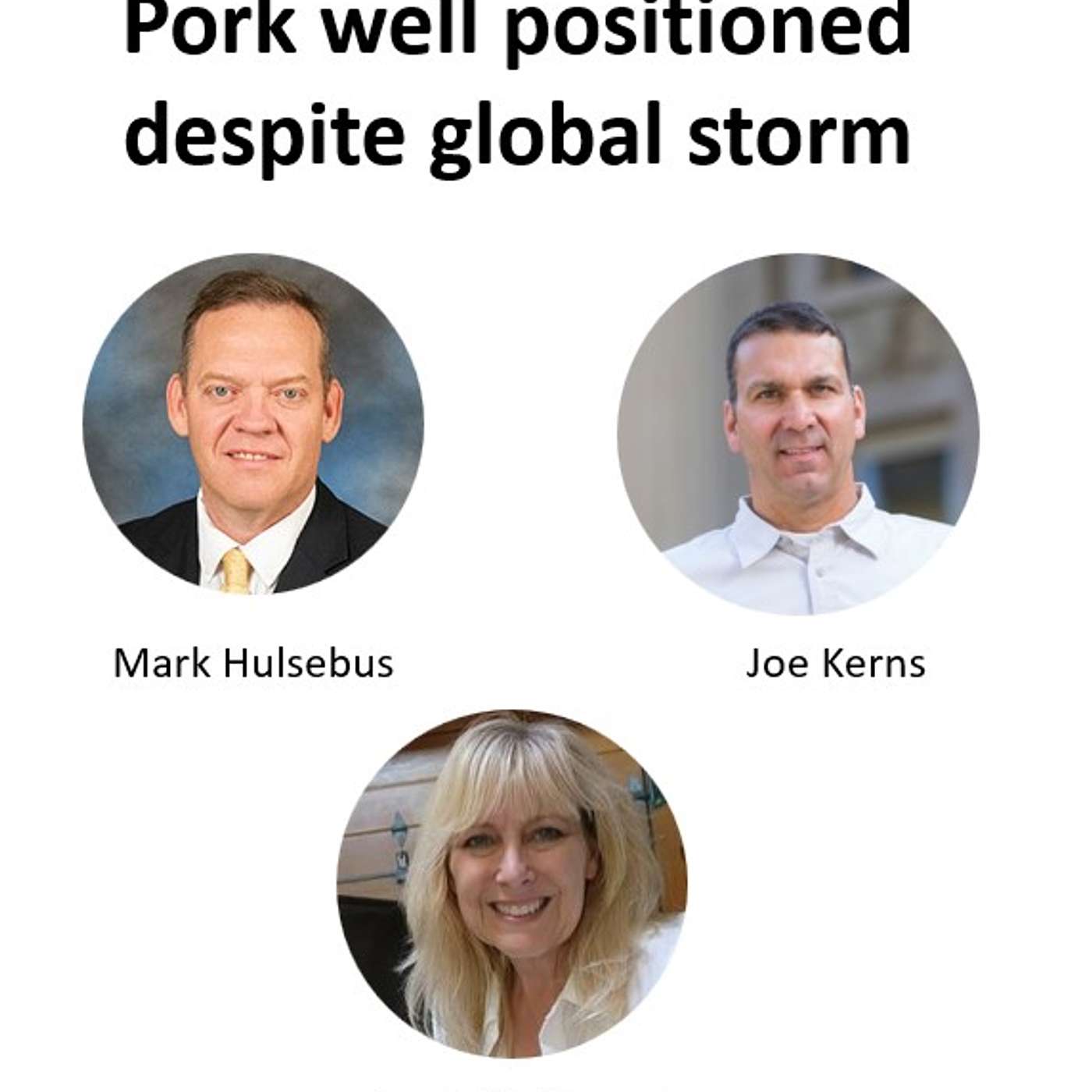
Pork well positioned despite global storm
Oct 1600:27:41Tap to summarizePrices are whipsawing, headlines scream chaos, and yet the U.S. pork complex feels…steady. We sit down with Joe Kerns to unpack this uncommon calm and why discipline—not luck—may be the quiet engine behind today’s positive forward curve. From high interest rates and soaring barn costs to the hard lesson of not overwhelming shackle space, we trace how a painful 2023 forced better habits that are now paying off.We dig into the protein stack. Beef is pinned by biology and a slow rebuild, keeping ground prices elevated for years ahead. Poultry can add birds quickly but still faces operational limits. That leaves pork with a strategic window to win share through innovation: smarter fabrication, retailer-friendly ground blends, and cuts sized for air fryers, slow cookers, and weeknight routines. Kerns shares what he learned at a carcass innovation session—from fiber and fat to flavor systems—and why tenderloin quietly delivers best-in-basket value without sacrificing taste.Exports and crops get equal airtime. A softer dollar helps competitiveness, Europe has hamstrung itself, and Brazil remains a tantalizing wildcard with real financing constraints. On the row crop side, China’s absence for soybeans looms large, pointing toward heavy carryout and the need to re-center soybean meal in livestock rations as a domestic demand anchor. We challenge the hype around renewable diesel, biodiesel, and a fast E15 jump, outlining why infrastructure and economics still don’t pencil. Then we level-set risks: ASF as the border-closing shock, aging consumers who eat less meat, and growth across Africa that demands fit-for-market products.This conversation is a playbook for staying disciplined while capturing upside: hedge inputs and hogs, align cuts with how people actually cook, and use beef’s price era to reset pork’s value story without overbuilding. If you found these insights useful, follow the show, share it with a producer or buyer who’d value the data behind the decisions, and leave a quick review to help more listeners find us. Your hosts for Feedstuffs Pork Nation are Mark Hulsebus of Alltech and Feedstuffs' Sarah Muirhead.
Transcribe →
Navigating policy pressures in modern pork production
Aug 2200:19:14Tap to summarizeThe complex challenges facing U.S. pork producers take center stage as Bryan Humphreys, CEO of the National Pork Producers Council, joins Feedstuffs Pork Nation to tackle the industry's most pressing issues head-on.Humphreys delivers a comprehensive assessment of what has been termed "Farm Bill 1.0," celebrating wins like $70 million for the National Animal Health Laboratory Network and vital tax provision extensions while acknowledging a critical omission – a solution to California's Proposition 12. This legislation creates what Humphreys describes as a "monumental threat" by allowing states to regulate production practices beyond their borders. "California is not just dictating to Iowa, they're dictating to our friends and colleagues up in Canada and in Mexico," he explains, highlighting the international ramifications often overlooked in policy discussions.The conversation shifts to nutrition policy as Humphreys addresses concerns about potential classifications of pork products as "ultra-processed" foods under health initiatives. "You cannot put sausage or pork chops in those same categories," he asserts, positioning U.S. pork as a nutrient-dense protein essential to balanced diets. Trade opportunities and challenges receive equal attention, with Humphreys noting that 25-30% of U.S. pork is exported, creating markets for cuts less favored domestically while ensuring Americans have access to preferred products like bacon. Vietnam and parts of Southeast Asia, Central, and South America represent key target markets where affordable protein is in high demand.Perhaps most pressing is the labor crisis affecting rural America, where some agricultural counties face unemployment rates below 2.5%. Despite offering jobs in communities with excellent schools and quality of life, producers struggle to find workers. Humphreys makes a compelling case for agricultural workforce solutions while closing with a passionate call for industry engagement: "Agriculture is an outstanding group of individuals, but we could certainly use everyone's voice in DC." His message is clear – the future of American pork production depends on producers speaking up and making their voices heard where policy decisions are made. Feedstuffs Pork Nation is hosted by Mark Hulsebus of Alltech and Sarah Muirhead of Feedstuffs.
Transcribe →
Coalition building a must for effective communication of animal agriculture's messages
Jun 26, 202500:13:47Tap to summarizeThe complex dance between community action, government directives, and public health creates the foundation for meaningful social change. Hosts for this episode are Mark Hulsebus of Alltech and Sarah Muirhead of Farm Progress. They are joined by Kylee Deniz of the Oklahoma Pork Producers Council.They dive deep into the power of directives and how they shape public response. There's always tension between top-down mandates and grassroots movements, with the most successful initiatives finding ways to honor both perspectives. Community decision-making processes receive significant attention throughout the discussion. How do communities navigate complex issues when faced with opposing viewpoints? Effective decisions require transparent information sharing, inclusive processes, and recognition of economic factors influencing outcomes. Public health services must be deeply integrated within community structures, balancing scientific expertise with community values to create approaches that are both evidence-based and culturally relevant.Building effective coalitions across different sectors proves vital for addressing complex social issues. By bringing together government agencies, corporate partners, and community organizations, we create comprehensive solutions no single entity could achieve alone. The concept of "third spaces" – where diverse stakeholders can engage in meaningful dialogue – offers promising pathways forward, especially when communities face seemingly impossible constraints.Join us for this thought-provoking exploration of how we can work together to build stronger, more resilient communities through thoughtful collaboration and creative problem-solving. Share your own experiences with community coalition-building or public health initiatives – we'd love to hear your perspective!
Transcribe →
Decision-making, or lack thereof, can impact profitability
May 30, 202500:20:53Tap to summarizeIndecision in the pork industry is rooted in companies pushing products rather than providing solutions. The truth of the matter is that organizational engagement begins with customer engagement and that results from great technology resulting from great research delivered in a relevant and compelling manner.In today's Feedstuffs Pork Nation, hosts Mark Hulsebus of Alltech and Sarah Muirhead are joined by Ernie Hansen, manager of swine nutrition and technical services at Hubbard Feeds, to talk about how decision-making is often times tied to profitability. Feedstuffs Pork Nation is brought to you by Alltech. Alltech delivers smarter, more sustainable solutions for agriculture through a diverse portfolio of products and services. Contact the Alltech Pork Team or visit go.alltech.com/swine-research to learn more.
Transcribe →
Sow nutrition and gilt development among highlights of Midwest ASAS
Apr 3, 202500:16:18Tap to summarizeWelcome to Feedstuffs Pork Nation, where we dig deep and get to the heart of the issues affecting the pork industry. Your hosts for this episode are Mark Hulsebus of Alltech and myself, Sarah Muirhead. Joining us to provide insights on topics, trends and conversations from this year’s Midwest Animal Science meeting is Dr. Henrique Cemin, Senior Swine Nutritionist with Alltech. Topics we address are that of sow nutrition and gilt development as well as what it will take to bring down industry walls to get veterinarians, nutritionists and the production industry to work together more to address industry challenges. Feedstuffs Pork Nation is brought to you by Alltech. Alltech delivers smarter, more sustainable solutions for agriculture through a diverse portfolio of products and services. Contact the Alltech Pork Team or visit go.alltech.com/swine-research to learn more.
Transcribe →
PRRS-resistant pigs set to improve pig health and productivity
Feb 28, 202500:19:37Tap to summarizePorcine reproductive and respiratory syndrome (PRRS) is a highly contagious viral disease that affects pigs, causing significant economic losses. Gene editing technology has been used to develop pigs that are resistant to PRRS and that technology is currently making its way through regulatory approval in several countries. Dr. Lindsay Case, Director, Product Sustainability and New Product Commercialization with Pig Improvement Company (PIC) - North America, joins us on this episode of Feedstuffs Pork Nation to share with hosts Mark Hulsebus of Alltech and Sarah Muirhead:How gene editing creates resistanceThe benefits of PRRS-resistant pigsHow genetic engineering differs from genetic modification?Where is the PRRS-resistant pig in terms of commercial availability globally?What will PRRS-resistant technology mean for the hog industry and global pork trade?How might PRRS-resistant technology change the dynamics of the domestic and global hog industry?Feedstuffs Pork Nation is brought to you by Alltech. Alltech delivers smarter, more sustainable solutions for agriculture through a diverse portfolio of products and services. Contact the Alltech Pork Team or visit go.alltech.com/swine-research to learn more.
Transcribe →
State of the pork industry: Navigating economics, policy amidst challenges
Dec 26, 202400:18:47Tap to summarizeIn this episode, we explore strategies to bolster the pork industry's resilience.Christine McCracken, Senior Animal Protein Analyst at Rabobank, graces Feedstuffs Pork Nation with her expertise on the state of the pork industry. Curious about the path to recovery and what lies ahead in 2025 for pork producers? We're unpacking the improving financial health and potential for more robust margins, despite looming challenges like political uncertainties, tariffs, and changing immigration policies.Discover why maintaining solid trade relationships with key partners such as Mexico and Canada is more crucial than ever. We also tackle how the industry is innovatively addressing labor shortages through automation and improved workforce management.We also delve into critical economic concerns, including the national debt's effect on the US credit rating and its potential ramifications for agriculture. While sovereign debt issues linger, we discuss the importance of staying informed and engaging with lenders to mitigate risks. With only minor interest rate adjustments anticipated, some stability is expected.As we close the year, Christine emphasizes the critical need for biosecurity and community support within the industry. Risk management takes center stage as pork producers are encouraged to partner with advisors to navigate shifting market conditions and capitalize on emerging opportunities.Feedstuffs Pork Nation is brought to you by Alltech. Alltech delivers smarter, more sustainable solutions for agriculture through a diverse portfolio of products and services. Contact the Alltech Pork Team or visit go.alltech.com/swine-research to learn more.
Transcribe →