← Financial Advisor Success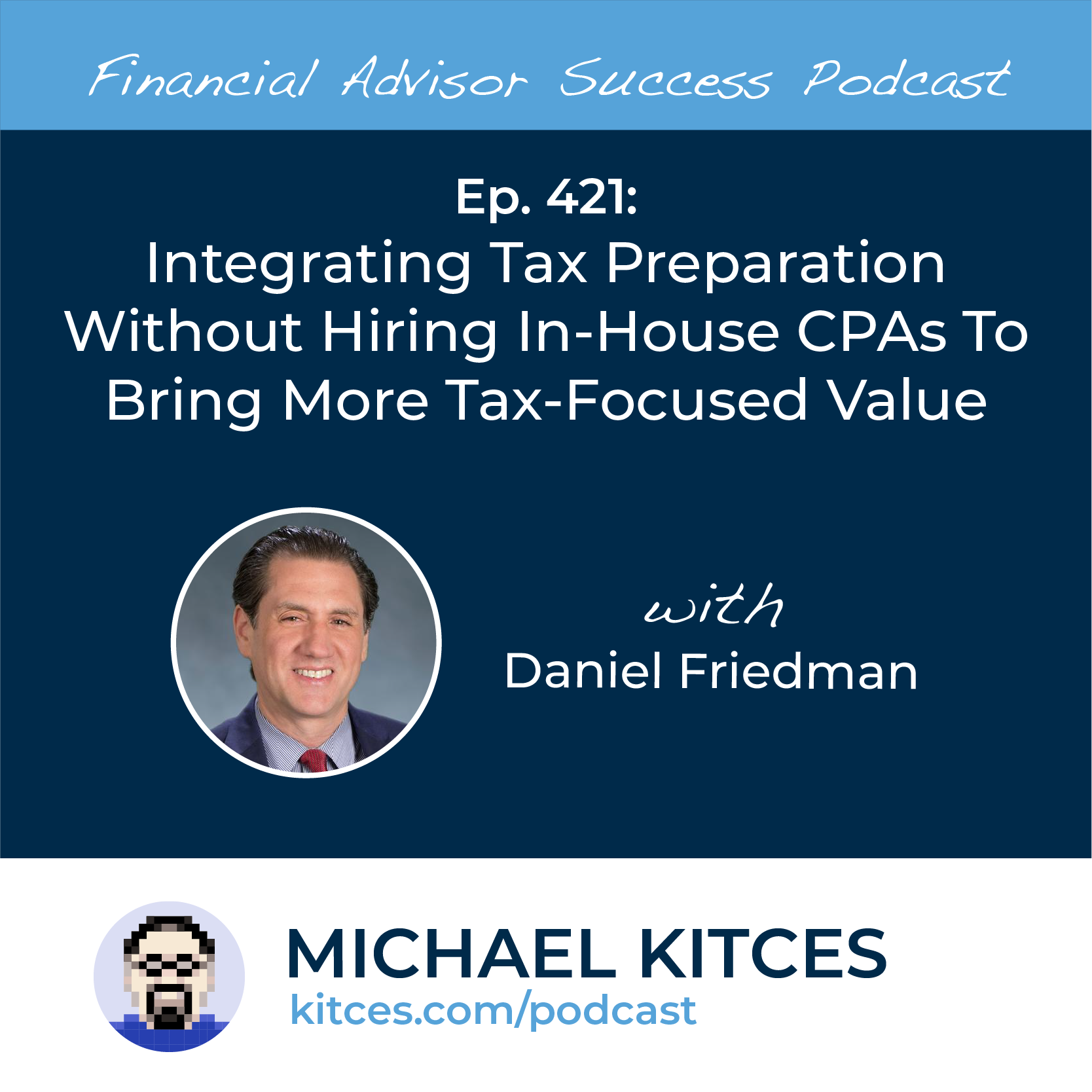
Financial Advisor Success
Ep 421: Integrating Tax Preparation Without Hiring In-House CPAs To Bring More Tax-Focused Value with Daniel Friedman
01:24:11
Offering “in-house” tax return preparation by outsourcing to trusted CPAs, allowing the team to focus on tax planning strategies central to the firm’s value.
Loading summary
Transcript181 lines
- [00:02]
A
Welcome to the Financial Advisor Success Podcast.
- [00:06]
B
Where you go behind the scenes with.
- [00:07]
A
Financial planner, speaker and consultant Michael Kitces.
- [00:11]
B
To hear stories of how leading financial advisors navigated the inevitable challenges that arise.
- [00:16]
A
On the path to success and get insight from leading industry consultants about how.
- [00:21]
B
To break through to the next level.
- [00:23]
A
In your advisory business. And now, here's your host, Michael Kitces.
- [00:28]
B
Welcome everyone. Welcome to the 421st episode of of the Financial Advisor Success Podcast. My guest on today's podcast is Daniel Friedman. Daniel is the CEO of WMGNA, a hybrid advisory firm based in Farmington, Connecticut that oversees approximately 270 million in assets under management for 200 client households. What's neat about Daniel though is how his firm has expanded its tax focus to include in house tax preparation for its clients as a one stop shop, but then actually outsources the tax preparation work itself to trusted CPAs that Daniel pays out of his own revenue rather than bringing the service fully in house so that he can focus his team time more fully on the tax planning analyses and strategies that make up the core of his firm's value proposition to clients. In this episode we talk about why Daniel decided to outsource the tax return preparation rather than hire someone to do it in house to be able to access the expertise of the CPAs his firm uses, particularly for clients with complicated equity compensation plans. How Daniel views these CPA relationships is mutually beneficial from a financial perspective. Daniel not for the purposes of generating cross referrals, but simply because his firm can negotiate bulk discounts on tax return preparation on behalf of his clients while the CPA firms get the efficiency of just being able to bill Daniel's firm once directly and how Daniel positions these strategic professional arrangements as a value add for clients as they can benefit from independent perspectives on tax planning strategies and the preparation of their tax returns. Let's talk about how Daniel has used a subscription based model for financial planning fees for nearly 30 years now, setting a monthly subscription fee based on each client's unique needs, including the complexity of their tax situation why Daniel finds that the vast majority of clients also decide to have his firm manage their assets and pay a separate AUM fee for the service priced based on the all in investment cost plus a margin for his firm that's grown to the point that AUM fees actually surpass his still core subscription fees and how Daniel's firm has successfully implemented a money back guarantee for its subscription based planning service to give prospective clients confidence to try out the value his firm offers. With only 2 clients and 30 years having ever actually asked for a refund and be certain to listen to the end where Daniel shares why his firm uses the term restylement rather than retirement to reflect that they're trying to help their clients restyle themselves for the next stage of life, not for the end of life. How Daniel has benefited from having a director of first impressions on staff whose job is to both make a good first impression on prospective clients, to come to the firm and send cards and gifts to commemorate client milestones with existing clients and how Daniel found that while success did not come as quickly as he would have liked in the first several years after starting the firm, his persistence in providing a high level of service to clients has paid off over time in the form of a thriving business today, as client relationships really do compound over time. And so with that introduction, I hope you enjoyed this episode of the Financial Advisor Success Podcast with Daniel Friedman. Welcome, Daniel Friedman, to the Financial Advisor Success podcast.
- [03:33]
A
Great to be here, Michael.
- [03:35]
B
I appreciate you joining us today and a chance to dig into this. What to me is like a really a really interesting ongoing convergence of tax and financial planning. I mean, we've always had taxes as part of the financial planning umbrella. You know, the five or six domains of insurance and estate and investments in retirement like tax has always been in that mix. But I feel like there's a shift over the past five to 10 years where more and more advisory firms are getting deeper and deeper into the tax planning, sometimes not even just the tax planning, but outright incorporating tax preparation in their services. We were just queuing up the latest version of our Advisor productivity study and finding in Our Results Almost 1 in 6 firms now are including tax preparation in their offering to clients, either doing it in house or partnered externally, but bundled together. And I know you have very much lived this intersection of increasingly tax oriented offerings that kind of blend together the tax and financial planning. And so I'm excited to talk about how this has evolved for your firm as you're going deeper and deeper and more tax centric in the work that you do.
- [04:59]
A
Yeah, definitely. It's been part and parcel and at times the one of the keys to the relationships that we have with folks.
- [05:14]
B
So as we get started, I think I'd like to just hear from you, the advisory firm as it itself, as it exists today, just help us understand the business, what you do, who you serve, and then we'll kind of get a little little deeper into how really does all this work.
- [05:36]
A
Yes, absolutely. So the folks that we serve, it's sort of a Barbelled approach. We serve folks that otherwise would not be able to perhaps get financial planning services solely under an AUM model, the Henry's, if you will, as their lives are becoming a bit more complicated. Higher incomes, not a ton of money outside of retirement plans. But there are some tax issues now, whether it's on, you know, should you do Roth contributions, traditional, some tax planning around perhaps 529 plans per in your state. And so those folks who are getting, who are starting out and then the more traditional folks that are, we would say have accumulated, you know, significant amounts of money and are in the red zone for what we call restylement where there's going to be some changes in the next, you know, five, 10 years. So you know, mid career approaching that. Hey, you know what, maybe look at that restyling, making a change. I think those would be the two, the two demographics that we are focusing on now. Of course we've got people, you know, all over the place.
- [07:30]
B
Sure.
- [07:30]
A
You know, above, in between those two spots.
- [07:34]
B
And can you help us understand a little bit more just what is restyle meant in your nomenclature? Is this kind of your, your word and label for retirement and like an alternative way to think about retirement or.
- [07:48]
A
Yes, yes. Well, many moons ago we retired the word retirement because that conjures up, you know, sitting around and waiting for, you know, to go on to the next stage, which is not here anymore. Most folks, I think, dramatically underestimate their mortality. You know, they go back to, you know, we all do, you know, how we grow up and how we grew up and that will shade a lot of our financial decisions, among other decisions. So it's, it's restylement is the next stage. So you know, we were talking to someone, a rather, you know, 20s, 30s executive at a tech startup that went crazy during the pandemic and is making several hundred thousand dollars a year, long term incentive compensation. She's looking at leaving though, because it's taking a toll on her. Yes, they love her and the money's great. So we're now looking at her restyling into something else. There's a family business opportunity. So that's what restylement is. It really is planning for the next stage of your life.
- [09:18]
B
Okay, so now help us visualize overall. So you've got clients that are kind of barbelled here. You've got the proverbial Henry's at one end, higher income, in need of planning, not necessarily fitting the AUM model. And then folks at the other end that are closer to retirement have More assets in kind of the sweet spot for restylement conversations. So how many clients are there? Or like approximately how many clients are there of each? Where do they sit on this?
- [09:58]
A
Well, one thing is grasping exactly what we do. Sometimes I have to take a look at everything. The subscription is not a replacement for AUM revenue. So we also have a significant investment management services that are part of the suite of services that subscribers can avail themselves to. So the other end of the barbell often, often they bring over significant assets once they become a subscriber. We put the investment policy together, you know, looking at the tax placement, all that good stuff. And if they want to hire us to do it, then that's a separate conversation.
- [10:51]
B
So, so the, so in your world, the Henry's run on a subscription model and the restylement clients run on an AUM model. And people basically go from one to the other. Like the Henry's go from subscription to a. As they accumulate.
- [11:09]
A
No, the subscription.
- [11:10]
B
Okay.
- [11:11]
A
Is every, the. The folks that, that avail themselves to the AUM for their investment management. And we are looking at. And maybe a separate conversation. You could connect me to someone who's managing money. We don't manage the money that we use investment excellent, great, great financial technology. We have open architecture there through our own ria. So subscribers come in, a financial plan is done, they sign up for the, the services again include your taxes and then we go about implementing the plan. They want outcomes, they want tangible things done. And it. So the, the, the AUM is there throughout. Even, even the Henrys, they may have, you know, an inheritance comes along or we want them to diversify even if it's, you know, 250, $500 a month into a taxable account to start to build up that. So though it's not a requirement. And sometimes, and in many cases the AUM revenue to the firm is equal to or greater than the subscription.
- [12:33]
B
So how many clients is it in the firm overall?
- [12:39]
A
So we have capacity for 100 subscribers per advisor. And so Brian and I are, we're usually hanging out in that, you know, 80 to 90 range.
- [12:59]
B
Okay.
- [13:00]
A
And we brought in a really bright, great guy, good person, knows everybody who came from a wirehouse five, six years ago. So he has a lot of investment only I would say investment sales clients where there's sort of the financial planning and it's sort of nebulous and converting them to subscribers. We thought, and I have in my notes to talk about challenges. We thought that it would be easy for him to. After 20 years, you know, go to his folks and talk the subscriptions. So he's not at that 100 subscribers but he's got, you know, double the investment AUM that Brian and I have. So we're working on that. So we could handle 100 subscribers per advisor.
- [14:02]
B
So how many clients do you actually have in the firm now?
- [14:06]
A
Subscriptions? I would say we probably have 200.
- [14:13]
B
And then do you have. It sounds like then you have a few more clients who are purely AUM investment only and not subscribers.
- [14:22]
A
Yes, yes. And that's primarily through the. For a long time it was just Brian and I and we were a little trepidatious about because of that. So we're, you know, we're sort of still learning to fly on that. And we recently brought in a G2 tax out advisor specifically who was again at more of a sales office investment that was somewhat, he's a CFP somewhat constricted on what they could do financial planning wise, what they could charge for financial plans. He came over and so we're going to get him up and running. He's sort of apprenticing right now, the first six months or so, sitting in on meetings and things like that.
- [15:12]
B
And what's the, what's the AUM base then? Because it sounds like you, you've got 200 plus subscribers but it's a sizable asset base as well.
- [15:22]
A
I would say the AUM is 2 70, something like that. 270 million.
- [15:31]
B
Okay. And, and can I ask what's revenue overall? If you've got mixtures of AUM fees and subscription fees, there's. I'm just trying to visualize how they come together.
- [15:45]
A
Yeah. Gross revenue is 2, 2.5 2.7 million.
- [15:51]
B
Okay, okay.
- [15:53]
A
You know, and sometimes we got to share it with some, you know, with some of our friends out there.
- [15:59]
B
I was going to say, I mean if you're using like Envestnet's TAMP platform then like a portion of fees have to go to those.
- [16:05]
A
Oh yeah, yeah, yeah. I'm just saying we do also have, and our philosophy on the investment piece is independent, open minded and opportunity agnostic. And while almost all of our new money and new probably the last 10 or 15 years has gone almost exclusively through the unbundled. Every dollar has a name, you know, Investnet Space. We still have relationship with broker dealers that can appreciate the again, hybrid. I don't really consider ourselves a hybrid but we want to be able to until things get to the place where we can push more through. And I think that's happening through the unbundled non broker dealer space. You know, there's opportunities where we've made money, folks have made money. Private placements, 529 plans. It's really often a convenience. You know, if a subscriber has a business we often take over the retirement plan. Make sure it's actually a benefit for the employees. Make sure we're maximizing all of the opportunities and then that our TPA strategic professionals do a bang up job on all that stuff.
- [17:41]
B
And then. So who's the broker dealer that you tie in for the BD side of the business?
- [17:46]
A
Well, we just, we can have a long conversation on broker dealers. I let go of my registration many years ago. Brian and the two other advisors are registered and we just switched from osaic A lot of great experiences and friends there to a. We were really with Triad. Triad then went into Advisor Group, Advisor Group to ozaic, to Arcadios small broker dealer out of Atlanta. They are the predecessors of Triad. So some people that we talk to and Triad was a broker dealer that catered to and basically didn't leave us alone on our RIA but didn't require corporate RIA relationships like an LPL would. And I think Ozaik was going to end up going down that line anyhow, which would not work for us.
- [18:50]
B
Okay, so the big thing for you was you have to let me be my own ria. Like I'll put the brokerage business through you for whatever brokerage I'm still doing. But y' all can't be be up in my ra.
- [19:02]
A
Right, right. And the compliance and again follow the, the the letter and intent of all rules and regulations. It's always been our mantra. We also do not we get the broker dealer gets a taste on the investment part of cost of doing business. Hey, you want to do your broker dealer stuff through us. So we give them a little. But our subscriptions, they have nothing to do with it. We have our own RIA consultant. Of course any marketing stuff that we do goes through them. But 99 of I'd say 100% of the stuff we do gets approved in a day because it has nothing to do with, with investments or you know, FINRA stuff. So.
- [19:55]
B
So now help us understand the, the fee structure and how this works. Like what, what are the subscription fees? What are the AUM fees and how does it, how does it blend together for clients?
- [20:08]
A
Well, I read a, or saw a study Invesco did and investors hate the word fees so I don't use that. So the cost of A subscription. The preponderance are between $575 a month and $2 a month.
- [20:31]
B
Okay.
- [20:31]
A
And that's based upon. Since it includes the taxes.
- [20:37]
B
Meaning, includes tax preparation.
- [20:38]
A
Tax preparation. We do tax approximations, the sourcing, the whole nine. So we will often price out something that we can tell by going through it. Schedule C. There's maybe some more, more complicated things. We're going to have to break out SOP options versus this. And we're going to, you know, the, the accounting work may be a little more. So we would send it out to our strategic professionals, and we've worked with them. So it's. We're not, we're not wed to it. And so sometimes the first year, you know, we live with it if it was, you know, maybe $1,000. So we, we go back to the subscriber. And so that's. That's a key piece of it. The other piece is, you know, how much time and is this something that is reasonably affordable to get the relationship going? So, you know, a young family that's paying, you know, you know, $225 a month often has a lot more work to do. You know, there may be no wills, there may be no trust. We send it out to our insurance people to make sure that, you know, life insurance, disability, we often will go through open enrollment to see what benefits we can get subsidized through that. So there's a lot more time and energy that goes into that. So if there are subscribers who have, you know, significant monies, again, no obligation to bring it over. But many times we know that part of the reason they want someone to take care of everything, and they understand that, you know, we're in business and we're not shy about it. Everything that we touch or everything our strategic professionals touch, we believe we're getting you amongst the best terms and conditions. We will detail every dollar. But. But we're going to get paid. And it's, you know, it's a great deal for what you're getting, is our philosophy. You want to do it yourself. That's great. We can work with you. You know, we have the quarterly call. Here's what you need to do. You log into your account, you go ahead and, you know, follow what the rebalance is. And then we can also evaluate the subscription based upon the liquid net worth of someone. But since it's an individualized thing, we individualize the costs that are associated.
- [23:27]
B
Can you help us understand a little more, though, just how do you get to a number, just a Person walks in between 225 and 575amonth. That's a fairly sizable range. Thousands of dollars per year rang. So how do you actually price an individual client? Like what are the factors, what are the inputs? How do you arrive at a number?
- [23:50]
A
Well, the ones that are higher usually are higher income earners. They may have more complicated pay schemes. There may be. If there's two couples working, let's say we're here near espn, one's at ESPN and one is at Pfizer, we've got clicks at both of those. There's a lot of complicated employee benefit, especially on the compensation side. It takes us sometimes to go through, then they change things, then they get verbs, voluntary early retirement offers. So we price that in. What we don't want to do is nickel and dime people. And every two years we look at it. So I know you're looking for a nerd's eye, like some chart that we could, but that's not how it necessarily how we do it. They may have a ton of accounts that are going to take a lot of consolidating old 401k plans. Again, we're not marking up the AUM by any stretch on that. But then often we have to get on phone calls with them to make sure it goes exactly how we want to do it. Are we leaving money behind in a 401k plan because they're 55 but not 59 and a half. So a lot of the, when we do the plan, it's almost like a subscription proposal. And so we often price it in real time. We also give a 12 month wow money back guarantee on the subscription less if there's tax work. We attach that. Where if you're not wowed, where if you don't naturally want to tell other people what we're doing, we'll give you your money back. You know, that's sort of how we were mentored and coached up when we started the whole thing. I hope that that gets you close to where we come up with this.
- [26:05]
B
So it, so I mean, my understanding is like you talk to the person and you figure out a number. There's no formula, there's no calculator. You have a conversation with them and you make a judgment call about where they need to be on the spectrum.
- [26:20]
A
Yes, that's correct.
- [26:22]
B
And, and if it turns out you were off, you revisit in two years. Get it, get it back to, to, to where it needed to be.
- [26:30]
A
If we're seriously off. Every year we have a new Agreement. And it's not a matter of shy, it's just being straightforward. It's like hey, you know what we thought and the accountant thought it was going to be $750. It ended up being 12 $50 and you didn't do anything wrong. So we're going to adjust this year's to cover that.
- [26:56]
B
And, and I curse you, anybody exercise the money back guarantee. Like that's always a scary thing.
- [27:04]
A
Yeah.
- [27:04]
B
You know what put it out there.
- [27:06]
A
There may have been one years ago that Brian was working with, but two, two subscribers in 30 years have asked for and again I think it's good business. We parted company as friends. They thanked us. They just figured that you know what they're doing all the work. Who knows what's going on. You know, we always take it, take it like we did something wrong. There could be something going on in their household that we don't know about and nor do we need to. And you know folks who are dissatisfied with a service and if you give someone their money back, it's an easier pill for them to swallow someone who is not satisfied or unhappy with the service regardless of financial or Otherwise, they'll tell 20 people. Yeah if they're wowed, they'll tell three people. So we, we, we don't like to be on the, the exchange a minus 17 exchange.
- [28:07]
B
So, so now how does the AUM side of the, of the business work? What is that fee schedule?
- [28:16]
A
So at a million dollars first million dollars will not exceed generally. And again there's always, there's always exceptions but the rule is will not exceed 1% all in everything US what it costs for Envestnet, what it costs for the money managers. And the reason is that 80% of what we do strategic ETF strategists that you can't get direct from Vanguard or State Street Symmetry partners. Following everyone's variation of modern portfolio theory BlackRock uses, they're more US large than say vanguards 100% CRSP. And those are very low cost. The underlying investments are very low cost. And so we detail all that out and then as it goes up it goes, you know there's, there's discounts families that we have we household everything even though it's not necessarily one address.
- [29:41]
B
How, how steeply do you do you break point? Like how are, what does it step down to as assets rise?
- [29:48]
A
Well let's say you know after 2 million it's another 15 or 20 basis point discount and then you know when you get up to that, that, that you know over 5 million. It goes down considerably, probably in the range of, you know, 60, 65 maybe all in.
- [30:19]
B
So does that mean like you'll end out with a different fee for different clients? Because you know, client a, you're charging 90 basis points because the underlying is only 10 bips, but client B has different stuff that's got a cost of 30 basis points. So you're only going to have a 0.7% AUM fee on that client.
- [30:41]
A
And part of it also is on the administration of the accounts. So if there's a bunch of accounts for whatever reason, there's a trust account, some couples, blended families, they want some money here in an individual account for each of them, a joint account. Then there may be a joint TOD account. We factor that in into what the costs are. So someone could have a million dollars and four or five different accounts. They may be paying our. We may be making a little more because there's more time and energy on that. On the investment management side, I guess.
- [31:24]
B
I'm just trying to envision from just the sheer billing and setting fees end. Does everybody have the same 1% fee and you just eat the underlying investment costs or you really like. No, no clients going to end out with their own AUM fee because you have to back into what your fee is after you get to the entire 1%.
- [31:45]
A
The 1% at a million is everything. That includes us and investment and we're one.
- [31:55]
B
Understood. So I'm just trying to envision like when you run billing, 100 clients could have 100 different fee schedul.
- [32:01]
A
You know what?
- [32:01]
B
Because you have to like reverse engineer the fee.
- [32:04]
A
Here you, here you go. We don't do the billing. Investnet does it.
- [32:08]
B
Okay. And so you can program into invest Net to say we just fill it out 1% and they'll remit to you whatever.
- [32:18]
A
You're right. Right. Well, it's broken out on the SIS again. We're getting a little. I know you like to get technical. I'm left handed, so whenever I get technical it's. I get a rash or something. But yeah, the SIS and the service team, they're experts. I will say here's what the house needs to make and tell me what it will cost us, what it will cost the subscriber if the house needs to make 70 basis points on managing all their money.
- [32:50]
B
Okay.
- [32:51]
A
And then if it clicks to what I. Because we have a certain manager, then sometimes I will get on the phone with my friends at envestnet and say is there something that is as suitable because they've got 1400, they got thousands of. We've got open. Anything that Investnet has. And is Envestnet perfect? No. Is it, you know, any large financial institution has a problem with their. No. Customer service. Customer service. You know, same with, you know, custodians that we work with. So yeah, we're able to back it in that way.
- [33:33]
B
Okay. And so then I'm presuming clients end out essentially having two fees. There's a subscription fee for the planning work because you're running those subscription three ria. And then if they've got investments, whatever they've got, that's a separate AUM fee that runs through envestnet and they facilitate your billing and your comes right out.
- [33:57]
A
Of their account like any other AUM in the subscription. We send a bill payout at the beginning of the month. Again, compliance got to make sure so they've got time to accept the draft. So it's basically an ACH from their checking account to the RRA WMGNA's checking account. And then the, the Investnet goes, you know, they go ahead and pull the money from Schwab is who we're with right now. And then that then gets sent to the broker dealer because that's our relationship with this hybrid broker dealer, Arcadios. We just, we're in the process of switching over now. And then they, then they send us.
- [34:53]
B
The money and then the tax preparation fee side, is that a separate cost as well or do you just.
- [35:01]
A
That's included in the subscription.
- [35:03]
B
Okay. So kind of functionally you've got a, you know, a subscription fee of 225 to 575 and the tax prep comes out of that. You've got an AUM fee up to 1% and the underlying managers come out of that.
- [35:20]
A
And, and so there are some cases where it's more than than 1% all in. Very, very rarely. So let's say one and a quarter all. Let's say not to exceed one and a quarter all in on the first million.
- [35:39]
B
Sue, I think you said you've been doing the subscription side for almost 30 years. So as this has evolved now, I guess I'm just curious in, in practice, do you know of the. You said like 2.5 to 2.7 of million of revenue? Like.
- [35:57]
A
Yeah.
- [35:57]
B
How much is subscription and how much is AUM? Like what's, how has the split evolved?
- [36:04]
A
About 20%, 15% of our. Of our gross revenue comes from subscriptions. Maybe, maybe 250, $300,000. And I may Be off a little, but let's say it's 350. So the other 2 million, 2.2 million, whatever it is, from either AUM or broker, dealer or commissions. And so the vast majority of the other GROSS is from AUM. And then you know, there's probably a handful of 1012 retirement plans. So here's a guy who's humping subscriptions. As you know, the be all and end all. But there's the preponderance of the revenue is through aum. Keep in mind we are looking at other ways of perhaps incorporating. So you have a million dollars and we know it's going to be $8,000, $10,000 a year all in of incorporating that into the subscription. And so no of the costs come out of your account right now getting there with Envestnet or in, in. In most custodians. We won't talk about how custodians get paid. That's a separate conversation. They may not, but we've had conversations with Envestnet as far as being the, the, the guinea pig and saying, okay, now, now the account goes down, the subscription doesn't change. We started with a million again, right. You can ask about having it the both ways and I'm fine. Hey, you know what? So we are looking at that right now. We're just not there as far as is, you know, the boots on the ground making that happen. But it is in my mind and I tell people that, that, you know, the AUM is for people who are in it and are comfortable. We don't have to have that conversation for newer people. I sort of say let's this is going to be good. It's not great. But we don't want great to be the enemy of good. We are working towards bifurcating all of these things and the logic behind, you know, we didn't work any harder and the Vanguard went up 30% or 22% trailing. So we made 22% more. Conversely, we weren't asleep at the wheel if it goes down 22%.
- [39:10]
B
So I'm struck you started this as a subscription business many decades ago. Was it your expectation that this would grow into being a majority AUM revenue business after a few decades of, of growth and compounding like was was that the goal and the plan? Is that just how it turned out? Was that the expectation?
- [39:36]
A
We thought that the subscription services would be as ubiquitous as Netflix is now.
- [39:42]
B
Okay.
- [39:42]
A
And it isn't. The original one was $75 a month.
- [39:49]
B
Okay.
- [39:49]
A
Kaching, Kaching, Kaching. Kaching. Kaching. Just, just. And then we realized that, that a. You need a lot of $75 a month and they're then going to. Most people are not going to implement it themselves if they're seeking out a financial planner to begin with.
- [40:14]
B
Yep.
- [40:14]
A
Then you know their, their DNA isn't the do it yourselfer.
- [40:21]
B
So it sounds like ultimately just clients who wanted you for the advice disproportionately ended up wanting you to help them implement or you wanted to help them implement or they were going to implement in other screwy, less than ideal ways. And no one had a problem paying you for the implementation either because everybody is going to get an AUM fee or a commission or whatever it is.
- [40:45]
A
Yeah. You know what we had as we grew one of our first relationships was someone who had a energy technology company. They grew to 300 people. He signed up for his personal taxes. Again, we know what our limitations and what our strategic professional. Most of our CPAs farm out the audit work and they needed audit work because of this their banking relationships. So like if you're happy with your existing audit people. He moved site unseen to a new accountant. So one of the key things as far as the subscription and building your aum or building out your investment revenue is who if you come across to people proficient in their taxes the it's very powerful. It's like so we're doing the taxes and we. And we do not come out with economic forecasts. We don't have an in house and we tell people to avoid that. Okay, I would show me the Gibbs compliant of your live money based upon all your calls, please. And there's no one out there. There's always someone who knows where to be and when, just never the same person. And so we say that and you know, so that's what ended up happening. Just same with auto homeowners. We got strategic professionals. We looked at perhaps partnering up and or buying an agency. So we would like to get a piece of everything that we're doing obviously. And we tell people that and they're like fine, we'd rather pay you.
- [42:59]
B
Right.
- [43:00]
A
So obviously we can't. We bring in attorneys into the office. We have a, you know, a tax out approach to our strategic professionals. And Jerry Ballinger, one of our mentors call on people that are raising their hand. If I have to talk an attorney into saying here's how we work. So no sit down fees. You get paid and I will personally guarantee you will get paid once the documents are executed. Part of the reason people are anxious about all these things is they think it's going to cost an arm and a leg. They got to schlep to a lawyer's office. We have our like my office is like a living room. You come in, you sit down, we'll bring in the attorney. They're just regular people we know ahead of time. We either send your existing documents and so it's very rarely. Almost everyone who comes is like this is a godsend. And it goes to our true success formula. Great lifestyle plus money. And there's a lot of folks who are great financial planners. They can add money, they can add value. The subscription we get paid for multiplying it by the time to enjoy it.
- [44:26]
B
So what is the team structure that drives all of this for you? I guess. How many team members are there and what are those seats?
- [44:38]
A
We've got two client relations. I would call them subscriber relations. Two client relations people dedicated to just working with subscribers. Recaps after every meeting, prepping the advisors with red tail notes, everything open activities. The last since the last call. We also have a three day a week retired air Force vet who was in technology there. She's amazing. And so she does all the fintech gets all of the E money I call them two pagers that show the asset allocation, the holdings. We also work directly with the subscriber if there's any technology issues. So again a lot of, a lot of people have this portal but nothing's ever. It's a. It's a double verification. So you know, we will set up a call. If there's something screwy with that, get in touch with Vicki. She'll help you. So that's all. All, that's all Vicki does. And it's three days a week. We've had her in more recently because of the. This God awful transition.
- [45:59]
B
Which transition is that?
- [46:00]
A
Oh, the, the broker dealer. And, and we're switching custodians.
- [46:06]
B
From. From who?
- [46:07]
A
From Schwab to Raymond James.
- [46:10]
B
And what's, what's driving that shift for you?
- [46:15]
A
The Schwab TD merger.
- [46:18]
B
Were you TD originally got sucked in. Okay. Okay.
- [46:22]
A
And so. And we have an opera. So we are a bigger fish in a smaller pond with Raymond James independent raa. They also don't have a custody direct to consumer model. We talked to Fidelity. Fidelity substantially the same thing. And they wanted at least 25 or 30 million of our money to be in these Fidelity managed products that are on investment. And I'm not, I'm not confirming or denying the efficacy of them, but we had no Money in them.
- [47:07]
B
Yeah.
- [47:08]
A
So I said to Brian, if we're going to, you know, a. I don't like to be required and if we're going to do that, then we've got to put our money in these things too.
- [47:18]
B
Yeah.
- [47:18]
A
And so. Or they were going to charge us. I think we got down to four bips in, in. In custody or. And Right. Doesn't sound like a lot, but four on 300 million. You know, we're growing. It ends up being, it ends up being something.
- [47:38]
B
Yep.
- [47:39]
A
You know, so, you know, visited, talked to a lot of people. Raymond James again, their technology. We're finding out it isn't quite what the other guys and gals are, but that's what we're doing. We're doing both of them now as we speak.
- [48:01]
B
Okay.
- [48:03]
A
And so then after Vicki, there's Beth, who's the director of first impressions, someone who our ideal subscriber can relate to. And Beth runs the runs red tail. She does the reminders for meetings. When we have a service that sends out like brownies and birthday cards, everyone, she makes a great first impression.
- [48:35]
B
Okay.
- [48:36]
A
So that's what Beth does. We have a controller, Stacy, who's remote, who's been with us I think the longest, 25 years she was involved in client relations. She also had been doing some bookkeeping for us. Now she's a controller, works with Brian on the finances. Again, you need to know your numbers. As a matter of fact, we have an open architecture on our numbers here. Daily totals, here's the, you know, so we have this revenue sharing. Part of our team stuff is, hey, you know, if no money's come in this month, then you better start looking around because you know, Brian and I will be the last two going down with the ship.
- [49:26]
B
So part of your compensation is that team. Team gets the slice of revenue. How does that work?
- [49:34]
A
We do a trimester revenue bonus and Brian comes up with that each year and then we go through it. So we're going to be doing our semi annual. We do. We, we have two meeting is here in, in Connecticut. The other is. Brian is in. We have a shared office. We have an address in Boca Raton. He was in Delray. So we go down there and then we go through, hey, here's what we did. Here's what our, our metrics are. And so when we hit our numbers then there. Then everyone knows what their trimester bonuses you're. When, when we do a, a review on the team members, then we look at, okay, hey, here you're getting a pay Increase. You did great. Most of our pay increases, we look at a cost of living increase and we sort of have that like at 4% using again long term cost of living and then performance based on bonus. Someone, someone did something, we would recognize it in real time. And then increasing the, the, the revenue and that can be, you know, five figures for, for folks throughout the year easily. So we want everyone to feel that, you know, we're all in this boat rowing together now. I have to make sure that my trimester is better than anyone else's. But you know, but we're all in this and you can see in real time, right? You can see how much the. So I can go in right now and see revenue to date. And then we have what's known as the revenue bonus. Then we have a super bonus, Michael, where if we hit the super bonus, we close down Christmas Eve till January 2 pay. We add that onto your, to your deal. And we also have a points bonus on subscribers. And we break subscribers out into platinum, gold and silver. And so if we bring in a new relationship and it's going to generate at least $10,000 a year and maybe it's 15 now, then you get points for platinum and every trimester we base it upon or if someone goes from silver to gold. Because we can, Brian and I can really only take on between us maybe a dozen new relationships a year. You know, we're trying to build up, you know, Chris's thing. And then now we've got Jake, the younger one, But. Or the G2 advisor. So. And so Stacy's the controller.
- [52:35]
B
We often have just quick question back, back to bonus structures, I guess, sort of two things. I'm wondering, is there like an overall percentage of the revenue that just that you allocate to this compensation pool in total? I mean, is it 2% of total revenue? Is it 10% of total revenue?
- [52:57]
A
I. We basically go from where we were and then if there's a growth on that, I do not come up with the calculation. Brian does that and then he rolls it out and then we have a frank discussion as to. Here's what we think. You know, how do you guys feel about it?
- [53:22]
B
You know, I mean, it's a percentage of the, the growth of like new revenue, not necessarily of the entire revenue of the company because you're measuring from.
- [53:31]
A
Yeah, yeah, yeah, right, right. So if the bonus this year, the trimester and again it can be in arrears, you know, we can hit it all at the end of the year is 2.3 million and we eclipse it. Then we say okay, you know what regular growth would be? Let's say 3, 4%. Right. You know, we can't count on the, on the market we know that the subscriptions every couple years, those go up. So if we, let's say we do, you know, 5%, then that extra 2% goes into and then we look at where everyone's trimester bonuses and those go up every year with their compensation package explaining of course it's not guaranteed. And then we also have a point system on new subscribers and subscribers that are advancing. We also give a little when there's a new subscriber, there's a $500, $350 into the next payroll for when someone becomes a subscriber, you know, rewarding people in real time. So when we hit it, if we hit a trimester bonus number either on the revenue side, it goes right into the next, you know, right into the next paycheck when the, when the trimester is over, it's not waiting and you know, encourage, you know. Yeah, that's our, our thing because without the team we wouldn't have what we have.
- [55:21]
B
And so, and so if I'm following so team overall, you and Brian are co founders. Chris was an additional advisor and then Jake is like a newer next generation.
- [55:35]
A
Came on three, four months ago. Yeah. Yep.
- [55:38]
B
So, so four of you as advisors and then four, like four and a half team who support your, your two subscription support folks, director, first impressions controller and the part time person helping on technology.
- [55:57]
A
Yes.
- [55:58]
B
Okay. And so you're kind of like a four, I guess I sort of think a four plus four of team with the caveat that you don't have to do some things like billing and trading because that all happens on the investment platform.
- [56:12]
A
Right, right. The yes. It would encourage folks again to figure out how to you know, outsource pay. It's, it's. If we had to do all those things we would at least, we would at least have to have another highly proficient person who's familiar with this. And in our neighborhood, you know, those are hard to come by and you're looking if it's not, you know, almost a hundred thousand total comp. To get someone who knows what they're, what they're doing and has experience and we've got to then train them up because almost everyone who comes over if they've been at somewhere else, Stephanie was somewhere else is like this is completely different than, than anywhere else I've been.
- [57:00]
B
And so then I'm struck relative to the original Discussion. So tax preparer is not on your list of team.
- [57:09]
A
No.
- [57:12]
B
So help us sort of understand that the approach there that you bundle the tax preparation in but you're using outside strategic partners instead of hiring internally. So just talk us through that decision, that evaluation. I'm imagining this has been a discussion for you and your partner over time about bringing it in versus referring it out. So how has that evolved for you?
- [57:44]
A
Well, we have looked at bringing someone in. We've also are in conversation with accounting firms to tax out their services, pare down and they're doing it. We've been talking to accountants. Many of the accountants now are getting out of the 1040 new business or they're, you know, it's $700 which, which to me again is very low. And in this cranking out 1500 tax returns per partner.
- [58:30]
B
Right.
- [58:32]
A
Though the, the, the CPAs typically are not raising their hands. So again when I feel that I'm persuading them to do it, even the ones we've had long term relationships, they're like you know what? Here we will send you the people. I've talked to some, talked to some firms about coming together or setting up a separate LLC where we, where we come up with some, you know, get you guys riad so we can share in this and you know, 7 75, 25. You know we do all the investment management work, you do all the tax work. We get 25 and, and I'm just using those numbers off the top of my head. It hasn't gone anywhere.
- [59:30]
B
Did you ever look at just hiring this internally or was that never of interest for you?
- [59:35]
A
You know what, it really hasn't. The, the level that we need a one woman shop might not be robust enough. And so if they're then farming stuff out then. Yeah. So you're concerned we've always used. Yeah there's things where even the existing people but they then go ahead and find someone who can help us with folks who've got Glaxgo, Smith Kline, UK pensions, you know, to going through with F bars and not that a small firm could do that. And do we want to buy a small accounting firm? You know it's something we've thought about but.
- [60:30]
B
So your concern is that the breadth of client needs is the breadth of different client tax return needs is more than what you could get in hiring one person. And you know, you don't really want to hire a whole giant firm because you've only got so many returns to do.
- [60:44]
A
And the other part. Yes. And the other Part of it is, and it could be my own barbed wire if I was a subscriber. It's not a closed shop. So we do a lot of tax planning, meaning that there's an independent third party that you're contracting. So there's an. It's not a redundancy. But we, A lot of the tax planning that we do, if it gets a little higher up and Brian's a cpwa, okay. He's really bright on that. I'm self taught, but that's, you know, you don't need Harvard lawyers to run a law firm.
- [61:29]
B
Right.
- [61:31]
A
So 90%, but sometimes there's 10% thing where I want to run it by the accountant. And so it's an independent accountant as opposed to someone who would say, well, wait a second, of course the accountant's going to sign off. He's in house, she's in house.
- [61:51]
B
So you position it as a plus that this is an external independent and not just us doing everything under one roof.
- [61:59]
A
Yeah.
- [62:01]
B
So how involved are you in the tax returns if you're, if you're sending them out? I mean, like how involved do you want, do you want to be?
- [62:10]
A
We are heavily involved. I can take a look at a tax return, see what's going on and usually either have questions that most of the time lead to. The answer is we need to do something to save thousands of dollars in taxes and often other expenses. When you find out what's going on, tax return says a lot. So the WHO tax process and a lot. And we just invested in Holistaplan. So we used to send out the tax approximations and then we do a quarterly tax approximation. We're doing ongoing tax opportunities. Whether it's, you know, again, there's a lot more to it than just tax loss harvesting. You know, money comes up, where do you, where do you take it from? And that's why the one stop nature of it. Okay, well, you know what, get us the statement from Morgan with the cost basis, year to date realized, unrealized. And then we can say, all right, you know what, there's a great opportunity on this second home at the shore. Where are we going to come from the money? Should we take an asset based loan right now or is there an opportunity somewhere where we can maximize current opportunities? We were going to rebalance anyhow. It's a long term gain. We may be able to offset it with something else that we've done. So we do all of that and then Holistaplan, we're doing tax approximations. We do them often the fourth quarter or early 2025. These are not necessary planning opportunities. But just so you avoid one of our popular podcasts, you avoid the triple whammy, where a lot of folks bring in their stuff in February, maybe right middle. They have everything. And their tax person, she says, let's see how we did this year. I mean, really. And you end up with a situation where you're hit with penalties, perhaps you owe taxes and you don't have the money sitting around to pay for them. And it happens to be, you know what, the honeymoon's over, over with this new administration. And you think you're diversified, but everything's 90% correlated to the S&P 500, and it's down 15% the first quarter. And you've got to sell to meet that April 15 deadline. So we do a lot of the tax work in house. I'm not a tax whiz, but if I need a tax whiz, then we send it out to the. But most of the stuff, again, again, keep it simple. Any tax thing that is really complicated, I get antsy.
- [65:09]
B
And, and so how do you, like, how are you able to find CPAs who will work with you this way? And like, do you have one or two that everybody goes to, or do you have a wide base?
- [65:21]
A
No, we have, I think we have three. And the one does probably 85, 90% one of them. We, we tell other people that we trust and admire in, in, in the, in the, in the area. And, you know, we need your help. We're looking to bring on a. A service is important. You know, phone calls, emails. It's the little stuff that, that really. And then we've, we, we. Darlene and I will sometimes go, if it's down in Florida, obviously, Brian, we go and meet them and say, here's what we're doing.
- [66:07]
B
Right?
- [66:08]
A
This is not a. I hate the word referral. This is not a referral. And folks get frustrated, ooh, I gave them a tax return and they're going to send me. Yeah, they're not going to send you because you gave a $750 tax return one of their A clients. It's just. That's not going to happen happen ever. We've got the. You need to be a value added to their people. So when there's an issue that, that their, that their clients have, they can call us to solve the issue. And so that's how we work. And we do get a fair amount of folks. We redid, we redid their. They were not maximizing their own retirement plan. We, we put them through, we put them through a tax out. So you know what we're doing and how, and if you think you'd fit in, great. And you know, it's tens of thousands dollars a year of revenue where you don't have to do anything different than you're doing.
- [67:13]
B
I was going to say, and ultimately you're writing a check for all these folks. I mean, you're writing, you're not sending.
- [67:20]
A
Us the bill, you're not chasing down people, you're not waiting to get paid.
- [67:25]
B
So do you actually try to negotiate, I don't know about bulk discount, volume discount. Do they give you a break on the fees that get charged because you're bringing them a big old block of.
- [67:35]
A
We manage a lot of the firm's money and partner's money. And guess what? The more money it is, the less it costs, the more money. We do the same thing with Envestnet. We were taught to leverage everything and our own money lasts. So every couple years we go to invest in that and say, well, here's what the cost was at 250 million. We're at 300 million. You guys are making, here's how much more you're making. You're not doing anything more right now. We are willing to spread the wealth, but not 100%. Yeah, give us a little something. And we just saved four basis points for everyone who's a counselor under $1 million in part of that negotiation. They're like, here's what we'll give you. And then Brian and I can say, all right, you know, part of it will build into the, into the, into the platform. Part of it, we, we won't build into the platform, you know, on the discount. Same thing goes with the accountants. And it's, it's, you need to kiss a lot of frog firms to find your princes and princesses.
- [68:48]
B
So as you've gone this journey over 30 plus years of building the advisory business, what surprised you the most about building the firm?
- [69:01]
A
The first 10 years that it took so damn long to get to a place where Brian and I, we always made sure to, we always had a 3% match in 75% of the single rate on healthcare and obviously payroll role. So there were times, the first 10, I figured within 10 years, within five years, I would have already been on Nerd's eye, I would be speaking at conferences that people would be knocking our doors down and it just didn't happen that way. So one of the things when you're you're starting out is, you know what? Just continue to be. You don't have to be great. Just be really good and continue to do it. Once we had the first person, ron and Jane, August 14, 1990. Once we had the first person sign up, it was like this proof of concept. This works. We've got a person. And it wasn't my mother or, you know, charity. These were disinterested third parties that we had marketed to and they were interested, did. And then more came along. But it took a. It took. It took 10 years before our. Before, you know, and a lot of folks, you know, have this idea that, wow, you know, he's on Michael's podcast, they're doing this. But beneath all that was a now, now. I had always. The privilege of a lifetime is being who you are. I was convinced that Brian and I, if we committed to each other, we could build this thing. And if we brought in the right people and we treated them well and we were completely transparent with everyone that we met with, we're not all things to all people. Again, folks who want to do it yourself, they're good people. We'll give you some ideas. We want everyone to walk away from us and they say, wow, these are good dudes and dudettes, but not everyone's going to sign up.
- [71:16]
B
Was there a change or a turning point that made it gain momentum or was it just raw time and eventually just started compounding and adding up?
- [71:27]
A
I would say the folks who were good. Derek Jeter wasn't the best baseball player on the Yankees ever, but he will go down as one of the greats. He showed up up early. He understood the respect that you earn. Respect. You don't come in even if you're the first round draft choice. Mr. Tory. And he was always, I don't want to use profanity. The SOB was always in the right place at the right time. So it looks like he was always lucky. No, he was prepared. And so we got lucky. We got that one big $30 million, 401k because we got the owner anyhow, so. So, yeah, part of it was, yeah, we got a couple people. We've always haven't been shy about getting credibility marketing. We don't pay for media, but Peter Montoya has a great book on how to market yourself. We send these. Do things in your own voice. And, you know, if you're onto something, often it takes a little longer than, you know. Patience is a virtue.
- [72:46]
B
Yep. So what was the low point for you on this journey?
- [72:51]
A
I would say a Lot has to do with me, with my personal situation. There were some relationships and children and things in the, you know, wondering if I'm going to, you know, be able to pull through. And again, mentors and definitely Brian and the rest of the team has been there. So for whatever reason, you know, I never, I never thought we weren't going to make it. There were some times, you know, Brian and I never had that conversation where it's like, if we don't bring in, you know, blah, blah, blah, because that was not our thing. It's a process. It's, you know, you first, then me. Over time, you know, the Getty gas station, instead of owning all of them, we will take a small piece, but there will be a service station on every corner of every town in the country. And, you know, so was the low point that this has not spread as, as much as I thought. So, you know, and again, in a roundabout way, it really had to do with where I was personally. And that was probably around my age, 40. I made some personal changes, you know, two failed, failed marriage, two kids, failed relationship, another kid. And so I had to sort of take a look at myself and say, hey, you need to make some changes. And guess what happened when I made those changes magically. And maybe it was coincidental with us being at this for a good 10 years or so, things started to change.
- [74:43]
B
So what were some of the changes you were putting yourself through?
- [74:50]
A
I have always been into health and fitness. I've got a gym, garage and I have nicknames for everything. I have a name for opponents. Lil Wayne. Show me my opponent. But my. And for large periods of time, I had my sons. I moved in with my mother and stepfather when I was 40 with the three boys. They of course, peace and love to their mothers, but they were with me a lot. And Jerry Rafferty, he gave up the booze in the one night stands on Baker Street. I woke up one day and said, even though you're getting up and working out, taking care of the kids, when there's not things going on, your life is not congruent, let's say, with that health and fitness. And so I think that, you know, those were some difficult times for me and it bled over into the business probably, you know, there were some times where I just was making bad decisions and, you know, would, would, would not be as effective. So maybe that was the low point around, you know, between 35 and 40.
- [76:19]
B
So what else do you know? Now you wish you could go back and tell you 10, 20 years ago, as you were still earlier in the building stages.
- [76:31]
A
Well, I was turned on to a book Reflections on the Art of Living by Joseph Campbell. Great title. And the first sentence is the privilege of a lifetime is being who you are. And I always, my mother, my stepfather, my father, whether they, I always was sort of that way like you know, I'm going to make my own own way. You know, it's okay to be different. Be yourself and you'll attract your. You want to make a million dollars. All you need is 100 families to buy into your to your thing.
- [77:29]
B
Any other advice you would give younger, newer advisors like looking to build their careers today.
- [77:36]
A
People we serve on websites, anyone who can fog a mirror is not people that you serve. So you know, again, call on the pre retireers, retirees, executives, doctors, divorced people, people who got inherited so it's okay to be different. Call on people who are raising their hand. Scarcity, Cialdini stuff. Read thought leaders. Ultimately when you're talking to someone if you can't answer so what and what's in it for them? It's going to be a struggle back and forth, high anxiety, you know, talking to other people. We have very, you want to have long term relationships in the, you know, maybe the last thing that we talk about is you know, we always know how much money we have. We don't know how much time and so how are you using your time when you're talking to your, your clients, your subscribers, your customers, your policyholders, you know, your, your, your corporate clients that they're just like, just like you are and sort of this balance between, you know, spending now and spending later. There's two things you can do with it. Money and it's a means to an end. If you can find out what's important about money and, and you know, coming from me who's been talking most of the time and listen to what other people are saying and not with an agenda to put them into something but hey listen, I've got something. Then you end up with something that's repeatable. You'll find out, you know who your tribe is and those folks will naturally want to tell other people and the people that they're going to tell are probably like them again. All this whole Cialdini liking people like to do business with people that are like them. They end up liking people like that and not sales. You know, hey Michael, you look great. What gym do you go to? Nonsense or you know, but true stuff like that, it takes time. I think it's one of the greatest Businesses, professions, things to do. You know, we don't call it. I don't let anyone go home and say if someone asks them how work was, you have to correct them and say, how was fun today? Have fun. You can have fun. This isn't brain surgery. It's important. And what's next to your health is your money. But you can still have fun. We're not operating on people's brains. We're not resuscitating people in car accidents.
- [80:48]
B
Right.
- [80:49]
A
So that's how I would, would wrap it up for folks.
- [80:55]
B
So as we come to the end of the, the podcast, this, this is a, a podcast about success. And, and one of the themes that comes up is just Lurie, that word success means different things to different people.
- [81:06]
A
Yes.
- [81:07]
B
And, and so you've had this wonderful path of building a, a very successful multimillion revenue advisory business. And so as I view the firm has been very successful. How do you define success for yourself at this point?
- [81:24]
A
You know, that's a I Andy Grove. Where was he? Intel. I have the book Only the Paranoid Survive. I have it right here. Okay. So for some reason I still success is that, that you know what, I get up at five o' clock in the morning. Tim the trainer has been with me for 10 years. He shows up at 5:45. We do our thing. I come in here and I am constantly thinking someone is going to find a soft spot. There's something that we're not doing to take care of everyone here, that someone's going to leave that existing subscriber. So, you know, I still look at myself as just like, you know, when someone says it and my mother and other people, I need to figure out how to maybe enjoy it. But it's a yin and yang. If I start enjoying it, am I going to rest on my laurels? So, you know, being close and taking care and encouraging my sons to, to figure out their path in life. 29, 31 and 23. All of my parents are alive, spending time with them, you know, being there for the people that have been there for me.
- [82:58]
B
Yeah, yeah.
- [83:00]
A
So that's what I would measure my successes. I really haven't given that much thought to it because there's still a lot of successes that I know are ahead for me personally and professionally.
- [83:19]
B
Yeah, I love it. I love it. Well, thank you so much, Daniel, for joining us on the Financial Advisor Success podcast.
- [83:27]
A
Thank you, Michael.
- [83:29]
B
One even more ideas, tools and resources on how to break through to the next level of success as a financial advisor.
- [83:37]
A
Check out the leading financial planning industry.
- [83:40]
B
Blog Nerd's eye view at www.kitsis.com, where Michael covers the latest practice management trends and financial planning strategies. And by joining the Members section, you.
- [83:53]
A
Can earn IMCA and CFP continuing education.
- [83:56]
B
Credits along with exclusive member content.
- [83:59]
A
Get it all now at www.kitsis.com.