← Fintech Leaders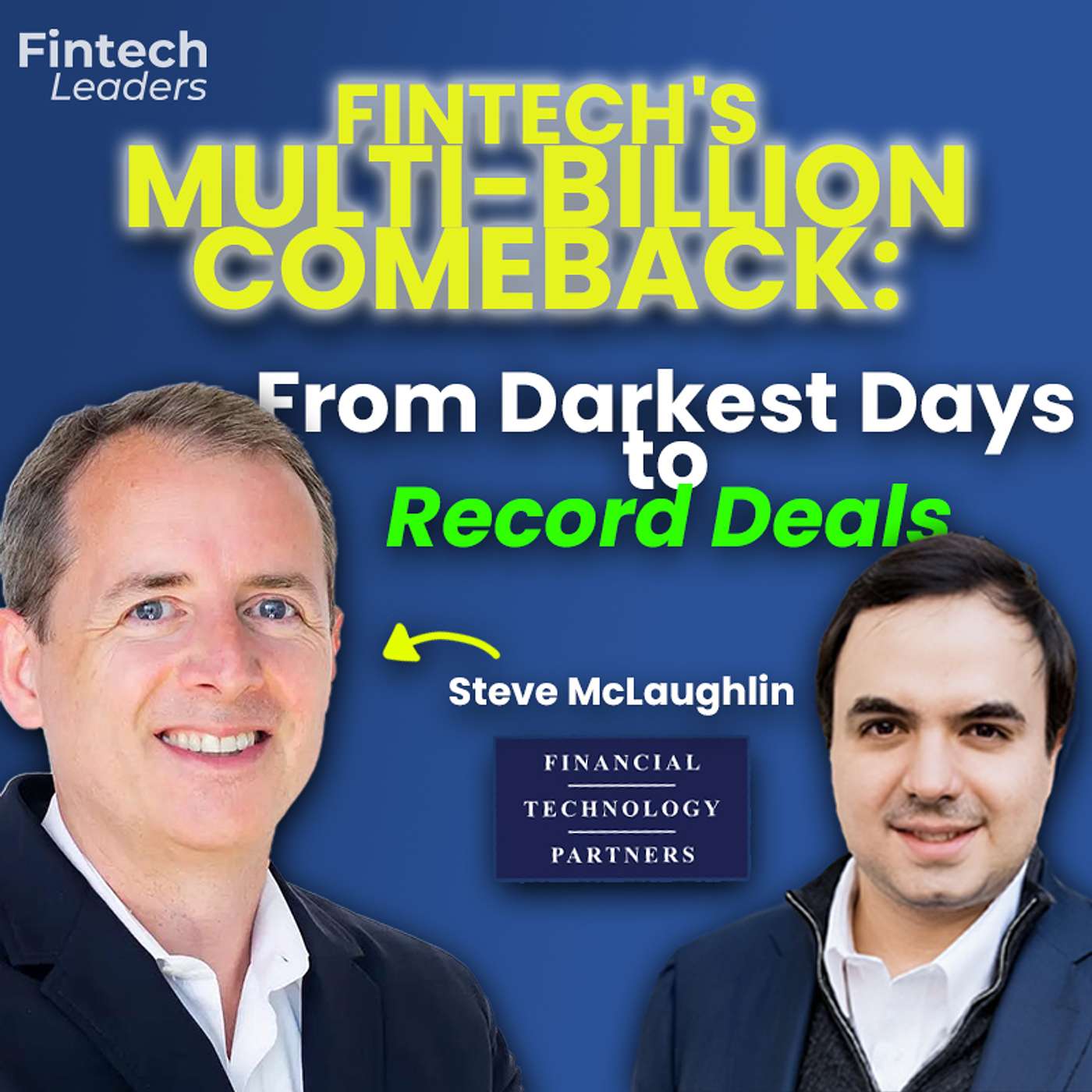
Fintech Leaders
FinTech's Multi-Billion Comeback: Steve McLaughlin (FT Partners), From Darkest Days to Record Deals
00:30:30
Loading summary
Transcript32 lines
- [00:00]
A
Right now you're seeing companies that took note of what went wrong, you know, leading up to 20 and 21. And they're not doing those things right. They're not spending to oblivion, they're not trying to market for marketing's sake. They're using AI, so they're building products with a quarter of the capital that it took before late. 23 is probably the darkest part of the fintech journey, even the last 25 or 30 years, because I lived through the whole.com up and down, lived through the whole 2002 to, even through the financial crisis, things are well in FinTech. But so 23 was that that year where like nothing really was getting done. My prediction is in 20 years, every single asset class is fully tokenized. What is going to happen to financial services is going to be unprecedented. I mean, it is going to be the wave of all waves of FinTech.
- [00:51]
B
Speaking of AI, animal spirits are high both in private and public markets. Are they ignoring any of the Fintech lessons from 21?
- [01:00]
A
That's a good question.
- [01:01]
B
Welcome to Fintech Leaders. I'm Miguel Arma and I'm fascinated by the company's reshaping financial services, which is why I co founded Gilgamesh Ventures, a fintech fund where we have backed almost 50 fintech companies worldwide. And over the last five years, I've recorded over 350 conversations with the top leaders in fintech to extract how they think, what they've learned and insights that can be helpful to builders in fintech. I recorded this episode at Fintech Nerdcon in Miami with Steve McLaughlin, founder and CEO of FT Partners, the largest fintech focused investment bank. Since 2001, Steve has built a 250 person firm that has advised on landmark deals including Coinbase's $4.3 billion Deribit acquisition and Revolut's multi billion dollar raises. FT Partners works with everyone from early stage startups giants. In this conversation, Steve shares his unfiltered views on fintech's dramatic recovery, the tokenization revolution, and why AI will completely reshape financial services. Steve, this is the third podcast that I'm doing with you.
- [02:21]
A
Third podcast. Oh my God, this is. Third time's a charm, right?
- [02:25]
B
Absolutely. Won't be the last one, I promise. No, no, no, Steve, I consider you kind of the central node in fintech.
- [02:32]
A
Oh my God, you know what's going on.
- [02:34]
B
You know everything. Tell us about the state of the market today because it's certainly more active than our last recording, which was late 23.
- [02:43]
A
Oh my God, late 23, the best of times, the worst of times. I guess late 23 is probably the darkest, you know, part of the fintech journey. Even in the last 25 or 30 years in my opinion, like as I lived through the whole.com up and down, lived through the whole 2002 to, even through the financial crisis, it was, things are going well in fintech. So really that to me it was just so good leading up to 21 that in 22 for us you had a lot of things happen in 22 that were a result of 21 activity. But so 23 was that that year where like nothing really was getting done. I mean we did get a bunch of deals done but like in, in, in, in a broad way it was pretty slow. Right now, you know, we're at the tail end of 25. So Trump's been in office for a year, he's been great for crypto. Fintech I think is probably as good as it's ever been right now. And that doesn't mean that valuations are where they were in 21, they're not. But I would say that the number of high quality companies at all levels is significant. We're meeting companies with, you know, 1, 2, 3, 4, 5 million of revenue that are just crushing it, that really seem to have their, their tech stack down, they seem to have their product market fit, they know what they're doing. And what I've been saying is that like right now you're seeing companies that took note of what went wrong, you know, leading up to 20 and 21 and they're not doing those things right, they're not spending to oblivion, they're not trying to market for marketing sake, for growth's sake. They're using AI, so they're building products, you know, with a quarter of the capital that it took before. So I just think there's a lot less mistakes being made, there's a lot more people taking advantage of the technologies that are out there today. And I think the business models are, are where they need to be. So the early stage, we're looking really good. I think mid stage, you know, companies, you know, you know, 10, 15, 20 million of revenue, up to 100 tons of those great companies in all spaces. Insurtech, even back. And InsurTech was a dirty word for a while. Crypto is doing great capital markets. Tech is going, is going great. You know, companies like Capitalis for example, you probably never heard of it.
- [04:46]
B
I have.
- [04:46]
A
But you have, most people have, of course. Yeah, yeah. I mean, just these Guys are crushing it. You know, then you look at companies like in 2020, whoever heard of Tether, right. They're now, you know, talking about half a trillion dollar valuation growing like a weed, you know, and that's at the mega company, right? So you look at the revoluts and things like that, who we raise a lot of money for. So, you know, I think right now is a heyday. I think what's tough right now is if for whatever reason you weren't able to get Escape Velocity and you had to cut costs and, and you're flat or you had to cut costs and you're growing 5% or you had to cut costs and you're. Then I think M and A is tough. You know, people don't want to buy flat companies, right? People don't want to buy decreasing revenue companies. People don't want to buy companies that have upside down unit economics. So I think there's like a bit of a dead zone of, or a zombie zone of where pretty good companies out there that just weren't able to really scale up. And it's hard to get capital from equity, it's hard to get debt capital. So I think you're going to see a lot of M and A at depressed prices and I think you'll start to see a lot of mark to markets coming down on a lot of assets. But I think yeah, by and large it's probably one of the more positive moments in time. I think we're bursting at the seams. We're signing up more engagement letters than we ever have, closing more deals than we ever have. And that's mostly, I'd say the back half of 25 or the maybe the middle half so far. And then the back quarter is fine. But I think 26 will be a blowout year for us. And yeah, and that's across the globe, across sectors. So I think the state of fintech's really good right now.
- [06:16]
B
I've seen FTSE partners announce some incredibly large deals both on the financing, new rounds for companies or also IPOs or even M and A. What have you learned about the most recent deals? How are they different from let's say three, four or five years ago?
- [06:34]
A
Yeah, I would say on strategic, it gets kind of back. What I was saying, there's many, many types of deals. But like for example, let's name actual deals. So we just sold a company called Forge, which a public company, for $670 million to Schwab. They were losing $62 million a year. Right. GAAP earnings and Schwab, amazing company, the big brand, they ultimately realized that the private market so forged is a private markets marketplace basically. Right? So and Schwab is saying hey, we've got 30 billion or x zillions of dollars of RIA assets looking for privates, so we want to get something in this space. So they look through the earnings, through the valuation and paid a strategic price for a company that was I think in demand by other companies. But they won the deal. So it's a really strategic price. They weren't looking at 20 times EBITDA or X times gross profit. They just said look, we can do a lot with this company. So there was a really strategic deal. We sold another company called Avid Exchange which has been a client since 2009, met them when they were worth $20 million and sold it for 2point something billion dollars, let's just say. And that one was TPG and CorePay kind of coming together. So kind of a combination of an LBO player and a strategic corepay bought a third of it, TBG bought 2/3 of it. So you know, there's a deal where a company had kind of had gone public, hadn't reached escape velocity, was very profitable and they paid a big multiple for that. So you're seeing like a lot of different types of deals get done. There's rumors of the bvnks of the world, of the zero hashes of the world which are great companies getting bought from multiple billions of dollars, you know, on, you know, probably sub $100 million of revenue. So you see stuff like that out there. So you know, in the crypto space you're seeing people really pay up for assets. You know, we sold Deribit for $4.3 billion largest ever, believe it or not, for all the crypto stuff that's happened for 10 plus years, the largest deal in the history of the world has been the Deribit sale for 4.3 billion to Coinbase. We also sold Hit and road to ripple 1.25, the second largest M& A deal in crypto. So. So you're starting to see some of the big strategics come out of their shoes to get more big and more institutional, diversify their product set. Coinbase, which people think of as a US company but Dermot, it's really international going, not doing business in the US in a whole different product set than Coinbase. So now you're seeing Robinhood buy things. We just sold them a company called Wonderfi. So they're now getting big into crypto etc. And I think you're going to see a lot more in the crypto space. A lot more tradfi coming over to Defi and Defi going to tradfi. Look at Ripple buying G Treasury. Just incredible, incredible amount of activity right now. I don't have favorites, but I think for the moment my favorite sector is blockchain in crypto. I mean it doesn't take a genius to say that that's a big sector right now. You look at, you know, some of the IPOs and some of the companies, but for me it's finally hit its stride. I was kind of skeptical in the earliest days. Almost invested in Ripple, almost bought a bunch of XRP in the very earliest days, Ribbit and some other funds and things like that that were great. But right now it feels like the whole world is broken wide open for crypto. And I think it's going to dramatically change the landscape of financial services. And I say crypto but I really mean blockchain and crypto. Right. It's not so much a bitcoin phenomenon anymore. I think bitcoin was the test case for does the blockchain technically work? And it technically works incredibly well. And now you've got all sorts of private chains and other types of instruments. I think it's in the, I'd say still in the first inning. I mean. And the thing that gets me super excited right now is the whole concept of real world assets going tokenized and companies like Digital Asset holdings who's just exploding with volume right now or like a braille, who's enabling other companies to create their own stablecoins or securitize who just, you know, got signed up with this back with BlackRock and others mentioned tether, et cetera, et cetera. This mesh payments, you're digitizing the whole payment space for tokenization. So I think it's just the bottom of the bottom of the bottom of the first inning because you know, I think the prediction is, my prediction is in 20 years every single asset class is fully tokenized. And I don't think 100%. I think every asset class would go from 0% to maybe 80% tokens. I think you need 20% of it to be the old school world to price the assets, to work the old school way. And slowly but surely it'll be, you know, 30, 40, 50, 60, 70, 80% and then, you know, someday I'm sure 100. But that's the space we're spending a ton of time in right now in.
- [10:53]
B
That Kind of future. What repercussions, what second or third order effects does this tokenization of assets have?
- [11:01]
A
I think for better, for worse, it's going to be slow but sure, right? I mean asset class by assets by asset class and it'll be just a slow evolution. I think some of the traditional incumbents will, will morph and be players. I mean Goldman Sachs. I just talked to the lead digital assets persons at Goldman Sachs yesterday and they're evolving, right? They're starting to trade digital assets. You know, you talked about J.P. morgan. They'll have the J.P. morgan token, right? So these big banks are, they've got a lot of money, they're smart, they're going to come up with ways to participate in the sector. So I think it's going to be a meshing together of the old world and new world a little bit like how, you know, fintech and digitization of stock markets kind of just led into the New York Stock Exchange. New York Stock Exchange bought Archipelago and NASDAQ went from being pretty old school to buying a bunch of companies and becoming fully electronic. You don't have guys running around the floor with tickets anymore. I do think some old school, old school players will get wiped out over the course of time and look, can hardly believe we've been this long in the conversation. Miguel, we haven't talked about AI. Right, I was just going to go. I'm not talking about Allen Iverson, although he's, he's a legend too. But he's the original AI.
- [12:04]
B
And you're from Philly.
- [12:05]
A
I am from Philly Exactly. In the Dr. J days. But AI is something to behold right now. I mean, sure, we all love ChatGPT, we all love our Grok, et cetera, but what is going to happen to financial services is going to be unprecedented. I mean it is going to be the wave of all waves of fintech with AI attacking every single possible corner of financial services. I've been saying this for, I don't know the whole time I've been in fintech that financial services, such an incredible sector for technology in particular because it's other than, you know, credit cards and verifone terminals, it's an ATM machines which are all going away. It's pretty much 100% a business of zero physical products. So if it's zero physical products, when it's all digital, it's all numbers, but it's paper, it's information, it's risk, it's controls, it's compliance across payments and lending and insurance and crypto and everything. So it's a space where there's so much manual labor, there's so much rework, there's so much error, there's so much fraud that it's just, it's the perfect sector to get massively, massively destroyed by AI. And what I mean by that is the big, big, big insurance companies are going to have to adopt AI tools, and thousands and thousands and thousands of people are going to lose their jobs across all these big institutions. There's no doubt about it. I just talked to a mortgage company yesterday who is working with Palantir and Palantir's new network to come in and essentially more or less decimate the cost structure of the company. Is a pretty big insurance company or mortgage company, I should say. You know, it's going to take several years, but there's no part of that process, almost no part of that process that you really need humans doing. Application checking, IDs, checking all the paperwork, you know, collecting all the paperwork that can all be done and checked and verified in a borderline errorless way. And same thing with underwriting insurance policies and the amount of data that's available to underwrite insurance policy. There's no way a human is going to make a good decision on that. So I think we're an unprecedented, even in our own business. And I'll. I'll give a toot out to a company that we just invested in, so the world kind of knows that we have some capital, that we do make some investments. And we just invested in a company called Model ML that I bet you most people on this podcast have never heard of. It's. It's a company that is effectively trying to create, effectively call it for short, the open AI of investment banking or financial analytics, financial analysis, with the stuff that banks and brokers and VCs and private equity firms do, like analyzing companies ripping apart data rooms. So we put a $25 million check into this company, Model ML. We led the round. We led a $75 million round. Hopefully by the time this podcast comes out, there's a press release. It's not known as we sit here and speak it. We'll coordinate at NerdCon. A lot of nerds here, by the way. I look around. But anyway, so these guys have a platform that's able to, for example, look at an entire data room with a thousand files and folders and models and decks and, you know, PDFs and Word documents and literally look through every single document and create effectively a first draft of an investment Committee memo or a pitch deck or an evaluation deck or an overview and do the evaluation and do the comps and look for buyers, you know, and find errors between all the files and look through all the audits. And you know, you think about agent by agent by agent. This agent is going to look at all the audits and pull that stuff out. This agent's going to look at all the models and pull that stuff out. This agent agent's gonna look at all the decks and pull that stuff apart. Then this agent's gonna start comparing everything and then this one's gonna start building a presentation and this one's gonna edit the presentation. This one's gonna ask questions of you. And that's just a very broad scrape of a data room. But if you start talking about I'm gonna have a whole set of agents that just build models or just look for investors. For example, I would say F2 Partners is the best firm in the world if you wanna find a list of investors who invest in your company having done deals for 20 something years, the list that we created for a thousand companies and, and knowing who does what to whom, like we're going to be really good at that. But we're not going to be as good as us plus AI because I will tell me, well, what were the thousand growth equity investments made in the last week? Who made them? What trends are we seeing from those investments? And who might invest in XYZ Stablecoin company. Right. Those insights we're already starting to see, you know, in some of the analysis and AI that we're using. So I just think it's something we're doing for our clients, not so it's not for us to save money or be efficient internally. You couldn't really care less about that. It's about how do we get a better answer for the clients. Because in six months there probably shouldn't be a deal done where the buyer doesn't hire a company like Model ML to rip through 100% of the diligence information, read all the legal contracts, right? Rip through all the models and then summarize it and find where all the errors or omissions are in whatever's in the data room. So if you're selling a company, you're raising money, you better do that first. What is someone else going to like accidentally, inadvertently find? Even if it's just an accidental error or whatever, we're kind of providing those tools to our clients on the sell side so that the buy side gets a more crystal answer of how the company should be evaluated and that there's no surprises. We've been doing that kind of thing with our data science team and our financial forensic team for years. But you start adding AI and ML and it's wild.
- [17:16]
B
Yeah. And I know you have a lot of data and a lot of research internally. What does a tool like modern Model Model, what is a tool like Model ML do to the nature of the entry level job at FT Partners? How does it change?
- [17:30]
A
It gives everyone superpowers. It won't eliminate a single job. Right. At FT Partners. And if anything, we hired 25 more people. So if you're listening to this and you're a complete baller, hardworking stud, amazing. Apply investment banker. Yeah, shoot us a resume. But no, it's. But if I'm an analyst and someone says, hey, go check this book for errors and I can hit a button and in 15 seconds it has checked the book and it will find 15 little things that are wrong with the book that would have taken hours and hours and hours to find it. And it will find things you would never found. And when it's done, you won't find any errors. Or if you say, go build a DCF model with 16 different scenarios, go calculate the WAC, go calculate the beta, it'll be able to do all that like in 10 seconds, right? And then you could say, well, actually, you know, I want to build out three more years and lower the growth rate each year by 15%. It can do that in 10 seconds, right. So it's going to make analysts much more faster, much more efficient to do the basic road thing. So much of banking is you have all this information in your head and you know literally exactly what to do to model it, but it takes you hundreds of hours to do the modeling. But if you could just sort of tell the AI, take these source files, look at every other model I've ever created, right? And say, I want a multi continent model. I want to break it out into these four lines of business. I mean, you do have to tell the machine what to do, right? To some extent. But it can take a stab at it. And you say, well, how did it do? Now let's improve upon that, let's improve upon that. And so one of the things that we're doing as a firm Model ML, as part of the deal that we did with them, we're going to become a lead design, the lead design partner for them. So they're looking for like the most intense, call it elite investment banking experience. And saying what would the most intense investment banking experience be in building models and building decks and looking for buyers and looking for investors and building data rooms and analyzing data cubes and all that kind of stuff. And so they're going to install at least four full time employees in the company. Looking at all of our workflow, looking at how we do things and how it could be done better, what's the most deep work that we do that's highly repetitive, that takes a lot of time, and we've already got a list of 20 things that they can sink their teeth into. So their product isn't fully, fully developed yet. So they're going to be fully developing it with us. So we're like one of their design partners and we'll be a key design partner for them. So it'll be, it'll be big.
- [19:44]
B
Speaking of AI, animal spirits are high in AI both in private and public markets. Are they ignoring any of the Fintech lessons from 21?
- [19:54]
A
That's a good question. I mean, it was something like AI. I think the difference is you have to go for it, right? If everyone knows this is big, I'm going to go for it. And by the way, the lessons from 21, because they're so fresh. The thing I love is that if you're taking this kind of risk now, you know you're doing it, the investors know you're doing it, everyone knows it's super risky, but you're doing it anyway. And I think that's the essence of venture capital, right, where you're really taking a risk. Model ML is a good example. They're going to put a lot of money into developing code and doing design partnerships, but they're not going to put like any real money into just stupid marketing like throwing parties, getting fancy offices. Hopefully I'm talking to you, Chaz. So we got to, we got to be kind of frugal, but we want, we want to go kill it too. So we want to, we want to go build a big business in a very, very smart way. If the money all goes into product and you're building product at five times the speed, at one fifth the cost, the product can be just that much more incredible. So I think if you were to use AI to look at everything I've ever said on every podcast, how many times I've said, we're product people, so we're bankers, but we understand product. We built our own product. We built our own databases, our own systems internally. We don't use salesforce, we build our own deal cloud type platforms. So we look at our clients products and say that's where the money has to go. We just invest in a company called, well, I can't say the name of it, but it's a very broad platform that competes with an existing incumbent. But they built the whole platform and it's better than an incumbent with a $15 billion market cap and they built the whole thing on like $10 million programmers in Pakistan, you're making $12,000 a year developing at high end AI rates of productivity, using high end AI tools, develop a high end AI product. So I think that putting really good money to use in products. So I'd say yes, I think the money is being better raised at more fair prices in most instances. Someone was saying the other day that, you know, they think OpenAI is going to zero because they're just spending way, way too much money. They're burning ridiculous amounts of money to create something that obviously they think is worth many, many trillions of dollars. But you know, there's a lot of people, not me by the way, that say, look, there's going to be 15 of these things. They're all going to do the exact same thing and that's going to be a race to the bottom. You're not going to be able to really make any money because you're just kind of providing the same service and it just takes too much compute to do all these things and too much storage and too much energy and everything else. So who knows? I don't think that's the case. We just invested in anthropic ourselves so at, you know, some crazy evaluation, $300 billion or something. So we're excited about these businesses on that point.
- [22:22]
B
How connected is the faith of fintech to the rest of the market? Nvidia, all the hyperscalers, the foundational model companies, if that were to, you know, go through a decline or a rocky period over, you know, the next few years. How connected is fintech?
- [22:39]
A
I don't think it's like directly connected. You know, if Nvidia blows up and some Chinese company starts creating chips and that's fine, who cares? It shouldn't affect fintech. But my guess is if it blows up, you know, it's probably not good for anybody, right? I don't think of it that way. I just think people need to have more faith in fintech. I mean, like, okay guys, just because XYZ companies blew up and someone overpaid and they lost money, that's too bad. Like that's, that's, that's called Venture investing, do your diligence, you know, and be prepared to lose some money and hopefully you're gonna have some wins, some losses. And some of the best investments made were probably during 22 and 23 when fintech was dead. If you could get into Revolut at 20 billion, right, or get into Stripe at 40 billion or get into Klarn at 5 billion, right. That was the time to really dig deep and get into Fintech. So I think Fintech, there's one lesson is, and I say this, I'm more confident about this today than I have ever been and I've always been a big proponent. The fintech space defined the way we define it which is like you know, technology touching financial services. To me the opportunity is bigger than ever. And the reason why Insurtech kind of I think flopped is because insurance companies themselves are so old school, so slow to change, right? And consumers don't buy insurance that much. But I think in the world of AI these insurance companies have no choice but to change. They will be extinct without buying AI tools. So I think by the way one thing that's been a bit of a revelation is like the fact that Palantir is now creating really, really high powered tools to go into these financial services. So I think it's not just going to be fintech companies, it's can be people like Palantir and others but at the same time there will be brand new insurance companies built from scratch and brand new tools in finance. There's another company we're talking to, I can't say the name of it but they're raising money to go essentially compete with, sounds hard to say with a startup competing with Palantir but create their own versions of Palantir for specific verticals. But I think it's a bit of a question will the Palantirs over the world win or will these vertical solutions win within financial services? I think the jury's out but it probably is.
- [24:34]
B
I think this is also the year that the rest of the world, people outside of Fintech, unlike us rest of world has realized that Fintech is going to produce multiple hundred billion dollar plus businesses across many geos. Right? Not just tribe, not just Revolut, there's a lot more. One that I wanted to ask you about because I know you're close to them is Bilt Bilt and I think it's a misunderstood company by the market. Maybe talk a little bit about them.
- [25:02]
A
Yeah, so first of all the one thing I'd say is the thing that makes companies Great. Are the leaders. At the end of the day, Nick Stronsky, you could strip that guy of every dollar he has, throw him on the street naked, penniless, and he would pop up creating another trillion dollar company. I have no doubt in my mind. And Ankur is one of those kind of guys, you know, who just, he's a force of nature. I've never met someone is so well connected, so smart. So he is the full package, this guy. And, and he's built an incredible company where he had a vision, right? He saw that there was an unmet need of, you know, renters, right? Where there's, number one, renters have a lot of issues, right, in terms of like trying to find the right apartment, you know, trying to pay their, their rent and, you know, not getting any cash back, not being able to use credit cards. So he, he kind of like took that whole world of renters and said, you know, what if I just go renter by renter? It's, it's, it's a, it's a B2C play and that's, that's a race zero, right? So I said, look, I'm going to go top down. I'm going to sign up, quote, unquote, every major property owner in the country, right? And eventually the world. And then as I do that, I'm going to become their payment provider. And it's sort of, you know, have it so that everyone in every unit of every building has to pay using the built payment network, right? Well, once I do that, then I can, then I've got an app in every single renter's pocket across the country. And then I can start serving them up rewards cards and things like that. So he kind of created this movie massive closed ecosystem that now I would say impossible for others to kind of break into in the way that he's done it. And he can serve up product after product after product. And now that he's got all the renters, those renters then become homeowners and there's homeowners associations. Same thing with so kind of create this incredible closed loop ecosystem that he's able to monetize in a credible way. And then you say it's a misunderstood company. And I wouldn't say by the people that spend time with them. It's not misunderstood. Right. The people that think it's a credit card company or, you know, a plain Jane payments company that don't understand the closed, highly network effect ecosystem that he has are really missing out. And of course, since we just helped Them raise hundreds of millions of dollars at 10 to 11 billion dollars in valuation. People start to say, wait a minute. Well I didn't understand that coming before but they must be doing something right if everyone's throwing money at them and FD Partners is working with them. So yeah, we're huge fans of those guys and it's a company that's just a juggernaut.
- [27:18]
B
I had a chance to spend some time with Anchor last week and he's coming on the, on the pod.
- [27:22]
A
Oh perfect.
- [27:23]
B
And your name came up obviously, hopefully said good things. Yeah. So Steve, before we go, tell us what has you, I mean you've kind of answered this question, but what has you the most excited about fintech in the short term and in the long term you really are at the center of everything.
- [27:43]
A
I could talk about this sector, that sector, this geography, this type of company, but to me in a weird way is building our own company. Right. You know, we have 250amazing people that come to work every day or work from home as well. They are just incredibly smart, hardworking people. And I, I had to give you know, some pep rallies during some of the periods of time where it was harder to get deals done. It said, you know, look what we do. Never ever, ever goes out of style. Doing super deep work, being super earnest, you know, supporting founders, supporting VCs, supporting companies and in growing and getting that much, much, much needed capital or M and A that they need, it's, it's super fun like building the team and inventing all these things that we've invented and getting into AI ourselves, building our own technology, you know, breaking records on valuation in every single sector and then seeing the smiles on everyone's faces when we do good things. And I'm seeing people that I knew when they were like kids, you know, grow up to be real adults. And a lot of people that are MDs here were associates trying to figure out how to do, you know, all the analytics that we do and how to learn fintech and now they're 40 year old complete baller people winning deals, executing deals and doing great things. So to me the most fun thing is just getting to know all the entrepreneurs and doing deals and like I said, building our own company. At the end of the day people forget like, oh, we're a business, you know, it's not just like we're doing a couple deals here and there, you know, we, we've got a business to build and you know, gaining equity value and building a team and building a reputation and Building a brand and building client loyalty and that, that kind of thing. So to me, you know, just like, always think of my team and how thankful I am for everyone coming to work every day and being winners and, you know, being there for the great moments, the tough moments. So. So, yeah, that's probably the thing that's most exciting to me. It's like, if you have. Look, if you don't love what you do, what's the point, right? If I ever stop loving what I do, then I'd be shocked. But because I love this job. You just said to my wife, dude, I'm like, I actually love my job. I actually said that sitting at my house, I love this job. There must have been like six good things that happened that day. Some days they're not as good, but, you know, I really do think that way. And, And I love seeing my team members succeed. You know, that's. That's probably the biggest, most proud thing. You know, I've seen companies succeed. To the clients, it's great, but the people that help, you know, build the company, that's probably my pride and joy.
- [29:50]
B
Yeah. And we, we always enjoy working with you and your team and appreciate all the support.
- [29:55]
A
It's. It's great being a friend of yours. And from the back in the Wharton days to. To here at Fintech Nerdcon, a bunch of nerds. The nerdiest place around. Anyway, good to see you. Thank you, Steve. Ciao.
- [30:07]
B
Thanks for tuning in. I hope you enjoyed. If you want more interviews, make sure to subscribe, follow and leave a review on Apple Podcasts, Spotify, YouTube, or wherever you get your shows. It helps and truly means a lot. And if you have any suggestions or thoughts, just drop me a line on LinkedIn. Signing off till next week. I'm your host, Miguel Armasa.