← Fintech Leaders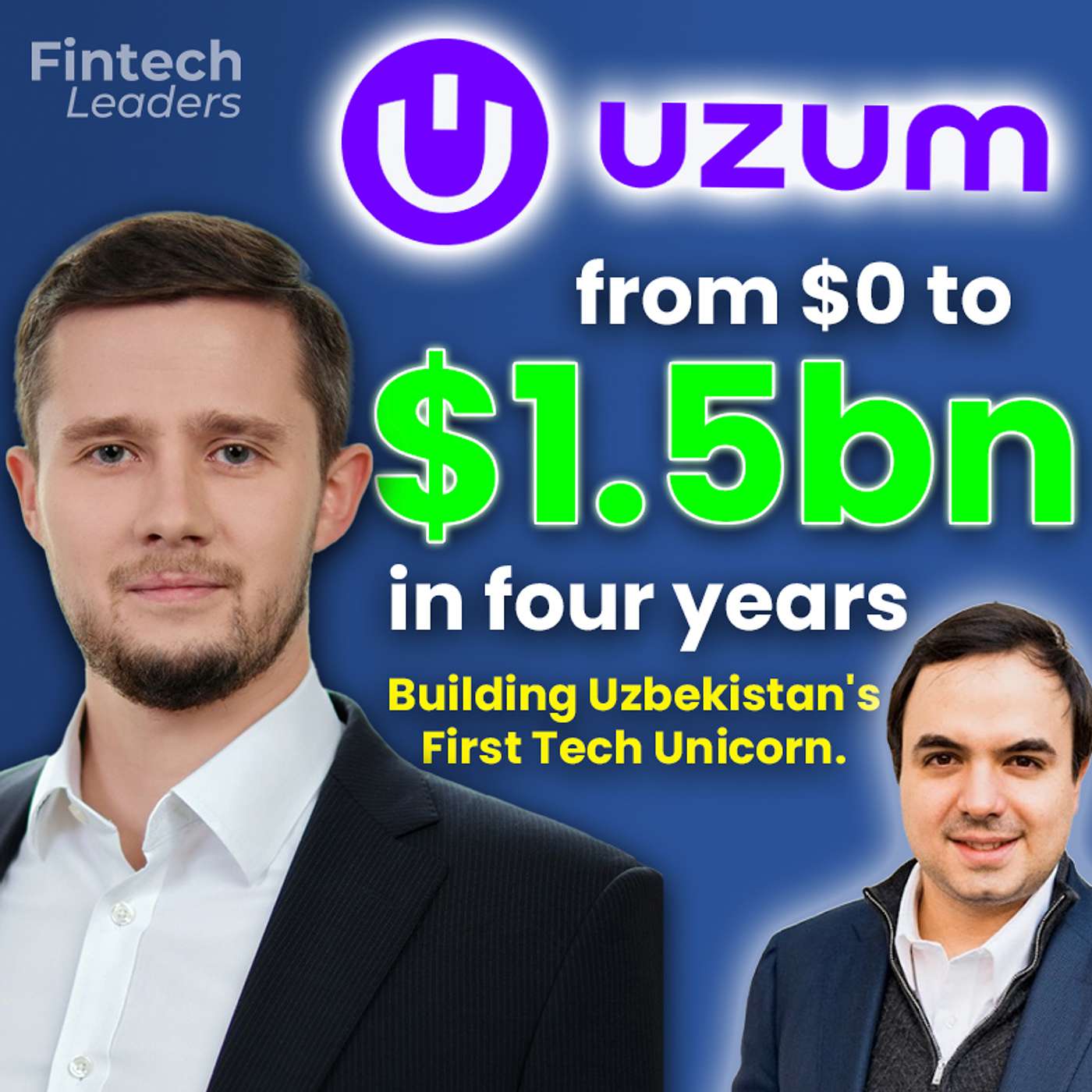
Fintech Leaders
Uzum, from 0 to $1.5Bn in Four Years. Building Uzbekistan's First Tech Unicorn. Nikolay Seleznev, Co-Founder
00:38:03
Loading summary
Transcript60 lines
- [00:00]
A
The forecast for the first full year of operations was either 25 or maybe 35 million in GMV. The gross merchandise volume, that's the amount the marketplace processes over a year and we did 150 million that year. Everyone has a smartphone. Uzbekistan, if I'm not mistaken, leads the region in the use of AI. The country is basically it's trying to leapfrog the agricultural society to modern technology driven country that has its place sort of at the big table to achieve great things, do things that needed a plan and not quite enough time.
- [00:35]
B
Welcome to Fintech Leaders. I'm Miguel Armaza and I'm fascinated by the company's reshaping financial services. Which is why I co founded Gilgamesh Ventures, a fintech fund where we have backed almost 50 fintech companies worldwide. And over the last five years I've recorded over 350 conversations with the top leaders in fintech to extract how they think, what they've learned and insights that can be helpful to builders.
- [01:04]
A
Fintech.
- [01:05]
B
I sat down with Nikolai Selesnev, co founder of Ozum, Uzbekistan's first tech unicorn that's redefining e commerce and fintech in the country. In just four years, Oozoo has grown into one of the fastest growing e commerce and fintech companies out there. They've reached over 20 million monthly active users, issued 4 million debit cards in 2025 alone, crossed 150 million in net income in 2024 and and crossed a $1.5 billion valuation backed by Tencent. We discussed how they built a next day delivery marketplace in a country with no warehouses or 3 PL infrastructure, why they believe time pressure is essential to building something great, and how they outperformed their first year GMV forecast by 4 forex.
- [02:00]
C
Nikolai, welcome to Fintech Leaders.
- [02:02]
A
Thank you Miguel, thank you for having me. Pleasure to be here.
- [02:05]
C
Listen, there's, there's a lot to talk about and I'm excited to really dive in in this on the story of oom because the way I understand it, in a matter of four years you and the team have managed to build one of the fastest growing e commerce fintech tech companies worldwide. And that didn't just happen. There's a lot of intentionality behind it. Nikolai, let's start. Maybe tell us about your story and the origin story of Ozone. Let's start there.
- [02:47]
A
Sure, absolutely. But look, since you've phrased the question, one thing came to my mind. I'm what our CEO and founder Djesur Zimaev, my partner, always says to achieve great Things, two things are needed, a plan and not quite enough time. So that would be one of the mottos we live by here and which basically defined what we are building here in Uzbekistan. Going back to my story, I'm originally from Moscow, Russia, studied there, started my career in finance, worked in London and in EMEA in general, then spent almost four years in Kazakhstan and realized that I cannot do anything else but start building something myself. So this would be the origin. The inception came again from Jazor, who's originally from Uzbekistan, born and raised here almost five maybe six years ago, wanted to order something online and realized that the customer experience was subpar. And he realized that the country for a very long time was under the radar for the international investor community, is on the verge of transforming to a completely different thing. So we came, as you said four years ago, we came here to transform how people are consuming all they paying, how basically they to a certain extent leave their daily lives. And it was a very, very rewarding experience. So the inception was a very subpar experience. When he ordered, I think a smartphone and a cover for it online, received several calls from various vendors that we do have that smartphone but in a different color. So it was a very volatile experience, let me put it this way. And we thought about bringing something that the market has never seen before. We came with the idea to build a marketplace with a next day delivery guaranteed across the entire country, similar to, I don't know, Amazon prime for instance, but also with the financial services because again, a country was ready to consume modern digital products.
- [05:08]
C
One thing you have mentioned to me when we talked in the past is that your original plan looks very much like what you are building today. Right. Sounds like you did not have a major pivot, at least about the, the.
- [05:29]
B
Product itself maybe of how you get there.
- [05:31]
C
You actually did, but I'm not sure. But yeah, share that blueprint that you had in the beginning to kind of how you got started, what was the initial product and how the company looks today.
- [05:45]
A
Absolutely, indeed. That's quite spot on. And it's very, very unusual in my experience. If you look at it from the startup perspective when we're sitting in a conference room with Jesur and Roman, another co founder we started this whole thing with. I outlined on the whiteboard strategy of sort of a super app or an ecosystem because I believe that this is, this works really well in Southeast Asia, in Asia in general, and in emerging markets in particular. So the idea was to build an ecosystem where people are acquired with the lowest cac, customer acquisition Cost, then retained on a daily banking product and then monetized through various products, through various things, but primarily through credit products. This was indeed the original plan. And what's so unusual about this thing is that three and a half, four years down the road right now, all the major pieces are in place right now.
- [06:51]
B
How about the pace?
- [06:53]
C
Have you moved at the planned pace? Have you moved faster or have you moved slower?
- [06:58]
A
That's a very good one. We wanted to hit certain KPIs faster. That was the original idea to achieve potentially do an IPO in five years. After the product launch, however, I realized that that might be a little bit too ambitious. And now as the business matures, becomes more and more stable and even versatile to a certain point. It takes in emerging markets roughly 12 to maybe 24 months to do the addition, in addition to the original plan. But seems like we're still on our trajectory to becoming the first technological, publicly traded unicorn from Uzbekistan.
- [07:43]
C
You mentioned at the beginning that your co founder Jesur has a saying that, you know, you need a plan and not quite enough time. That tells me you have a culture that has some aspects of pressure of time pressure. Maybe share a little bit more about that. Why is this important?
- [08:05]
A
I'm thinking about it as time is the most precious resource a person, an employee, an entrepreneur can ever have. You have very limited. If you think about it after I know from 30 to 50 you have like four or five shots at making something big. And we here assembled a eight player type of entrepreneurial team that is ready to execute, that wants to achieve and to build something significant. This is how we operate here. And as a result, this time pressure is not a pressure per se. It's like a component to the equation that's always there and in my opinion helps us to differentiate between the projects, the hypothesis, the options to achieve the best results, to yield the best outcome possible. So we are thinking about it in terms of sort of capital allocation, if I may, but rather time wise.
- [09:15]
C
Another thing you just mentioned is the team that you've assembled, right? I mean it has to be a great team. I have no doubt about that. But at the same time, and I've seen this in other markets, Uzbekistan has been for a while sort of like a tech desert, right? Obviously that's changing now, but definitely five years ago you didn't have a lot of specialized talent in building tech startups. You did have some great talent period. So how did you build your team?
- [09:51]
A
That's a good one. And this is where we can think about it as Solving a chicken and egg problem where you need to bring some superstars, some team leaders, unit heads and key personnel who would help you hire additional talent from abroad. But I appreciate that no big business has ever been built by foreigners. You do need to rely on local talent. This is why we invested a lot in building a nurturing local talent that thanks to all the efforts that are being done by the government, by the ministry and the regulating bodies, who's trying to reinvent Uzbekistan in the modern world, Invest a lot of education, we see that flow of talent willing to learn from best practices and get their firsthand experience working for a tech company. So the situation changes. And this is actually one of the thing that fascinates me so much about working in this market is the sheer pace of the change. Because some people say, hey, uzbekistan is like XYZ country, I don't know, 10, 15, 20 years ago. And product wise, or maybe technology wise, sometimes they're correct in their understanding. But what the thing that they are missing is the pace. So if you've never been to Uzbekistan, I actually invite you to come over and see it with your own eyes to see how fast the things are changing. Because the new Uzbekistan that's opened up to the wider world, not only to investors, to everyone, is a completely different. Cup of tea, if I may.
- [11:41]
C
I've never been, but I'll accept your invitation. We'll figure it out.
- [11:47]
A
Be properly surprised.
- [11:48]
C
When it comes to change, in what aspects of the society is that change manifesting itself?
- [11:55]
A
You won't believe it, but in my opinion, everything undergoes quite a change. Obviously some big changes do not happen overnight. Others take, I don't know, month or even years. But if you think about it from like an economist perspective, you've seen it in Asian tigers, Asian, Asian dragons, several countries that in the late 20th century went through a rapid transformation. Here the country does this, but on steroids. And these steroids are technology. Technology is ubiquitous. This is the first country in the CIS region, the former Soviet Union bloc of countries with the 5G Internet that's available across the country. Everyone has a smartphone, everyone is Uzbekistan leads, if I'm not mistaken, leads in the region. The use of AI. The country is transforming. Basically it's trying to leapfrog from the agricultural society to the modern technology driven country that has its place sort of at the big table.
- [13:09]
C
So Nikolai, let's talk a little bit about the product. Tell us what was product number one. And today I believe you have six business units, maybe more. Give us a map of how OSUM looks like today.
- [13:25]
A
That's another unusual thing about ozum because late 21, very beginning of 2022 was a unique moment in Uzbekistan where it was still, as I said, under the radar for the majority of both investors and operators. And we came at the right time and we had this head start opportunity, that is we launched several business units at once. The first actually came the Ozum market which is a 3p next day delivery guaranteed marketplace. We operate across the entirety of Uzbekistan. We are omnipresent in every city, town, settlement, village, hamlet, you name it, 10,000 plus inhabitants. We are there next day with all the assortment of products. Then we added food delivery business. We started in the capital in Tashken. Now we operate in more than 20 cities and we're very pleased with the results. And this is actually confirms the idea that it's not about sort of the capital versus the regions, which is sometimes the play in the emerging markets. Every city or smaller town is ready to consume your products. And this is what's so unique about the country. So these two products, they cover our commerce vertical which is now in my opinion leapfrogging even the modern retail. Because when we arrived the majority of retail was happening on street bazaars and you won't believe it, but the biggest, the largest street bazaar had only 80,000 SKUs on a given day. SKU is a stock keeping unit. Basically this demonstrates you that the assortment was not there and now they have millions and millions of SKUs available at their fingertips ready to be delivered to their pickup point. So that's our commerce business, Fintech. If you think about it, you can think about it as a funnel. That's why I'm saying the ecosystem play or ecosystem strategy. So we primarily acquire, retain and monetize people. On the fintech side we have a neobank that's comprising of a typical neobank and the most successful product there we have to date right now is a debit card that comes with a pre approved credit limit attached to that, essentially turning that into a quasi credit card for the population of 40 million that was drastically underbanked and under serviced. In terms of your convenient modern fintech products, can you imagine that? I think in 2020, 50% of all the adult population in Uzbekistan didn't have a bank account. Half of the population. What makes it so unique is that out of the remaining 50% however only 3 to 4% had any actual money on it. So it was a very, very cash driven country. Over the course of just last year, with the product that we launched in late 2024, this debit card, we issued more than 4 million of those. So people are using it both as a debit card and as a credit card whenever they need something extra, when they're paying or buying something, paying online or buying something offline, it's essentially a credit card. This year we plan to add additional products to improve our product offering on the Neobank because in my opinion, we're just scratching the surface. The potential hits here is huge. And again, we're very, very happy to, you know, operate in this market.
- [17:18]
C
You mentioned having millions of SKUs 4 million accounts with the card open last year. Any other numbers to give us an idea of the scale and size of the company?
- [17:35]
A
So Uzbekistan is a roughly 40 million nation. More than 20 million unique users are using one of our products at least once a month. We are also targeting or focusing on the repeat users, those who are using our fintech solutions, for instance, more than 20 times a month. Those are like the core group of users that are now transitioning from other banks to Ozone bank, where they are now turning essentially into their primary bank account. And that is why I'm saying that 2026 will be the year of our product focus, to work harder on that one and bring more innovative products for Uzbekistanis in Tashkent and in other cities.
- [18:26]
C
Is there something you learn about reaching mass adoption? And, and the reason I'm asking this is in a country that is less digitized than most, that also leads you to assume that it's a country where people used to shop online a lot less. And I remember when I started shopping online, you know, you're not so trustful of every website out there, right? So how did you build trust to reach mass adoption?
- [19:02]
A
The short answer, and this might be the repeating theme across Zoom in general or maybe even across emerging markets, is investing in infrastructure. Indeed, people have very, at first, quite few of them have trust in shopping online. And given that the majority of their user experience was subpar, in my opinion, obviously they do have very little trust to try something new. And this is why we invested in both the warehousing facility to ensure on our next day delivery SLA. Because when we arrived there were no warehouses, no 3 PL players, no trucks to to deliver across quite big a country actually. Then we invested heavily in pickup points, the poodles. So this is the thing that allowed us to start our digital journey where people can actually come and see, they can try and even do returns if they don't like something. And these islands in the sea of Uncertainty allowed people to gain some initial trust. That's why on the marketplace side we also developed our own trademark called Oil Autonomy, which can be translated as a family choice. We do have Roughly, I think 100 to maybe right now, up to 200 different SKUs that act as a customer acquisition cost for us. Really these are the products of a decent quality that people can easily try themselves, starting from, I don't know, cooking oil, sunflower oil or some canned products, FMCG goods, T shirts and other stuff that people can order, try themselves and figure out if they trust the service or not. This turned out to be a very good customer acquisition tactic for us. Just one of them. To give you an example on the fintech side, for instance, given that we are also investing heavy in the infrastructure and developed our own processing capacity within our Zoom bank, allowed us to drop all the commissions for the peer to peer transactions to zero. Because essentially you are just moving bits of information within the server of a bank. It cost me nothing. It allowed us to gain a lot of trust and as a result became another customer acquisition and retention tool for resume. There's just a couple of examples that come to my mind very, very naturally here.
- [21:59]
C
So last year it was announced that you had a pretty big raise and you became a company with a valuation of over 1.5 billion, which obviously is a fantastic milestone. Maybe share your fundraising journey prior to this big round that was announced because I know you've had to be efficient but also sure, it wasn't easy raising capital.
- [22:28]
A
Yeah, absolutely. We did our first fundraising round in the spring of 2024. The round was led by Finsight Ventures, a US VC firm who invests a lot in India. And it was a very natural step for them to consider something. They also do invest in E commerce and fintech globally. So it was a very natural and close for them in terms of their education on the subject matter. But yeah, indeed, you're 100% right. This round we did was I think 70 million, the original round, plus some debt to fund our unsecured lending business. This was the first funding round made as a unicorn in 2024 and we spent almost a year trying to find investors and interest because it wasn't about us or our story really. The feedback we received was that, well, we understand the team, we understand your execution capacity. The strategy is very clear for us, the numbers speaking for themselves, but it's about, you know, very something, something unknown. No one has built a technological unicorn out of Uzbekistan before and it's always a little bit hard to be sort of a trailblazer here. After that we, we see a lot of attention both on the VC side to Uzbekistani companies and we, we believe that even though we, we were the first one, we are definitely not the last one. So it helped I think a lot for the local ecosystem to get attention from international investors. And the round you are talking about, the one that was led by Tencent, the Chinese Tencent and US fund called VR Capital, specialist in emerging markets. It was also quite a long process because it was the first deal for Tencent not only in Uzbekistan but in Central Asia in general. Again we are very happy with them supporting us. Opened a lot of doors for us especially in the Southeast Asia region. We see a lot of interest both as from investors and potential partners there. So yeah, we are finally getting above the radar hopefully here in Uzbekistan.
- [25:09]
C
And so prior to these rounds were you bootstrapping?
- [25:13]
A
Yeah, yeah we were bootstrapping. And Jazor is, he's a serial entrepreneur. He built several successful businesses in CIS and in Africa. He sold the majority of them to fund to get initial funding for Uzum for this project. So it's like an all in from, from us which actually was met pretty well by the investors. They appreciate this is like laser beam focus for us on Uzbekistan and on this project.
- [25:45]
C
Yeah, yeah. So let's talk a bit about your approach to building the infrastructure. Right. You've been in hyper growth mode the last four years. How do you prevent your infrastructure from breaking down? Right. I'm sure it's not easy.
- [26:06]
A
Right.
- [26:07]
C
What have you learned about kind of maintaining operations but also growing them at the same time?
- [26:14]
A
Well that's a good one. The quick answer would be that that immediately comes to mind. You you need to design it properly so the architecture would be the correct one word response to the infrastructure problem. And we were blessed to work with one of the brightest guys in the industry for the fintech side who had previous experience in designing high load systems. That is why we can be more than sure that our debit, credit card, the payment infrastructure can sustain much more. On the E commerce side it's a constant development and investment in the infrastructure. One of the key learning points for us that it's never enough actually. And I do remember quite vividly the original business plan that I developed. I think the forecast for the first full year of operations was either 25 or maybe 35 million in GMV. The gross merchandise volume, that's the amount the marketplace processes over a year and we did 150 million that year. Indeed, there was a home run in terms of becoming a household name for shopping online. And as a result, at one point our own warehousing facility became sort of a bottleneck for us and we had to improvise, build very light construction, almost a tent to turn it into a fulfillment center while we were building and investing into a proper warehouse right next to it. So a very quick one to have your options open. And while I was saying it, I just realized this is nothing but when it comes from experience it sounds a little bit different.
- [28:11]
C
How about the debate between an ecosystem of apps versus a super app? I know that that's something that you thought about over the years.
- [28:22]
A
Oh yeah, we did. I think either two or three times we changed our minds. As I've mentioned earlier, the original idea was to build a super app up because we were looking at very successful examples in other markets in Southeast Asia or in the neighboring Kazakhstan in the form of Caspi, but then realized that there is no like silver bullet or an easy solution. The thing that we learned is that even though this markets have a lot of in similar, you need to be local and you do need to adapt your experience and benchmarks and everything to cater to the needs of the population you are working for. So right now we to your point around the super app, we started I think with six different apps and as those apps were hitting certain KPIs, we actually began to unite and converge them into bigger chunks and verticals. For instance, in the E commerce vertical you can order something from Tescor which is a food delivery business, through Oozoo Market app and it works really well. We have not converged into a single B2C super app just yet. We do have a separate fintech app, but certainly features are available both in both apps simultaneously. For instance, something very light like peer to peer transactions is available in the commerce app or part of the commerce app is a automobile classified. And again you do receive some promotions and some merchandise in the fintech app so that like slowly converging into a single app. We have not made the final decision yet. We believe that it's like an ABC sometimes type of testing before actually moving to any particular direction or solution.
- [30:38]
C
It's interesting because you have to follow your users, right? What is it about a country where super apps are dominant and other countries where there's basically no super apps like the US or most of Western Europe? What have you learned about kind of user behavior super app versus no super app?
- [31:03]
A
It depends on the country really. That would be the fastest and the most honest question because the original super app idea I think dates back to smartphones being not good enough and, and not having enough memory space for all the apps. And now it's about the, I don't know, the loyalty program that allows you to use several apps. And now maybe we might still have several apps for Ruzum for instance because it's about the capabilities of your technical team to actually support and maintain the two interfaces. Whereas on the backend they are using the same infrastructure up to a certain point. So it really depends on the user and their behavior pattern changes a lot. So I cannot say there is a single solution. Why? For instance, in Central Asia people tend to have super apps. I actually see that sometimes it's really the battle for attention and if you can have enough, let me put it this way, interesting, stimulating stuff on the app that allows you to continuously engage with the user. You can add additional functionality. Sometimes it is driven by relatively lower or higher, for instance financial literacy or literacy in general. There are some other markets outside of Uzbekistan which are much bigger that do have, I don't know, 75% literacy rate, which is not the case for Uzbekistan thanks to, I don't know, the Soviet Union, 100% people here are literate and this completely changes the pattern and the UX UI ways of the user. You can have have a little bit more complicated products compared to some other markets. The only advice here is to adapt to the local market. That's I think the only way you can look for other ways and get some inspiration from them. But you do need to study your own customer here.
- [33:25]
C
So let me ask you this, what's the vision down the line? I know you mentioned IPO is something that is part of your goals, but beyond that, what's your vision for Ozum?
- [33:43]
A
Look on one hand side we are now 100% focused on Uzbekistan and I've seen too many entrepreneurs doing geographical expansion or some other sort of expansion too early, too fast, without properly winning your local market. And we do not want to do that because Uzbekistan right now is such a unique place and we're just really getting started. I believe there is a lot of Runway for future growth here. Want to focus on Uzbekistan on the other side. And this is where I put my head of strategy hat on. I do see a lot of potential in the Central Asia region here to disrupt both how people are consuming and shopping coupled with, with the fintech services. A lot of people are still underbanked here and under serviced. I see a lot of potential to do that. But again, up until ipo, that would be like one or two steps down the line. We want to stay super focused on Uzbekistan.
- [34:52]
C
Before I let you go, I have a couple of quick questions. Any books that you often recommend or that you are a fan of?
- [35:04]
A
That's a good one. I would say. One thing that comes immediately comes to my mind actually. Two of them thinking fast and slow and from zero to one. That would be my two recommendations. I think they're so famous and so helpful for the builder, for the entrepreneur that they need virtually no explanation. Everyone can have a look, read them and find something very, very useful.
- [35:35]
C
Do you have an entrepreneur that you admire, dead or alive?
- [35:42]
A
I haven't thought about it really. There are lots of entrepreneurs who did an amazing job, but I tend to not to focus or to compare myself to them. I do have some inspiration and again, there is a ton of US Chinese and even the guys from the Central Asia region that I admire. But I probably won't call anyone specifically because I tend to focus more on myself and what can I do in that particular situation or can do differently next time around.
- [36:27]
C
Favorite hobby outside of Uzum.
- [36:29]
A
That's a good one. I actually picked up golf in Uzbekistan. There is one and only golf course in, in the country that's in the vicinity of Tashkent and I sometimes during the warm part of the year spend my weekend there.
- [36:48]
C
Very nice, very nice. How about the cold part of the year?
- [36:52]
A
I actually tend to work more. More productive. Yeah. Yeah.
- [36:56]
C
Eli, thank you for, for joining. I. I really admire what you and the team have built at Ozum so far so quickly that it needs to be studied more. So I hope, I hope this podcast helps kind of elevate the brand and all the good work that you're doing.
- [37:19]
A
Thank you. Thank you, Miguel. Always a pleasure to share some good word about the country we live and operate in and the business we are scaling here. Once again, I invite you to come and see it with your own eyes. More than welcome.
- [37:34]
C
We'll make it happen. Thank you.
- [37:35]
A
Thank you.
- [37:36]
C
Thanks for tuning in. I hope you enjoyed this great episode with Nick from Ozum.
- [37:42]
B
If you want more interviews, make sure to subscribe, follow and leave a review.
- [37:46]
C
On Apple, Spotify, YouTube or whatever you get your shows. It helps and truly means a lot. And if you have any suggestions or.
- [37:56]
B
Thoughts about the show, just drop me.
- [37:58]
C
A line on Twitter or LinkedIn. Signing off till next week, I'm your host, Miguel Almasa.