
Podcast
Fintech One-On-One
Hosted by Peter Renton · EN
Fintech is eating the world. Join Peter Renton, Co-Founder of Fintech Nexus and now an independent fintech media and events consultant, every week as he interviews the fintech leaders who are leading the transformation of financial services. If you want to understand what the future will look like for lending, payments, digital banking and more, tune in to Fintech One-On-One.
32episodes
Episodes
Newest firstAll episodes

Why Card-Linked Installments is a Better Form of BNPL With Nandan Sheth, CEO of Splitit
6d ago00:31:37Tap to summarizeNandan Sheth has spent 25 years in payments, building three growth companies along the way, including Harbor Payments (sold to American Express) and Acculynk (sold to First Data/Fiserv). He now runs Splitit, which takes a different path than most buy now, pay later providers: instead of originating a new loan, it turns the credit a consumer already has on their existing card into an installment plan, with no underwriting, no social security number, and no new debit card for repayments. With agentic commerce infrastructure being built in real time, Nandan argues that a frictionless installment option is exactly what merchants need to avoid being commoditized on price inside an LLM shopping platform.What We CoveredThree growth companies across 25 years in paymentsWhat attracted Nandan to Splitit from FiservCard-linked installments with no underwriting or new loanThe card loyalist versus the credit needy$3.5 trillion of unused credit sitting on US cardsMerchant-funded 0% economics and where the budget comes fromA $1,300 average order value versus $250 to $300 for standard BNPLPoint of sale through the Samsung Wallet integrationBacking Google's Universal Commerce ProtocolThe overlooked small business to large supplier B2B use caseChargebacks, repudiation, and who carries the risk in agent-led purchasesSplitit Go for the face-to-face services economyKey TakeawaysBNPL is really two markets, not one. Card loyalists want rewards, protections, and habit, while the credit needy want a new line of credit. Nandan thinks both get served, but by different products.The economics work because the merchant treats it as marketing spend. About 98% of Splitit's volume is a merchant-funded 0% plan, priced comparably to a percentage-off promotion, and it lifts average order value roughly four times over standard BNPL.In agentic commerce, price and delivery speed are the easiest things for an LLM to compare. A 0% installment option gives merchants a third lever that is not pure price competition.The B2B version may be the stronger use case. Small business owners face both a time problem and a working capital problem, which is a sharper reason to hand off buying to an agent than a consumer shopping for a polo shirt.About Nandan ShethNandan Sheth is the CEO of Splitit, the card-linked installments platform. He moved to the US from the UK 25 years ago and has spent his entire career in payments and fintech, including running e-commerce and omni-channel commerce at Fiserv. He previously built Harbor Payments, acquired by American Express, and Acculynk, acquired by First Data/Fiserv.Connect with Fintech One-on-One:Tweet me @PeterRentonConnect with me on LinkedInFind previous Fintech One-on-One episodes
Transcribe →
The $70 Billion Escheatment Problem for Banks, Fintechs and Crypto With Allen Osgood, CEO of Eisen
2w ago00:32:47Tap to summarizeEscheatment is a $70 billion problem hiding in plain sight: every state, territory, and dozens of countries have laws that hand dormant and unclaimed accounts over to the government after three to five years of inactivity. Allen Osgood, co-founder and CEO of Eisen, left a five-and-a-half-year run as a payments product manager at Coinbase to build the compliance infrastructure that helps banks, brokerages, and crypto platforms reunite customers with their money before the states ever claim it. In this conversation, Allen makes the case that crypto is about to collide with escheatment rules written in the 1960s, and that most institutions have no idea how large their own dormant balances really are.What We CoveredWhat escheatment actually is and how the state-by-state rules workThe $70 billion states are holding for more than one in seven AmericansMissingmoney.com and what happens after money is remittedOhio's fight over using unclaimed property to fund a football stadiumThe Walter story: an E-Trade Amazon account liquidated to DelawareWhat counts as a "dormant" account and why logins matterWhere Eisen plugs into the escheatment processWhy reactivation beats remittance, and the Binance.US 48% case studyWhy institutions are blind to their largest dormant balancesThe 12-to-24-month gap where accounts just age untouchedDisplacing big-four spreadsheets with a single pane of glass, forecasting, and access controlsData volume as the hardest engineering problem, and where AI earns its keepThe Claims Portal and QR-code reactivationWhy crypto makes escheatment far more painful, from volatility to dustThe coming wave of crypto liquidations and the tax problemChannel strategy with the cores like Fiserv, and the road to 1099 and tax reportingKey TakeawaysThe best escheatment outcome is no escheatment at all. Eisen's real value is retention: keeping customers, deposits, and assets in the institution rather than shipping them to the state.Institutions routinely underestimate their exposure. One prospect thought it had 10,000 accounts about to escheat, the real number was 100,000. The disconnect sits between the compliance team and the data on the ground.Crypto changes the stakes. States generally require liquidation, so a dormant token gets sold, creating an unwanted taxable event and, if the market rips afterward, another Walter waiting to happen.Stale data is the enemy. The information that comes due for escheatment is by definition three to five years old, so address enrichment (LexisNexis, Socure, USPS NCOA) and early engagement are what actually move the reactivation numbers.About Allen OsgoodAllen Osgood is the co-founder and CEO of Eisen, a compliance operations platform that automates escheatment and account offboarding for financial institutions. Before founding Eisen, he spent about five and a half years as a payments product manager at Coinbase, where he first ran into the strange world of unclaimed property and stayed through the company's IPO.Connect with Fintech One-on-One:Tweet me @PeterRentonConnect with me on LinkedInFind previous Fintech One-on-One episodes
Transcribe →
Why Accounts Receivable Is Fintech's Biggest Untapped Market With Caitlin Leksana, CEO of Fazeshift
3w ago00:33:32Tap to summarizeAccounts payable has produced multiple billion-dollar companies, yet its mirror image, accounts receivable, remains almost entirely manual at most enterprises despite decades of software spend. In this episode, Caitlin Leksana, co-founder and CEO of Fazeshift, explains why AR has remained unsolved and how her company's AI agents are changing that. A mechanical engineer turned BCG consultant turned founder, Caitlin came to the problem the hard way, doing her own AR by hand at a previous startup, and her outsider's view of a stubborn back-office chore is exactly what makes the conversation worth your time.What We CoveredA million AR analysts doing manual work in the USWhy accounts payable got solved and AR did notThe leverage imbalance between AP and AR departmentsThe swivel chair problem and fragmented data$200 million in unapplied cash on one balance sheetFazeshift as a context layer, not a rip-and-replaceWhy traditional SaaS and if-then logic could never scale ARThe collections, cash application, and AR inbox modulesHuman in the loop and building trust when AI touches moneyTraining agents on historical data and tribal knowledgeFrom Y Combinator to a Series A led by F-PrimeThe vision for the context layer and autonomous financeKey TakeawaysAR is the inverse of AP, and every bill is someone else's invoice, so the market is at least as large and mostly uncaptured.The real unlock is not the AI model but unifying fragmented data across the ERP, bank, CRM, and inbox into a single context layer.Human in the loop with full auditability is what earns risk-averse finance teams' trust, and it is how agents move toward full automation over time.Some of the best unsolved startup problems are the ones furthest removed from an engineer, because no one with the tools to fix them ever felt the pain.About Caitlin LeksanaCaitlin Leksana is the co-founder and CEO of Fazeshift, a San Francisco startup building AI agents for accounts receivable. She earned bachelor's and master's degrees in mechanical engineering from Georgia Tech, advised Fortune 500 companies at BCG, and earned her MBA at Harvard Business School before founding a crypto marketing startup and then Fazeshift. The company went through Y Combinator's Summer 2024 batch, raised a $4M seed led by Gradient Ventures, and announced a Series A led by F-Prime in 2026.Connect with Fintech One-on-One:Tweet me @PeterRentonConnect with me on LinkedInFind previous Fintech One-on-One episodes
Transcribe →
Why the Best Fintech Companies Are Staying Private With Sahej Suri, Founder of Blue Dot Investors
4w ago00:34:10Tap to summarizeSahej Suri is the founder of Blue Dot Investors, a late-stage growth equity firm that invests exclusively in fintech across both primaries and secondaries. Before Blue Dot, he built his career at J.P. Morgan, TPG, and as chief of staff to Nigel Morris at QED Investors. In this conversation, Sahej explains the scrappy origin story of the firm, the overlooked opportunity in fintech secondaries, and his new report with FT Partners on the coming fintech liquidity supercycle, including the finding that the top 100 private fintechs now out-earn the top 100 public ones.What We CoveredSahej's path from J.P. Morgan to TPG to QEDThe 2008 recession and why access to financial services stuck with himThe happenstance origin story of Blue DotWhy fintech is closer to biotech than to generalist techThe gap in the market for late-stage fintech specialistsWhy the top 10 names dominate secondary market activityFinding undervalued companies outside the marquee namesThe "Liquidity Supercycle" report with FT Partners and how it came togetherWhy the top 100 private fintechs out-earn the top 100 public onesThe state of the IPO window and the SpaceX bellwetherWhy the 2025 IPO cohort cleared a much higher barThe have versus have-nots dynamic in fintech fundraisingThe Blue Dot dinner series and building communityHis AI thesis and where the value creation will landA 10-year view on fintech as an asset classKey TakeawaysThe best fintech companies are now private, and on the top 100 they out-earn their public peers on revenue, a finding Sahej says had never been put on paper before.Fintech rewards specialists. Banking, payments, capital markets, and insurance are almost different worlds, and most investors who piled in during 2021 without that depth are no longer around.The IPO window is real but conditional. The 2025 cohort was roughly three times the size on revenue and more profitable than historical norms, and the near-term window hinges on how bellwether listings perform.Sahej's bet on AI value creation is not the startups or the large AI labs, but the scaled fintechs that already own distribution and customer trust.About Sahej SuriSahej Suri is the founder and Managing Partner of Blue Dot Investors, a New York-based late-stage growth equity firm investing exclusively in fintech across primaries and secondaries. He previously worked at J.P. Morgan in the financial institutions group, at TPG in growth equity and buyouts, and as chief of staff to Nigel Morris at QED Investors. Blue Dot came out of stealth in early 2026 and manages roughly $100M in assets, with a team of six and around 30 advisors. Peter is an advisor to Blue Dot Investors.Connect with Fintech One-on-One:Tweet me @PeterRentonConnect with me on LinkedInFind previous Fintech One-on-One episodes
Transcribe →
Why Full Autonomy Beats Co-Pilots for AI in Banking with Dimitri Masin, CEO of Gradient Labs
Jul 200:31:39Tap to summarizeDimitri Masin was one of the first 30 employees at Monzo, where he led AI and data science as the bank grew from 30 to 4,000 people. That vantage point showed him where the real work in financial services still lives: the manual, repetitive customer operations running behind the app. In 2023, he co-founded Gradient Labs to automate that work with fully autonomous AI agents, and the company now serves more than 30 fintech and financial services customers. In this conversation, we get into why co-pilots can quietly degrade quality and compliance, why Dimitri believes full autonomy is the safer path, and the story behind what may be the largest known AI agent deployment in banking.What We CoveredFrom Google to one of the first 30 people at MonzoThe second half of the fintech transformationWhy customer operations never got reinventedWhat GPT-4 unlocked at the start of 2023Putting banks on autopilotSitting as an orchestration layer over existing systemsThe 15% customer experience uplift over human teamsWhy cost savings are more nuanced than people expectHow bank implementations and bake-offs actually workWhy co-pilots can degrade quality and complianceThe case for full autonomy over a human in the loopBenchmarking agents against the human team, not perfectionRedeploying staff instead of cutting headcountThe largest known AI agent deployment in bankingWhy banks aren't seeing productivity gains yetThe build-it-ourselves mindset shiftA five to ten year view of the transformationHow the US bake-off culture plays to a specialist's advantageKey TakeawaysThe overlooked opportunity in banking is not the app experience but the manual operational work behind it: customer support, AML, fraud, KYC, onboarding, and screening.Co-pilots can backfire. When suggestions are right 90% of the time, people start accepting them blindly, which degrades quality and compliance in the other 10%.No agent is correct 100% of the time, and that is the wrong bar. The right question is whether the system beats the human team it replaces, which becomes the benchmark.Automation has not meant layoffs at any of Gradient Labs' customers. Teams get redeployed to complex, higher-empathy work like vulnerability and financial difficulty cases.The bottleneck on transformation is not the technology, which has existed since GPT-4, but how slowly organizations diffuse and adopt it. Dimitri's horizon is five to ten years.About Dimitri MasinDimitri Masin is the CEO and co-founder of Gradient Labs, a London-based startup building autonomous AI agents that run customer operations for regulated financial services companies. Before founding the company in 2023 with two former Monzo colleagues, he was among the first 30 employees at Monzo, where he led AI, data science, financial crime, and fraud as the bank scaled to roughly 4,000 people. He started his career at Google.Connect with Fintech One-on-One:Tweet me @PeterRentonConnect with me on LinkedInFind previous Fintech One-on-One episodes
Transcribe →
How Navan Coded Company Policy Onto the Card to Kill the Expense Report with Yuval Refua
Jun 2500:33:14Tap to summarizeYuval Refua is the Chief Product Officer at Navan, the global travel and expense platform he joined seven years ago when it was still just a travel booking service. Since then, he has built out its payments and expense products from the ground up, turning the company policy that used to live in a PDF into code that runs on the card itself. This conversation matters because T&E is one of the most universally disliked workflows in business, and Navan is rethinking it from scratch just as AI and agentic commerce start to reshape how companies spend.What We CoveredFalling in love with credit cards at American ExpressWhy Navan started as a travel-only booking serviceThe reconciliation pain that led to launching a cardCoding company policy directly onto the cardReal-time approval the moment you swipeWhy travel-first beats procurement-firstContext as the key to managing distributed spendGoing global with VAT, GST, per diems and mileageThe e-invoicing wave hitting more countriesThe GTA model for revealing complexity graduallyThe Expense Admin Companion and recommended actionsFrom single approvals to bulk to full automationThe Visa partnership and the Connect productWaymo for travelers, Formula One for financeKey TakeawaysThe expense report exists to answer a question that company policy already settled. Coding that policy onto the card removes the work instead of automating it.Starting from travel gives Navan context (where the employee is, why they are there, who they are visiting) that procurement-first tools lack, which makes per-employee limits far smarter.Going global is less about features and more about mastering country-by-country tax, e-invoicing, per diem and mileage rules.The path to full automation runs through trust. Navan moves finance teams from a single recommended action, to bulk approvals, to hands-off automation, which is also how it intends to handle agentic spend.About Yuval RefuaYuval Refua is Chief Product Officer at Navan. He started two companies of his own early in his career before moving into fintech and product management at Thomson Reuters, then American Express, where he developed a deep love for credit cards and the rails behind them. He joined Navan around seven years ago and has built out its payments and expense products from the ground up.Connect with Fintech One-on-One:Tweet me @PeterRentonConnect with me on LinkedInFind previous Fintech One-on-One episodes
Transcribe →
Fintech Revealed: Deep Dive on Vertical Fintech with Increase and Tekion
Jun 1800:52:31Tap to summarizeThis episode is part of our occasional Fintech Revealed series, where we do an extended deep dive into one topic with two industry experts. The topic today is vertical fintech, and I am joined by Matt Hennessy, the Business Lead at Increase, the modern banking infrastructure company, and Jamie Fox, the General Manager of Fintech at Tekion, the AI-native cloud platform that runs the entire business for auto dealerships across the US, Canada, and the UK. Tekion built its embedded banking on Increase, so the two of them give us both sides of the same story: the platform that lives inside the dealership and the infrastructure that connects it to the banking system. We get into the surprisingly large money flows inside a single dealership, why paper checks still beat instant rails for many operators, how compliance and trust get engineered into the product, and just how big this embedded banking opportunity gets.What We CoveredWhat vertical fintech is and why it matters nowThe money flows hiding inside a single car dealershipWhy outbound dealer spend is roughly 2x inboundOperating account vs. ledgering account adoption pathsDealer-to-dealer payments as a ledger change with zero rail feesInstant rails: RTP, FedNow, and Request for PaymentThe persistence of paper checks and the cost to operationalize themDirect Fed access vs. layers of middlewareCompliance as code, codified into the productBuilding trust in building blocksWhere agentic payments and "know your agent" fit inHow large the embedded banking opportunity ultimately getsKey TakeawaysOwning the financial system of record inside core operating software is the defensible position in an age when light "systems of engagement" can be replicated with AI.Outbound payments, not inbound, are the bigger prize: US auto dealerships pushed out roughly $1.3 trillion in 2024, about 2x what they took in.The barrier to instant rails is education, not technology. Many dealers do not know RTP or FedNow exists, or that they can pay a vendor any day of the week.Trust cannot be launched all at once. Holding a dealer's operating cash is a different level of trust than processing a payment they can fall back on, and it is earned in building blocks.For the founding story and more about Increase, check out my conversation with CEO and Founder Darragh Buckley from last year.Connect with Fintech One-on-One:Tweet me @PeterRentonConnect with me on LinkedInFind previous Fintech One-on-One episodes
Transcribe →
How Edge Focus Is Bringing Quant Trading Precision to Consumer Lending With CEO Elliott Lorenz
Jun 1100:31:26Tap to summarizeElliott Lorenz took an unusual path into consumer lending, moving from applied mathematics and high-frequency trading into the business of pricing credit risk. Today he is the CEO and co-founder of Edge Focus, a technology-enabled private credit firm that sits between consumer lending platforms and the institutional investors who want to deploy capital into the asset class. In this episode, Elliott explains how the firm's credit engine works, why speed is its biggest edge, and how he reads the recent wave of criticism aimed at private credit.What We CoveredFrom engineering and applied math to high-frequency tradingWhat Michael Lewis's Flash Boys got right and wrong about HFTSpotting an edge in LendingClub's public loan dataTurning a data-science hobby into Edge FocusThe Origin credit engine and how it makes decisionsExpanding a lender's credit box with an orthogonal view of creditModeling with a single month of payment historyUpdating a credit model within a dayThe Lens portfolio analytics toolWhere alpha comes from beyond the underwriting modelFraud and asset liability mismatch in private creditBuilding the EDGEX ABS shelf and partnering with FortressProving ML models are free from biasWhere consumer lending goes over the next few yearsKey TakeawaysEdge Focus competes less on having a single better model and more on combining technology, capital, and platform relationships in one package, which Elliott calls the firm's "big unlock."The firm can incorporate even a single month of payment history into its models and push an update within a day, letting it react to macro shifts faster than firms that wait 12 to 24 months for data.Most of the recent private credit criticism falls into two buckets, fraud and asset liability mismatch, and Elliott sees the fraud cases as largely idiosyncratic and the redemption problems as a function of investors misjudging illiquid assets.Because Edge Focus invests its own capital alongside partners rather than acting as a pure technology vendor, its incentives are tied directly to loan performance.About Elliott LorenzElliott Lorenz is the CEO and co-founder of Edge Focus, a technology-enabled private credit firm focused on consumer lending. He trained as an engineer and applied mathematician, earned a master's in finance from Princeton, and spent several years in high-frequency trading before bringing those modeling techniques into consumer credit in 2013.Connect with Fintech One-on-One:Tweet me @PeterRentonConnect with me on LinkedInFind previous Fintech One-on-One episodes
Transcribe →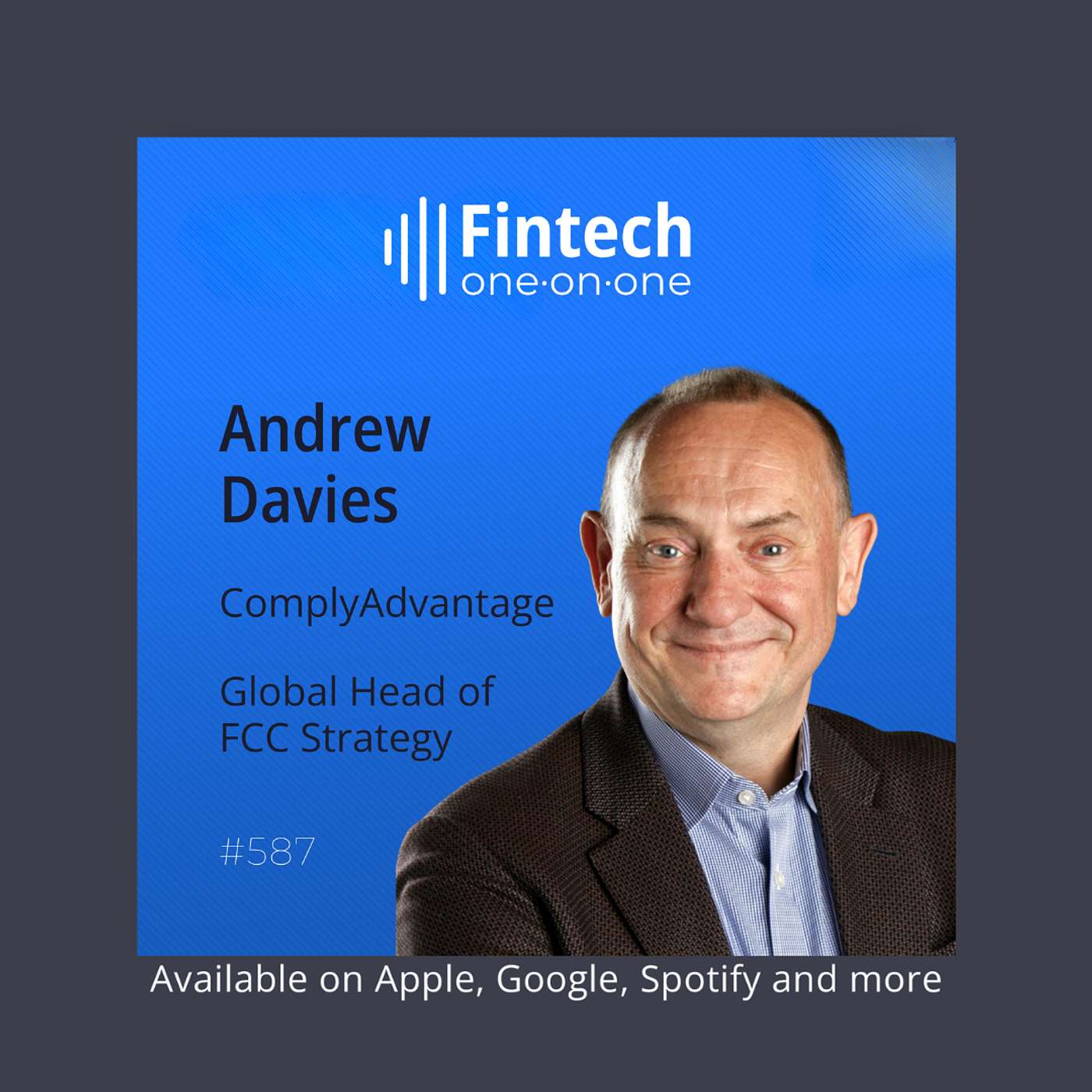
What's Finally Changing to Help Catch More Financial Crime With Andrew Davies of ComplyAdvantage
Jun 400:33:50Tap to summarizeAndrew Davies has spent more than three decades fighting financial crime, starting with sanctions screening tools for central banks in the mid-1990s and arriving at ComplyAdvantage after nearly 16 years at Fiserv. He sits at the center of one of the most consequential questions in financial services: can we finally move the needle on financial crime detection after decades of catching less than 2% of what's laundered globally? ComplyAdvantage serves more than 3,000 enterprises across 75 countries with its AI-native Mesh platform. If you want to learn more about the founding story and their early days, check out my podcast with founder Charlie Delingpole from 2019.What We CoveredWhy the industry has historically caught less than 2% of money laundered globallyHow the money laundering economy ranks as the world's third largest at an estimated $5.6 trillionThe evolution from sanctions screening to FRAML to multi-dimensional financial crime riskThe Mesh platform and what a unified financial crime system means for compliance teamsCassie, the agentic AI analyst automating customer screening investigationsHow 90% of compliance work was historically spent chasing false positivesReal-time payments compliance and the risk-based approach to payment screeningThe SEPA Instant Payments challenge and batch screening against the EU journalStablecoins, unhosted wallets, and the compliance infrastructure gapFATF's finding that stablecoins represent 84% of illicit crypto transaction volumeData sharing consortiums as the next inflection point in fighting financial crimeThe network problem at the heart of money laundering and terrorist financingKey TakeawaysThe money laundering economy is estimated at $5.6 trillion, making it the third largest in the world, above Germany, yet we detect less than 2%. Agentic AI tools like Cassie are designed to eliminate false positives so human analysts only work cases that genuinely warrant their expertise. Data sharing consortiums, where organizations contribute to shared detection models, represent the most promising path to materially improving financial crime outcomes. Stablecoins create real compliance risk at the unhosted wallet layer, the Bank of England has floated a ban, while the US is unlikely to go that route, leaving a gap.About Andrew DaviesAndrew Davies is the Global Head of Financial Crime Compliance Strategy at ComplyAdvantage. He began his career in the mid-1990s building sanctions screening tools for central banks and large financial institutions, and spent nearly 16 years at Fiserv in their financial crime division before joining ComplyAdvantage.Connect with Fintech One-on-One:Tweet me @PeterRentonConnect with me on LinkedInFind previous Fintech One-on-One episodes
Transcribe →
Why Embedded Payments is a Retention Strategy for Vertical SaaS with Joshua Silver, CEO of Rainforest
May 2800:29:32Tap to summarizeJoshua Silver has spent two decades in embedded payments. Before co-founding Rainforest, he built Patient Co, a healthcare payments business scaled to billions in processing volume and tens of millions of patients, then spent several years consulting with software founders on building their payments programs. Rainforest is payments as a service, purpose-built for vertical SaaS — and in this conversation Joshua makes a compelling case that embedded payments is not just a revenue opportunity but a competitive moat.What We CoveredWhy vertical SaaS companies are still leaving money on the table with embedded paymentsThe gap in the market Rainforest was built to fillHow payfac as a service works and who it is designed forWhy the number of registered payfacs is shrinking, not growingThe $5 billion volume threshold for when becoming a full payfac makes economic senseHow Rainforest differentiates from Stripe and Adyen for vertical SaaS platformsVertical-specific risk models versus general-purpose toolsRainforest's real-time ledger and what it unlocks for complex payment structuresAdding PayPal and Venmo for untapped vertical SaaS marketsExpanding into Canada and building the playbook for international growthHow AI is being used across the business and the rising threat of AI-driven fraudWhat success looks like for Rainforest in the next five yearsKey TakeawaysEmbedded payments builds a moat. Joshua's closing point is the sharpest: once merchants are running their money through your software platform, competitors face a much harder job dislodging you. Payments isn't just a revenue line — it's a retention strategy.Vertical-specific risk models matter enormously. Stripe and Adyen have to serve everyone, so their risk tooling is built for the lowest common denominator. Rainforest has built models tuned to individual verticals — lawn care looks different from HVAC, which looks different from nonprofit donations — and it takes the fraud liability rather than passing it to the platform.The $5 billion payfac threshold is the new reality. A decade ago the rule of thumb was around $1 billion in card volume. Regulatory and compliance burdens have risen so sharply that Joshua now puts the threshold at $5 billion with line of sight to $10 billion before it makes economic sense to go full payfac.A real-time ledger is a competitive differentiator. Most legacy processors are batch-based, settled overnight on mainframes. Rainforest's ledger is real-time, enabling split payments, franchise fee hierarchies, and complex billing structures that batch systems simply cannot support.About Joshua SilverJoshua Silver is co-founder and CEO of Rainforest, a payments-as-a-service company purpose-built for vertical SaaS platforms. Before Rainforest, he co-founded Patient Co, scaling it to billions in healthcare payments volume before a sale, and subsequently consulted with software founders on building their payments businesses. He has been working in embedded payments for twenty years.Connect with Fintech One-on-One:Tweet me @PeterRentonConnect with me on LinkedInFind previous Fintech One-on-One episodes
Transcribe →