Podcast
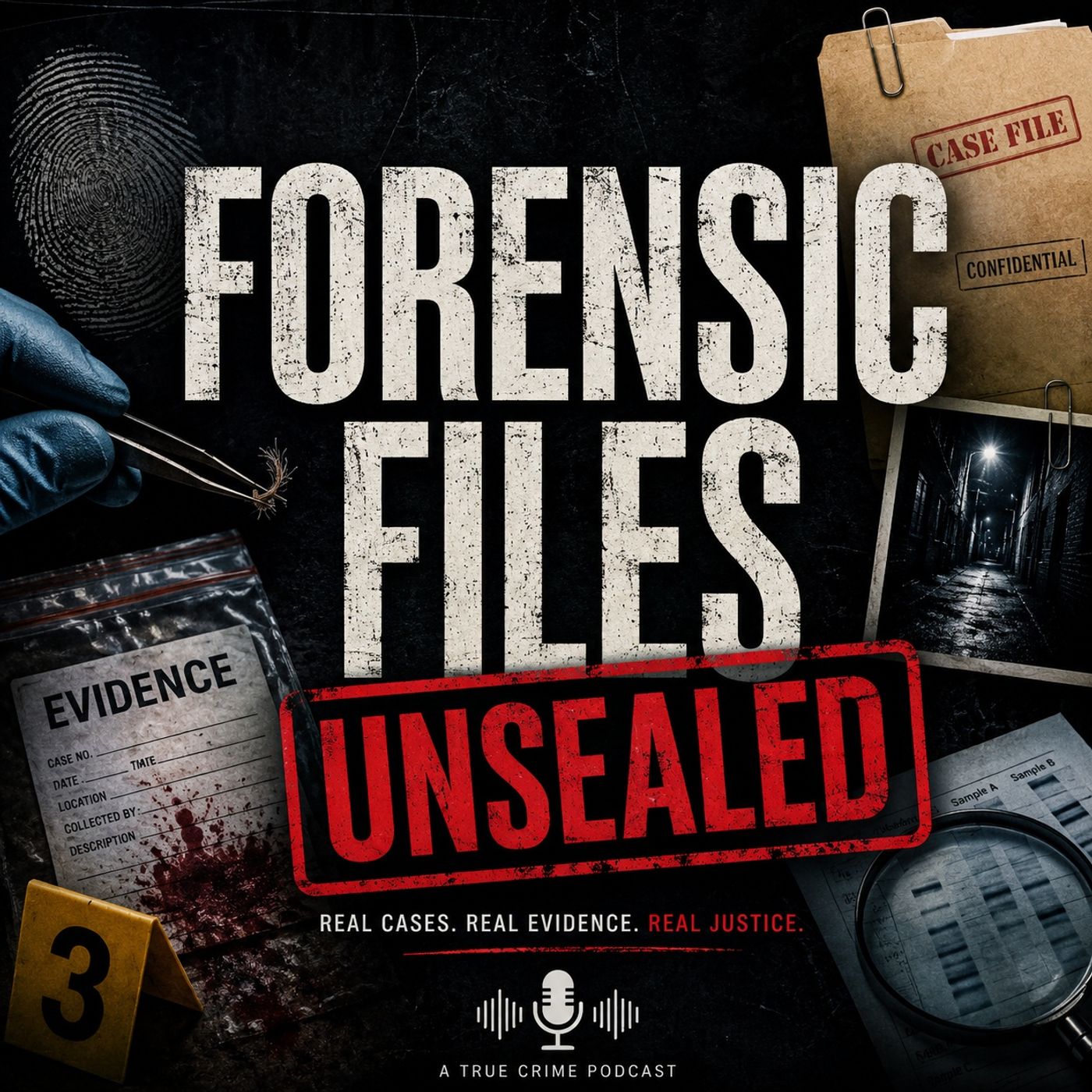
Forensic Files Unsealed
Hosted by AC Wilson · EN
Forensic Files Unsealed takes you beyond the original cases and into the deeper world of forensic investigation, hidden details, and unanswered questions behind real-life crimes. Each episode revisits compelling cases involving forensic science—from DNA breakthroughs and digital evidence to overlooked clues that changed everything. We go beyond the headlines and reenactments to explore what really happened, how investigators pieced together the truth, and what details often go unspoken in public case summaries. Whether it’s cold cases, courtroom revelations, or scientific breakthroughs, this podcast pulls back the curtain on the evidence that solves—or sometimes complicates—the story.
Disclaimer
Forensic Files Unsealed is an independent true crime podcast created for informational and educational purposes only. All cases discussed are based on publicly available records, news reports, court documents, and documented investigative material. This podcast does not claim to provide legal advice, nor does it assert the guilt or innocence of any individuals mentioned. Some interpretations are based on analysis and may include commentary or speculation intended to explore investigative possibilities, not to state definitive fact. All individuals are presumed innocent until proven guilty in a court of law. Listener discretion is advised, as this podcast may contain discussions of violence, death, and sensitive subject matter.
Disclaimer
Forensic Files Unsealed is an independent true crime podcast created for informational and educational purposes only. All cases discussed are based on publicly available records, news reports, court documents, and documented investigative material. This podcast does not claim to provide legal advice, nor does it assert the guilt or innocence of any individuals mentioned. Some interpretations are based on analysis and may include commentary or speculation intended to explore investigative possibilities, not to state definitive fact. All individuals are presumed innocent until proven guilty in a court of law. Listener discretion is advised, as this podcast may contain discussions of violence, death, and sensitive subject matter.
184episodes
Episodes
Newest firstAll episodes
The Coach in the Shadows - Solving Linda Slaten’s Murder
2w ago00:55:34Tap to summarizeThe episode details the 1981 murder of Linda Slaten and the exhaustive thirty-eight-year investigation that followed. Though her sons and police initially suspected her ex-husband or a local man with a history of violence, the case remained unsolved for decades despite the preservation of a palm print and DNA evidence. In 2019, genetic genealogy finally identified the killer as Joseph Mills, the boys’ former football coach who had maintained a relationship with the family after the crime. The episode reveals the emotional toll on Slaten’s children and the investigative failures that allowed a known associate to escape scrutiny for nearly forty years. Ultimately, Mills was sentenced to life in prison after a DNA match from his discarded trash confirmed his guilt.This episode includes AI-generated content.
Transcribe →M-Vac Used to Help Link Serial Killer Bruce Lindahl to 1981 Murder of Teen
2w ago00:36:45Tap to summarizeTechnological breakthroughs in forensic science have finally identified Bruce Lindahl as the murderer of Kathy Halle, a nineteen-year-old who disappeared in 1979. Although traditional DNA testing was unable to process evidence submerged in a river for weeks, investigators utilized the M-Vac wet-vacuum system to successfully extract a usable genetic profile from the victim's clothing. This discovery links the deceased Lindahl to a broader history of serial violence across Chicago’s western suburbs, confirming his responsibility for multiple cold cases from the late 1970s. The resolution of this case highlights how genetic genealogy and advanced recovery tools can provide closure for families after decades of uncertainty. Ultimately, the sources illustrate a powerful intersection of persistent detective work and modern scientific innovation in solving historical crimes.This episode includes AI-generated content.
Transcribe →Illinois Mom Found Executed Amid Messy Divorce
2w ago00:41:36Tap to summarizeThis source details the brutal execution of Becky Bliefnik, a mother of three from Quincy, Illinois, who was found shot 14 times in her home. Investigations revealed that the victim was embroiled in a contentious divorce from her husband, Timothy Bliefnik, who had previously appeared on the game show Family Feud. Although there was no murder weapon, detectives linked Tim to the crime through incriminating internet searches, bicycle surveillance footage, and shell casings found in his basement that matched those at the scene. Prosecutors successfully argued that Tim’s fear of losing custody and assets drove him to premeditate the murder. Despite his claims of innocence, a jury found him guilty of first-degree murder, leading to a sentence of life in prison. The narrative serves as a sobering reminder of the lethal potential of domestic disputes and the importance of heeding warnings from those in fear for their lives.This episode includes AI-generated content.
Transcribe →The Photographer, the Boyfriend, and the Ex-Wife
2w ago00:46:23Tap to summarizeThe episode details the investigation and trial surrounding the 2023 murder of Joe Shymanski, a well-known photographer whose remains were found in a rural clearing. Authorities ultimately convicted Brandon Holbrook, a man linked to Shymanski’s ex-wife, Heather Snyder, after discovering forensic evidence and suspicious vehicle sightings. Despite Holbrook’s life sentence, the victim’s family and defense attorneys maintain that Snyder may have orchestrated the crime to resolve a bitter custody dispute. While Snyder asserts her innocence and provides an alibi for the time of the killing, her suspicious text messages and refusal to testify under the Fifth Amendment have left many questioning her true involvement. The case remains a subject of public fascination as local authorities hint that the investigation into potential accomplices may not be entirely closed.This episode includes AI-generated content.
Transcribe →Forensic Tracks of a Stranger Killer
2w ago00:51:37Tap to summarizeThe episode review from the true crime series The New Detectives illustrate how forensic science serves as the primary tool for solving complex homicides and identifying serial killers. The first segment details the investigation into Caesar Baron, whose diverse methods of murder were linked through ballistic analysis and distinctive footprint evidence. A second case follows the pursuit of Dennis Dwayne Webb, highlighting how latent fingerprint technology and the recovery of a discarded weapon from a cliffside proved pivotal to his conviction. The third source focuses on the use of toxicology to expose murders committed with succinylcholine, an untraceable drug used by two different killers to stage accidental deaths. Finally, the text documents the capture of Jason Desoyers and Shaun Gobel through DNA testing and fingerprint databases. Collectively, these narratives emphasize that even when criminals attempt to obliterate evidence, meticulous criminalistics can reconstruct the truth to achieve justice.This episode includes AI-generated content.
Transcribe →The Secrets of Palm Beach - The Linda Fishman Murder
2w ago00:54:48Tap to summarizeThis episode documents the investigation into the 2003 murder of Linda Fishman, a prominent Palm Beach socialite who was strangled in her home. Initial police suspicion focused on her nephew, Michael Jamrock, due to his financial struggles, troubled history, and a failed polygraph test. However, the case shifted dramatically when an anonymous letter led detectives to Fred Kretzmer, a much younger man with whom Fishman had a previous relationship. Kretzmer eventually confessed to the crime, explaining that he killed Fishman in a panic after she failed to recognize him and threatened to call the police. The source highlights the tragic consequences of the investigation on family dynamics and the crucial role of a tipster in solving the cold case. Ultimately, Kretzmer received a life sentence, finally exonerating Jamrock after years of intense public and familial scrutiny.This episode includes AI-generated content.
Transcribe →The Detective's Secret: The Trial of Brian Fanion
2w ago00:48:35Tap to summarizeThis episode details the murder investigation and trial of Brian Fanion, a former Massachusetts detective convicted of killing his wife, Amy. Although the defendant initially claimed his wife committed suicide during a heated argument, state investigators became suspicious due to his extramarital affair and a lack of ballistic evidence on the victim. Prosecutors presented incriminating digital searches regarding poisons and gunshot residue, countering the defense's theory that the victim’s thick hair had masked forensic markers. Despite the unwavering support of the victim's family for the accused, the jury found the evidence of premeditation compelling. Ultimately, the case concluded with a guilty verdict for first-degree murder, resulting in a sentence of life without the possibility of parole.This episode includes AI-generated content.
Transcribe →Could New DNA Analysis Break Open the Madeleine McCann Case?
2w ago00:32:49Tap to summarizeThis episode provides a comprehensive status update on the Madeleine McCann investigation nearly two decades after her 2007 disappearance. It highlights the shift in focus toward Christian Brückner, a German sex offender, while noting that a lack of direct evidence prevents formal charges. The narrative emphasizes the potential of modern DNA technologies, such as probabilistic genotyping, to re-examine original samples that were once deemed inconclusive. Despite ongoing international cooperation and recent searches in Portugal, legal and forensic hurdles remain significant due to the passage of time. Ultimately, the source examines the persistent gap between investigative theories and the rigorous proof required for a criminal conviction.This episode includes AI-generated content.
Transcribe →DNA Databases May Help Solve Cape Cod Cold Cases
2w ago00:44:51Tap to summarizeMassachusetts is currently debating the legal and ethical boundaries of using investigative genetic genealogy to resolve decades-old cold cases. High-profile successes, such as identifying the "Lady of the Dunes" and her killer, demonstrate how advanced DNA sequencing and public genealogical databases can provide closure for families when traditional methods fail. However, these techniques raise significant privacy concerns because they allow law enforcement to scrutinize the genetic information of relatives who never consented to such searches. State legislators are weighing a regulatory framework that would permit these tools for serious violent crimes while establishing strict oversight and privacy protections. Ultimately, the state must balance the public safety benefits of solving historic homicides against the risk of government overreach into intimate biological data. This ongoing policy shift reflects a broader national struggle to integrate rapid scientific advancement with fundamental civil liberties.This episode includes AI-generated content.
Transcribe →The DNA of Innocence - The Ricky Davis Case
2w ago00:38:18Tap to summarizeThis episode chronicles the 1985 murder of Jane Hylton and the subsequent wrongful conviction of Ricky Davis. Decades after the crime, the Northern California Innocence Project utilized advanced DNA testing to prove that Davis and a key witness were not responsible for the killing. Investigators discovered unknown male DNA on the victim's clothing and under her fingernails, which directly contradicted the narrative used to imprison Davis for fifteen years. By employing genetic genealogy, authorities finally identified the actual perpetrator, leading to Davis’s exoneration and release in 2019. This case highlights how evolving forensic technology can correct historical judicial errors and identify killers in long-dormant cold cases.This episode includes AI-generated content.
Transcribe →