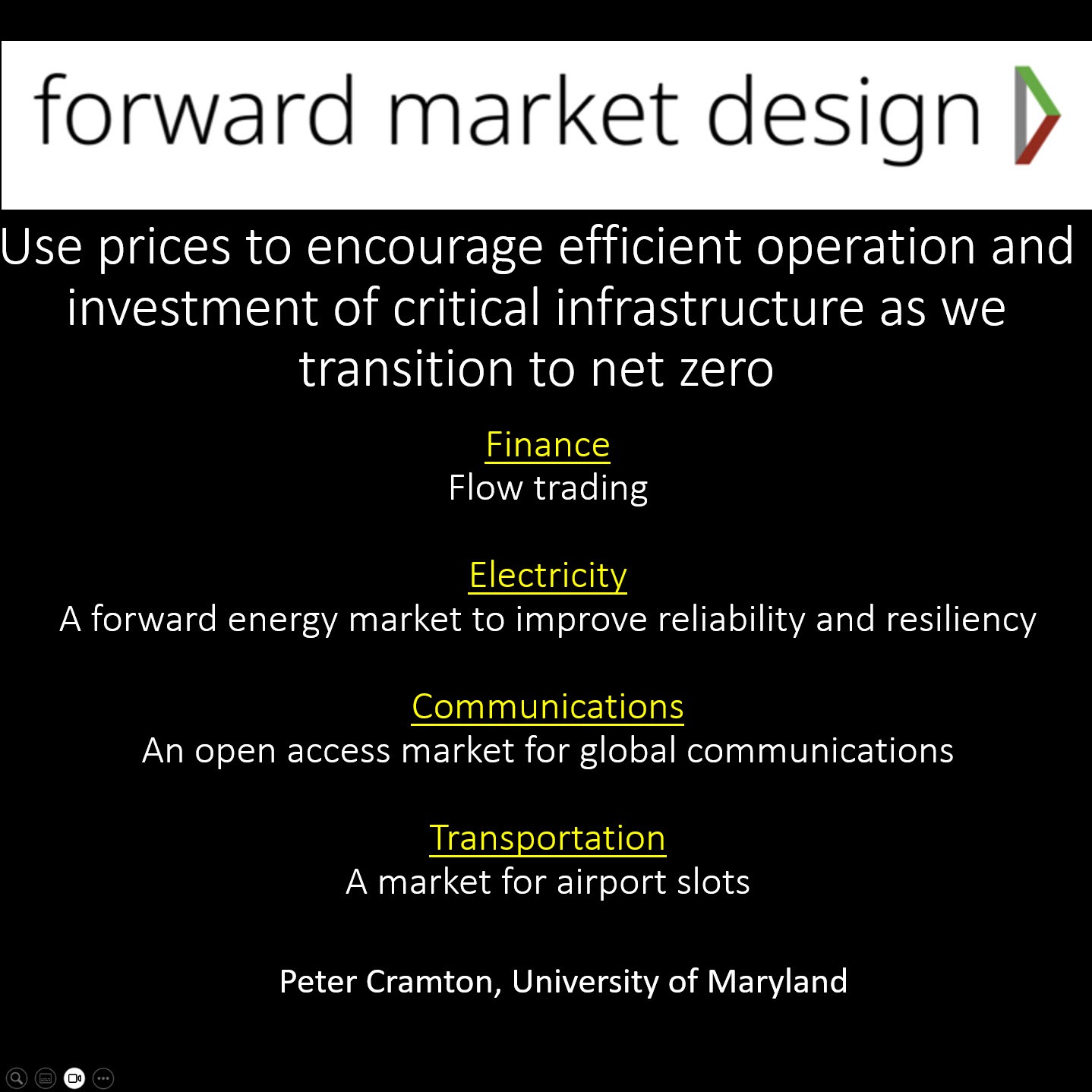
Podcast
A few NotebookLM generated podcasts from Peter Cramton
Hosted by Peter Cramton · EN
Electrifying nearly everything is necessary as the world transitions to net zero carbon emissions. Electricity demand will double with rapid innovation in supply and demand. As the share of intermittent renewables, primarily solar and wind, grows and extreme weather events become more frequent, balancing supply and demand every second becomes more challenging. Restructured wholesale markets provide real-time balancing. The market determines clearing prices that balance supply and demand, motivating operations to maximize social welfare.
Prices vary by time and place. Electricity prices, typically about $40 per megawatt-hour, may be negative when renewable production is high and thousands of dollars during extreme weather. Participants attempt to manage this risk with forward trade, but several market failures limit risk management and undermine efficient investment. Electricity markets have struggled with these challenges for decades.
Our market platform addresses the critical market failures that have hindered efficient electricity investment and stifled innovation: incomplete markets, market power, and uncertainty. Once adopted, this research will expedite decarbonization. It leverages robust market designs to foster innovation and competition, bringing essential flexibility for reliable and resilient electricity in a setting with high renewable penetration. The research identifies the need to involve demand, particularly during extreme weather. Such a market significantly enhances price incentives, enabling efficient investment and operation of participants' resources. Notably, retail consumers stand to benefit from these reforms. The result is a net-zero economy that provides reliable and resilient electricity at the least cost.
The venture develops a forward energy market that aligns market participants' incentives with social welfare. The new market promotes competition and innovation through improved forward trading and improves investment incentives, reliability, and resilience to extreme events, avoiding a costly and inefficient capacity market. The market reforms are designed to be introduced by existing independent system operators. The process can be gradual and low-cost since core systems need not change. The open-source platform we are building and testing is highly customizable, recognizing that every system operator has its ideal adoption path.
The forward energy market allows frictionless, gradual trade of energy and related products that are defined finely in terms of time and location. It complements the system operator's spot market. The bidding language is designed for easy and effective participation, and market participants can tailor strategies to their circumstances.
Our team, comprising computer science, economics, applied math, and finance researchers, is leading a global effort to expedite the green energy transition while improving the reliability and resiliency of critical infrast...
13episodes
Episodes
Newest firstAll episodes

Comparision of Platform Take Rates
Jan 28, 202500:29:53Tap to summarizePeter Cramton asked three questions of Perplexity.AI about platform take rates. 1) Companies often take a percentage when the platform they provide to others is used for financial transactions. For example, Substack takes 10% and its payment processor, Stripe, takes 2%. Google Ads takes about 40% from sellers and buyers combined in the Google Ad Exchange. What are some other examples of "take rates" across industries? 2) Why are some take rates higher than others? 3) Is there any evidence that Google's high take rate is enhanced from its anti-competitive behavior? The answers produced a six page pdf including citations. He then asked Google Notebook LM to create a podcast about the answers. Here is the podcast. Enjoy.
Transcribe →
Thailand Independent Mobile Operator to foster competition and innovation
Dec 27, 202400:16:55Tap to summarizeSummaryIn this conversation, Peter Cramton discusses the complexities of the Thai telecom market, focusing on the duopoly between AIS and True. He introduces the concept of TIMO, a proposed independent market entity designed to enhance competition and consumer choice. Cramton draws parallels with the electricity market to illustrate how market design can improve efficiency and responsiveness. The discussion also addresses potential implementation challenges and the political landscape surrounding regulatory changes. Ultimately, the conversation emphasizes the need for innovative solutions to foster a more dynamic telecom market in Thailand.TakeawaysCramton proposes TIMO as a neutral referee for the telecom market.The duopoly in Thailand's mobile market leads to collusion risks.More competition can lead to better prices and services for consumers.TIMO aims to create a market where prices fluctuate based on demand.The success of TIMO relies on overcoming political and regulatory challenges.Market-based solutions can address issues traditional regulation struggles with.A bigger market can benefit all players, including incumbents.Innovative market design can draw lessons from other industries like electricity.The implementation of TIMO could take around two years.Challenging the status quo is essential for fostering innovation. Sound Bites"A bigger pie benefits everyone.""We need to think outside the box."Chapters00:00 Introduction to Thai Telecom and Market Dynamics02:37 The Role of TMO in Enhancing Competition05:47 Market Design Principles: Lessons from Electricity08:35 Implementation Challenges and Political Landscape11:28 Key Takeaways and Future Implications
Transcribe →
An open access global communications market
Dec 24, 202400:15:36Tap to summarizeAn open-access market design is presented to manage network congestion and optimize network use and value. Open access eliminates the walled-garden approach; instead, it commoditizes communications network capacity while decentralizing access to a transparent wholesale market. It ensures that scarce capacity is put to its best use by providing a platform for efficient trade. The market operates without friction using flow trading. It allows participants to bid persistent piecewise-linear downward-sloping demand curves for portfolios of products, gradually adjusting positions toward targeted needs. Flow trading allows fine granularity of products in time and location, creating complete markets. Liquidity and computational feasibility are maintained despite trading millions of interrelated forward and real-time products. Participants manage risk and adverse price impact through trade-to-target strategies. The market operator clears the market every hour, finding unique prices and quantities that maximize as-bid social welfare. Prices, aggregate quantities, and the slope of the aggregate net demand are public. The market operator observes positions, enabling it to optimize collateral requirements to minimize default risk. Priority pricing is used to manage real-time imbalances. An application of the model is developed for intersatellite wholesale communications with optical (laser-beamed) mesh networks in space, showing several efficiency gains.
Transcribe →