← Free Thinking Through the Fourth Turning with Sasha Stone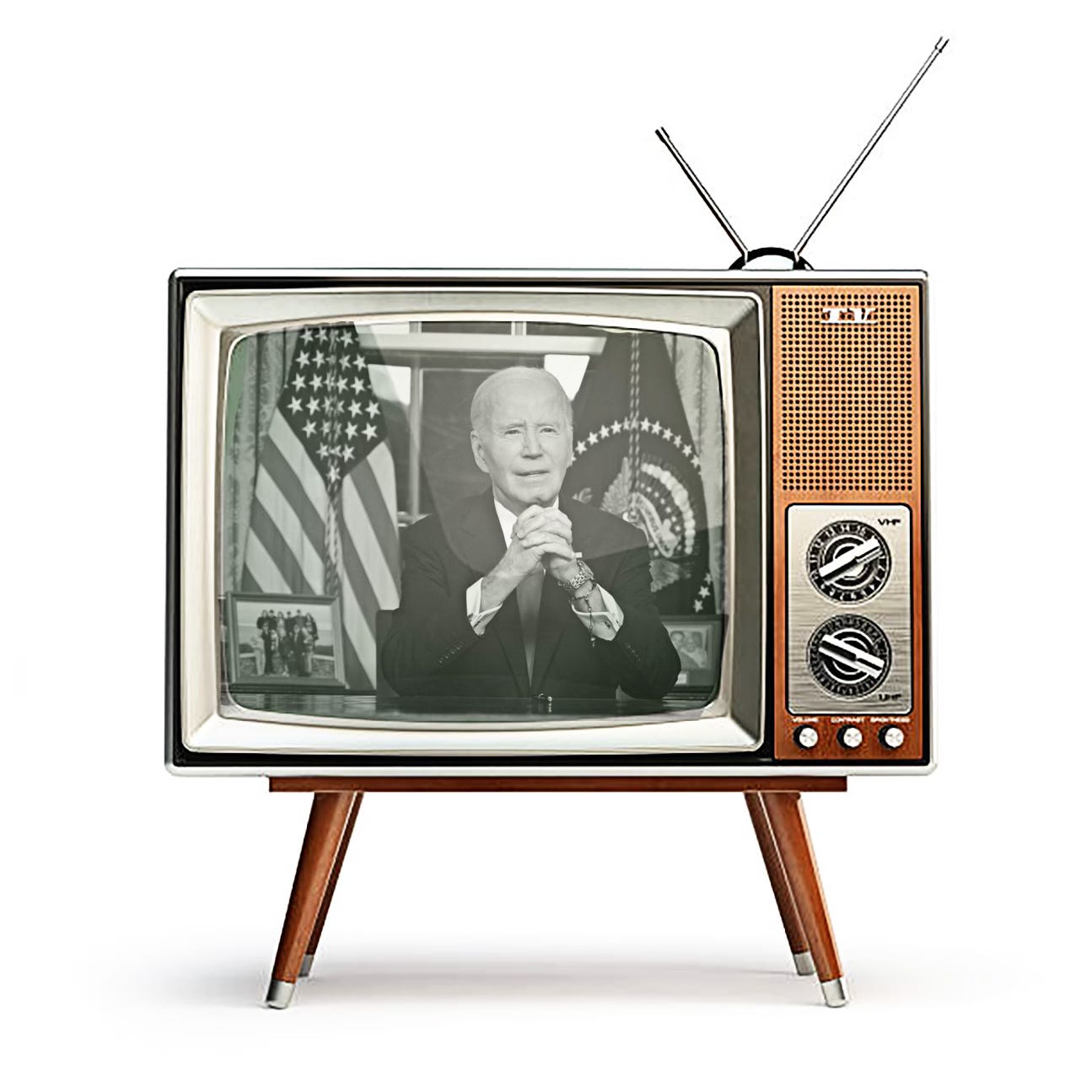
Free Thinking Through the Fourth Turning with Sasha Stone
A Farewell Address to a Woketopia Gone Wrong
00:12:32
Loading summary
Transcript6 lines
- [00:00]
Sacha Stone
Hi, this is Free Thinking through the fourth Turning. My name is Sacha Stone. A farewell address to a woketopia gone wrong and not a moment too soon. Joe Biden said goodbye. He wanted to mirror Eisenhower, who once warned of the military industrial complex. But Biden saw something equally alarming. The big tech oligarchy. He sees Zuckerberg and Bezos attending Trump's inaugural. He greatly fears the power of Elon Musk. He realizes that his side lost control of it and now he wants all of us to be afraid. Well, I'm sorry, Joe. I can't play that game anymore. It's time to say goodbye. Farewell, Joe Biden. Farewell Democrats. Farewell hysteria. Farewell to mandated preferred pronouns in everyone's bio. Farewell to being forced to lie about whether or not masks work. Farewell to not being allowed to give people the benefit of the doubt. Farewell to being too afraid to ask questions about an experimental vaccine. Farewell to critical race and gender theory in elementary schools. Farewell to the ruling oligarchy. Yes, Joe, you were the front man for it. You can't fool me. I was part of it, too. It was like a daisy chain of paper dolls, Hollywood, all major corporate and cultural institutions, Big Pharma, and all of the ads they pumped into the veins of Americans that showcased the American utopia in all of its splendor. Just take this pill and you too can be with us in the happy place. Farewell to a government censoring speech via social media. Farewell to the absence of masculinity. Farewell to worrying about every word that comes out of our mouths. What we drive, what we wear on Halloween, what we buy, what we eat, what we watch, what we desire. Farewell to being made to hate ourselves and everything we know to be true but can't say out loud. Farewell to being the oppressors and the oppressed defined only by the color of our skin. Farewell to hating our history, hating our country, hating our heroes. Farewell to virtue signaling our goodness. Farewell to always being told that it's better to keep your head down and say nothing about any of it. Farewell to never being able to take a joke. Farewell to seeing problematic content in every movie. And farewell to the warning labels now affixed to all of them. Farewell to seeing all men as predators and all women as victims. Farewell to a country ruled by fear because our leaders can't see it any other way. Farewell to a president who called half the country ultra fascists, ultra Maga and extreme Maga Republicans. Farewell to a government that believes its biggest threat comes from the people of the United States. Farewell to life inside the doomsday culture where every single day is the end of the world. Farewell to every word taken literally and seen as another chapter of Mein Kampf. Farewell to repression and sanctimony. Farewell to the long dark winter. Farewell to lawn signs. Farewell to pretending Kamala Harris wasn't a terrible candidate installed by the deep state. Farewell to ever having to worry about speaking the truth. Farewell to the unshakable hopelessness, the unending sadness, the mourning of the long forgotten old left. It's never coming back. Everything has to be rebuilt. Welcome to the beginning of the rest of your life. At least now you can have a life bringing it all back home. Watching the confirmation hearings brought it all back. Adam Schiff was still out of his mind, braying like he's Cotton Mather in the Oyer Interminer in Salem, demanding Pam Bondi say Joe Biden won the election. Why did it matter so much to him? Are there really that many Americans out there who need to hear those words said out loud? The nominee's worth depended on whether or not they would stand up to the tyrant, fascist, rapist, racist dictator that they impeached twice indicted, four times convicted on a bogus felony charge and all of which eventually landed in the fevered dreams of a washed up surfer hippie from Hawaii who got himself a gun and tried to kill the president to save democracy. And they still lost. They lost the electoral college and they lost the popular vote. I never get tired of saying that. Talk about owning the libs. What can we do except quote Marlon Brando in A Streetcar Named Desire?
- [05:04]
Unknown
You hear me?
- [05:07]
Sacha Stone
That's how much America hates them. After all, how hard could it possibly be to beat Hitler? The problem with utopias is they can't last. They either must become more authoritarian and thus less utopian, or they collapse. By the end of our utopia, anyone we knew could be one of those things. A bad person, a sexist, a racist, a homophobe, a bigot, a transphobe. Toxic masculinity, white feminism. Everyone was either an abuser or a victim. The weaker we were, the more we were celebrated. We'd snuffed out all independent thought. We were under constant surveillance by the government, advertisers, AI algorithms, and each other. We began to wonder what real life even was anymore. It was like Winston and Julia in 1984 trying to carve out some love and lust from the dystopia under Big Brother's ever watchful gaze. With children, spies at the ready to tattle and cancel those who break the rules. So if you say Joe Biden won the 2020 election. Like you say two plus two equals five. Then democracy might have a chance. But if you dare think for yourself. And you start looking behind closed doors. And see things you aren't supposed to see. Well, now you threaten democracy. When I pushed open the door of the Doomsday bunker and I escaped. I knew there was no going back. I also knew I couldn't save anyone. Much less the once great culture I used to love. There is no saving whatever it is we used to call the Left. There is only saving America from what it had become. So that all of us can at least have a fighting chance. No, it won't be perfect. Yes, it might be chaos, entertaining chaos, but chaos all the same. We'll have to learn how to tolerate each other again. Live together somehow. And learn this new way of life. Suddenly foisted upon us with the Internet. Because now we know what it looks like to shut ourselves off. From people and ideas we cannot control. If the Democrats on Blue sky and in the Senate confirmation hearings are any indication. Nothing much has changed on the inside. They're still transfixed by the one guy they couldn't cancel. The one guy they couldn't destroy. 1984, part two. If there was hope, it must lie in the proles. Because only there, in those swarming, disregarded masses. 85% of the population of Oceania. Could the force to destroy the Party ever be generated. The Party could not be overthrown from within. Its enemies, if it had any enemies. Had no way of coming together or even identifying one another. Even if the legendary Brotherhood existed. As just possibly it might. It was inconceivable that its members could ever assemble in larger numbers than twos and threes. Rebellion meant a look in the eyes. An inflection of the voice. At most, an occasional whispered word. But the proles, if only they could somehow become conscious of their own strength. Would have no need to conspire. They need only to rise up and shake themselves like a horse shaking off flies. If they choose. They could blow the Party to pieces tomorrow morning. Surely sooner or later it must occur to them to do it. George Orwell, 1984. And maybe now we're about to find out what happens in the sequel. Does Big Brother find a way to regain power by destroying Elon Musk to retake X and make it Twitter again? Do those of us exiled and canceled remain on the outside? Does the New York Times beg Bari Weiss to come back. Or the Atlantic to throw themselves at the feet of Walter Kern? Or Rolling Stone magazine, the crap rag it has become, offer Matt Taibbi millions to write for them again? Can those on the inside who have speciated with a whole new language and belief system learn to live with the unwashed masses again? Can they tolerate offensive speech? Can it all be one big, happy, dysfunctional family on the inside? The news that Carrie Underwood and the Village People were playing at the inaugural birthed a fresh new crop of mass hysteria and rage. So I'm guessing Saturday Night Live won't have Trump back anytime soon. The Oscars won't ask him to attend, and those who still believe they control this country will hold on to their collapsing empire until ashes, ashes, it all falls down. I don't know, but it doesn't matter, because today we say farewell and oh how sweet it is. Thank you for listening to my podcast, sashastone.substack.com don't forget to leave a review if you like the podcast. And remember to thine own self be true.
- [10:32]
Unknown
If I had wind and Nora's dumb I'd fly up the river to the one I love fairly well O her knee fair the world early one morning drizzling rain and in my heart I felt a naked pain Very well far the world now one of these mornings it won't be long? You'll call my name and I'll be.
- [11:47]
Sacha Stone
Gone.
- [11:49]
Unknown
Fairly well, oh honey, fare fairly well. If I had wings like Nora's dove I'd fly up the river to the one I love oh fairy where oh honey, fair.