← Free Thinking Through the Fourth Turning with Sasha Stone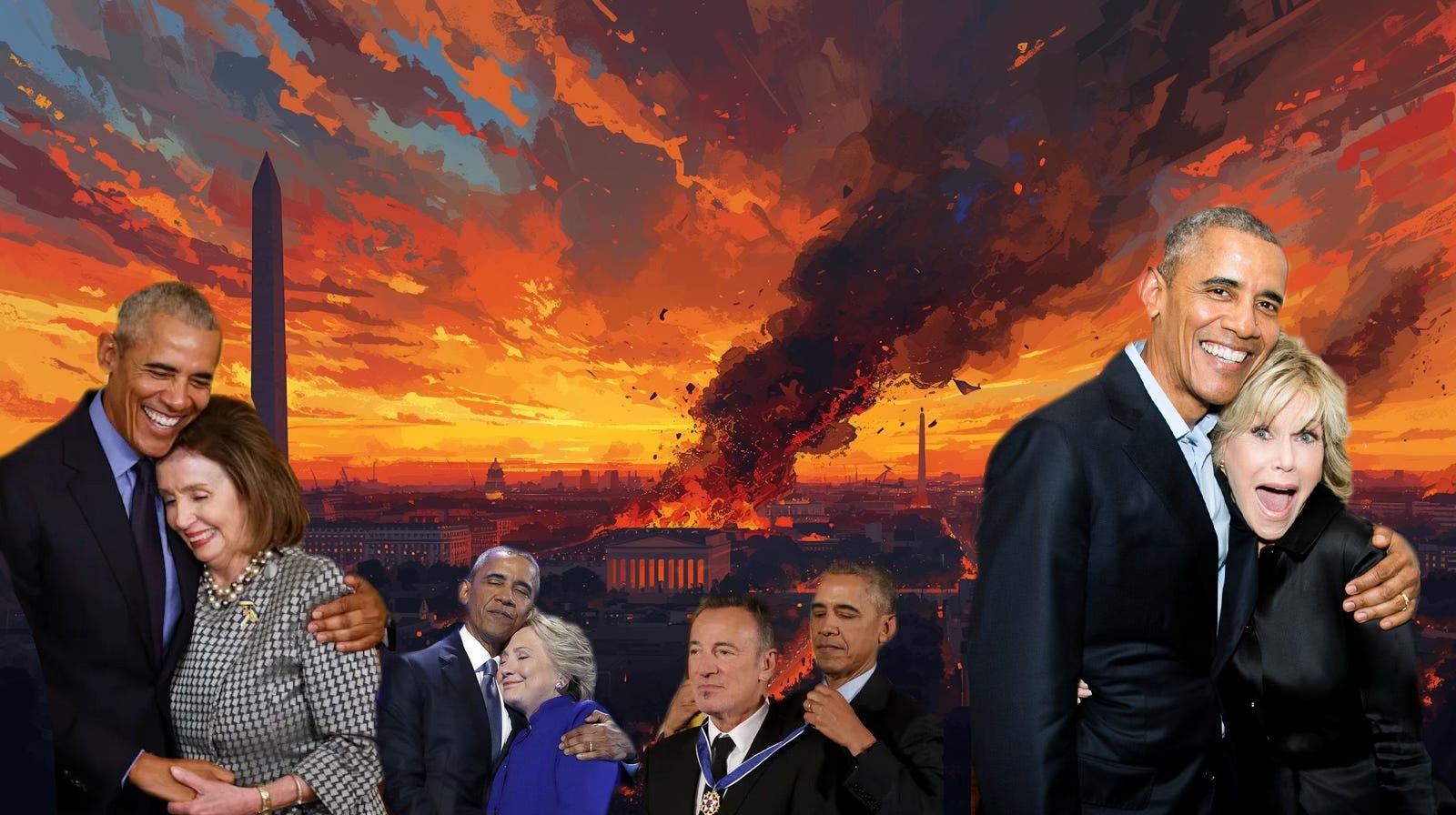
Free Thinking Through the Fourth Turning with Sasha Stone
Barack Obama and the "Bitter Clingers"
00:43:39
Loading summary
Transcript119 lines
- [00:01]
Sacha Stone
Hi, this is Free Thinking through the fourth turning. My name is Sacha Stone. Barack Obama and the bitter clingers. Part one of a virtual civil war. When I look around at the crumbling empire I helped build, I wonder how it all went so wrong. How did so many people lose their minds, the legacy media lose its objectivity, and so many so called educated people lose their grip on reality. A tweet from JoJo from Juror, F you. To anyone who voted for this effing monster, F you. And to my family who voted for this, F you too. Don't ever speak to me again. What is Trump derangement syndrome anyway? Here is a psychotherapist on Fox News. First of all, identify it for us. You're in a session and you pick up on what?
- [01:06]
Psychotherapist on Fox News
Well, Harris, it doesn't take long for me to pick up on this. People are obsessed with Trump. They're fixated. They're hyper fixated on Trump and they talk about some of the features of this disorder. They can't sleep. They feel traumatized by Mr. Trump. They feel restless. I had one patient who said she couldn't enjoy a vacation because anytime she saw Trump in the news or on her device, she felt triggered. So this is a profound pathology. And I would even go so far as to call it the defining pathology of our time.
- [01:43]
Sacha Stone
These people come to you for the things that you described. Can't sleep. Traumatized, perhaps depression. I don't want to put words in your mouth, but at first you are there to treat an illness, a disorder of some kind, and what you figure out is the trigger.
- [02:00]
Psychotherapist on Fox News
Well, and Trump is the trigger for many of these people. And to be that fixated on a figure, on a person, it's simply not healthy. And our country has strayed so far away from where we once were. If you look at in the 80s, when President Reagan was shot, people were united. He famously said, I hope you're all Republicans to the surgeons. And the response was, Today, Mr. President, we're all Republicans, but our country has lost that. We've strayed so far from that unity.
- [02:36]
Sacha Stone
And what do you see? Because you say you told me off camera, three quarters of your patient load right now has what you're calling this tds.
- [02:45]
Psychotherapist on Fox News
Well, three quarters of my patients will present with a lot of these symptoms, and within probably five minutes of seeing me, their hatred for Trump comes up. So if you're that hyper focused on Trump, that's a real issue and it's worth being treated.
- [03:04]
Sacha Stone
I think as someone who lived it and has been online for the last 30 years that the people with all the power could not let go of that power. Just like the south during the last Civil War, the South had built for itself a utopian version of America, one not rooted in reality, but one they deeply believed in. And the same is true for the left today. I know I helped build it. I believed in it too, and thought it would last forever. Trump's win in 2016 was a sign that half the country was not happy with how things were going and wanted change. Just as much of America understood that a country that proclaimed all men are created equal could not keep slaves. And just as the freeing of the slaves sent the south into mass psychosis that would lead to Jim Crow laws and the oppression of black Americans. After eight years of deeply rooted propaganda that said Trump was a racist and for him to win would be an existential threat to our way of life. One our country could not survive, sent those of us inside utopia cascading into madness. And so we began fighting a civil war. No, not at Gettysburg or Shiloh.
- [04:33]
Dan Harris (ABC News)
But.
- [04:33]
Sacha Stone
On Facebook, Twitter, X, YouTube and TikTok. But only one side is cutting off friends and family. Only one side has no plan for the rest of America. On the outside, only one side seems prepared to become violent to preserve their utopia. I thought November of 2024 was like the burning of Atlanta. Not quite the end of the war, but almost. Now after Charlie Kirk's assassination and the fracturing of the right, I'm not so sure. What I do know is that so much of what defines our Civil War, so much of what explains the left's mass psychosis, took root in 2008. What is an American? 2008 was the crisis that sparked the Fourth Turning. According to Neil Howe, who co wrote the book with William H. Strauss, it wasn't just the election of the first black president or the launch of the iPhone, the rise of social media, or the $800 billion bailout of Wall street that birthed two populist movements on the left with Occupy and on the right with the Tea Party. It was also the year an idea contagion began to spread. In April of 2008, Obama was recorded writing off half the country as people who were bitter and cling to their guns and religion.
- [06:09]
Tea Party Member/Conservative Commentator
Or more differently, towards.
- [06:11]
Sacha Stone
People who aren't like that.
- [06:12]
Tea Party Member/Conservative Commentator
But as I hilbert Southern for all that trade.
- [06:21]
Sarah Palin
Their frustrations in Pennsylvania this afternoon, Hillary Clinton pounced all over those.
- [06:27]
Sacha Stone
Remarks.
- [06:29]
Sarah Palin
I saw in the media. It's being reported that my opponent said that the people of Pennsylvania who faced Hard times are bitter. Well, that's not my experience. Pennsylvanians don't need a president who looks down on them. They need a president who stands up for them, who fights for them, who works hard for your futures, your jobs, your families. The McCain campaign is attacking Obama's words as well. It's a remarkable statement and extremely revealing. It shows an elitism and condescension towards hardworking Americans that is nothing short of breathtaking. It is hard to imagine someone running for president who is more out of touch with average Americans, the Obama campaign is pointing out. The Illinois senator has long said that Americans are upset with their government's broken promises.
- [07:35]
Sacha Stone
From the New York Times. On the defensive, Obama calls his words ill chosen For a second day, Mr. Obama sought to explain his remarks at a recent San Francisco fundraiser that small town Pennsylvania voters, bitter over their economic circumstances, cling to guns or religion or antipathy to people who aren't like them as a way to explain their frustrations. End quote. Senator Hillary Rodham Clinton activated her entire campaign apparatus to portray Mr. Obama's remarks as reflective of an elitist view of faith and community. His comments, she said, were not reflective of the values and beliefs of Americans. Those comments were not seen as racist. Yet months later in October, when Sarah Palin said more or less the same thing, she was called an Islamophobe. Seven years after 9 11, that is what the left was worried about, not radical Islamic terrorism.
- [08:38]
Dan Harris (ABC News)
Republican vice presidential candidate Sarah Palin has lobbed a new charge at Democrat Barack Obama.
- [08:43]
Sarah Palin
Our opponent is someone who sees America as imperfect enough to pal around with terrorists who targeted their own country.
- [08:52]
Dan Harris (ABC News)
Palin made the charge at three separate events in California Saturday.
- [08:56]
Sarah Palin
I was reading today a copy of the New York Times. Turns out one of his earliest supporters is a man who, according to the New York Times, was a domestic terrorist and part of a group. Part of a group that, quote, launched a campaign of bombings that would target the pentagon and the U.S. capitol.
- [09:23]
Dan Harris (ABC News)
That article analyzed the relationship between Obama and Bill Ayers. Ayers was a founder of a 1960s radical group called the Weather Underground, which was blamed for several bombings. They include a pipe bomb in San Francisco that killed a police officer and injured another. Obama was a child when the group was active and he's denounced Ayres radical views and activities. They do live in the same Chicago neighborhood and served on a charity board together and had a fleeting political connection. Neither the Associated Press or the New York Times found evidence to suggest that the two men palled around and it's simply wrong to suggest that they were associated while Ayers was committing terrorist acts. Palin pushed the case again on Sunday.
- [09:59]
Sarah Palin
Associated Pressers wrong. The comments are about an association that has been known but hasn't been talked about. And I think it's fair to talk about where Barack Obama kicked off his political career in the guy's living room. And he of course having been associated with that group but known domestic terrorist group. It's important for Americans to know it's really important for Americans to start knowing who the real Barack is on the island.
- [10:24]
Sacha Stone
Obama chose as an associate a man.
- [10:26]
Tea Party Member/Conservative Commentator
Who helped bomb the Pentagon and said he didn't do enough.
- [10:30]
Dan Harris (ABC News)
That hasn't stopped an independent group from linking Obama and heirs in a new commercial. And Palin's charge is part of a line of new attacks on Obama As Republican John McCain slips further behind in the polls.
- [10:41]
Sarah Palin
Now this is not a man who sees America as you and I see America. We see America as a force for good good in this world.
- [10:52]
Dan Harris (ABC News)
With just 30 days until election Day, expect the attacks to get even stronger. Matt friedman, the Associated Press from the.
- [11:00]
Sacha Stone
Washington Post issue of Race creeps into campaign quote Palin's words avoid repulsing voters with overt racism. But is there another subtext for creating the false image of a black presidential nominee palling around with terrorists while assuring a predominantly white audience that he doesn't see their America? End quote. Race and racism became the dividing line after that. By 2010, the idea that the Tea Party was racist became a big story. ABC still had some objectivity and attempted to tell both sides a controversy surrounding the Tea Party, the nation's oldest civil rights organization.
- [11:46]
Sarah Palin
The NAACP has just adopted a resolution this evening at its annual convention contemning, quote, racist behavior by Tea Party members. Tonight, the Tea Party is fighting back and here's Dan Harris.
- [11:59]
Dan Harris (ABC News)
My message to the Tea Party is this.
- [12:01]
David Webb (Tea Party Co-founder)
The NAACP points to the racial epithets allegedly hurled at black members of Congress by Tea Party members during the health care debate and the and to the racist signs that critics say they've spotted at Tea Party events to support its conclusion that the Tea Party movement is a threat to the pursuit of human rights, justice and equality for all. At the group's annual meeting in Kansas City, the resolution had plenty of support.
- [12:29]
Walter Kern or Matt Taibbi
When we turn on the television and we see posters and flyers that send very frightening messages to our community, we have to address it.
- [12:36]
David Webb (Tea Party Co-founder)
Tea Party favorite Sarah Palin called the resolution divisive, asking today on Twitter, are liberty loving equality respecting patriots racist? David Webb is the co founder of The New York City Tea Party.
- [12:49]
Sacha Stone
I think the NAACP and its march towards irrelevancy as an organization needs an enemy to maintain its power base.
- [12:57]
David Webb (Tea Party Co-founder)
Let me push you a little bit.
- [12:58]
Sacha Stone
Sure.
- [12:59]
David Webb (Tea Party Co-founder)
We've all seen the signs. There have been signs that compare Barack Obama to a monkey. There have been signs that have had the N word on them. But when you see those signs, how do you feel?
- [13:10]
Sacha Stone
They're offensive. They don't belong there. But there will always be fringe elements.
- [13:14]
David Webb (Tea Party Co-founder)
The biggest reasons people join the Tea Party are politics and ideology rather than views on race. But today the NAACP rejected the charge that it's playing politics.
- [13:26]
Sacha Stone
We have no problem with the Tea Party. We have a problem with the Tea Party tolerating racists in their ranks.
- [13:31]
David Webb (Tea Party Co-founder)
This race based fight shows no signs of letting up. The NAACP is planning an anti Tea Party march on Washington this fall. Dan Harris, ABC News, New York.
- [13:42]
Sacha Stone
Reasons. Michael Moynihan made a video montage showing how widely accepted it was to call the Tea Party racist. That is nothing but a bunch of tea banging rednecks.
- [13:52]
Dan Harris (ABC News)
Angry government and racism.
- [13:55]
Sacha Stone
The conservative movement has now crystallized into the white power movement who are ill.
- [13:59]
Dan Harris (ABC News)
Into killing blacks and Jews and women or whatever it may be.
- [14:02]
Sarah Palin
I haven't met any racist yet, to.
- [14:04]
Sacha Stone
Be honest with you. Not in the Tea Party.
- [14:06]
Dan Harris (ABC News)
Have you yourself, has anyone accused you of racism for your involvement in the Tea Party today?
- [14:11]
Sacha Stone
Yes, I've been called a couple of bad words today. They're a cult. Nazis, fascist, Un American racist. Any opposition? You have any opposition to Obama, to.
- [14:21]
Dan Harris (ABC News)
The Democratic Party, anything? Right now, the way to end any argument. Racist.
- [14:25]
Sarah Palin
This is racism straight up.
- [14:26]
Dan Harris (ABC News)
They say racist and the argument's over.
- [14:30]
Sacha Stone
How can that be? I mean, there is freedom of speech, but you know, that comes with a responsibility. I think this is dangerous rhetoric. They're fascist stooges who, in the true.
- [14:39]
Tea Party Member/Conservative Commentator
Sense of that word, that's not hyperbole.
- [14:41]
Dan Harris (ABC News)
And you know, we see these hate.
- [14:42]
Sacha Stone
Groups rising up and this is definitely part of that.
- [14:46]
Tea Party Member/Conservative Commentator
No, I see a lot of anger toward the government, but I don't see any hate.
- [14:48]
Sacha Stone
The media has told everyone, these blind, misguided people that the Tea Party is racist. So that, so that, you know, African Americans and other, other groups and Democrats won't participate in something which would definitely help out their children.
- [15:05]
Tea Party Member/Conservative Commentator
You can't deal with these people at all. That that's what they want to do.
- [15:09]
Sacha Stone
They want to categorize us to where.
- [15:11]
Tea Party Member/Conservative Commentator
We'Re all, all fighting each other.
- [15:13]
Sacha Stone
I think they're threatened and they're afraid we're gonna win. So they're trying, like, how can we bring it down?
- [15:17]
Sarah Palin
Oh, the worst thing you could be in this country is a racist.
- [15:20]
Sacha Stone
So let's say that this is about hating a black man.
- [15:24]
Tea Party Member/Conservative Commentator
Be honest with you, the first time I heard Obama speak, I thought, there's a guy that knows what he's talking about. He speaks very, very well, but he has converted it to socialism. Take from the people who are working and give to those who aren't.
- [15:36]
Sacha Stone
You are un American, you are anti.
- [15:38]
Tea Party Member/Conservative Commentator
American, you do not love this country, and you are rooting against America.
- [15:43]
Sacha Stone
They see millions of people in this.
- [15:45]
Tea Party Member/Conservative Commentator
Country asking the question among themselves and within their neighborhoods, are these rules in Washington going to wreck our country? And it scared them half to death.
- [15:56]
Sacha Stone
Two years later, in 2012, amid Obama's reelection, Mitt Romney and the Republicans had no idea what they were up against. I was among those fighting Obama's media wars on Twitter, having followed him since the beginning. We were his loyal flock, building the narratives, correcting the bad news, reshaping, retooling, deconstructing and reconstructing reality to push pure propaganda and keep our side in power. As wealth shifted leftward thanks to the rise of Silicon Valley, big tech also leaned left. Google, YouTube, Facebook, Amazon, Audible, and book publishing. It was in every university, in every institution. As society began migrating online and we were in control of all of it. To combat the idea of the racists and the bitter clingers, public schools and universities began teaching critical race and gender theory. It was the beginning of the great feminization and the great awokening. This contagion was seeded on sites like Tumblr with the oppressor, oppressed mindset, free Palestine, open borders, and a choose your gender worldview. It wasn't just Twitter by then. It was all of Hollywood too, and most of our culture. And that's why In February of 2012, HBO released the movie Game Change, a retelling and repurposing of the 2008 election, where Palin had been portrayed as a ditzy know nothing we all laughed at on snl. Did you enjoy your week in New York City?
- [17:39]
Sarah Palin
You know, I did, Katie, and I wasn't sure I would at first. New York is of course, home to the liberal media elite, but Todd and the kids had a great time going to the Central park and the FAO Schwarz and that goofy evolution museum.
- [17:59]
Sacha Stone
So it sounds like the trip was a success.
- [18:02]
Sarah Palin
Well, there were some funny moments. For instance, I had fun 15 to 20 false alarms where I thought I saw Osama bin Laden driving a taxi. I was embarrassed to be wrong, but mostly disappointed I wasn't.
- [18:17]
Batya Unger Sargon
Right.
- [18:19]
Sacha Stone
Now, Julianne Moore's version was darker and more sinister. A never Trump narrative was just beginning, as Steve Schmidt of the Lincoln Project and Nicole Wallace were portrayed as the heroes. Not to mention the only GOOD Republican, John McCain, who stood up to the racists and the bitter clingers. Here is a clip from Game Change. Most of these polls have us trailing.
- [18:44]
Tea Party Member/Conservative Commentator
Five to eight points. So what now, John?
- [18:48]
Sacha Stone
I mean, these numbers do show it.
- [18:50]
Ken Burns
We've got to make this about Obama. We've got to get tough and we've got to get negative.
- [18:57]
Sacha Stone
If we go this way, Reverend Wright is still the best play we have.
- [19:04]
Tea Party Member/Conservative Commentator
Any of you ever been accused of having a Negro child out of wedlock because your adopted daughter was born in Bangladesh? And then when she was 16 and googled her name, I had to explain to her why President Bush's henchmen called her a bastard when she was 10 years old. Yeah, listen, South Carolina, that was an ugly primary.
- [19:30]
Sacha Stone
But this isn't the same thing.
- [19:32]
Tea Party Member/Conservative Commentator
I mean, Reverend Wright really did say those things. That may be true, but there's a dark side to American populism. Some people win elections by tapping into it. I'm not one of those people.
- [19:49]
Sacha Stone
Okay, so what about Bill Ayers? Obama began his career in the living room of a domestic terrorist. Domestic terrorist. Nothing to do with race.
- [20:06]
Tea Party Member/Conservative Commentator
Yeah, okay. Yours is fair. Okay, who should do this?
- [20:13]
Sarah Palin
And Barack held one of the first meetings of his political career in Bill Ayers living room palling around with terrorists. He's not a Christian. And I am just so fearful that this is not a man who sees America the way that you and I see America as the greatest source for good in this world.
- [20:55]
Tea Party Member/Conservative Commentator
What does Barack Obama plan for America?
- [21:01]
Sacha Stone
Our superpower in the Obama years was manipulating the flexible nature of words to make them mean anything we wanted them to mean, like binders full of women that would become good people on both sides or fight like hell. When you're famous, they let you do it. The reality we shaped was everywhere. Gas stations, airports, and magazine covers in the checkout line. Having control of that, the background noise is what the left has been fighting to preserve. It is a fight they're losing, thanks to the rising voices on the right and Trump himself who are exposing them. Podcast listeners, a series of headlines. Trump says he will sue BBC for at least a billion over Panorama edit. But it was accusations of racism and Islamophobia that would become Obama's most powerful weapon to win. It is the kryptonite of the ruling class and what has divided this country for 10 years. Podcast listeners, A headline from Politico Race Issue Flares in Campaign Race has suddenly become a Flashpoint in the 2012 presidential race, with the Obama campaign on Thursday accusing Mitt Romney of reacting tepidly to a secret plan that would play up Barack Obama's race and his connections to controversial pastor Jeremiah Wright. What a difference 17 years makes. Back in 2008, Obama was accused of being a Muslim socialist not born in America who palled around with terrorists. Now one of the new leaders of the Democratic Party is a Muslim socialist not born in America who pals around with terrorists. Zorhan Mamdani not only feels no shame in admitting this, but he also won because of it. Identity is everything now, so why not scream it from the rooftops? Anyone who complains can be easily dismissed as a racist or an Islamophobe. In Mamdani's New York there is an oppressive ruling class keeping the black and brown workers poor instead of the reality, an enclave for the guilty white liberals who fund their movement. But for those checks to keep flowing, they have to give those guilty whites what they so desperately crave, confirmation that they are the good white people doing good things. And those bitter clingers over there are the racists who want to oppress the black and brown people they protect. Just give us absolution from our sins of wealth and privilege. Here is a video of Ken Burns the day my interest in race in America was born.
- [24:04]
Ken Burns
As we left our house that day, the station wagon groaned under the weight of our remaining possessions. My parents up front, my brother and me in the back. But we had one last stop to make. My parents said to say one last farewell. It was to Mrs. Jennings house. She literally lived across the tracks on Cleveland Avenue in the black section of town. She greeted us warmly, as she always did, but she was also clearly quite upset and worried to see us go, concerned about our family's obviously dire predicament. Just as we were about to head off for the more than 12 hour drive to our new home, Mrs. Jennings leaned into the back of the car to give me a hug and a kiss goodbye. Something came over me. I suddenly recoiled, pressed myself into the farthest corner of the back seat and wouldn't let her now. This was the early 60s. I had heard the N word used frequently in my neighborhood growing up, but had known in my bones and from my parents stern lectures that it was wrong. Yet I had Also somehow allowed myself to be infected with the prejudice that had metastasized throughout my country. Mrs. Jennings understood completely and made no fuss about it. She knew. My father, on the other hand, waited only a few seconds after we had pulled away before he stopped the car and turned around and said to me, young man, I am so disappointed in you. I was disappointed in myself. And I have felt the sharp sting of disappointment now for 53 years. And carried the guilt of that inexcusable snub. Later I convinced myself that my lifelong interest in the subject of race in America was born in the anguish transference that took place there at Missouri Mrs. Jennings curb on Cleveland Avenue in Newark, Delaware, in 1963. And in the coming years, as death grew closer to our door, when I would lie awake at night replaying that horrible moment, paralyzed, too, by irrational fears of fire hoses and dogs in Selma, confusing and conflating the cancer that was killing my country with a cancer that was killing and would kill my family. From Thomas Jefferson to Lewis and Clark, from the west, the Statue of Liberty and the national parks. Yes, the national parks. Their first protectors were the African American buffalo soldiers of the 10th Cavalry to the heavyweight champion Jack Johnson in a film called Unforgivable Blackness. From Prohibition, the Roosevelts and the war, about World War II, to the Shakers and Mark Twain, race percolates close to the surface. In nearly every project I've worked on. Our world is chaotic. We know deep down that we are mortal, that none of us get out of this alive. So to keep that wolf from our cabin door, human beings, we human beings seek always to find some frame, to understand things, to overlay some order on that randomness of events, to find some meaning in it all, precisely because of our inevitable mortality. But Ecclesiastes, there is nothing new under the sun. May be all that we need to understand, to help us tell and organize our stories. That truth might appear fatalistic or pessimistic, even discouraging, that we've made no progress. But it also means that we can often divine in history, and I believe, particularly in biography, the way human beings are, are sometimes that human nature is reassuring and inspirational. Sometimes it is unsettling. But it is always useful. And it echoes in our daily life today. Ghosts haunting ghosts who may turn out in the end to be our greatest teachers.
- [27:54]
Sacha Stone
Guys like Ken Burns live comfortably away from the harder realities of everyday life in America. Trust me, I know. I used to see him every year at the Telluride Film Festival. His telling of the American story must lead with race and must be yet another lecture to those with less wealth, less power and less representation in our culture. Hated people in their own country forced to accept that America is a corrupt, rotten, imperialist and white supremacist empire. Here is a video of Ken Burns, Lin Manuel Miranda and the American Revolution.
- [28:32]
Ken Burns
We're going to just show a very short clip from the beginning. It's as the snow is beginning to melt at Valley Forge and characters that we've met, characters that we're meeting, are beginning to think about bigger ideas that this idea of revolution, which starts off as an argument between British people and suddenly breaks out into a war about universal rights.
- [29:02]
Tea Party Member/Conservative Commentator
Valley Forge would for a time be the fourth largest city in America. 20,000 men, women and children from all 13 states. For many, English was not their native language. They spoke German, Irish, Scots, Welsh, Dutch, Swedish, French, Mohican, Oneida, Wolof, Kikongo, and more. Nearly 10% were African American, most of whom served alongside whites in integrated regiments. Some 60 men were enrolled in a brand new all black company belonging to the 1st Rhode Island Regiment. The state legislature promised those who were enslaved their freedom at war's end and pledged to pay compensation to those whose.
- [29:52]
Sacha Stone
Property they had been making. Everything about race justifies the ruling class's place atop the wealth hierarchy. Nothing in that hierarchy can be disrupted. So the oppressed must remain oppressed. And for now, there is no way out except to do what I did. Escape, find the truth, get to know the people they've been told to dehumanize. Here is Bhatia Unger Sargon.
- [30:22]
Batya Unger Sargon
I used to be pretty woke. I had the tds, the Trump Derangement syndrome. I thought everybody who voted for Donald Trump was a racist. All that changed when I encountered a Yale study in 2018. The study found that there was a difference between how white liberals and white conservatives talk when they talk to black people. And when I saw the headline, I was jubilant.
- [30:45]
Sacha Stone
Heh heh heh heh.
- [30:46]
Batya Unger Sargon
We got em. That's what I thought. Turns out the opposite was true. The study found that when white liberals talk to black people, they do something called presenting lower competence. They dumb down their vocabulary using fewer syllables than they do when they talk to white people. And white conservatives don't do this. I remember seeing the study and thinking with horror, and we liberals call conservatives racist. What could be more racist than the patronizing view that black people need to be protected from our big vocabularies? Yet it was this patronizing view that minorities are oppressed and in need of saving that I could suddenly see was at play in much of the progressive worldview. It caused me to think, well, if I'm wrong about conservatives being racist, what else might I be wrong about? A lot, it turns out. Including my next guest. I spoke to Dana Lasch this week, the former doyen of the National Rifle association, as my woke liberal self. Dana was enemy number one. Now she's one of the most moral voices protecting the right from embracing its far fringe. Here is some of our conversation. Dana Lash, thank you so much for joining me. It's so great to be here with you.
- [32:08]
Sacha Stone
Batya. Thank you so much for having me.
- [32:10]
Sarah Palin
And I'm so happy that you came around and it just, it just warms my heart.
- [32:14]
Sacha Stone
I love that the left's idea of utopia erases the value of being an American citizen. It seeks to align with a global world order of like minded people. Yet for so many in maga, being born American is hitting the jackpot. Nothing is more valuable than the rights all of us have as citizens, no matter our skin color. And yet the ruling class in America for the past 17 years has decided none of that should matter. Because our identity is not where we were born. Our identity is whether we are white or not. And if you oppose illegal immigration and support mass deportations, you are a racist, according to them. And your citizenship matters less than your white privilege. And that is how illegal immigrants became the oppressed group that governors like Gavin Newsom and JB Pritzker are willing to fight to protect. And ordinary American citizens can be thrown away like human garbage. The New York Times Peter Baker loved reporting how bad the ticket sales are at the Kennedy center, never once acknowledging how Trump tried to open it up to the underclass who'd been shut out for years. They see Trump's inclusion of the wrong half of America's taking something away from them. Their glory days of utopia. A tweet from Peter Baker. For those of us born and raised in the Washington area, the Kennedy center was always a place to escape politics and enjoy some music or theater. Now it's been turned into just one more venue for the polarization of the current era. And another tweet from Peter Baker. When Trump took over the Kennedy center, his team accused it of not selling enough tickets and vowed to make it hot. Instead, ticket sales under Trump have plummeted to their worst in years. The ballroom will be something lasting, a monument to half the country that fought for representation and a permanent structure to remind them of that fight. Here are Walter Kern and Matt Taibbi from America this week.
- [34:37]
Walter Kern or Matt Taibbi
Yeah, one last point. Last week I, somebody commented that Trump's interview about the new gilded and beautiful White House ballroom was, was very off key in a country where people are, you know, struggling to buy groceries and so on, that his, that his, you know, celebration of the new luxury and high interior decoration standards of, of the White House was off key.
- [35:17]
Psychotherapist on Fox News
That's a nice read, but whatever.
- [35:19]
Walter Kern or Matt Taibbi
Yeah, it is a misread because go to South America, you will see towns in abject poverty. But you know what they have in common? Their cathedral. They're, in other words, Trump is in a weird way, speaking to a new kind of America in which a lot of people who don't feel particularly proud of anything at least will have a stake in a beautiful ballroom. That's a psychological, that's a psychological technique of identification for people who feel powerless with power that I think the elite media has a hard time reading. But when people start to be demoralized, they realize they only have in common one thing, which is their citizenship or their, their participation in the American commons or even their pride in its monuments.
- [36:26]
Sacha Stone
Or ensuing England, frankly.
- [36:28]
Walter Kern or Matt Taibbi
I mean, or ensuing England. I, I, I, I'm, I've had it with freaking England. I really have. Yeah, yeah, I, I went there and you and I have both spoken about this. We love Sherlock Holmes, we love the literature of the, of the empire. We love the authors and language that, you know, flowered in the 20th century, early 20th century, mid 20th century. But they are, they are exercising a prerogative that I don't believe is theirs. And America needs, I think, to have a little bit of a second revolution in terms of throwing off this, throwing off this encrustation, this burden of prestige. Europe that hasn't done anything for us, that really wants us, in a way, to become subjects in the way its people are subjects. And we are straying dangerously close to that kind of servility.
- [37:44]
Sacha Stone
The bitter clingers. Now it's the left who are the bitter clingers. They can't accept defeat and they won't let go of the past of utopia. Hillary Clinton is a bitter clinger who can't get over the 2016 election. Barack Obama is a bitter clinger who had to call Charlie Kirk a racist when he felt his own legacy dimming. Nancy Pelosi is a bitter clinger who helped manufacture a delusion about January 6th just to obtain absolute power. Barbra Streisand, Rosie O', Donnell, Katie Couric, Richard Gere, Rob Reiner, Bruce Springsteen, Martin Sheen, Robert De Niro and Jane Fonda are all bitter clingers who have never even seen the other half of the country, much less understood. Those of us on the other side see the danger of utopia, what 17 years of it has done to the minds and bodies of children, what it's done to women and girls and boys and men, what infusing propaganda into our culture has done to truth and art. It is a manufactured reality that reflects an American utopia that doesn't exist and never did, just like the antebellum South. As the Southerners back then were the bitter clingers, so too are today's woketopians, the virtue signaling army at war with the trolls. They are the ones who can't stand people who are not like them, and the ones who can't move on from the past. So they fight on, hoping this time it's not Gone with the Wind. Thank you for listening to my podcast sashastone.com I hope you had a great weekend and I will be embarking on my annual road trip to see my daughter for Thanksgiving in Ohio. But as you know, I'll still be working while I'm on the road. If you like my work, please consider either writing a review or becoming a paid subscriber. Or you can leave a tip on the tip jar on the main page and remember to thine own self be true.
- [40:23]
Musical Performer/Singer
Home is where I want to be Pick me up and turn me around I go numb Born with a weak heart I guess I must be having fun the less we say about it the better make it up as we go along Feet on the ground, head in the sky it's all right I know nothing's wrong nothing's wrong I got plenty of time you got light in your eyes and you're standing here beside me I love the passage of time Never for money, always for love Cover up and say good night say good.
- [41:38]
Ken Burns
Night.
- [41:48]
Musical Performer/Singer
Home is where I want to be but I guess I'm already there I come home she lifted up her wings I guess that this must be the place I can tell from the.
- [42:07]
Sarah Palin
Air.
- [42:09]
Musical Performer/Singer
That I find you and you find me There was a time before we were born Someone asked this is where I be, where I'll be.
- [42:26]
David Webb (Tea Party Co-founder)
We.
- [42:26]
Musical Performer/Singer
Drifting it out sing it to my.
- [42:35]
Sarah Palin
Mouth.
- [42:39]
Musical Performer/Singer
Out of all those kinds of.
- [42:42]
Sarah Palin
People.
- [42:44]
Musical Performer/Singer
You got a face with a.
- [42:46]
Sacha Stone
View.
- [42:49]
Musical Performer/Singer
I'm just an animal looking for home Share the same space for a minute or two Love me till my heart stop yeah love me till I'm.
- [43:03]
Sarah Palin
There.
- [43:06]
Musical Performer/Singer
I light up, I see through you cover up your blank smile hit me on the head like. Like it?