← Free Thinking Through the Fourth Turning with Sasha Stone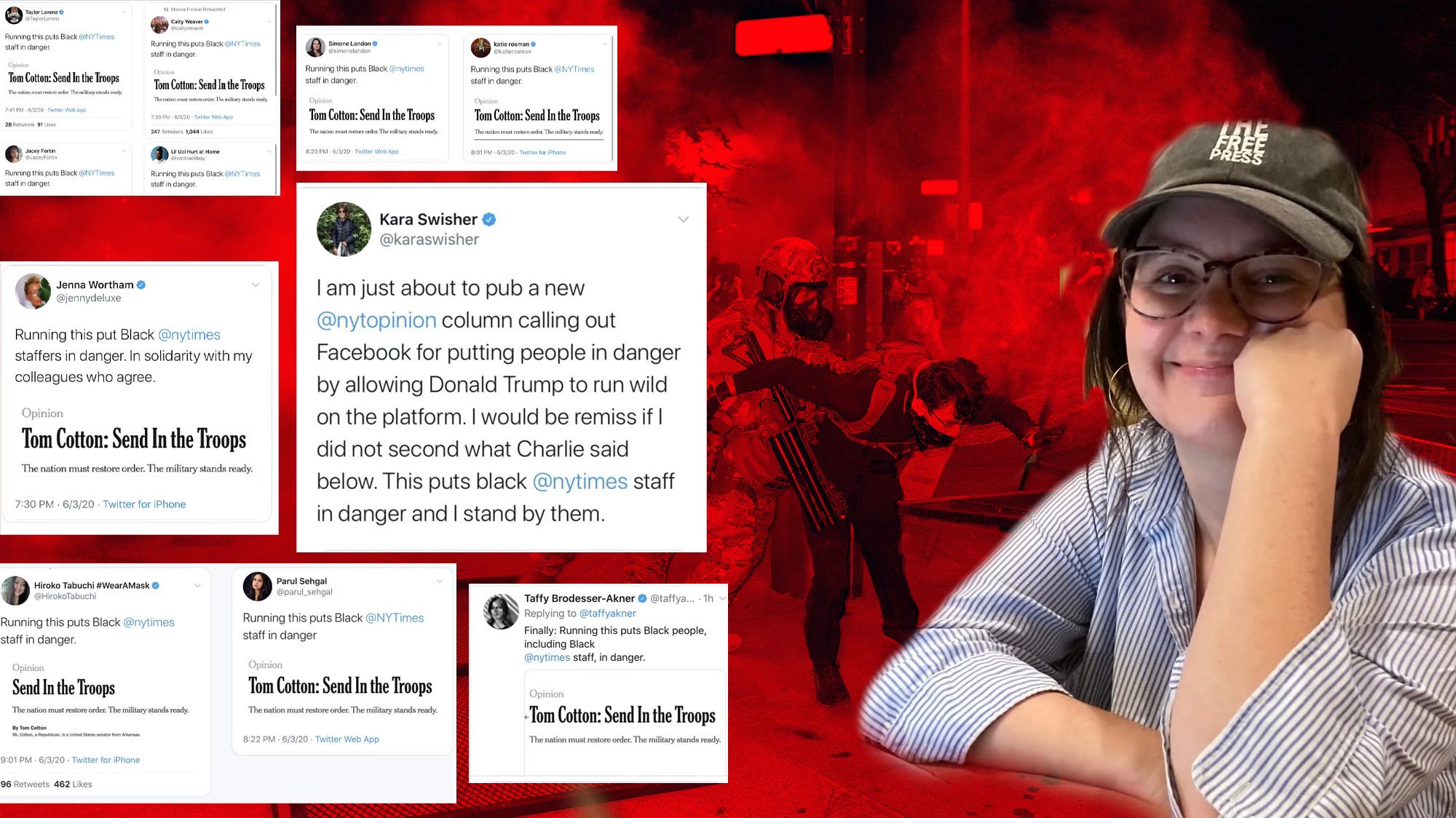
Free Thinking Through the Fourth Turning with Sasha Stone
Bari Weiss and The Substack Revolution
00:28:34
Loading summary
Transcript28 lines
- [00:00]
A
Hi, this is Free Thinking through the Fourth Turning. My name is Sacha Stone. Bari Weiss and the Substack Revolution Local Girl Makes Good. For podcast listeners, the headline from the New York Times, tom Cotton, send in the troops. The Nation Must restore order. The military stands ready. June 3, 2020. Everything changed for me in early June of 2020 when the Tom Cotton essay appeared in the New York Times and all hell broke loose on Twitter. I was scrolling the app to my detriment, as I always do, and all of a sudden it was like the night Donald Trump won the election. Big trouble in Blue Check City.
- [00:46]
B
Here to react right now is the Senator himself, Senator Tom Cotton of the Armed Services, Intelligence, Banking and Economic Committees. Good to see you, sir. Thank you so much for joining me. Senator, what happened with the Times op ed? Was it rushed?
- [01:03]
C
Hardly, Maria. I will say. My op ed didn't meet the time standards. It far exceeded their standards, which is usually sophomore left wing dribble. But here's what happened behind the scenes last weekend. We saw riding looting, really, anarchy and insurrection on our streets in Washington D.C. seven days ago, a famous church was torched, memorials were desecrated, stores were looted. And I said simply last Monday that if the local police are overwhelmed by the numbers of these insurrectionists, if they need support from the National Guard, or if necessary, as a last resort, federal troops under the Insurrection act. And that's exactly what has to happen. Now, fortunately, that's what happened in most places over the course of last week. So what we saw yesterday was people exercising their First Amendment rights to demonstrate and to protest. But in the meantime, we published that exact argument in the New York Times. The New York Times editorial page editor and owner defended it in public statements, but then they totally surrendered to a woke child mob from their own newsroom that apparently gets triggered if they're presented with any opinion contrary to their own, as opposed to telling the woke children in their newsroom, this is the workplace, not a social justice seminar on campus.
- [02:19]
B
Well, it's unbelievable because I know that it went back and forth three or four times in terms of edits and re edits. So obviously they had a process with which to go. I like what Howie Kurt said. Howie Kurtz said, look, this is such a window into how biased the New York Times is when they've just totally exposed themselves. The opinion page is just that, an opinion page.
- [02:41]
C
Yeah, that's exactly right, Maria. We've published op EDS in New York Times before, it was the exact same process. And again, the senior leaders of the New York Times publicly defended the decision to publish the op ed after this woke mob began to rise up. It was only after another day of infighting that they finally backpedaled. They still haven't identified any facts that are wrong in the op ed. They haven't identified what was so rushed about this process. They've only prostrated themselves in front of their young children who are acting like children who are acting like kids in a social justice seminar as opposed to acting like grownups in the workplace.
- [03:20]
A
The New York Times published an op ed that called for the military to be brought in if the riots could not be controlled. Even typing that sentence, calling them riots instead of protests was a thought crime and could not be said out loud. So you can only imagine how horrifying for the reality deniers on Team Fragility to hear Cotten's thesis statement this week, rioters have plunged many American cities into anarchy, recalling the widespread violence of the 1960s. It was dangerous because it was the truth. Like this scene in the Insider where Jeffrey Wigan's story has to be buried because it might disrupt a corporate merger at CBS News. Except this time it might upset the Times staffers and the Twitter hive mind. CBS does not do that.
- [04:11]
D
And you're questioning our journalistic integrity? No, I'm questioning your hearing. You hear reasonable and tortious interference. I hear potential Brown and Williamson lawsuit jeopardizing the sale of CBS to Westinghouse. I hear shut the segment down. Cut Wigan loose, obey orders and F off. That's what I hear. You're exaggerating. I am? You pay me to go get guys like Wigan, to draw him out, to get him to trust us, to get him to go on television. I do. I deliver him. He sits. He talks. He violates his own f confidentiality agreement. And he's only the key witness in the biggest public health reform issue, maybe the biggest, most expensive corporate malfeasance case in U.S. history. And Jeffrey Wigan, who's out on a limb, does he go on television and tell the truth? Yes. Is it newsworthy?
- [05:02]
A
Yes.
- [05:03]
D
Are we gonna air it? Of course not. Why? Because he's not telling the truth? No. Because he is telling the truth. That's why we're not gonna air it. And the more truth he tells, the worse it gets. You are a fanatic, an anarchist.
- [05:18]
E
You know that?
- [05:19]
D
If we can't have a whole show, then I want half a show rather than no show. You won't be satisfied unless you're putting the company at risk. What are you? Are you a businessman or are You a newsman? Because that happens to be what Mike and I and some other people around here do for a living. Put the corporation at risk? Give me a fucking break. These people are putting our whole reason for doing what we do on the line.
- [05:41]
A
Lowell. What?
- [05:44]
F
I'm with Don on this.
- [05:48]
A
The point was Cotton was not only telling the truth, a truth all of us could see with our own eyes, but he was reflecting the majority of opinion of Americans. That's why Bari, Weiss and James Bennett asked Tom Cotton in the first place. To represent the other half of America that the New York Times and everything else under the left's control abandoned. I sat in my apartment gobsmacked that all of this was playing out here. We'd spent months on lockdown making our own hand sanitizers and masks. My daughter was sent home from her senior year of college to have her graduation on my balcony. And all of a sudden none of that mattered. Because systemic racism mattered more. Yeah, that's what the experts told us. All right, here we go. Graduation 2020. Happy graduation, Emma. Thank you. All the best here. You in 2020. Thanks so much. You can. Can't hear the roaring crowd behind us.
- [06:51]
G
Yeah.
- [06:52]
A
We're actually at Yankee Stadium right now. We're at Yankee Stadium. Don't. Those are fake mountains. Yeah. Don't worry about it. Right. That's not Burbank. That's actually not Burbank. It's Brooklyn. Yes. Just different. They all start with bees, so it's hard to get. It's easy to get in position. And we accidentally bought a huge cake. So. For scale Giant. So that's what we're going to be gorging on. Yeah. And have a beautiful future, kid. Thank you so much. Thanks to everybody who wished us well and sent in gifts and all that was really appreciated.
- [07:24]
F
Thank you.
- [07:25]
A
I appreciate it a lot. Yeah. All right.
- [07:28]
G
Bye.
- [07:33]
A
All of these years later, after everything we've seen and learned about that time in our history, we knew Democrats needed it to be bad. Bad enough to pressure Americans into voting out a one term president with a strong economy. It's just that I didn't know that then. All I knew was that no one would talk about it. If you did. Your career would be over. The Tom Cotton op ed would change the course of my life forever. Because that was the moment I could suddenly see that I wasn't getting the truth. I was getting the negotiated truth. The narrative. What they wanted me to know. I began to wonder what else wasn't true. It was also the moment everything changed for Bari Weiss, who had been hired to shake up the media bias at the New York Times. Everyone I knew on Twitter swarmed her, attacked her, and attacked the Times. The day the OP ed was published, they were dragging out the history of James Bennett. They were accusing the Times of putting black bodies in danger. The staff felt unsafe, and before long, Bari Weiss became the problem. They kept the piece up at a fixed and embarrassing disclaimer at the top, which is still there, and it reads, quote. After publication, this essay met strong criticism from many readers and many Times colleagues, prompting editors to review the piece and the editing process. Based on that review, we have concluded that the essay fell short of our standards and should not have been published. The basic arguments advanced by Senator Cotton, however objectional people may find them, represent a newsworthy part of the current debate. But given the life and death importance of the topic, the Senator's influential position, and the gravity of the steps he advocates, the essay should have undergone the highest level of scrutiny. Instead, the editing process was rushed and flawed and senior editors were not sufficiently involved. While Senator Cotton and his staff cooperated fully in our editing process, the OP ed should have been subject to further substantial revisions, as is frequently the case with such essays or rejected. For example, the published piece presents as facts assertions about the role of code cadres of left wing radicals like Antifa. In fact, those allegations have not been substantiated and have been widely questioned. Editors should have sought further corroboration of those assertions or removed them from the piece. The assertion that police officers bore the brunt of the violence is an overstatement that should have been challenged. The essay also includes a reference to a constitutional duty that was intended as a paraphrase. It should not have been rendered as a quotation. Beyond those factual questions, the tone of the essay in Places is needlessly harsh and falls short of the thoughtful approach that advances useful debate. Editors should have offered suggestions to address those problems. The headline, which was written by the Times, not Senator Cotton, was incendiary and should not have been used. Finally, we fail to offer appropriate additional context, either in the text or the presentation, that could have helped readers place Senator Cotton's views within a larger framework of debate. End quote. After that, Bari Weiss didn't just resign, she took a flamethrower to the Times in a fiery resignation letter. That was the shot heard round the world, or at least the Internet, she wrote, quote. But the lessons that ought to have followed the election lessons about the importance of understanding other Americans, the necessity of resisting tribalism and the centrality of the free exchange of ideas to a democratic society have not been learned. Instead, a new consensus has emerged in the press, but perhaps especially at this paper, that truth isn't a process of collective discovery, but an orthodoxy already known to an enlightened few whose job it is to inform everyone else. Twitter is not the masthead of the New York Times, but Twitter has become its ultimate editor. As the ethics and mores of that platform have become those of the paper, the paper itself has increasingly become a kind of performance space. Stories are chosen and told in a way to satisfy the narrowest of audiences rather than to allow a curious public to read about the world and then draw their own conclusions. I was always taught that journalists were charged with writing the rough draft of history. Now history itself is one more ephemeral thing, molded to fit the needs of a predetermined narrative. End quote they thought that was the end of Bari Weiss. They chewed her up and spit her out. Boy, were they wrong. It is now one of the greatest success stories ever told, almost on par with Donald Trump defeating the machine and winning again. According to Puck News, Bari Weiss and the Free Press have now been offered a deal upwards of $200 million to sell the site to Paramount Skydance and put Bari Weiss in charge of guiding CBS News back to some kind of credibility. Even if Weiss doesn't take the deal, it's still a victory lap for her. For podcast listeners Headlines the New York Post Paramount to buy Bari Weiss Free Press for up to $200 million give her senior editorial role at CBS News the rap Bari Weiss set for top role at CBS News as Paramount closes in on Free Press acquisition and a Tweet by Caitlin Flanagan From Barry's letter to AG Sulzenberger resigning from the New York Times. Quote I've always comforted myself with the notion that the best ideas win out. But ideas cannot win on their own. They need a voice. They need a hearing. Above all, they must be backed by people willing to live by them. There will be rumblings that this deal only took effect because of Weiss's overt pro Israel stance after October 7th. No doubt she will be hit from both sides over that one. What happened to me because of Weiss? I started a substack2 five years ago in July of 2020. By then I was already a pariah on my side. I could not use Facebook because of the ongoing attacks, which would still exist should I make my return, which I never will. I'd been swarmed and harassed on Twitter more times than I could count and on July 11, 2020, I wrote my first substack post. On the one hand, I am worried that if I start writing what I've been thinking, it will be met with harsh reprimands. At the same time, there are not enough people on the left willing to speak up to talk about what is happening for fear of being called out, shamed and put out of work. I run my own business, but in this climate, the fear is real. A few angry phone calls can put anyone's source of employment in jeopardy. I'm having a hard time keeping my mouth shut is the only problem. I see disaster looming and I feel like joining those brave voices that are trying to shift the course of the Titanic, which is about to slam into the iceberg. End quote. Nobody read it. Nobody knew it even existed, but it made me feel better that I didn't have to suffer in silence. Keeping it confined here meant I could still earn an income at my other site, awardsdaily.com, one I'd been running for 26 years and earning a decent income from for almost as long. In ordinary times, my own website would be where I wrote what I thought and felt, but I knew even the most subtle descent offered up would be the end of everything. I'd made a name for myself on medium writing from the other side of the aisle, and I couldn't return there either. In both cases, the readership did not want to hear what I had to say. I kept thinking I had to be that person with the machete, clearing away the sticks and weeds, snakes and spiders so others could safely travel after me. Especially my daughter, who deserved to grow up in a free country where she did not have to be afraid to say what she thought and believed, or where she could write any book she wanted to write. I couldn't know that the more people that read this substack, the closer I'd dance to the flame. It didn't really take off until RealClearPolitics began linking to my column and Megyn Kelly interviewed me on her show. So did Glenn Beck. Now, somehow, miraculously, people were paying to subscribe and wanted to hear what I had to say. But this world is kept far, far away from the other world. The doomsday cult, the bubble of the left. Most of them had no idea what I was up to because they would never even think to look to them. All of those bad people on the outside are to be shunned and ignored. At some point, though, considering how many people were out there gunning for my destruction I knew I had to come clean and come out and let all of them know what I thought and where I stood. I also wanted to use whatever voice I had to help Trump win and to defeat them. I was too loud and too obnoxious on Twitter. I was careless. I was doing what I've always done in the 30 years I've been online, I didn't change. Everything around me did. I made a joke mocking white dudes for Harris, and that tweet went viral with people whispering that I was a white supremacist and a racist. That caught the attention of the Hollywood Reporter, and they thought a story on my political shift would be interesting. They called me a MAGA darling, and that was the end of that. That ended any hope of making money on my website. Even though I defended those who were getting canceled many times, I was still taken aback by how it felt to have all those doors slam shut and all those people turn away. It was isolating and in some ways terrifying. The crime I committed was crossing the Trump line. Most heterodox voices refuse to cross it. They'll mingle with Trump supporters, but they will hold that one card back, knowing that when the ship rights itself, they might want to play it. So I don't have the same happy ending Bari Weiss does. I can't take a victory lap, at least not yet. She has her whole life ahead of her. I have my whole life mostly behind me. But I'm eternally grateful that there are so many readers out there who get something out of what I write. In some ways, this has been the summation of my life online. Tapping out words on the screen, hoping that those words land in the hearts and minds of readers, hoping that I can be heard. I don't know what I would have done without that. I will never stop saying thank you for saving my life. I don't know if Weiss will take the deal. 100 million or even 200 million means she'll be set up for life. She will never have to struggle. It also means she is less free. It means they can cancel her again. And believe me, they will try. If she is the head of CBS News, everything will be her fault. The bad ratings no one on the left talks about now will suddenly be the headline in every mainstream media outlet. Every story will be heavily scrutinized in a way it never was before. They manifest failure where no such failure exists. And they'll never give her any credit. She should heed the wise words of Megyn Kelly, who has been there and.
- [19:54]
H
Done that CBS is among the worst when it comes to being insular. Like, you have to be raised at CBS to be respected by the CBS people. Ask Katie Couric if. If you don't believe me. Ask Katherine Herridge if you don't believe me. You know, to. Whatever you think of Katie Couric, within that circle, she would certainly be considered one of the most storied, established journalists of modern times. And they hated her guts that she didn't rise up within CBS and she didn't come from the evening news and all that crap. There's no way they're going to respect somebody who did a stint at the Journal in the Times and then went off into independent media as a television editorial boss. And I'm sorry, but they're also not going to respect somebody who's young and a woman, because CBS is not built that way. Again, ask Katie Couric. Ask Katherine Herridge. I've watched it happen time after time, so I just don't get the allure, like, are we on an independent media train where we're, like, creating and building something new that matters and is really going to replace these dinosaurs, or are we going back into the dinosaurs to try to somehow put the paddles on them and continue to ask for a charge when the patient has long since expired?
- [21:14]
A
Yeah.
- [21:14]
E
Such a good point. I'll just give you this quick anecdote. You know, I founded the Intercept in 2013, and we did so with Pierre Omidyar, the multibillionaire founder of ebay. And at the time, he was strongly considering buying the Washington Post for the same amount he invested in the media company that we created, which was $250 million. And ultimately, Jeff Bezos bought it instead. And I remember him telling me he wanted to buy the Washington Post to change it, but realized that with an institution that kind of longstanding, that kind of ossified, even if you buy it, you're the owner, it's extremely difficult to change it. He decided it would be just better to start something from scratch that he felt he could put his imprint on. And I do think, while I do, you know, I did express the concern that Barry is going to go there and exert a lot of influence. I think more likely is what you said, which is kind of like the rotted roots of cbs, even with new ownership, probably telling her she'll be protected or whatever is more likely to consume her and change her and the free press than it is the other way around. And also, I think you're so right. This is a Dying medium, not just cable and, but network news. Like I have never heard anyone under 40 being like, hey, did you catch 60 minutes, you know, the other night? That's not where they get their news from. And Barry has created something, whether I like it or not, that is extremely influential because of its independence. And I have seen people go in the reverse way. Like you and Tucker, for example, were freed when you finally got out of working for a major corporation. Even if you and I had that same experience, like even if you don't realize the constraints that are there, they're still there. Just going to work there every day or why would you want to sacrifice the credible freedom and liberty that you have of being your own boss and having this great influence to go basically become an employee of a stodgy old corporation that seems to be more dying than it is rejuvenating. Maybe it's just the allure of a brand name job, but I don't really think she'll hate it kind of person who. Yeah, yeah, I wouldn't do it.
- [23:12]
H
They're going to be nasty bitches to her. And I use that term in a non gendered way. I think they're going to be terrible to her. I think she's doing something really exciting right now and she is succeeding. Then finally exit plan. If she wants to sell the Free Press, I have no judgment on that. I'm sure she could build something else awesome from scratch. And she's got a lot of investors who love her because Barry's liberal. I mean, she's more of a, you know, old school liberal and she's not woke, so she's safe, you know, because a lot of these leftist investors, they love that kind of. They're not woke either. They can't say it publicly. They love the things that she writes that are non woke, but they still don't like Trump. So Barry's a great investment for them and they probably would get behind any new publication or project that she would put out there. But this just is not it. Honestly, Glenn, I can tell you truly, if anybody, if Fox News came to me tomorrow and said, would you come in and head up Editorial or any other organization, you know, come in and help us. It may be like an ABC or a CBS and like help us right the ship, I would say no, thank you. No thank you. I've already gone into these networks and seen the hatred they have for people who are genuinely not of the left and for outsiders, which Barry 100% will be considered, notwithstanding her liberal bona fides. Card. And they're miserable places to be. CBS is notorious for how unhappy everyone is. So I just think, like, why it's so wonderful to be independent, not to have these corporate bosses. You and I are in this great place where if somebody loves our product, maybe we'll license our product to them. That's fine. They don't own us. It's like, whatever, but there's no way they own us. You wouldn't give your editorial freedom up? I wouldn't give my editorial freedom up. And you go and join one of these organizations and they're the ones who control you, not the other way around.
- [25:09]
A
Either way, if she's sitting on 100 million, maybe it won't matter. Then again, who knows? Maybe she could lead a revolution in the legacy media too. Thank you for listening to my podcast, sashastone.com. i hope you all have a wonderful weekend. And remember, thank you for saving my life. And to thine own self be true.
- [25:50]
G
I'm free to sing my song any old time I'm free to sing my song any old time so love me O man love me oh man I'm free Sing my song and he holds out yeah, I feel right I'm free to choose the wild please any old time I'm free to please Do I choose any old child so love me oh man oh man Love it cause I'm old yeah yeah yeah I want you to get an altar.
- [27:14]
F
There's a lot of people want to come and hear the music. There's some people that don't. To them it's just an extraneous event, like being in a village where there's a fete. I may not like. The fate doesn't stop me having a drink in the pub. I think English people on a day like this won't be annoyed. The horses didn't mind at all they rode by.
- [27:42]
G
I'm free to sing my song any old child oh yes I am I'm free Sing my song the wind gets out of time I'm free to sing my song the way it gets out of town Love me, oh me love me I wanted to hold me Cuz I'm free to sing my song I get it all time oh yeah my.