← Free Thinking Through the Fourth Turning with Sasha Stone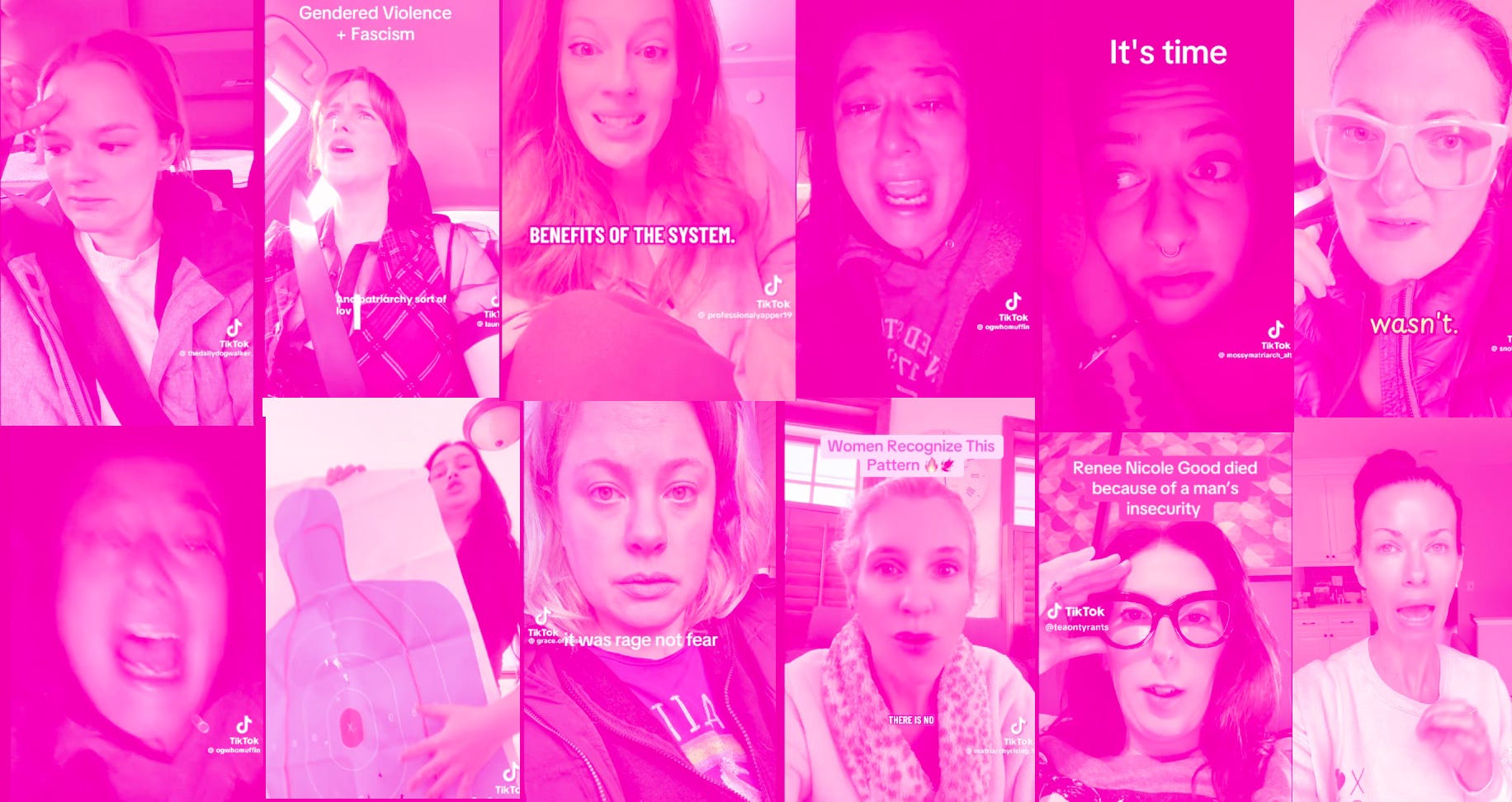
Free Thinking Through the Fourth Turning with Sasha Stone
Confessions of a Recovering Liberal White Woman
00:50:09
Loading summary
Transcript1 lines
- [00:00]
A
Hi, this is Free Thinking through the Fourth Turning. My name is Sacha Stone. Confessions of a recovering Liberal white Woman. How did it all go so wrong? You've heard of the great awokening in the great feminization. Now meet the great crackup of 2026. Grown women. Liberal white women losing their minds and going to war on federal officers. People are starting to notice. For podcast listeners, a headline from Fox News. Deluded wine Moms are committing deadly crimes, not simply protesting. We haven't seen a great crack up like this since my childhood when those hippie chicks sat on the sidewalk, even crawled on the sidewalk with X's carved into their foreheads, their heads shaved off, prattling on about the revolution. Here is a video of the Manson girls. You've heard the verdicts. How do you feel now? What are you going to do now? You've all judged yourselves poorly. Are you guys proud of a system where a man cannot defend himself? Are you proud of it? That was an eight month trial with many witnesses. That was a trial. Eight months of prosecution. Death until Charlie's out. Looks like that will be never. He'll be out. All the people will be out. What makes you so sure? Angela Davis will be out. Bobby Seal will be out. There's a revolution. We'll be here. When do you expect this revolution? Soon. Very soon. You'll know, you'll see it. You'll probably be out there trying to televise until he comes out. Did you expect this verdict? The revolution? What do you mean by a revolution? A bloody revolution. You gonna be part of it? Oh, I'll have a part, maybe. I'll do whatever. Everybody will be part of it. Wanna take the children to the desert? Your children? There's no reason why your children should die. They'll go to the. We'll take them to the desert. Do you give them to us? When's the revolution coming? Well, we haven't scheduled it. It's not our revolution. Black man's gonna judge this world for every blow he's received. For every blow, every person that stepped on by the system. It's going to all come back to you all at once. You obviously can't sit here. And it all seemed like a harmless fad until they found dead bodies and blood soaked walls in the Hollywood Hills. And the shocking case unraveled to reveal a cult with a leader who seemed to have hypnotized young white college girls into violence as they decoupled from society and believed the laws no longer applied to them. I have X'd myself Out of your world, said Charlie. Then came four dead in Ohio, a shooting at Kent State a year after the Manson murders. And by then, ordinary Americans had had enough. Students protested against the Vietnam War in large numbers. Young people who watched their friends, siblings and peers being drafted were particularly active in demonstrating. And by 1970, US involvement in Vietnam had actually begun to decrease. That is, until April 28, when President Richard Nixon authorized a preemptive strike for troops to cross from South Vietnam into Cambodia. Two days later, he made a televised speech justifying these actions. This triggered a new wave of anti war demonstrations. First, the day after Nixon's announcement, two peaceful rallies were held at Kent State University in Kent, Ohio. Later that night, drunken revelers in downtown began pushing over garbage cans, lighting fires and breaking store windows. Police in riot gear pushed everyone back to campus, and the whole thing was over by 2:30am the next day. As students cleaned up the damage, downtown Kent Mayor Leroy Satrom declared a civil emergency and called in the Ohio National Guard, worried that violence would erupt again. That evening, 1,000 demonstrators gathered near the campus ROTC building, and several set it aflame. The building ultimately burned to the ground. By May 3, 1200 National Guardsmen occupied the Kent State campus. The governor of Ohio even helicoptered to the school and spoke at a press conference, promising to use law enforcement against student protesters. Frustrated students waited to meet with officials that night. But the officials didn't show up. So the students blocked traffic in protest. Some grew violent and were met with bayonets and tear gas. On May 4, the governor banned demonstrations, completely distributing 12,000 leaflets prohibiting protests. But the students either didn't get the message or they didn't care. By noon, nearly 3,3000 students had congregated in the university commons, 500 protesting, 1,000 cheering and 1,500 watching. That's when 100 guardsmen confronted the protesters with M1 rifles. What happened is still clouded in confusion. The general commanding the guard ordered the crowd to disperse from a jeep, but was met with chants and rock throwing. The guard retaliated with tear gas and advanced, using bayonets on their rifles to push the crowd back. And it worked. The crowd dispersed, but then, as witnesses say, 28 of the Guardsmen who had retreated up a Hill fired between 61 and 67 shots, some in the air and some directly at the protesters. Four students were killed. They wanted a safe country, one free from the unpredictable wildness of revolutionaries, their cults, their uncontrollable violence. Bombings, riots, murders. When would it end? With a landslide victory for Richard Nixon in 1972, followed eventually by Ronald Reagan in 1980. From Ronald to Donald. Now, like then, it's a race to see which side is less crazy. And so far, it's the left by a mile because it is dominated by these crazy liberal white women like I used to be. But they never snapped out of it like I did. To them, Trump destroyed everything. Their country, their culture, their sanity, and even to some of them, their ability to parent their children. Here is a video from TikTok. It's hard to admit, but I'm aware that I would be a better mom if I had kids when Obama was president. And now I'm distracted, I'm upset, I'm angry. I'm spending time going to protests and trying to stay up on everything, and my kids are paying the price for that. And it just makes me really mad and disappointed, and I feel really bad as a mom. In their minds, there was no other option. Elections don't work. They tried, they failed. This country they believe belongs to them. And if they want to end mass deportations, they have every right to do so. Who needs borders anyway? For that matter, who needs law and order? Who even needs elections? After 10 years of cycling mass hysteria through their nervous systems, they've reached the breaking point, the great crackup of 2026. Here are women from TikTok. I can't stop looking at her face. I can't stop looking at Renee Nicole Goode's face. I'm looking at this person and I see myself and, like, I'm just f? Cking curious. Are we great yet? Are we f. Cking great yet? Are we a great country? Is this what. It's great, huh? Is America great? Where ICE agents are shooting citizens in the street and the government's saying it's self defense? Are we great yet? Well, it's another shitty day in paradise where masked ICE agents are allowed to bully, berate, harass, stalk, beat up, murder people, even citizens. Well, I am not okay today, and I have to document this. Today is January 7th, and I just murdered an innocent woman. I. I did terrible thing. And I watched all the videos in all angles. And to. To watch a woman fight holding on to her wife screaming is not something I could take lightly. Wow. And to all the people that voted for this, you voted for this. Can you just sit with me? If you hate him, too, just sit with me. I hate him. I don't like to hate people, but I hate him. So they're killing moms now? They're killing moms. Well, this mom's ready. This mom is ready. I. I am having an out of body experience an absolute existential crisis. Like someone made a comment that has stuck with me for days and it was he didn't kill her because he was scared. He killed her because she wasn't. I don't know guys. I'm starting to think that maybe we shouldn't let psychotic, chronically angry men with mommy issues be. Federal agents. Renee Nicole Good died because a man felt insecure. What women are responding to right now is pattern recognition. Because let's be so real, when armed mask men surround a woman, there is no safe option. It wasn't even just murder. It was a rage kill. It was a rage kill. He rage killed her for defying him or what he saw as defying him. He didn't feel threatened. It was a rage kill. There they are on display for all to see. Once empowered women living the dream, now radicalized online in Facebook groups on TikTok, mainlining Rachel Maddow and are now combat ready, wild eyed and preparing for war. Here are some more women from TikTok. All of this can be avoided with simple compliance. You all don't want to hear that, but the only thing that you need to do is comply. If they say stop the car, you compl. If they say roll down the window, comply. Step out of the vehicle, comply. Put your hands behind your back, comply. Walk silently in single file to the gas chamber, comply. If you believe deep down in your heart that people have the right to stand up to an oppressive government, then you cannot also hold the belief that people should comply with law enforcement no matter what. It is not surprising that the first bystander murdered by an on duty ICE agent was a white woman. And I want to talk about it because I think it's really important if we're going to fight this. To do what? The art of war and know thy enemy. And right now our enemy requires a little bit of a lens adjustment in order to fully understand them. Because the lens we have to operate under now is fascism. There's been a lot of commentary on the murder of Renee Nicole Good by piece of shit ICE agent Jonathan Ross as being of note because she is a white woman. Oh, we're cooked if they're out here killing white women. Oh wow. Even white women aren't safe now. And that's not wrong. Historically, American violence and oppression is rooted in colonialism and white supremacy. So it's always fallen disproportionately are black, brown, indigenous and immigrant communities. And that hasn't changed. But what we have to do is put this nice little, like, layer of fascist icing over the American colonialism and white supremacy cake. And then what happened makes a lot more sense. One of the main tent poles of fascism is patriarchy. And patriarchy sort of loves to say that it protects women and upholds women, but it's only certain kinds of women, women who perform submission, who align with power, and who uphold the hierarchies. Renee didn't do that right off the bat. She's a queer, is standing up to the powers of the state, and she is siding with the abducted people rather than with the white men, upholding the violence of patriarchy and fascism. If a bunch of masked, armed, unidentified men are trying to enter my vehicle as I'm driving through my neighborhood, I'm going to run over. You know, like, when it comes down to it, I'm going to die. I will die because I will be putting my body in front of another person's body to protect them. Because this is. Let me ask you a question. If there's more of us that don't like what's going on than them that like what's going on, don't you think we can take over the people that we don't like what's going on? Check. Clear. It's just a matter of time before somebody shoots back. And I don't think we're gonna have to wait that long, not with the way things are going. This is it, guys. This is the tipping point. I'm a Marine Corps veteran, and I'm going to tell you how to prepare for the impending civil and world war. And I know that that sounds scary, and I am not trying to fear monger here, but please stay with me. Today, J.D. vance went on record and publicly declared that that ICE officer who shot Renee Goode has absolute immunity before an investigation is even complete. And they have all of the facts. So you know what else that means? That means he thinks he has immunity and Trump has immunity. He just gave every member of ICE permission to unalive Americans. Let me repeat that. Our vice President of the goddamn United States gave total immunity to ICE to off Americans. Don't get it twisted. This is state sanctioned. Harm Donald Trump today. I was at the range. And it'll do your heart good to know there was a lot of women there. I was there. Not with my. But with the little one that I carry with me all the time. And I'm going to show you up here a little picture of what I was aiming at today. You Motherf ing maga. You might think that we're out here just sitting around wondering what's gonna happen. I know what's gonna happen. It doesn't seem to occur to them that mass deportations have been carried out by every president in the modern era. They're going back to their own countries, not concentration camps. But does it even matter? When was the last time you heard any Democrat tell the truth about anything? They make up their own reality, and that's why they're losing their minds now. Nothing feels real anymore. They believe their one true purpose, because every other purpose has been taken from them, is to protect illegal immigrants from the evil white supremacists. In America, it's Patty Hearst. Only this time with a legacy media and an entire political party backing her up. Meanwhile, in the real world, anyone not indoctrinated by MsNow, the New York Times and the algorithms can hear what sounds like common sense policies by the Trump administration, even though liberal white women believe it's nothing but lies, here is Tricia McLaughlin, the DHS assistant secretary, talking with Ben Shapiro. So when we look at the sort of thing that's been happening in Minnesota where you have people suggesting that ICE is engaged in state sponsored terrorism or that that ICE is the Gestapo, what was the exact operation that was happening in Minnesota for people unfamiliar? So we have, we've arrested in just the last five weeks alone, 2,000 illegal aliens. That includes multiple, I would say scores, in fact, multiple murders, a known and suspected terrorists, multiple gang members. But we also, in Minneapolis itself, of course, we've seen a scourge of fraud, $9 billion. But we think that that's just the tip of the iceberg. So our Homeland Security investigators are on the ground there. We've had about 300. They're not doing immigration enforcement. They're really looking at this fraud and white collar crime. In addition, we have about 1,000 plus ERO, which is ICE enforcement, those members on the ground who are really sweeping the city there. When you look at this particular incident, of course, any loss of life is tragic and we pray for the deceased and her family. But what happened leading up to this, those facts are incredibly important. At 10:25am Central Time on Wednesday, January 7, what happened was this individual, she had been impeding and blocking in our ICE law enforcement officers. She had been doing that throughout the day, obstructing lawful operations, which, Ben, as you know, that is a felony. At one point, our ICE law enforcement officers then approached her vehicle and said to get out of the car, she was going to be under arrest and they commanded her to stop obstructing operations. That's when she would not obey those lawful commands. That's when we see in the video the law enforcement officer is in front of her. She hits the gas. And he was in fear of his own life and he was in fear of the law enforcement who are around him. She used, she weaponized her vehicle. She used it as a deadly weapon. And our officer, he responded as his training instructs him to do. I can't help but feel badly for these crazy women trying in vain to outrun all of that crippling self hatred and white guilt. They're ready now to put their lives on the line because this thing goes much deeper than politics. Trust me, I know. I was one of them. For podcast listeners, a picture of a woman with the quote the moment I realized I was in the same situation Renee Goode was in, heading to report ICE and I could potentially never see my kids again. I wasn't quite this crazy, but I know what it felt like to believe our country had been invaded and that a whole of society effort was necessary to bring down the Trump presidency and the MAGA movement. But all we were really doing was defending our status as the ruling class, beating back a populist revolt. There but for the grace of God go I. I was the first generation to come of age after Roe v. Wade and in the wake of the 1970s feminist movement. I felt like I had an obligation to put myself first because that was now my right. Abortions would be like biological bulimia pleasure now, get rid of the problem later. I was supposed to chase my dreams, to become something, to be someone, because being a wife and mother wasn't enough. That was the first lie and the most damaging. The idea that babies shouldn't matter as much as our own happiness, that they are a burden and a thing to get rid of was in direct contradiction of who we are as women. It is to deny biological reality. Sound familiar? One lie piled atop more lies for decades. How do we ever think that would work out well for us? Instead, it has driven us slowly insane. We teach our young women to disconnect, to not care, to almost want to get pregnant just so they could have an abortion and post about it on social media. They celebrate it. They flaunt it. For podcast listeners, a montage of TikTok posts a woman with a young girl Abortion is health care. Another happy Mother's Day to everyone, including women who had abortions. Because the most motherly thing you can do Is admit that you can't be what your child will need. And another one. I wish everyone who's had an abortion or who's about to have one, an amazing day. You're so strong and brave. And another one. Hot take. Even if abortion was murder, I'd still think it's acceptable. And another. Yes, I've had an abortion and yes, I will be celebrating Mother's Day. And another abortion is health care, not murder. And another ability. Photo of a pregnant woman. Throwback to a few days before my 33 week abortion. It wasn't until I had a child and held her in my arms, raised her and watched her grow that I realized what a lie it all was and what a huge mistake I'd made. Living so carelessly and killing what would have been, could have been. A life. It haunts me even now. You can't outrun it. My body somehow still remembers and asks, where did they go? The answer is one I have to live with now. What I did and why I did it and why I can't forgive myself for it. And why I will live with regret for the rest of my life. I bought into the feminist lie because I thought I was doing the right thing, serving my own needs. What I realized over time is that progressivism is like an invasive species. It can't stop on its own. The wheel of oppression must keep spinning. And for feminists, they would come to realize sooner or later it was bound to spin away from them. The Great feminization. The downfall of the women's movement is evident in the late 70s movies like Network, where career hungry Faye Dunaway is seen as a childless cipher who will never find true happiness. Here is a scene from Network being dark on his hands like this. Oh, hell, Diana. I knew it was over with us weeks ago. Will you go back to your wife? I'll give it a try, but I don't think she'll jump at it. But don't worry about me. I'll manage. I always have. I always will. I'm more concerned about you. And you're not the boozer type. So I figure a year, maybe two, before you crack up or jump out of your 14th floor office window. Stop selling, Max. I don't need you. I don't want your pain. I don't want your menopausal decay and death. I don't need you, Max. Don't need me? You need me badly because I'm your last contact with human reality. I love you. And that painful, decaying love is the only thing between you and the shrieking nothingness. You live the rest of the day. Then don't leave me. It's too late, Diana. There's nothing left in you that I can live with. You're one of Howard's humanoids. If I stay with you, I'll be destroyed. Like Howard Beale was destroyed. Like Lorraine Hobbs was destroyed. Like everything that you and the institution of television touch is destroyed. Your television incarnate, Diana, indifferent to suffering, insensitive to joy. All of life is reduced to the common rubble of banality. War, murder, death, all the same to you as bottles of beer. And the daily business of life is a corrupt comedy. You even shatter the sensations of time and space into split seconds and instant replays. You're madness, Diana. Virulent madness. And everything you touch dies with you. But not me. Not as long as I can feel pleasure and pain. And love. In Kramer vs Kramer, Meryl Streep leaves her husband and son to find herself in California. Here is a Scene from Kramer vs. Kramer. That's everything. Hey, hey, hey, hey, hey, hey, hey, hey. Enough. Enough, all right? What are you doing? Where are you going? Come on. Just tell me what I did, that's all. Just tell me what I did that's so terrible. Then what is it? It's me. It's my fault. You just married the wrong person, that's all. I can't get anything. Let's just go inside. I can't. I tried, I swear. Joanna, please. Now, just. I'm sorry. No. No, don't. Don't make me go in there, please. Please don't make me go in there. Don't make me go in there. If you do, I swear, one day next week, maybe next year, I don't know, I'll go right out the window. Oh, please. Now, come on, now. What about Billy? I'm not taking him with me. I'm no good for him. I'm terrible with him. I have no patience. He's better off without me. Joanne, please. And I don't love you anymore. By the 1990s, I was among the women who were more than ready for a spiritual infusion. Nothing else had worked. Not sex, drugs and rock and roll, not chasing my own happiness, not even a fulfilling career. We were depressed, and no one could explain why. It's chemical, they said. So we found the answer in therapy, culture, self help and ways to become ideal human beings. All we had to do was change the language and we could remake society into a place where everyone felt safe. Before long, we had a real leader in Barack Obama. Who had a mission to put women and girls first. We were building what we thought was not just a better America, but our better selves, better children, better schools, better movies, better corporations and industries. Women can do it. We can organize, we can raise money, we can mobilize. We can change the world. Here is Helen Andrews. The libertarian economist Tyler Cowan once wrote a blog post describing all of the revolutions he's seen in the course of his lifetime, starting with the moon landing when he was a little boy and going up chronologically to today's advent of AI. And there were only seven revolutions on this list because this was only the greatest and most earth shaking ones. And right there between the fall of communism and the invention of the Internet was something called the Great Feminization. That is not a phrase that a lot of Americans know, but future historians may well rank it as having greater importance than almost any other revolution on that list. The Great Feminization is very easy to define. It refers to the increasing representation of women in all of the institutions of our society. But as simple as it is to define, it's very difficult for those of us on the other side of that revolution to fully grasp its significance. The first thing that most people fail to understand about it is how unprecedented it is in human history. There have been many societies that have been feminist to one degree or another, in which women have been queens and owned businesses and held positions of authority that commanded the respect of men. But there has never been a society in which women hold as much political power as they do today. Think of all of the parliaments that have ever existed, every legislature in every country in every century. None of them has been as ours is one one third female. The idea of a female chief of police would have seemed very strange even to many early feminists. And yet today the police department is led by a woman in the largest city in America. And in the city in which we are now standing. Law schools today are majority female. Law firm associates are majority female. Medical schools are majority female. Women earn a majority of B and PhDs. College faculty are majority female. Women are 46% of the managers in the United States, and the white collar workforce overall workers with college degrees. A majority of them are women. And before we were Karens or woke libs or resistance warriors, we were the center of the universe. Corporations catered to us as a powerful spending demographic. Our every need was met with ways to improve ourselves because we were worth it. And at some point over the past 20 years, we became more powerful than we'd ever been at Any time in history. We were the leaders, we were in charge. And all that was left was our first female president in Hillary Clinton. First and foremost. It's finally here. Going into this night. Where do we stand? This is where we stood coming into the night. 268 to 204. So clearly an advantage for Secretary Clinton. Take a look here. If Donald Trump wins tonight, no matter who they voted for, take a look at these numbers here. 21% say they'll be concerned. 37% say they'll be scared. This is what both candidates want. They want to be living there starting January 20th of next year. Florida been going back and forth, back and forth. Just changed again. It's only 11,000 vote lead just now. A change. Math on your feet. I like this. The Empire State Building in New York City. Take a look at our running tally, the electoral vote. Anderson, this night is turning out to be a real nail biter. All along the Trump campaign has been saying that Florida's must win for them. They can't win without it. Donald Trump will carry the state of the Florida. You know, I'm guessing that the people in Brooklyn, they're probably there. I can see their fingers. Hillary Clinton. Yeah, fingers probably bleeding because there's no more nail to bite. There are. I wouldn't call anything encouraging for Hillary Clinton at the moment, to be honest with you, my friend. Wolf, the scene here is so different than it was a few hours ago when people were happy and relaxed. I have been looking around the room at people who are stone faced. Some of them have been crushed. This was a white lash against a changing country. It was a white lash against a black president. This is the people rising up saying it's time to listen to us. It's time to listen to us in Michigan and Wisconsin and work for the people. Hillary Clinton has called Donald Trump to concede the race. Donald j. Trump is now president of the united states. President of. For the moment. What a great honor to be able to introduce for the first time ever anywhere, the 45th President of the United States of America. Donald, I am so sorry to my world. I am so sorry to my world. This is not what we want. We will face challenges. So much potential for beauty and for devastation in this one moment. It's almost incomprehensible that they can exist right now. So. And we are grateful. So President Opaque on. Needless to say, 2016 was our apocalypse now. We had just been assaulted by the Electoral College and what choice did we have but to say me too. And just like that our power was peeled back layer by layer. The more we clung to it, the worse it got for us. Now we were sobbing hysterical women and saw ourselves as victims of men, of racists, of oppression. Then Black Lives Matter called us white feminists with white privilege and white fragility. And now we had to feel guilt and shame for our whiteness, our microaggressions. So we decentered ourselves. And then came the transgender women who demanded they were women too. And we had to further shrink back because now trans women had higher status inside our doomsday cult. We had to be not women anymore, but chest feeders whose body parts were interchangeable, whose history of sexual violence never happened. We couldn't even say women anymore without being called terfs. And now that women were effectively silenced, who had been made to feel guilt just for standing up for any right that wasn't the right to kill our own babies, it wasn't hard to sacrifice the children, too. Here is a video from TikTok. I'm going to be honest. I don't feel good about being white every day for a lot of reasons, because it's a point of privilege that I get to move through the world in a way that so many of my other colleagues and friends and family members of the community don't get the privilege to do. And I'm just a female, but just a woman, just a white woman. If, if I was a white man, I would be functioning from a point of even greater privilege. I think we're missing an opportunity when kids. When kids have a moment to reflect about how the color of their skin does and does not allow them to move through the world, it's running, running to them and trying to stifle that and trying to say, you shouldn't feel bad. So we don't want to ever expose you to something that is going to make you have to pause and have maybe some internal feelings. It's a missed opportunity for some really good dialogue. Sooner or later, the wheel of oppression would spin toward illegal immigrants or undocumented workers who are now the ones in need of protection. So that became the new cause of the day for all these forgotten, ignored, purposeless, liberal white women. Feels kind of wrong being here in some way. I don't know why. I mean, part of it is being like a white woman, that I'm privileged and I have a lot of privilege. So I feel like white tears are not always something that's helpful or necessary when black and brown people have been exposed, experiencing this. Yeah. For a long time. This isn't new for them. And so I don't know if that makes any sense in that way. How did you decide that you should be here? Are you still figuring that out? Well, I work like two miles from here, so driving by just. I don't. You know, it's like. So you can't be a good white person and put your body in between them, trying to kidnap a brown person or harm a black person. When you do that, you lose your proximity to whiteness and you lose the benefits that come along with it. That's the cost. We're all acting so shocked that they murdered a white woman. Well, see, she was in a good white. She was out there advocating for brown people, so she lost her proximity to whiteness. This is the work of dismantling white supremacy. This is what it's going to cost. It's time for some radical acceptance because they've been out there killing black and brown people for hundreds of years. And people who looked like me were having picnics under black bodies as they blew in the breeze after they'd been lynched. And then six years ago, when they kneeled on George Floyd's neck, we all put a black picture in our Instagram, acting as if that were enough. In order to dismantle white supremacy, we have to be willing to lose the benefits of whiteness means they kill us too. That's what that means. And it's time for some radical acceptance about that, guys. That's what it's going to take to dismantle white supremacy is losing the benefits of the system. So we can't be so shocked as white people continue to die because we weren't this shocked when black and brown people were dying. Because we expected it, not because we weren't grieving, but we expected it. Right? You should expect it. We have to lose the benefits of the system if we want to tear the system down. White supremacy has been killing black and brown folks and it's not going to go down without a fight. So if you lose your proximity to white supremacy and whiteness, you will lose the safety that goes along with it. The doomsday cult the left had become meant all the children had to be indoctrinated too. But no, I don't expect any of those out there screaming about fascism to see the connection between the cult and putting their lives in danger. Here is a video from the YouTube channel Saving Culture from itself. So here we go. White children are the devil. White children are minions of the devil. That is what this book, which is written by a White woman, of course, is telling young American children who read it, tell me that's not evil. How much more evil can you possibly be? Very interestingly, this little, this wording here to mess endlessly with the lives of your friends, neighbors, loved ones and all fellow humans of color. That language is explicitly and almost identically reproduced by white women all over social media who are right now going out there and protesting about ICE enforcement actions to remove illegal immigrants from the United States. They are often always talking about they are going to stand in the line for their neighbors, friends and loved ones of color. This book is not necessarily. I'm not saying this book is. Renee was Renee Good's favorite book. I have no idea if she ever read it or not or ever came across it. What I am saying is that this book is the perfect encapsulation of the kind of racially toxic social justice woke ideology that so many American progressive women are currently in the grips of. 54 years after title IX passed, it is now up to the Supreme Court to protect women in crime, girls in sports. It took the election of Donald Trump to even start rolling back the delusions that children can change their sex with powerful drugs and surgery. That's why this former liberal white woman didn't just vote for Trump. I put everything on the line to support him, loudly, to help other silenced women find their voice and stand up for the kids, to protect them from the cult, to give them a chance at a normal life. And it might have cost me everything, but it was worth it. All I have to do is log on to social media and I see the self I once was to realize I made the right choice. Drive, baby, drive. Hearing those words by Renee Goode's wife just before disaster hit and the bullets killed her instantly. I thought of Ridley Scott's Thelma and Louise back then. The controversial ending where they drive off a cliff and we assume, crash to their deaths seemed like a twisted form of empowerment. But all it really meant was that they had to give up on a world that had given up on them. Here is a scene from Thelma and Louise. I don't know. I think. I think it's a goddamn Grand Canyon. Isn't it beautiful? Yeah. Something else. All right. Oh, my God. It looks like the army office grass. Hey, don't have to shoot those girls. This is too much. They got guns pointing at them. These women are armed, Hal. This is standard. Now fall down. These boys know what they're doing. Place your hands in plain view. Any failure to obey that command will be considered an act of. Of aggression against us. I repeat, turn your engine off and place your hands in plain view. What are you doing? I'm not giving up. Max, you got to do something. How many times, Max? How many times did we got be up. Hey, listen. Will you pull yourself together? Now listen to me. You calm down. Don't make me sorry I brought you. Damn it. I repeat, cut your engine off and place your hands in plain view. Okay, then listen. Let's not get caught. What are you talking about? Let's keep going. What do you mean? Go. You sure? Yeah. Sa. Liberal white women in the past 20 years have lived the most privileged lives of almost anyone on the planet. But even having everything somehow wasn't enough. They needed to still feel like Thelma and Louise. Like they had no other choice but to scream in the faces of ICE agents. No other choice but to resist. No other choice but to step on the gas. Thank you for listening to my podcast, sashastone.com. and if you like my work, please consider leaving a review. Or you can leave a tip in the tip jar, or you can become a paid subscriber. And remember to thine own self be true. What's that flower you have on? Could it be a faded rose from days gone by? And did I hear you say he was meeting you here today and take you to his mansion in the sky? She's 41 and her daddy still calls you baby all the folks around Brownsville says she's crazy While she walks downtown with a suitcase in her hand look at in v Mysterious dark in younger days I called her delta down pretty as one. Then a man of a low degree stood by her side he promised her he takes bigger holy. D what's that flower you have on? Could it be your fade rose from days gone by? And did I hear say he was meeting you here today to take you to his mansion in the sky? What's that flower you have on? Could it be a faded rose from days gone by? And did I hear say he was meeting you here today to take you to his mansion in the sky? I el d what's that flower you have on? Could it be your fade rose from days gone by? When did I hear say he was meeting you here today to take you to this mansion in the sky? To take you down to this mansion in the sky?