← Free Thinking Through the Fourth Turning with Sasha Stone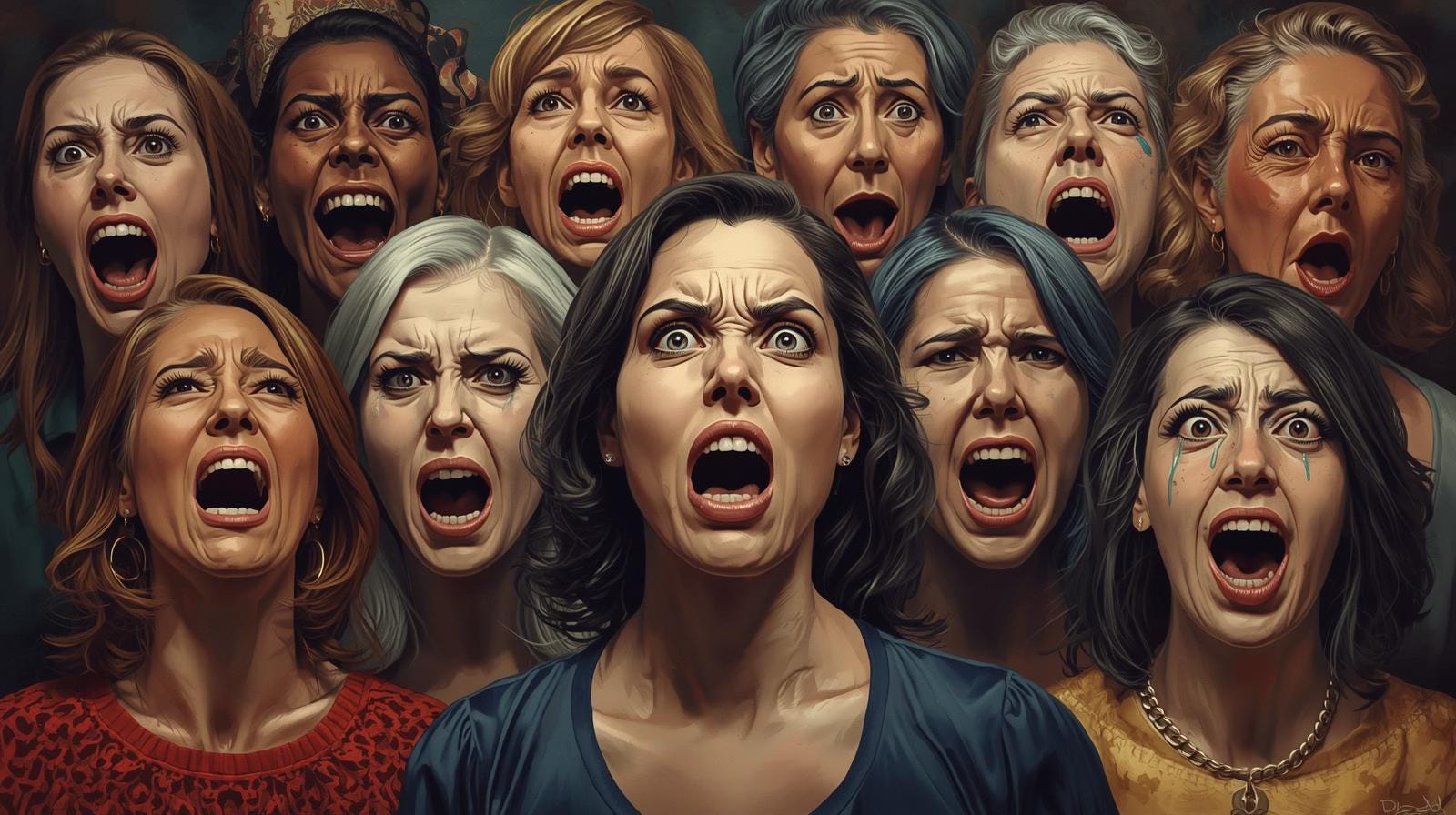
Free Thinking Through the Fourth Turning with Sasha Stone
Did The Great Feminization Cause The Great Awokening?
00:24:48
Loading summary
Transcript40 lines
- [00:00]
Sacha Stone
Hi, this is Free Thinking through the fourth Turning. My name is Sacha Stone. Did the Great Feminization cause the Great Awokening? The short answer is yes. The question then becomes, what then must we do? Somehow I miss the story that appeared in Compact Magazine by Helen Andrews, the Great Feminization. In it, she writes, cancel culture is simply what women do whenever there are enough of them in a given organization or field. That is the Great Feminization thesis, which the same author later elaborated upon at book length. Everything you think of as wokeness is simply an epiphenomenon of demographic feminization. The explanatory power of this simple thesis was incredible. It really did unlock the secrets of the era we're living in. Wokeness is not a new ideology, an outgrowth of Marxism, or a result of post Obama disillusionment. It is simply feminine patterns of behavior applied to institutions where women were few in number until recently. How did I not see this before? End quote. And the substance fits too. Everything you think of as wokeness involves prioritizing the feminine over the masculine, empathy over rationality, safety over risk, cohesion over competition. Other writers who have proposed their own versions of the Great Feminization thesis, such as Noah Carle or Beau Weingart and Corey Clark, who looked at feminization's effects on academia, offer survey data showing sex differences in political values. One survey, for example, found that 71% of men said protecting free speech was more important than preserving a cohesive society, and 59% of women said the opposite, end quote. And this, which would make a great dystopian sci fi novel. All of these brilliant observations matched my observations of wokeness. But soon the happy thrill of discovering a new theory eventually gave way to a sinking feeling. If wokeness really is the result of the Great Feminization, then the eruption of insanity in 2020 was just a small taste of what the future holds. Imagine what will happen as the remaining men age out of these society shaping professions and the younger, more feminized generations take full control. End quote. Yes to all of this. I would also argue that a feminized society has given more power to the LGBTQIA movement because the one identity group not allowed is masculine, heterosexual men. Feminization has meant to me a much more boring and dreary culture. Agonizing if you want the truth. Hollywood has never recovered. Her piece explains much of what I've been dancing around in the past five years. And it might explain why hatred toward me, especially by women, is so profound. Why am I not behaving like all the other women by obeying the rules of Woketopia. Cancel culture started on the pages of Tumblr circa 2013 when middle school aged girls began constructing a totalitarian system of control that punished people for stepping out of line. Here was Liat Kaplan admitting she helped Start also has its roots in the rise of Black Twitter. Though largely driven by women, when it was co opted by the more dominant group, white women, it swallowed society whole. At least on the left and in the bubble. And when you think about it, whole generations of girls have been raised to be empowered, while men have been raised to be exactly the opposite. Disempowered. How did we think it would turn out? So much of our common theories about what's happening to us can be laid at the feet of the matriarchy and the left's ongoing insistence that the system of oppression upon which their movement is based has not been fundamentally altered. They still need a fresh crop of oppressed people because that is how white women find their sense of purpose, their virtue signals illegal immigration, Free Palestine in order to justify their authoritarian control of our culture and its institutions. They still pretend we live in a rape culture where women are victims and men are predators. And yet we know things have dramatically changed. Their movement cannot account for that change. I raised a daughter in the same progressive schools and culture that bred this madness. Part of why I write this site and have risked so much is to help clear a path for her to live a freer life and say what she actually thinks without losing everything. But I also watched how boys raised alongside her came of age in a society that punished them for who they were, and many of them wander around aimlessly. Or they become mass shooters, or they suffer lives of quiet desperation. And yet none of us ever thought about why this may be, or at least why we didn't have adequate solutions. We all know what happened with girls and boys in our schools. I watched it happen. The boys had too much energy, couldn't be controlled, and were constantly singled out as the problem, while the girls thrived. Yet the only response was to try to change the boys so they fit rather than change the system to accommodate their needs. I lived all of this because I am, or was, the typical female liberal. I remember when mostly white women, the Oprah generation, became the most profitable demographic with the most disposable income. We were mostly unmarried homeowners, business owners, or the ones who went to work while men stayed home with the babies. All corporations aimed their products at us.
- [06:18]
CBS News Reporter
Well, you've likely seen them Advertisements focused on more than just selling the product. The new message is empowering women and young girls.
- [06:25]
Sacha Stone
As CBS News Cindy Hsu reports, the.
- [06:27]
Cindy Hsu
Thought provoking ads have a lot of people talking.
- [06:32]
Sacha Stone
Sorry, can I ask a stupid question? Sorry.
- [06:35]
Natalie Zamuda
There's a new ad from hair care company Pantene encouraging women to stop apologizing so often.
- [06:40]
Sacha Stone
I honestly feel like girls do say they're sorry too much when they don't need to. So I liked it.
- [06:45]
Natalie Zamuda
The company always sells feminine hygiene products and just released this ad.
- [06:49]
Sacha Stone
Show me what it looks like to run like a girl.
- [06:52]
Natalie Zamuda
It's trying to change the phrase like a girl from a negative to a positive.
- [06:56]
Sacha Stone
What does it mean to you when I say run like a girl? It means run fast as you can. I thought it was great. I felt so empowered.
- [07:04]
Natalie Zamuda
The Always video was posted on YouTube just last week and has already had more than 20 million views. Natalie Zamuda from Advertising Age says the campaign is brilliant.
- [07:14]
CBS News Reporter
Moms seeing that video are going to feel good about buying the brand for their daughters and then the daughters are.
- [07:21]
Sacha Stone
Probably going to continue to buy that brand.
- [07:23]
Natalie Zamuda
But some say these new ad campaigns are a step back for women.
- [07:26]
Sacha Stone
I don't like the type of ads because it's almost like it just brings out the negativity of the whole thing. They should just think like, okay, we're all equal. Let's approach it that way.
- [07:34]
Natalie Zamuda
While some say selling a product is the real goal, they like the mix with social issues.
- [07:39]
Sacha Stone
I feel like even if it is like a publicity thing, not only is that happening, but it's also helping with like women's self esteem and empowerment.
- [07:47]
Natalie Zamuda
And whether you like the ad campaigns or not, they have a lot of people talking. Cindy Hsu, CBS 2 News well, the.
- [07:53]
Cindy Hsu
Ad campaigns often include funding for education programs that help women and young girls.
- [07:57]
CBS News Reporter
They're definitely getting noticed.
- [07:58]
Sacha Stone
And that's the point, right? Yep. When Gen Z became the more desirable demographic, women took it personally. And that explains why they're in such a state now. When it comes to Trump and his defeat of Queen Hillary, a society that had empowered women expected a woman to finally be elected president. Women on the left believe that in a patriarchy, once women pass the childbearing years, they become worthless after the age of 40 or 50, invisible. But that's never been true. Postmenopausal women do have value because they can become leaders and grandmothers to help guide younger women. I could go into a whole thing here about human evolution, but I'll spare you the extra 500 words I used My own sexuality as a card to play for decades. And then when it was gone, I was lost in some ways. But I also realized that if you reorder society and smash the patriarchy, you never have to absorb that shift. You can pretend there is no reality to any of it. Fat women can be sexy. Old women can stay young and desirable if everyone is equal. Marxism women never have to face getting old and fading away. Makes sense. The truth is that once you see the feminization thesis, you can't unsee it. It's suddenly everywhere. Now I will look at personal attacks against me a little differently. It's just a screeching harpy. Relax. The other half of this story that must be told is the rise of Trump. In response to it, I've written about that too. Podcast listeners, a headline of A piece from September 30, 2024 it's the crisis of Masculinity, Stupid. There is a reason the man who is an affront to these screeching harpies has taken power and won our virtual civil war. He's an unapologetic, heterosexual, masculine man. Barack Obama was not. He was a sensitive, empathetic man who led our country for eight transformative years. If the end result of that was a feminization of society, then Trump is the response to it.
- [10:12]
Political Figure or Advocate
We're the only superpower in the world, and as such, we've got a moral obligation to spend our time, our energy, our money, our resources on solving these problems. We've got an obligation. We've got an obligation to stand up for women in the developing world and be their voice when no one else will. We have an obligation to see these women as our sisters, as our mothers, as our daughters, and help them as we would our own. And that's why investing in opportunities for women must be a cornerstone in our efforts in the developing world. The better off women are, the more powerful and and prosperous their countries become. Increasing a woman's income by even the smallest amount leads to better health care, education, and nutrition for her entire family. And so one of the quickest and most sustainable ways to improve the quality of life for billions in poverty is to enhance the economic power of women.
- [11:21]
Sacha Stone
I even jokingly made this political ad last year before the election. When you walk into the voting booth, the only place where a woman still has the right to choose, are we really going to stay with the same old, same old? Have you been noticing there's a little less masculinity around lately? Nobody has to know. It can be our secret because in the privacy of a voting booth, no one has to know who you're voting for or why. Let's make America masculine again. Let's make it okay to be a real man again. Are you with me, ladies? Because let's face it, we've seen what a culture without men looks like, and it's not very fun. Do we really want to live the rest of our lives without real men? Make America masculine again. So when you walk into a voting booth, just remember, nobody has to know. You can vote for the party that will make America great again by making men masculine again. Vote Trump 2024 not paid for by the Trump Vance campaign In all the ways, Trump is the gray champion of the Fourth Turning, this might be the most profound. The absence of men and masculinity has set society off kilter. We've all noticed. It's just that no one has articulated it quite as well as Helen Andrews or Jay Stone, who wrote the book. Here is Helen Andrews on the Unherd podcast.
- [13:57]
Cindy Hsu
Wokeness is feminization. It is feminine patterns of behavior and group dynamics applied to institutions or that had previously operated by more masculine rules of group dynamics. Our institutions changed radically in 2020. Wokeness really did mark a significant departure in how our institutions function.
- [14:23]
Helen Andrews
A rolling back or a reversal of the increased presence of women in the judiciary, in politics, in the legal profession, in the scientific community, in the academy even, would basically result in a much diminished voice for women in the institutions that wield the most power. Are you comfortable with that outcome?
- [14:45]
Cindy Hsu
In so many ways I depend on the institutions of society functioning as they are designed to. And if feminization is an obstacle to that, then I think I have an interest in seeing that feminization roll back. We have lost something. If history departments become feminized, when parliamentary debate becomes feminized, when all of these things become feminized things, just the institutions just don't work as well.
- [15:13]
Helen Andrews
Hello and welcome back to Unherd. When a writer or a thinker writes an essay or makes an argument that upsets people, attracts attention, and detonates a bomb under the discourse.
- [15:26]
Sacha Stone
Understanding it as a feminization also removes any discussion of race, which is where many get tripped up when discussing wokeness. They see the word woke as a dog whistle. And yet all this time it had nothing to do with race except in the way that white women who dominate the left need to virtue signal. And the best way to do that is to use minorities. It also tracks that emotional manipulation drives this. Women are more likely to use emotion as A lever of power. Which explains why for 10 years we've seen the rise of mass hysteria. Sure it's a cliche to call women hysterical, but how else to explain it? Listen to this woman who is straight out of central casting for the kinds of women who control the left and thus society. Here is a tiktoker.
- [16:15]
CBS News Reporter
And to Caroline Levitt, that moon faced pig who's married to her grandfather and stands up in matronly polyester tweed jackets to. To gaslight the American people day in and day out on national television. I didn't believe that hell was a place that actually existed until I saw firsthand Satan's accomplices weaving their way into Washington and inflicting terror on us every single day. And that includes you, kkk, Caroline. You are a rotten scumbag piece of filth whose only vocation in life has been to carry out the agenda of a bunch of men who. Who don't even look at you as halfway equal to them. Who will never accept or respect you as a person simply because you were born with a vagina. And one day, one day, and it may be when we are old and gray and senile, but one day you will be tried for treason and given the maximum punishment where you will know the depths of hell on earth.
- [17:19]
Beyoncé
Earth.
- [17:19]
CBS News Reporter
Before your fate is met in the afterlife. One day you are the literal Antichrist. You fascist shit breathing swine with blown up lips and a limp dick daddy to come home to every night. Who couldn't give a if you had rights or not. Who wants to take away your rights? As a matter of fact, like your right to vote. You are hell on earth. And one thing is for certain. One day, one day in the future, America Miracle will laugh at you. Frail, worn down. You will stand on TV with this receding hairline and no money to blow your lips up with neurotoxin. And you will stand there in an orange uniform, bleeding for mercy. And we will laugh. We will laugh and laugh at your pain. And it still won't be enough to erase the harm that you have caused. But it will be something.
- [18:23]
Sacha Stone
So then the question becomes, how do we stop it? How do we change it? I'm not sure it can be fixed. As I've been saying for a while now, there is no saving the left. There is only saving America from them. We must build anew. Build outside of what is in place. Now, we're halfway there already. But Helen Andrews believes that once we return to a meritocracy, the problem will take care of itself. It's hard to argue with that. And what a mess we've made of things by denying those who are good at what they do to rise in this country of all countries, it had to be Trump. There was no one else with the right set of skills to get the dirty job done.
- [19:09]
Beyoncé
Foreign.
- [19:13]
Sacha Stone
Thank you for listening to this Short Take podcast and if you like these Short takes, I'll do more of them. Usually I just confine them to writing on the site, but some people have said they prefer to hear me read it out loud even though it takes extra time to do it. And if you like my work, as always, please consider becoming a paid subscriber. Or you can find a link on my podcast on the main page. If you scroll down for the tip jar and if you have left a tip and you haven't heard from me, that's not unusual. I actually don't get a notification when people leave tips, but take it from me to you, from my heart to yours. Thank you very much. Thank you very much for your generosity and your kindness. And I'm sorry if I don't get back to everybody, I should be able to have a way to do that, but at the moment I don't. But thank you. It's much appreciated. And remember to thine own self be true.
- [20:27]
Beyoncé
Oprah Winfrey because of you, women everywhere have graduated to a new level of understanding of what we are, of who we are, and most importantly, who we can be. Run the world run the world Oprah we can run the world world ladies say run the world Run the world girl say run the world Girls we run this mother yeah girls we run this mother yeah girls we run this mother yes girls everybody get up and sing who run the world? Who run the world? Who run the world? Who run the world? Here we go Some of them think they freak this like we do but no they don't make your check come at their neck disrespect us no they won't Boy don't even try to touch this boy this be it's crazy this is how they made me Houston, Texas, baby this goes out to all the girls up in the club rocking the ladies who are quiet for themselves and get more money later I think I need a None of these people can.
- [22:09]
Sacha Stone
Fight.
- [22:11]
Beyoncé
I remind you I'm so hood with this boy I'm just playing oh come here baby Hope you still like me Take me, do anything for me who run the world? Run the world girls Run the world girls girls tied up in hip DJ don't be scared to run this run this back repping for the girls who taking over the world have me raising class for the college grads 41 roadie to let you know what time it is check you can't hold me run my nine better cut my check this goes out to all the women get in you on your prime to all the men that respect what I do Music Let my shine boy you know you love it how it's enough to make me million strong enough to bear the children then get back to f you better not play me oh, come here, baby Hope you still like me over your persuasion can build a nation endless power with your love we devour you do anything for me who are we? We've won this mother who are we? When we run the world we run this mother who are we run we run the world who run the world? Girls. Girls, girls, girls, girls. We love you, Oprah.
- [24:43]
Sacha Stone
Thank you, Beyonce.
- [24:44]
Beyoncé
Thank you.