← Free Thinking Through the Fourth Turning with Sasha Stone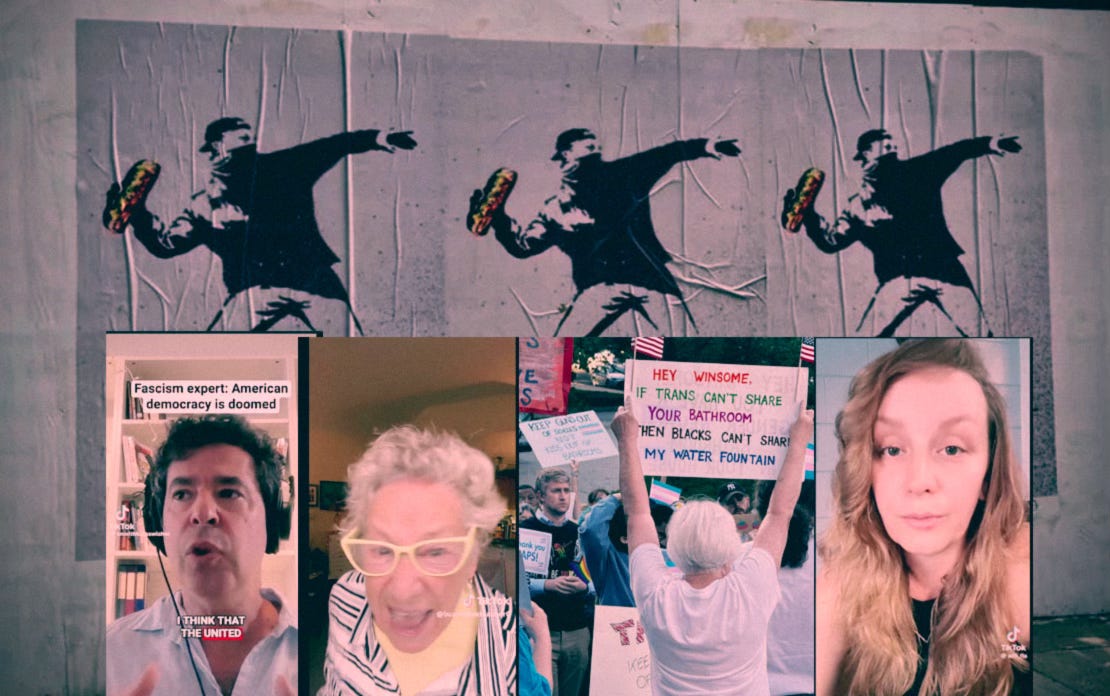
Free Thinking Through the Fourth Turning with Sasha Stone
First, They Came for The Smithsonian...
00:38:13
Loading summary
Transcript88 lines
- [00:00]
Sacha Stone
Hi, this is Freethinking through the fourth Turning. My name is Sacha Stone. The following must not be taken too seriously. It is satire. First they came for the Smithsonian, before the fascists came. America was finally on the right track. As the saying goes, when you have them by the balls, their hearts and minds will follow. That's what happened with our violent but mostly peaceful revolution in the summer of 2020, when Joe Biden took office. We had complete control over the message and could fire anyone at will if they used the wrong pronoun, doubted the election results, or dared to defy mask mandates or lockdowns, or even wore a red hat. We erected a high fence around the Capitol. We shunned, destroyed, debanked, fired, bullied, harassed and abused anyone who ever supported Trump. The hearts and minds did follow. They had to. We'd laid the groundwork for our revolution decades before. Most Americans were unaware of it. So were most parents. Until lockdowns that, unfortunately, they saw. But by then, it was too late. A whole army had come of age and now had taken to the streets. Conform or else. A video of a diner being forced to raise her fist to Black Lives Matter. That's how culture changed. And it changed dramatically almost overnight. All were in compliance. Movies, fashion, books, the arts, comedy, and yes, museums finally did what they were supposed to do. Tell us how to think, what to think and whose side to be on. America wasn't ready for that back in the 1950s, when communist hunters and government in Hollywood punished those seeking to use culture as a conduit for dogma. It's the conservatives once again attempting to purge American culture of an infectious mind virus. When Trump gave a speech at Mount Rushmore, it was a warning like Mein Kampf.
- [02:20]
Donald Trump
No nation has done more to advance the human condition than the United States of America. And no people have done more to promote human progress than the citizens of our great nation. It was all made possible by the courage of 56 patriots who gathered in Philadelphia 244 years ago and signed the Declaration of Independence. They enshrined a divine truth that changed the world forever. When they said, all men are created equal, these immortal words set in motion the unstoppable march of freedom. Our founders boldly declared that we are all endowed with the same divine rights given us by our Creator in heaven. And that which God has given us, we will allow no one ever to take away. Ever. 1776 represented the culmination of thousands of years of Western civilization and the triumph of not only spirit, but of wisdom, philosophy, and reason. And yet, as we meet here tonight, there is a growing danger that threatens every blessing our ancestors fought so hard for, struggled they bled to secure. Our nation is witnessing a merciless campaign to wipe out our history, defame our heroes, erase our values, and indoctrinate our children. Angry mobs are trying to tear down statues of our founders to face our most sacred memorials and unleash a wave of violent crime in our cities. Many of these people have no idea why they are doing this. But some know exactly what they are doing. They think the American people are weak and soft and submissive. But no, the American people are strong and proud. And they will not allow our country and all of its values, history and culture to be taken from them.
- [05:17]
Sacha Stone
America knew where we were headed, but they put him in power anyway. Four years later. Then again, how do we really know he was elected? Like they say on TikTok, he wasn't shot. He didn't win. He is on the list. He wasn't shot, he didn't win. He's on the list. Rating John Bolton is a distraction. Don't be distracted.
- [05:39]
Jillian Michaels
Keep talking about the files.
- [05:41]
Sacha Stone
We know how close the election was. Just as when Hitler won in Germany, Trump's win was close enough to rob him of his mandate to decide. America wants change. America doesn't. America is woke and likes it that way. And if they don't, too bad. Now the fascists want the old America back. They want people to feel proud of their country and be inspired to make the most of themselves, regardless of skin color or class. As if that's even possible in a white supremacist empire founded by colonizers on stolen land, on the backs of oppressed and enslaved people. But we're going to fight them. Just like we will fight them trying to close the border or clean up crime or end the crisis of unhoused persons. Fortunately, we have complete control of the BBC, NBC, cbs, abc, the New York Times, and the Washington Post. They will project our message. They have to. They know that and have since 2020. And that message will have to be that Trump wants to eradicate all mentions of slavery. Pretend it never existed at all.
- [06:55]
Narrator/Commentator
President Trump is now ordering a review.
- [06:57]
Sacha Stone
Of the Smithsonian museums, accusing the institutions.
- [07:00]
Narrator/Commentator
Of focusing too much on, quote, how bad slavery was.
- [07:05]
Sacha Stone
He made that comment in a social media post yesterday. The President says he will subject the museums to the exact same process his.
- [07:12]
Narrator/Commentator
Administration has conducted at universities, which have faced federal funding cuts over DEI and antisemitism concerns. We go from attacking affirmative action to attacking equality to attacking diversity. E pluribus unum. And now we're talking about exhibits. By the way, it's not just him, it's his supporters on cnn. The permission structure is being sent around. No, we need to talk about it and we need to talk about it. And Rev and I have talked about this a great deal because the arc of the American story is extraordinary.
- [07:59]
Jillian Michaels
Just days after the Smithsonian changed its text on a description of President Trump's impeachment following the January 6 Capitol riot.
- [08:08]
Sacha Stone
On the Smithsonian, I know that your administration is seeking to weed out a.
- [08:11]
Jillian Michaels
Lot of this left wing spin that's in the museums, but we're seeing from.
- [08:15]
Sacha Stone
People like Brian Seltzer or other commentators.
- [08:18]
Jillian Michaels
That they're insinuating that you are trying to change history according to your narrative. What's your response to that and is there anything you'd particularly like to we.
- [08:26]
Donald Trump
Want the museums to treat our country fairly. We want the museums to talk about the history of our country in a fair manner, not in a woke manner or in a racist manner, which is what many of them, not all of them, but many of them are doing. Our museums have an obligation to represent what happened in our country over the years, good and bad, but what happened over the years in an accurate way.
- [08:47]
Jillian Michaels
If we've gotten to a point in history where we think just learning about.
- [08:53]
Sacha Stone
African Americans and black people is too woke, then I think we're deprogressing in a sense. President Trump has attacked the Smithsonian museums for being woke and out of control. He said everything being discussed is how horrible our country is and how bad slavery was.
- [09:12]
Narrator/Commentator
By focusing on Americanism, the people, principles and progress that define our nation, we we can work together to renew the Smithsonian's role as the world's leading museum institution, which on its own might sound like a noble ambition, but it does not, of course, stand alone. It comes as part of what has been the administration's ongoing effort to purge government websites and American historical sites of references to black Americans, gay and lesbian Americans and transgendered Americans, at one point even flagging for removal on a Pentagon website a photo of the B29 bomber that dropped the first atomic bomb in combat. The plane was nicknamed the Enola Gay, a somewhat ironic control f fail, apparently, but also part and parcel of a deeply serious administration effort to eliminate from government websites any mention, photograph or video that, quote, promotes diversity, equity and inclusion. What followed was the elimination of references to black and Latino war heroes, gay service members, and the effort to integrate the armed services starting in 1948 and what followed in March was an executive order targeting the Smithsonian for coming, quote, under the influence of a divisive race centered ideology. Now, that order signaled out one of the eight museums named in the letter today, the National Museum of African American History and Culture. And specifically something someone wrote on a museum website once in 2020 and was quickly taken down and which the Secretary, Secretary Bunch spoke about in front of Congress in 2023. I think that the document itself was wrong and flawed. I do think, however, it's important for.
- [10:43]
Sacha Stone
The Smithsonian to help the country grapple.
- [10:46]
Donald Trump
With questions of race. So I'm not going to run away from that.
- [10:49]
Narrator/Commentator
But I agree with you very much that that document is not the kind.
- [10:53]
Donald Trump
Of document that should be at the Smithsonian.
- [10:56]
Narrator/Commentator
He acknowledged it was inappropriate and wrong and took it down. But if you've ever been to this museum, in addition to being powerful and moving, it's upsetting and it is unsettling. Just like parts of our history are. Parts of the administration has already taken steps to edit out or in as the case may be.
- [11:15]
Sacha Stone
When Jillian Michaels tried to explain to the good people at CNN that purging the woke from the Smithsonian wasn't about erasing slavery, it didn't go so well.
- [11:25]
Jillian Michaels
He's gone into the Smithsonian and he's effectively now has some random person deciding what is appropriate for the Smithsonian. Smithsonian to teach in terms of American history, things that don't offend parts of the MAGA base. Right. So we're now literally reviewing parts of American history and parts of American culture to make sure it comports with Dear Leader and what the maga. Can we address some of those things.
- [11:45]
Sacha Stone
That are in there?
- [11:46]
Jillian Michaels
Because have you looked at some of the things? Yes. Yeah. Slavery was a bad thing that was to talk about. Okay. Like he forgives. He's not whitewashing slavery. So he's not. He's not. No, he's not.
- [11:56]
Sting
And.
- [11:57]
Jillian Michaels
And you cannot tie imperialism and racism and slavery to just one race, which is pretty much what every single exhibit does. But let's talk about the fact that when you anti slave. Let's talk about the fact slavery in America was Only less than 2% of white Americans own slaves. But it was a system of white supremacy. You know, slavery is thousands of years old. White people were first raised to try to end. I'm very surprised in historical revisionism. I'm really surprised. Do you realize that, Jillian?
- [12:29]
Sacha Stone
I'm surprised that you're trying to litigate.
- [12:32]
Jillian Michaels
Who was the beneficiary of slavery. I'm not what I'm trying to tell.
- [12:36]
Sacha Stone
You is in the context of American history.
- [12:39]
Jillian Michaels
In the context of American history, what are you saying is incorrect by saying that it was white people oppressing black people? Every single thing is like, oh, no, no, no. This is all because white people bad. And that's just not the truth. Like, for example, every single exhibit, I have a list of every single one. Like, people migrated from Cuba because white people bad, not because of Pastor.
- [13:05]
Sacha Stone
Yes.
- [13:05]
Jillian Michaels
No, it's in there. That's what I'm saying. You don't actually know what's in there. Do you know that when you walk in the front door, the first thing you see you have gay. Jillian, you have a lot of stuff. Yeah, I do, because I don't. Because here's the thing.
- [13:15]
Sacha Stone
Are you talking about.
- [13:16]
Jillian Michaels
Okay, I'll give you an example.
- [13:17]
Narrator/Commentator
Yeah.
- [13:17]
Jillian Michaels
There's one called change your game. Right? This, this has been an installation. There is gender testing fair in sports does that. And then it goes on to talk about how it's complex to do gender testing in sports. It's not complex. It's basic science. That's untrue. It's XX chromosome, X, Y chromosome. That's sports. Is it fair to have biological men competing against biological women in sports?
- [13:44]
Sacha Stone
No.
- [13:45]
Jillian Michaels
But why is this in the Smithsonian? So it's. Look, it's. It's been completely captured. First of all, I don't. And it's totally. First of all, we don't have time to litigate. Of course we don't, because then you're gonna argument and everything is racialized, just like you're trying to do to me now. Excuse me. It's like, I can't believe you're trying to suggest. You know, just to be clear, you brought up race. No, this was a conversation about the.
- [14:08]
Sacha Stone
Arts and you brought up race.
- [14:10]
Jillian Michaels
It isn't race you brought up. But the whole point of this is that the issue you brought up, you brought up slavery, and you brought up the question of whether you did. You brought up the question of whether or not slavery in the United States is about race. The answer is no. I guess not in the United States. No, don't straw man my argument, because that's not what I said. So what are you brought out of slavery? And what I was talking about is that this isn't really about that. When you make every single exhibit about white imperialism when it isn't relevant at all, that is a problem. So when you're talking about Cubans leaving Cuba and you make it about white people bad, that's not Accurate, can I say?
- [14:56]
Sacha Stone
But she's a fascist apologist, which means we must do what we can to exclude, purge and silence her. There is only one point of view allowed in our America. Anyone who tries to criticize us or dismantle what we built over the past 20 years must be destroyed. That is anti fascism. So that meant she had to go on News Nation to try to further explain what she really meant.
- [15:24]
Jillian Michaels
This is a narrative that I am deeply concerned about. It is not because I'm trying to center white people's feelings at the heart of this issue. It's because I am seeing a young generation choke on this narrative. And my deep concern is that this pendulum does not swing back to the middle. It swings much farther into an alt right direction where it's begetting and breeding racism and hostility on both sides. Which is why it is so important to tell both sides of history, not.
- [16:02]
Sacha Stone
Just white, this anchor, in this case.
- [16:06]
Jillian Michaels
Pounds the table and calls you a racist. Yeah, yeah. And you know, if I could also elaborate a bit on what I mean by both sides, you touched on it earlier. So, people, I got one fact out which was from the 1860 census, which actually is when slavery was at its height in America, despite the fact that all of the states that fought solely for the Union had outlawed it, despite the fact that it was so overwhelmingly profitable. And yes, I know that the Southern economy was built on it and people in the south fought and died to keep it. Conversely, people in the north banded and outlawed it because it was morally reprehensible. And then subsequently, 350,000, or you said 360,000 Union soldiers died to end it. And this is the part where I think you have to say, yes, there were great evils and there were dark chapters, but there were good guys that came together to overcome.
- [17:06]
Sacha Stone
Doesn't matter what Jillian Michaels thinks. What matters is what we tell her to think. And if she doesn't go along with it, she must be punished. We want every child or teenager forced to visit the Smithsonian with their school or their parents to know they should be ashamed of not just the color of their skin if they're white, but of their country, its history and its so called heroes. We want every black child or teenager who is forced to visit the museum to also know that they are forever and eternal victims. We need them to be. We need an endless supply of oppressed people to continue demonizing the oppressors and preserve our power. Not to mention raise money from wealthy guilty white people who need absolution for their sins of wealth and privilege. Otherwise, what's the point? Yes, it's to make everyone feel welcome, but they must know their place as symbols of oppression and never be allowed to rise beyond the menial jobs white people won't take that keeps them in their lane. It's better than life in the Third World, and it helps justify our movement. One exhibit depicts what looks like the Baby Jesus, in fact, family caught by border agents while trying to cross over the wall. Podcast listeners A painting by Rigoberto A. Gonzalez, Refugees Crossing the Border Wall into South Texas, Oil on Linen, 2020 Art must tell us what to think. This image conveys the migrants as martyrs under an oppressive system. It's a message that we project across all facets of culture under our control. We guide viewers on how to interpret this image and draw a conclusion about America. The message must be that all people who cross the border do so seeking democracy and a decent life. They are good. If you see them as terrorists or rapists or gang members, you are bad. You are a racist. If there is a Sydney Sweeney ad that celebrates good genes, well, the Gap will answer it with how we're all supposed to reflect female beauty as every color of the rainbow. Because the Sydney Sweeney ad was racist. Here is the Gap ad.
- [19:29]
Jillian Michaels
My milkshake brings all the boys to the yard and they're like this is better than yours Damn right it's better than yours I could teach you but I have to charge My milkshake brings all the boys to the yard and their life is better than yours Damn right it's better than yours I could teach you, you but I have to.
- [19:45]
Sting
Know.
- [20:04]
Sacha Stone
Here is another exhibit which reflects how we see our protected groups. It's never about achievement. It's only about identity. Identity is achievement. From the White House, the National Museum of American Latino features programming highlighting animated Latinos and Latinos with disabilities with content from a disabled plus sized actress and an ambulatory wheelchair user who educates on their identity being Latinx, LGBTQ and disabled. An exhibit at the American History Museum depicts migrants watching Independence Day fireworks through an opening in the U S Mexico border wall and says America's founders feared non white immigrants. Quote fear and prejudice. Many US Politicians as early as Benjamin Franklin have feared non white immigration. Instead of being recognized as community builders, Latin American immigrants are sometimes described as invaders. Many have risked their lives to immigrate because they believe in US Ideals such as democracy, equality and opportunity. I mean, of course we knew that Irish and Italian immigrants were attacked and prevented from voting and working in the U.S. they were white. But we can't tell that story because it muddies the message. All children need to know is that Benjamin Franklin was a racist. Art should depict any person who is marginalized as saintly and godlike. For podcast listeners, a painting of a woman. My dreams are not illegal, with butterflies flying all around her. Here is an example of one of our children who is probably the last generation to know the truth before the fascists came.
- [21:55]
Jillian Michaels
So apparently Trump thinks that teaching about slavery is woke up. Like sir, slavery happened before WiFi, TikTok, and even your spray tam formula. How is history somehow political? The Smithsonian teaching kids about slavery isn't woke.
- [22:12]
Sacha Stone
It's literally just facts. Saying slavery is bad isn't some leftist agenda.
- [22:19]
Jillian Michaels
It's just called reality. When a leader calls history woke, it's about protecting their power, because if people don't know the truth, they're easier to control. So, no, slavery isn't woke. It's just history and ignoring it.
- [22:34]
Sacha Stone
That's the real agenda. All school children should learn as early as possible about all of these different identity groups, in case they might be one. Surely they know this even as toddlers. What we used to call a fetish is now also identity. Quote. The American History Museum's LGBTQ history exhibit seeks to understand evolving and overlapping identities such as lesbian, gay, bisexual, transgender, queer, transsexual, transvestite, mahu, homosexual, fluid, invert, earning third sex, two sex, gender bender, Sapphist, hijra, friend of Dorothy, drag queen, king, and many other experiences. End quote. If this were actual art, there would be an exhibit labeled the Woke Eye View and offer some critical thinking of critical theory. But that would be blasphemy. Artists have always spoken truth to power, and we have all the cultural power. So we decide the message because identity matters. The transgender fight is on par with Jim Crow in our ideology. So if you remove any of it, it's like you're erasing black history too. Per podcast listener is an image of a woman holding up a sign that says, hey, when some trans can't share your bathroom, then blacks can't share my water fountain. Illegal immigration is identity. Crime is identity. Theft, carjacking, murder and rape are identity. Unless you're white. Then you drive the news cycle for several weeks as we lament the harms of white supremacy on our society. If you try to stop any of it, then you will be screamed at. F you, you effing fascists. Why are you here? I don't want you in my city, said one brave resistance fighter who then in a Fit of pure rage, hurled a footlong sub at the Gestapo, then fled the scene. We turned that into art too. Podcast listeners. An image showing the Subway sandwich thrower as art. Ordinarily, we might care that the sandwich would make for a pretty good meal for unhoused person, or that it costs carbon emissions to grow the animal, slaughter it, then drive the meat to Subway and finally put the sandwich together. Probably all labor by people of color or other marginalized groups. We might protest him or cancel him on social media for his carbon footprint, but that would be in ordinary times. These are not ordinary times. Anti fascism is preventing crime in the cities because policing crime is another form of oppression. Anyone who supports making the streets safer is a fascist. All of the good white liberals agree. Podcast listeners, a tweet by Jill Simonillo. Dear Donald Trump, I've been carjacked in Chicago with my arm broken. I still don't want you or your troops here. By the way, there are no red hats here and a picture of her with a bruised arm. She has since taken down her account. Fascism is here. Even Bill Maher says so.
- [25:51]
Narrator/Commentator
Oh, also in America's different now news. And I remember John Bolton, he was. Oh wow, sophisticated crowd. Yeah, John Bolton, there he is. He was in the Trump administration and then he left the administration, wrote a book, you know, kind of a tell all book, and said Trump only cares about retribution and will abuse the Justice Department. And today the FBI raided his home.
- [26:24]
Sacha Stone
So.
- [26:29]
Narrator/Commentator
Trump administration says it wasn't about retribution, it was about law and order. They think he might have been the guy who. Who beat up Big Balls.
- [26:40]
Sting
Well.
- [26:44]
Narrator/Commentator
I will say this, ladies and gentlemen, in the future, historians will say this is a very dark time in American history. They won't say it publicly or put it in a book. They'll whisper it to each other when the cell phones are off. So remember to support your local police release date.
- [27:03]
Sacha Stone
Sure, he kind of has to, because if he doesn't, he might not get invited to the parties anymore or his show might be canceled outright. Or maybe he believes it. We get to say what kind of lawfare amounts to fascism. Terry Moran gets to say. For podcast listeners, a tweet from Terry Moran on the John Bolton raid. If this happened in any other country, we would know what to call it. The autocrat taking revenge on a man who angers him. A man who dares to criticize him. The most important thing in American life right now is to see the thing. And Dave Marcus responds, the left has this idea that words are magical incantations and if we just say fascism enough, it becomes real when the words you use don't reflect people's real lives. You can say them all you want, they mean nothing. Sure, we raided Trump's home and indicted him, took his mugshot, threw Steve Bannon, Peter Navarro in jail for contempt of Congress, tried to throw Trump in jail, tried to throw him off the ballot, probably tried to shoot him. We might have debanked a few and kicked a few people off of social media, fired them for offensive words, ideas or headlines. But you can't make an omelet without breaking a few eggs. It all works together. Keep teaching that America is an empire of white supremacy and black and brown. People must turn to crime and drug addiction just to survive it. Well, then we don't want the National Guard in our cities, because what would happen if they cleaned up crime? No crime, no democracy. Here are some videos from TikTok. Do you think America will overcome Trump's fascist projects?
- [28:49]
Narrator/Commentator
I think that the United States will fall to a sort of far right machine and democracy will be a thing of the past with some moments of enormous anarchy. It will basically become a semi dysfunctional nation run by a kind of far right machine. We've seen that you can be an autocrat in the United States. You can take the country over. So how do you go back from that knowledge?
- [29:18]
Sacha Stone
All right, that's what you think. I don't.
- [29:19]
Jillian Michaels
It dies after him.
- [29:21]
Narrator/Commentator
They won't have a charismatic leader. JD Vance is not a charismatic leader. But will they need a charismatic leader? I'm not really sure how, when you've seen this and when you've seen what Trump has done, how you're supposed to return to, as it were, checks and balances.
- [29:38]
Jillian Michaels
I warned you maggots. He's coming for you. He's got 17 states and he's sending out the National Guard. So what are you gonna do when he knocks on your door, you maggot. Maggots. Deleting slavery and other parts of American history that may not be that flattering doesn't mean it didn't happen. This is the same administration that, since January 20, has eliminated DEI programs in every federal agency, banned diversity training in school schools, cut federal funding for NPR and pbs, scrubbed government websites of LGBTQ and reproductive health materials, threatened universities with funding cuts over protests and curriculum, and even pushed for loyalty oaths for federal workers. While that doesn't cover all of it, they are now coming for the museums that hold America's story. And here's the thing. If you actually understand history, you know exactly where this road leads. This isn't about unity. It is about control. And if they can control the story of the past, they can control the future.
- [30:42]
Narrator/Commentator
Did y' all see that? The White House told the Smithsonian to rewrite American history.
- [30:46]
Jillian Michaels
Literally.
- [30:47]
Narrator/Commentator
Not in a metaphorical grandpa's Facebook rant kind of way.
- [30:50]
Jillian Michaels
They're actually combing through exhibits to make.
- [30:51]
Narrator/Commentator
Sure history lines up with Trump's. America was perfect until I lost the election.
- [30:55]
Jillian Michaels
Fan fiction.
- [30:57]
Sacha Stone
We have to talk because what do you mean that in the year 2025.
- [31:00]
Jillian Michaels
There are actual conversations going on right now about how maybe the way we talk about slavery is too much, and.
- [31:06]
Sacha Stone
Maybe museums are too woke for teaching about the bad parts of history and.
- [31:11]
Jillian Michaels
For making slavery seem too bad.
- [31:17]
Sacha Stone
We need the museum to explain why we need dei, why we have crime, and why we need to accept crime and homelessness as part of normal life in a sick and broken country like ours. As long as our country is sick and broken, then our movement is justified. We must eradicate fascism and restore democracy. 2020 was only the beginning. We just need to ensure we have complete control over the young. We want them as early as infancy. We want them in preschool. We want everything they see and everything they learn to be our message. Our America. Podcast listeners, A tweet from Evanloves. Not only should homeschooling be illegal, but private schooling, too. We should have a robust public system, funded better than any other system on the planet. That extends to daycare and through college. Was it Orwell who said, who controls the past controls the future? Who controls the present controls the past. That is our fight now. Who controls the present? We need to protect our message that not all are created equal. Our history must remind us every day that we should feel shame about our past, because how else to justify our survival? Thank you for listening to my podcast, sashastone.com I hope you had a great weekend. And remember to thine own self be true.
- [33:26]
Sting
Every breath you take Every move you make Every mind you break Every step you take I'll be watching every single, single day with every word you say Every game you play and I just say I've been watching can't you see you belong to me.
- [34:09]
Sacha Stone
Ey.
- [34:11]
Narrator/Commentator
With every.
- [34:12]
Sting
Step you take Every move you make Every vow you break Every smile you cover A claim you stick I will watch you since you gone I've been lost without a chase I dream night I can only see your face I look around until I can replace I feel so your face I keep crying baby baby is oh can't you see you belong to me I'm a bl with every step you take every move you make, every vow you break every smile you for you gonna reclaim you say I'll be watching every movie.
- [36:04]
Sacha Stone
I'll.
- [36:04]
Sting
Be watching you I'll be watch.
- [36:43]
Sacha Stone
You.
- [36:43]
Sting
Say Every game you play Every night you stay every breath you take every move you make every bond you break every step you take Every single day, every word you say everything you play I've been worried watch your break Every breath you take every move you make, every mind you break every step you take Every single day, every word you say every game you make Every night you stay Every breath you take every move you make, every bond you break every every step you take, Every single every word you say I will watch.
- [37:44]
Donald Trump
You.
- [37:58]
Sting
The one and only Sting. Thank you so much.