← Free Thinking Through the Fourth Turning with Sasha Stone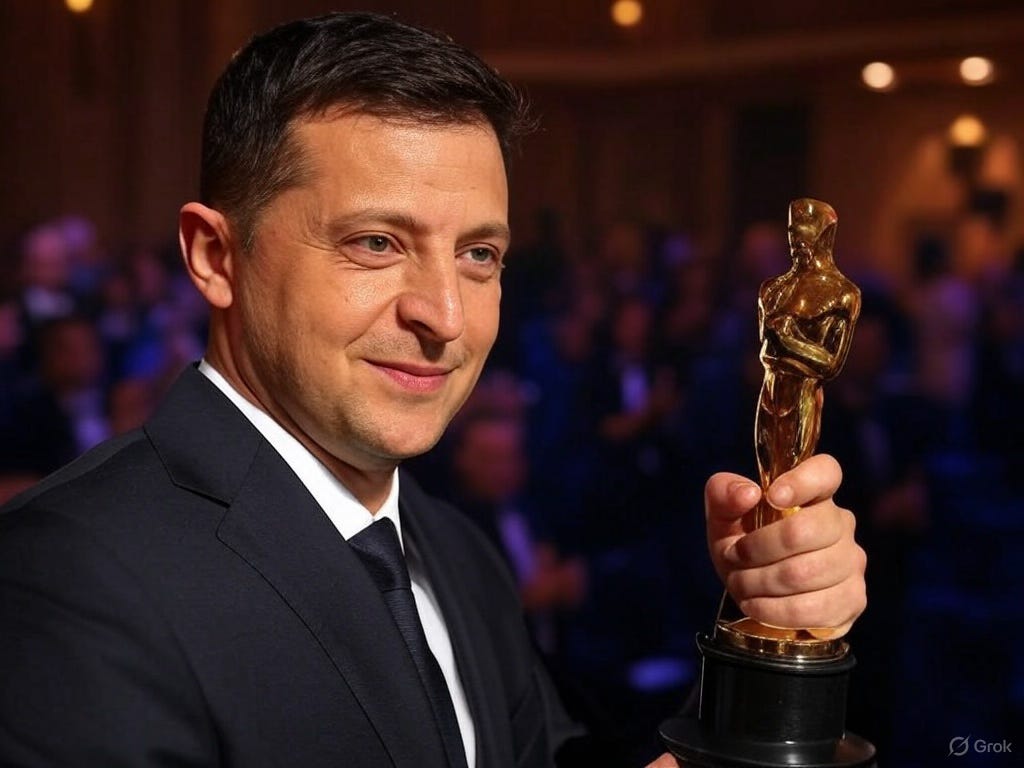
Free Thinking Through the Fourth Turning with Sasha Stone
Zelensky Believed His Own Publicity
00:26:35
Loading summary
Transcript53 lines
- [00:00]
Sacha Stone
Hi, this is free thinking through the fourth turning. My name is Sacha Stone. Zelensky believed his own publicity. They treated him like a movie star. How could it not go to his head? It's Oscar Sunday, a ceremony fueled by one publicity. We turn ordinary people into gods and goddesses by telling flattering myths about who they are and why they're important. The narrative gives voters a reason to care and almost always drives the win in Hollywood. They're not planning on changing anything, just as the Democrats won't. They haven't noticed that as they're watching the band play on, the ship is made of iron and will sink. What do they even stand for anymore? Transing the kids, open borders for cheap labor, and most importantly, the war in Ukraine. Attending the Oscars is like supporting the Democrats, which is like supporting Zelensky. An alignment of power like no other. For podcast listeners, a tweet by pop crave Kamala Harris is expected to attend the Oscars tonight. Unsuspecting dreamers who rise in Hollywood are often warned never to believe their own publicity. Anyone who has ever worked in publicity or in the Oscar races I have Knows that it's nothing but pretty lies. It isn't journalism. It isn't criticism. It isn't the truth. It's like Photoshopping a life. The Zelenskyy myth is necessary to keep hope alive that the Democrats didn't humiliate themselves when they lost to Trump a second time. No, it wasn't their failures. It had nothing to do with selling false narratives about Hillary and Joe, forcing voters to go along with it. This is bigger than an ordinary election. They're at war with a new axis of evil. And why not? They're the resistance, after all. Zelenskyy's entitled behavior in the Oval Office was proof enough that he believed his own publicity and lost perspective of who he was in this fight. He's not the man who can demand anything from the United States. But who's going to tell him? Certainly not the legacy media, not the Democrats, not Hollywood. For podcast listeners, a montage of covers of Time magazine in vogue with Zelenskyy and his wife. Almost as soon as the war began, there didn't seem to be any difference between celebrities, the Democrats, and Zelenskyy. The Ukrainian Tom Cruise was suddenly everywhere, not just at award shows, but on television, appearing at celebrity and news events alike, smearing together politics and culture like peanut butter and jelly. His war was supposed to be our war. If you were against it, you were pro Putin, commingling celebrity with the raw savagery of war and bloodshed didn't seem to give anyone pause. It was like it all became part of the same illusion. The resistance was a proxy war being fought not against Putin, but against Trump. A war Hollywood has also been fighting for years. When I saw Zelenskyy appear at the Golden Globes in 2022, I thought, what's the point of this? Does he not know that almost no one watches the Golden Globes now? Their ratings are worse than the Oscars have become. Why would this be important to Zelensky?
- [03:44]
Sean Penn
I'm privileged to be here tonight and proud that the leadership of the Hollywood Foreign Press has seen fit to encourage that those highest aspirations of film should share this stage tonight with a very real world example, that which inspires film's creation. From the otherworldly courage of young Iranians rising up to the ever persevering women's movement of Afghanistan, we are reminded in no uncertain terms that the freedom to dream is not simply a human luxury, but rather a human need that must be fought and sacrificed.
- [04:34]
Unknown
For.
- [04:36]
Sean Penn
If the freedom to dream were a spear, I proudly present a human being who tonight represents that spear's most honed tip.
- [04:48]
Volodymyr Zelenskyy
Ladies and gentlemen, dear participants of the 80s Golden Globe Award ceremony, the award was won at a special time. The Second World War wasn't over yet, but the tide was turned. All knew who would win. There were still battles and tears ahead. It was then when the Golden Globe award appeared to honor best performers of 1943. It is now 2023. The war in Ukraine is not over yet, but the tide is turning and it is already clear who will win. There were still battles and tears ahead, but now I can definitely tell you who was the best in the previous year. It was you. The free people of the free world. Those who united around the support of the free Ukrainian people in our common struggle for freedom, democracy, for the right to live, to love, to give birth, no matter who you are, no matter where you are from, no matter who you are, with the struggle for the right of the new generations to know about the war only from movies.
- [06:01]
Sacha Stone
He was there because Sean Penn demanded it. Penn was on the front lines in Ukraine, or at least he positioned himself that way. The problem is that he believes his own publicity too. Like every celebrity, he's told only what he wants to hear. No one dares to defy him or even criticize him. If he wanted Zelenskyy at the Globes, no one would say no.
- [06:24]
Sean Penn
I'm glad you asked that question, because you know There are those, and I think it sometimes has validity. Who would say that, you know, politics are for another place. Entertainment is for another. I believe that anyone, as an audience or a practitioner of film, that. That understands what that expression is, that to restrict it to just film is to say it can't be on television, it can't be on the stage. To restrict it to any of those is to say it can't be embodied within a human being. That kind of nature of poetic courage and expression that film aspires at its best to be. There is nothing greater that the Academy Awards could do than to give him that opportunity to talk to all of us. And by the way, this is a man who understands movies and had his own very long and successful career in that. Now, it is my understanding that a decision has been made not to do it. That is not me commenting on whether or not President Zelensky had wanted to. If the Academy has elected not to do it, if presenters have elected not to pursue the leadership in Ukraine who are taking bullets and bombs for us along with the Ukrainian children that they are trying to protect, then I think every single one of those people and every bit of that decision will have been the most obscene moment in all of Hollywood history. And I hope that's not what's happening. If it turns out to be what's happening, I would encourage any. Everyone involved to know that though it may be their moment, and I understand that to celebrate their films, it is so much more importantly their moment to shine and to protest and to boycott that Academy Awards. And I myself, if it comes back to it, when I return, I will smelt mine in public.
- [08:28]
Sacha Stone
Penn even gave Zelenskyy one of his two Oscars. I can't think of a single gesture that illustrates their complete disconnect from reality than that. I'm sure he meant it with the best of intentions. Not to be mean or anything, but imagine giving Winston Churchill one of those. What would I pay to see him try to hand one to General MacArthur.
- [08:48]
Sean Penn
This is for you.
- [08:49]
Sacha Stone
Oh, Sean.
- [08:50]
Volodymyr Zelenskyy
Yes, please.
- [08:52]
Sean Penn
That is yours. No, I. I feel terrible outside. I just. It's just a symbolic, silly thing.
- [08:57]
Volodymyr Zelenskyy
Yes, but if I know.
- [08:59]
Sean Penn
But if I know this is huge here with you, then I'll. Then I'll feel better and stronger for the fight.
- [09:04]
Volodymyr Zelenskyy
So great, great honor.
- [09:06]
Jessica Chastain
But.
- [09:06]
Volodymyr Zelenskyy
But until we will.
- [09:08]
Sean Penn
When you. When you win, bring it back to Malibu.
- [09:10]
Volodymyr Zelenskyy
Correct.
- [09:11]
Sacha Stone
Right.
- [09:12]
Volodymyr Zelenskyy
Okay.
- [09:12]
Sean Penn
Because I'll feel much better knowing there's.
- [09:14]
Volodymyr Zelenskyy
A piece of me here. We have to be.
- [09:23]
Sacha Stone
When you win. Sean Penn says, bring it back to Malibu. What was more strange? That Sean Penn genuinely believed Zelenskyy would win the war or that Zelenskyy seemed genuinely thrilled to be holding Sean Penn's Oscar? The delusions that fed Sean Penn and everyone else who bought into the lie that this war could be won meant that Zelenskyy couldn't possibly make a deal to end the war without giving up everything else. For Zelenskyy, all of this was life imitating art. He played a fictional Ukrainian president on television from 2015 to 2019, and when that ended, he won the election to become the real president. He became a star and then graduated to an even bigger star, with celebrities like the actress Jessica Chastain throwing themselves at his feet.
- [10:14]
Orlando Bloom
Hello.
- [10:15]
Volodymyr Zelenskyy
Nice to meet you.
- [10:15]
Jessica Chastain
Hello, nice to meet you.
- [10:16]
Sacha Stone
I'm Jessica. Hello, nice to meet you. Nice to meet you. And Ben Stiller.
- [10:24]
Orlando Bloom
Hello.
- [10:25]
Volodymyr Zelenskyy
Hi, sir.
- [10:26]
Sacha Stone
Really nice to meet you. You're welcome. Thanks for taking the time.
- [10:31]
Volodymyr Zelenskyy
We know you very well.
- [10:34]
Sacha Stone
It's a great honor for me, and nice to see you. It's really wonderful. You're my hero. You're amazing. Here is Orlando Bloom. Sir, thank you so much.
- [10:49]
Orlando Bloom
Thanks for coming.
- [10:50]
Sacha Stone
What an honor.
- [10:51]
Sean Penn
So Orlando Bloom met President Zelensky in Ukraine.
- [10:56]
Sacha Stone
Other celebrities included Angelina jolie, the band U2, Liv Shriver, and David Letterman. Imagine going from starring on a television show to leading what might become World War three, nuclear war. No one in Hollywood could write satire this good, but is it that surprising that he vibes so well with actors? How will they all feel when the whole thing comes tumbling down? For podcast listeners, a tweet from the Ukrainian TG channel. Ukraine has found itself in a situation from which there is no way out. The war has led to catastrophic consequences. More than a million have already died. The losses are increasing every day, but the mobilization does not stop. Everyone who can be caught is sent to the front without proper training, without equipment, with no chance of returning home. Those who fight for years do not receive or cannot achieve demobilization or the promised payments or normal support. Corruption has destroyed the army from within. Western aid does not reach the fighters, settling in the pockets of those who have made war their business. The government talks about new military aid, but on the ground, soldiers receive rusty bulletproof vests and Soviet weapons. People are dying, not because of lack of courage, but because of complete chaos in management and total incompetence in the leadership of the army, which is now run from Bankova. The economy is not just bursting at the seams, it is collapsing. The Official inflation of 12% is nothing more than a figure on paper. Real prices are growing many times faster. People are becoming poorer. Businesses are closing. Investments are leaving. There are no jobs left in the country except for the army. The only thing that is growing is the tax burden and the war fees, which have long since lost their meaning. The last hope for Western support has collapsed. Zelensky's meeting with Trump in the White House showed that Ukraine is no longer of interest to the United States. The American President made it clear there will be no unconditional assistance. Zelenskyy was effectively thrown out of the White House, after which, obviously, there could be no joint statements. This is a diplomatic disaster. But the authorities in Kiev continue to pretend that nothing happened. Now Kiev is left alone in this war. Europe is in no hurry to help. France and Britain are considering the possibility of sending troops, but only after a truce. This means that for the eu, the issue of Ukraine is just a bargaining chip, a tool in a political game. No one is going to save Kiev if it itself is not ready to take a step toward peace. But Zelensky does not think about peace. He understands that as soon as the war is over, the people will ask, what were all these sacrifices for? Why was the country ruined? The economy destroyed? Hundreds of thousands of lives lost? There is no answer to these questions. Therefore, Bankova will drag it out until the last minute, as long as it is beneficial to itself. When everything finally collapses, the elites will flee, as has happened many times before. Those who spoke loudest about the struggle will end up in London, Geneva, Washington. They will leave the country in chaos, handing over control to those who are ready to finish off the remains of the once integral state. But for now, the people still have a choice. To demand peace means to demand the salvation of the country. There is no alternative. The lies sold by the legacy press, Hollywood and the Democrats have had serious consequences beyond the bloodshed and ruin in Ukraine. Lest we forget the washed up surfer dude who escaped his pineapple shack in Hawaii and tried to shoot Trump. It was for Ukraine, for democracy, for the resistance, as he's done so often in the past almost 10 years. Trump splashed cold water all over their fever dreams when he confronted Zelensky and then threw him out of the Oval Office. While the resistance saw it as a dangerous escalation of Putin's dominance, ordinary Americans saw it a little differently. Here are some TikTok users.
- [15:28]
Jessica Chastain
Man, did y'all see that meeting with Trump and Zelensky, man? Standing on business. Trump standing on business. Okay, boss man shit. Boss man, shit. Okay, When? I mean, the way he talked to him, too, though, you know? Boss man. Like a real boss man. That's all I can say. We love you, Trump man. Punk. Where? Look, they're not laughing at America no more. Hell, no, they ain't laughing at us. Sleepy Joe been gone. So we got boss man back.
- [16:05]
Orlando Bloom
Okay?
- [16:05]
Jessica Chastain
Right. Right now we being respected. Respected by other countries because we got the boss man in the mother building.
- [16:17]
Unknown
With all due respect, we don't give a how any other country views it. The fact of the matter is, he was invited here in good faith to discuss peace, but that's not what he did. Once he got in front of those cameras, he started grandstanding and very disrespectfully demanding things of our country and of our president. The way that Donald Trump and J.D. vance handled that situation was very nice compared to what I would have done.
- [16:42]
So you think it's embarrassing that we now have an administration who demands respect from other world leaders, especially when they need our help? An administration who's no longer willing to fork over millions of your tax dollars to fund a war without a peace treaty because they understand the potential consequence of this war being the prelude to World War Three? You think that's embarrassing? I think it's embarrassing that for four years we had a president who had the mental capacity equivalent to that of a cold corpse. And I think your comments embarrassing, too, baby.
- [17:13]
Zelensky came looking for a paycheck, and he wound up leaving with a reality check. Y'all can say whatever y'all want, but Donald J. Trump will go down as one of the greatest presidents in American history. Mark my words. The way that him and J.D. vance stood on business today in that Oval Office against President Zelensky let me know that America made the right choice by re electing Donald Trump as president. Again. The way that these two had each other back in this meeting lets me know that this is the duo that America has been waiting for. This is the duo that America truly needed. I don't care what y'all may think, but that meeting was real. That meeting was raw. And that meeting was very authentic. And a lot of Americans couldn't handle it.
- [17:56]
Yo, every single person, every single generation other than Gen X right now is freaking out about this exchange that happened today between Zelensky and Trump. I don't know where we went wrong as Americans to ever think that this was okay. Meaning, like, the way that Zelensky came into our home, which is the White House, and act a fool when he had zero cards to play. In this. And this man right here, part of the deal he wrote, he is a New York City businessman, has been in some of the hardest negotiation rooms. And this guy right here is thinking that he's just going to come in and tell them what they're going to do.
- [18:33]
No, they were basically saying, Trump said, look, we want a ceasefire, we want peace talks, all of that, but what's going to happen? You're going to give us a stake in your minerals because we've sent you a lot of money, we sent you troops to a war that you knew you weren't going to win. So in order to kind of even the field, kind of get that back, how about you just give us a steak in your minerals? Was a. Linsky started kind of talking with a little air in his chest. I think he had a lot of pride. I think that's what it was. And Vance kind of shut that down. Vance started asking him questions like, come on, man, we didn't did all this for you. He said, you. You kind of arrogant. You got a lot of. And your chest, and you ain't even said thank you. We basically done saved you, and you ain't even said thank you. You real arrogant around here. That's basically what Vance was saying. So Zelensky kind of decided he wanted to talk even more greasy, right? So he went to talking, and then at the end he said, and you gonna feel it, too.
- [19:34]
Sacha Stone
That Zelensky believed himself to be Trump's equal in making demands is proof enough that he, too was caught up in the narratives written about him. They became a flattering reflecting pool. And by the end, he lost all perspective. Zelensky misread the moment and the room. I've never seen so many people attached so emotionally to a war in another country as the left is to Ukraine. I always found it strange, even when I was still a Democrat. Maybe that's because I never saw this war as necessary to begin with. Once it began, it seemed like it wasn't a war. Ukraine could win without us, without boots on the ground. That's still true, only now there are hundreds of thousands dead and a country utterly destroyed. That isn't Ukraine's fault. But the question that has to be asked now is how far Europe and the United States are willing to go to win the war for Ukraine. One thing is certain, the legacy press is not on the side of this country. They're doing what they've done from the beginning. Help the Democrats fight their imaginary war against Trump. Here is Jane Fonda. We are in A traumatized industry in a traumatized city in a traumatized country.
- [20:55]
Orlando Bloom
So it is hard for everybody.
- [20:58]
Sacha Stone
I'm guessing tonight at the Oscars, they will all make their collective emotional attachment to Zelensky and Ukraine known. If one of the films about Ukraine wins, like the documentary Porcelain War, then we'll see a sustained standing ovation by the richest people in the world who see themselves as the most oppressed. And any of us who are still watching are invited in. As long as we too believe the myths they're spinning, the lies they're telling, and the publicity that props up their collapsing empire just one minute longer. Thank you for listening to my podcast, sashastone.substack.com and remember to thine own self be true.
- [21:53]
Orlando Bloom
It's called masters of war. Come you masters of war. You that build the big guns, you that build the death planes, you that build all the bombs, you that hide behind walls, ye that hide behind desks. I just want ye to know I can see through your masks you that never done nothing but build to destroy. You play with my world I get your little toy you put a gun in my hand and you hide from.
- [23:03]
Jessica Chastain
My eyes.
- [23:06]
Orlando Bloom
And you turn and run farther when the fast bullets fly like Judas of old you lie in D.C. a World War can be won it won't meet you believe but I see through your eyes and I see through your brain like I see through the water that runs down my drain you fasten all the triggers pull the others to fire then you sit back and watch when a death count gets higher you hide in your mansion by the young people's blood flows out of their bodies and is buried in the mud you've thrown the worst fear can ever be hurled fair to bring children into.
- [24:32]
Sacha Stone
Their world.
- [24:35]
Orlando Bloom
Oh, threatening my baby unborn in a name you ain't worth the blood that runs in your veins how much do I know? The talk gotta turn. You might say that I'm your you might say I'm unlearned but there's one thing I know I'm younger than you that even Jesus would never forgive what you do. Let me ask you one question is your money that good? Will it buy your forgiveness? Do you think that it could? I think you will find when your death takes its toll all the money you made don't ever buy back your soul and I hope that you die and your death will come soon. I follow your casket by the pale afternoon and I watch while you're lowered down to your deathbed and I stand over your grave till I'm sure that you're dead.