
Podcast
FreightCasts
Hosted by FreightWaves · EN
A full trailer load of freight podcasts from FreightWaves. Enjoy shows like the award-winning WHAT THE TRUCK?!? podcast, Put That Coffee Down, Freightonomics, Fuller Speed Ahead, Great Quarter, Gals and more with one click of the subscribe button. One freight feed to rule them all!
338episodes
Episodes
Newest firstAll episodes
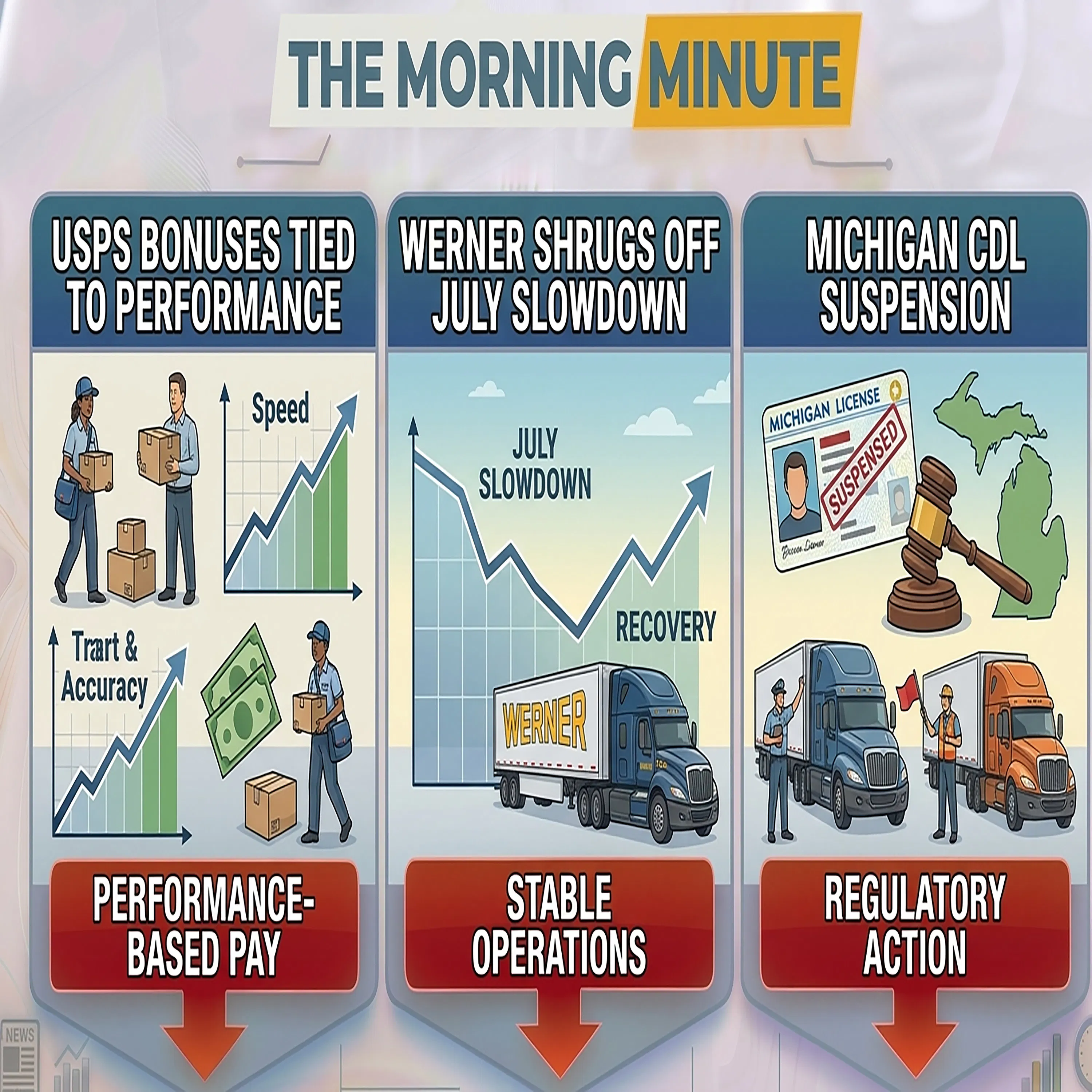
USPS Bonuses Tied to Performance, Werner Shrugs Off July Slowdown, & Michigan CDL Suspension | The Morning Minute
4d ago00:03:38Tap to summarizeIn this episode, we kick things off in Washington, where lawmakers are aggressively tying executive pay to actual delivery performance at the struggling Postal Service. A bipartisan bill barring USPS executives from receiving bonuses until on-time delivery hits ninety-five percent was approved by the Senate Homeland Security Committee last week. The No Bonuses for Bad Service Act comes as the mail carrier missed its on-time target for all eight delivery categories in fiscal year 2025, lost twenty-five billion dollars over the last three years, and reported a two point five billion dollar loss for the third quarter. Next, we shift over to the truckload sector, where Werner Enterprises is shrugging off recent spot market softness and doubling down on the supply-driven recovery. Speaking at Deutsche Bank's Chicago Industrials Summit Tuesday, Chairman and CEO Derek Leathers told investors the company remains unfazed by the seasonal slowdown in July truckload spot market trends. Leathers estimates that eight hundred fifty to nine hundred CDL schools have been forced to close due to insufficient training standards, powering Werner's turnaround with the company's one-way truckload fleet seeing revenue per truck per week jump twenty-eight percent year over year in the second quarter. Finally, we cover the nationwide crackdown on fraudulent CDL training programs as state regulators in Michigan join the fight. The Michigan Department of State issued a summary suspension to Northern Michigan University Truck Driving School on August fifth following an investigation that uncovered multiple alleged violations. Among the most significant allegations, regulators said the school provided behind-the-wheel instruction to students without first verifying they possessed valid commercial learner's permits and allowed students to sign blank instructional documents that were subsequently completed. Follow the FreightWaves Today Podcast Other FreightWaves Shows Learn more about your ad choices. Visit megaphone.fm/adchoices
Transcribe →
FreightWaves Today | August 11
5d ago02:01:24Tap to summarizeWelcome to today’s episode of FreightWaves Today! In this episode, we explore the cutting-edge technology, Q2 financial results, supply chain strategies, and market dynamics shaping the logistics and transportation industry. Here is what we cover in today’s show: AI-Powered Freight Execution with Overroute Alex Reed, Founding CEO of Overroute, joins the show to discuss the official launch of their AI-led freight execution platform. Developed in a year-long co-design partnership with J.B. Hunt, the platform uses AI agents to automate shipment coordination, detect exceptions, and streamline customer communications directly within existing carrier systems. Alex breaks down how the technology works day-to-day, how exceptions are handled, and the role of human oversight in AI-driven logistics. RXO Q2 Earnings & Market Share Growth Drew Wilkerson, Chairman and CEO of RXO, breaks down the company’s Q2 financial performance and market strategy. RXO reported strong volume growth across its business, with truckload volume outperforming the market by growing 2%. Drew shares how a 42% spot mix drove gross profit per load, the impact of agentic AI on operational productivity, and why he believes the freight market is in the early stages of a recovery. Managing Summer Retail Surplus & Returns Amrita Bhasin, Co-Founder and CEO of Sotira, returns to discuss how retailers are navigating late-summer return spikes and excess seasonal inventory heading into fall. Amrita explains how Sotira leverages AI to match overstock inventory with secondary buyers and donation markets—helping brands protect their bottom line while keeping surplus goods out of landfills. Transportation M&A & Freight Market Capacity Craig Decker, Managing Director at Brown Gibbons Lang & Company, provides an inside look at the dealmaking environment across logistics and transportation. Craig explores how capacity leaving the system—rather than a surge in demand—is driving early signs of freight market recovery, and what buyers and sellers need to know about transportation M&A activity heading into 2026. Follow the FreightWaves Today Podcast Other FreightWaves Shows Learn more about your ad choices. Visit megaphone.fm/adchoices
Transcribe →
Trucking Has a Driver Shortage? Then Explain 90% Turnover | Brake Check
5d ago00:59:22Tap to summarizeTrucking says it has a DRIVER SHORTAGE. So why are some carriers still burning through drivers at 90%+ turnover? Maybe trucking doesn't have a recruiting problem. Maybe it has a job worth keeping problem. On this episode of Brake Check, Charles Gracey digs into why professional drivers leave and why the industry's answer always seems to be recruiting MORE people instead of fixing what sends them out the door. Sherri Garner Brumbaugh, CEO of Garner Transportation Group and former ATA Chair, breaks down what her fleet does differently to retain drivers and faces tough questions about the disconnect between drivers, carriers and the organizations representing trucking in Washington.Then Charles brings on fellow SiriusXM Road Dog host Dan Ronan joins the conversation to tackle the numbers, the driver cycle and what drivers are saying that trucking's boardrooms still aren't hearing. We get into: 90%+ driver turnover The “driver shortage” debate Pay and unpaid working time Home time and dispatch Why good drivers actually leave Recruiting vs. retention The ATA-driver disconnect What successful fleets do differently Whether trucking has built jobs people actually want to keep You can recruit veterans, women, younger drivers and every other untapped workforce in America but if the job doesn't change, you're just pouring more people into a leaking bucket. Stop replacing drivers. Start giving them a reason to stay. This is Brake Check. Let's go full stop. #Trucking #TruckDrivers #DriverShortage #TruckingIndustry #TruckDriver #Freight #OwnerOperator #DriverRetention #BrakeCheck Follow the Brake Check Podcast Other FreightWaves Shows Learn more about your ad choices. Visit megaphone.fm/adchoices
Transcribe →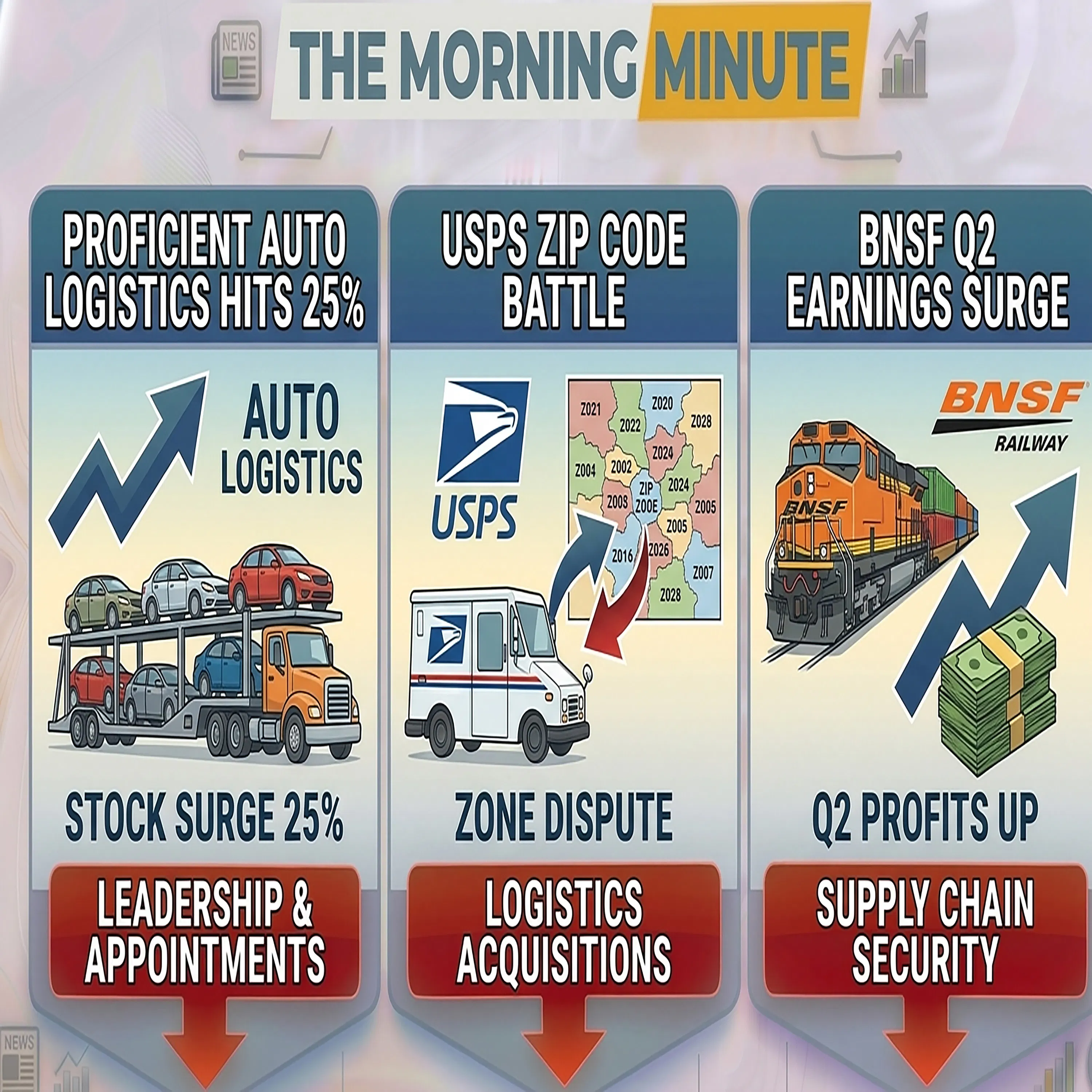
Proficient Auto Logistics Hits 25%, USPS Zip Code Battle, & BNSF Q2 Earnings Surge | The Morning Minute
5d ago00:03:38Tap to summarizeIn this episode, we kick things off with a massive consolidation move reshaping the finished vehicle logistics market. Jacksonville-based Proficient Auto Logistics announced a one hundred thirty million dollar agreement to acquire California-based Hansen & Adkins, a deal that will push the combined company's market share to roughly 25 percent of the new car hauling market. The acquisition will more than double Proficient's fleet to over seven hundred twenty-five company-owned units and add four hundred million dollars in annual revenue, with the deal expected to close in mid-August as the auto haul industry faces rising regulatory pressures and tightening capacity. Next, we explore a brewing battle in the parcel sector where a Senate bill aimed at solving Zip code confusion is triggering fierce pushback from postal leadership. The Homeland Security and Governmental Affairs Committee endorsed legislation requiring the U.S. Postal Service to designate unique Zip codes for eighty-three communities, but Postmaster General David Steiner is warning that the mandate would cause irreparable harm to both the organization and its customers. Steiner claims implementation would cost well over eight hundred million dollars, completely erasing last quarter's hard-fought performance gains for an agency that has lost nearly fifteen billion dollars over the past twenty-one months. Finally, we break down strong second-quarter results from one of the nation's largest freight railroads as BNSF Railway reported pre-tax earnings rising nearly fourteen percent on higher volume and revenue. Parent company Berkshire Hathaway disclosed that BNSF's earnings climbed to two point zero six billion dollars as revenue increased fourteen point six percent to six point five six billion, driven by a six and a half percent volume surge and higher revenue per unit. Consumer products traffic grew nine point three percent thanks to increased West Coast imports and tightening truck capacity, while agricultural and energy shipments jumped eleven and a half percent, though the railroad's operating ratio deteriorated slightly as fuel costs surged sixty-eight percent year over year. Follow the FreightWaves Today Podcast Other FreightWaves Shows Learn more about your ad choices. Visit megaphone.fm/adchoices
Transcribe →
FreightWaves Today | August 10
6d ago02:00:39Tap to summarizeOn today’s show, we dive into the shifting macro landscape, major breakthroughs in artificial intelligence, and new solutions for fleet electrification: Freight Market Shakeout: Ryan Farlow, Industrials Senior Analyst at RSM, discusses how regulatory enforcement, small-carrier cost pressures, and changing capital costs could trigger a capacity shakeout to rebalance freight pricing. Enterprise AI at Scale: Adrian Smith, Co-Founder and CEO of Ripple, breaks down their record enterprise deployment with global freight forwarder JAS, detailing how bespoke AI automation transforms core workflows. Autonomous Tech Milestones: Raquel Urtasun, Founder and CEO of Waabi, explains how the Waabi Driver achieved zero-retraining AI generalization by seamlessly transferring to the Volvo VNL Autonomous platform without new data. Electrification Solutions: Pat White, VP of Commercial at OptiGrid, highlights how battery-integrated fast chargers enable fleets to bypass long utility delays and slash deployment timelines from years to weeks. Follow the FreightWaves Today Podcast Other FreightWaves Shows Learn more about your ad choices. Visit megaphone.fm/adchoices
Transcribe →
$500K Cargo Heist, Fake Deliveries & The Global Trade Crisis | WHAT THE TRUCK?!?
6d ago00:50:52Tap to summarizeGet your week started with the fastest 45 minutes in freight! On today’s episode, Malcolm Harris and Michael Vincent break down the latest supply chain headlines, crazy cargo fraud cases, and the evolving landscape of global trade. In This Episode: Headline News: Justin Turner named CEO of Mariner Logistics, a breakdown of the Little Debbie snack delivery fraud scheme, Indiana's massive truck inspection crackdowns, a driver’s $510K fuel card fraud, and how new parcel surcharges boosted USPS revenue to $20B. Cargo Theft & Modern Security: Danny Ramon (Director of Intelligence at Overhaul) joins the show to walk through a real-time $500,000 electronics theft recovery in California. We dive into how cargo theft has evolved beyond traditional break-ins, the critical importance of continuous monitoring and law enforcement coordination, and why vetting brokers and carriers before pickup is your best line of defense. Overcoming Regulatory & Document Bottlenecks: Patrick Van Hull (Supply Chain Industry Consultant at Tungsten Automation) breaks down the operational reality of navigating tariffs and trade policy changes. Learn how document-heavy workflows—from bills of lading to customs entries—create massive supply chain bottlenecks, and how AI and automation are helping leaders build truly resilient operations. Watch on YouTube Visit our sponsor - GNOSIS FREIGHT Subscribe to the WTT newsletter Apple Podcasts Spotify More FreightWaves Podcasts #WHATTHETRUCK #FreightNews #supplychain Learn more about your ad choices. Visit megaphone.fm/adchoices
Transcribe →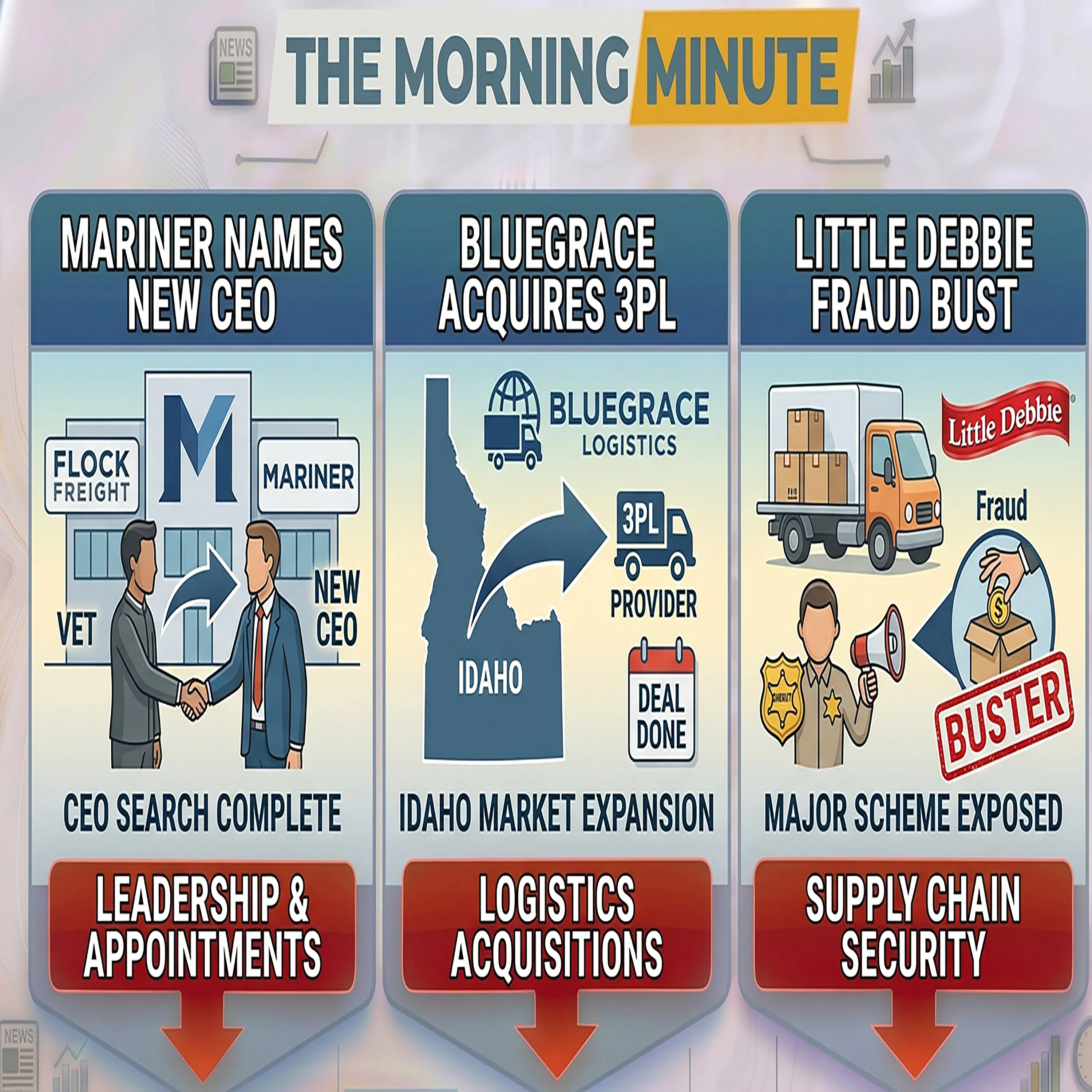
Mariner Names Flock Freight Vet CEO, BlueGrace Buys Idaho 3PL, & Little Debbie Fraud Bust | The Morning Minute
6d ago00:04:03Tap to summarizeIn this episode, we kick things off by examining a major leadership change at an integrated asset-backed 4PL that's betting big on carrier verification technology. Mariner Logistics recently named Justin Turner as chief executive officer, handing the Coppell, Texas operation to an executive who spent the past decade scaling brokerages and freight tech companies, including a critical role helping Flock Freight grow revenue from roughly ten million dollars to more than five hundred million dollars. The company's proprietary Sentinel Protocol continuously scores carriers and lanes rather than checking them once at signup, applying multi-source verification to every shipment. Meanwhile, consolidation is accelerating in the managed logistics sector as Tampa-based BlueGrace Logistics acquired Idaho 3PL Truk TMS, a broker focused on less-than-truckload transportation with a heavy concentration in the Pacific Northwest. Truk TMS had been operating as a BlueGrace partner and will now have full access to the company's technology platform and carrier network of over two hundred fifty thousand carriers, marking BlueGrace's third acquisition in recent years. Finally, we cover a freight fraud scheme that highlights the vulnerabilities in distributor delivery verification as Pennsylvania authorities filed fifteen criminal charges involving fraudulent Little Debbie delivery invoices. The City of Washington Police Department alleges that distributor James Powell created fake invoices showing Little Debbie products reaching Pennsylvania retail stores when the deliveries never occurred, using forged employee signatures to falsely verify receipt of merchandise. Powell now faces multiple felony counts including forgery, theft by deception, and fraudulent business practices, with authorities seeking over seventeen thousand dollars in restitution. Follow the FreightWaves Today Podcast Other FreightWaves Shows Learn more about your ad choices. Visit megaphone.fm/adchoices
Transcribe →
Can Trucking Survive the Nuclear Verdict Era? | Freight Expectations
1w ago00:44:30Tap to summarizeWhat happens to trucking when autonomous technology collides with driver jobs, highway safety and an increasingly challenging legal environment? On this episode of Freight Expectations, Craig Fuller is joined by Matthew Leffler and Julie Van de Kamp for a wide-ranging conversation about some of the biggest issues shaping the future of trucking. The discussion examines the complicated debate surrounding autonomous trucks and what increased automation could mean for professional drivers and the broader freight workforce. While technology promises new efficiencies and potential safety improvements, the transition raises major questions about jobs, responsibility and how quickly the industry should embrace autonomous operations. The conversation also turns to trucking’s legal environment and the impact of nuclear verdicts. The group discusses why juries can be particularly unforgiving toward large trucking companies, how emotion can influence courtroom outcomes and why a carrier’s investment in safety can become critically important when an accident ends up before a jury. Craig, Matthew and Julie explore questions including: Will autonomous trucking eliminate driving jobs or simply change them? How should the industry balance technological progress with protecting workers? Why are trucking companies especially vulnerable in jury trials? How much does emotion influence nuclear verdicts? What responsibility do carriers have to invest aggressively in safety? Can companies ever completely protect themselves from catastrophic verdicts? What happens when a fatal crash puts a price on corporate decisions and safety practices? It’s a conversation about technology, people, safety and liability as trucking attempts to navigate a rapidly changing future. Follow the Freight Expectations Podcast Other FreightWaves Shows Learn more about your ad choices. Visit megaphone.fm/adchoices
Transcribe →
FreightWaves Today | August 7
1w ago02:15:44Tap to summarizeFollow the FreightWaves Today Podcast Other FreightWaves Shows Learn more about your ad choices. Visit megaphone.fm/adchoices
Transcribe →
PACCAR Recalls 5,919 Trucks, Canada Fraud Hits Suppliers, & International Exits Ohio | The Morning Minute
1w ago00:03:54Tap to summarizeIn this episode, we kick things off by examining a major safety recall affecting nearly six thousand brand-new Kenworth and Peterbilt trucks. PACCAR is pulling model year 2027 vehicles due to a critical defect in the power distribution center that could cause drivers to lose engine power, antilock brakes, or windshield wipers without any dashboard warning. The problem originated from contaminated soldering at a supplier facility, though PACCAR estimates only 0.3 percent of recalled trucks actually have the defect. Meanwhile, a sophisticated fraud operation is targeting heavy-duty trucking suppliers across Western Canada as twelve businesses shipped truck tires, engine oil, and trailer parts on fraudulent credit card orders that initially appeared legitimate. Saskatchewan RCMP launched an investigation in March after companies across the province discovered that approved transactions ultimately failed, with callers having provided credit card details that prompted shipments before the payments declined. Finally, we cover a massive workforce reduction in Ohio as International Motors lays off 1,341 employees following the sale of its Springfield facilities to Canadian manufacturer Roshel. The sale is expected to close October 2nd, effectively ending the facility's contract manufacturing agreement with a major automotive company and paving the way for Roshel to transform the sprawling campus into a U.S.-based production hub for commercial, specialty, and armored vehicles. Follow the FreightWaves Today Podcast Other FreightWaves Shows Learn more about your ad choices. Visit megaphone.fm/adchoices
Transcribe →