← From Our Own Correspondent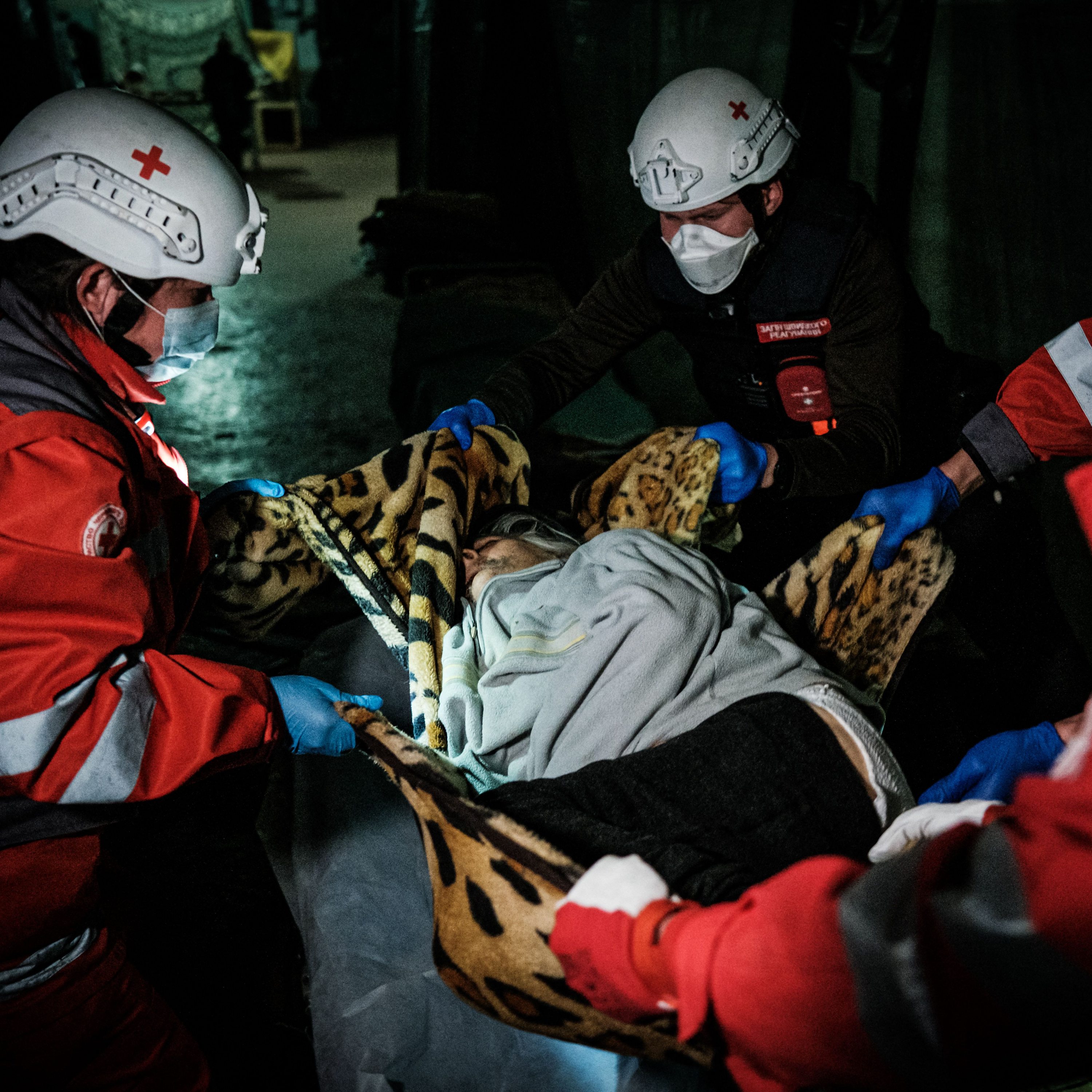
From Our Own Correspondent
Ukraine's Battlefield Doctors
00:27:43
How Ukrainian surgeons are learning to operate in the middle of a warzone.
Loading summary
Transcript12 lines
- [00:00]
A
Good morning.
- [00:01]
B
Today, training the doctors who carry out battlefield surgery in Ukraine. How nervous should Georgians be about their neighbour to the north, Russia? Our correspondent travels into the heart of the Congo to see a peat bog the size of England. We hear about the Yazidi people, now caught up in Iraq's fractious contest for power and opening a bank account in Greece. Not as simple as you might think. First, the task of a surgeon's not an easy one at the best of times. It requires a deep and detailed knowledge of human anatomy, of course, but also the physical prowess of a steady hand, one that can guide a knife with delicate precision. So try, if you can, to imagine what it's like to perform an emergency operation in the midst of a battlefield where the power supply might fail at any time, where the very building you're working in may be under attack. David Knott has done precisely that, working as a doctor in conflict zones around the globe. Now he's trying to teach what he's learned to surgeons working in Ukraine. Wira Davis joined one of his classes,
- [01:15]
C
looking tired and sleep deprived. Oleksandr Sokolenko sits at the back of the classroom. But he's still studiously paying attention. He's travelled a long way to be here and has momentarily left important work behind. Oleksandr is a civilian doctor, a recently qualified surgeon. But his green military style clothing reflects the nature of his most recent assignment, treating victims of war, military and civilian, on Ukraine's eastern front. It's thought that Ukraine may be losing as many as 200 troops a day in intense fighting in the Donbass region around the besieged cities of Sverodonetsk and Lysychansk. Russia is believed to have a 10 to 1 advantage over Ukraine in long range artillery and heavy weaponry. What's equally worrying to frontline doctors like Oleksandr is that they don't have sufficient medical expertise or experience, not enough to keep people alive when they arrive at field hospitals with catastrophic injuries from Russian shelling. Oleksandr is clearly traumatized by what he's had to deal with in the last three months. I'm not God, I can't save these people, he tells me, still deeply affected by the patients dying on his operating table. That's why he's made the perilous journey on the only safe road out of the Donbas region to attend a three day hostile environment surgical training course in the city of Dnipro, led by the celebrated British war surgeon, David Knott. Knott is one of the most experienced trauma surgeons in the world. He's worked under fire from Syria to Gaza to South Sudan and now Ukraine. David Knott and his small team of veteran war surgeons still occasionally operate on the front line, but he firmly believes that teaching trauma surgery to local doctors is the most effective way of minimizing casualties of war. The course is run by the David Knott Foundation. It is intense, graphic and not for the faint hearted. First of all, Nott has to get the audience on his side. In the class of, say, 20 doctors, there are the willing participants like Oleksandr, attentive and asking questions about how to assess and treat victims of shell attacks. Then there are the civilian medics and orthopaedic surgeons, completely overwhelmed by the recent appearance in urban hospitals of patients with life threatening war injuries they were never trained for. And there's also the awkward squad, the Rufty Tufties, as David Knott calls them. They're the Ukrainian military Doctors who since 2014 have been dealing with the pro Russian separatist insurgency in the eastern Donbas. Almost exclusively male, this group of reluctant students are sceptical that the quietly spoken British surgeon and his team can teach them anything at all about war surgery. Knott takes them through complex techniques and procedures to deal with catastrophic blood loss after blast injuries, damage control, how to quickly assess and stabilize a patient in the vital first minutes, plastic surgery, amputations, the list goes on. I know what it's like to be under fire. I know what it's like to be in an operating theater that's being shelled, nott tells me, adding that around 70 Ukrainian doctors would have been trained by the end of these courses. Soon enough, even the ruffty tufty doctors realise that David Nott knows what he's talking about and he can help them in Dnipro and then the frontline city of Kharkiv, which has been battered by Russian shelling with thousands of people killed or injured. Noth and his team delivered two energy sapping courses, often to doctors whose facilities have been dilapidated by the onset of war. It's really difficult and frustrating not to be able to help a patient because of limited resources, especially on the front line, says Amar Darwish, a Manchester based surgeon with the David Knott Foundation. In places like Ukraine or Syria or Yemen, he says, you just need to concentrate on your patient and treat them, especially when you have mass casualties. Just before the end of his short visit to Ukraine, Mr. Knott gets a message from Oleksandr, the studious young doctor who, who has now returned to a frontline field hospital in the eastern Donbas. Knott is delighted to hear that Oleksandr was confident enough, after attending the course, to perform a complicated thoracotomy, a life saving procedure which involves making an incision into the patient's heart. These days, it's more front of the class than frontline for David Knott and his team, but it's the most effective way of passing on such a wealth of surgical knowledge to those who need it most.
- [06:03]
B
Wira Davis Russia's attack on Ukraine has left other countries wondering if they might be next. After all, when someone starts throwing their weight about aggressively, those in the same neighbourhood may well start feeling jumpy. And Russia does have lots of neighbours. A land border with 14 countries to be precise. More than that, eight of these countries were once part of the old Soviet Union, which Vladimir Putin at times seems keen to resurrect. Among these is Georgia, which sits between Russia, Turkey and Azerbaijan. As Zeynep Badawi has found, the invasion of Ukraine has left many there eager to place their country firmly in the Western camp.
- [06:49]
D
I'm being driven to the centre of Tbilisi from the airport along George W Bush street, named in the US President's honour during a visit he'd made to Georgia. I recall that it was his father, President Bush Senior, who back in 1991 had said the prospect of a Russian invasion of Europe was no longer a realistic threat, so he cut US defence expenditure by a quarter. Now we know that he, like many others, got it wrong. As I pass by several banners bearing the slogans Glory to Ukraine or be brave. Like the Ukrainians, I want to know what Georgians really think of the Russian war on Ukraine and whether it's left them feeling vulnerable to attack. From Moscow, I make my way through Tbilisi, a beautiful city surrounded by undulating green landscape, nestling at the foothills of the Caucasus Mountains. The wide, tree lined streets are spotless, tended by multitudes of diligent sweepers. In fact, Tbilisi is so full of trees that at this time of year it gives the impression of being one giant urban botanical garden. The buildings are elegant, some modern and sleek, others older and constructed of heavy stone, with majestic, ornate exteriors and decorated arches. In a comfortable courtyard cafe fringed with lush plants and open to the brilliantly blue sky, I meet two Georgians who tell me about the mood in their country. One, dressed casually in shorts and multicolored trainers, used to be a senior government official until he abandoned politics for a career in industry, the other a senior executive in the banking sector is younger, slighter and dressed more conservatively in a striped shirt and trousers. They are both eager to talk, and over fresh mint tea and sparkling water, the banker speaks to me with passion and a sense of frustration tinged with genuine fear. Georgia is probably the most exposed country in the world to Russian aggression, he says. Moscow has troops and missile systems stationed about 30 kilometers from where we're sitting here. No other capital city is so close to Russian tanks and soldiers. He's referring to the stark reality of two separatist enclaves in Georgia, South Ossetia and Abkhazia, which are backed by Moscow. There are around 10,000 Russian soldiers in each territory. The Kremlin recognizes both as independent states, even though the international community deems them part of Georgia. In 2008, hundreds of people were killed and thousands displaced in a bitter five day war between the separatists and Georgian forces. Moscow provides both military and economic support to the enclaves, which means Georgia has an ongoing conflict, albeit a frozen one. This disqualifies Tbilisi from applying for NATO membership under current rules. Whilst the banker helps himself to a handful of peanuts on the table, I ask the former government official why Georgia is accused by Ukraine of not being sufficiently supportive. The Georgian authorities have stated publicly that they will not join Western sanctions against Russia, but Georgian citizens have held some pro Ukraine marches. It is simply because the Georgians feel so threatened by Putin that the government cannot afford to antagonize him, he explains. So we have to engage in a delicate balancing act. In March, Georgia brought forward its decision to make an official application to join the European Union. But we still have to tread carefully with Moscow, he adds. The banker interjects and tells me fervently that nearly all Georgians see Russia as their past and Europe as their future. His comments are backed by numerous opinion polls showing that two thirds of Georgians want to join the EU and NATO. In fact, the Ukraine war has made them even more anxious to escape Moscow's orbit. Both men insist that President Putin has genuine expansionist ambitions and a desire to recreate the former Soviet empire. I come away from my time in Georgia thinking that if Putin's aim is to build a new Iron Curtain, then certainly it's very clear from all my encounters that Georgia does not wish to be behind it again.
- [11:34]
B
Zaynab Bedawi the word bog tends to have rather negative connotations. A swampy kind of place where you might get trapped and covered in muck and mud. But we should remember that we owe the planet's bogs a debt of gratitude, peat bogs specifically act as hugely efficient carbon sinks. They suck carbon dioxide out of the atmosphere, storing it under so if we're going to tackle climate change, protecting the world's peat bogs is every bit as important as cutting CO2 emissions. Andrew Harding has just returned from a trip into the heart of the Republic of Congo, travelling with scientists who are working to protect a vast area of peat which is currently under threat.
- [12:20]
E
So there we were, already up to our waists or armpits in glistening black swamp water, a dozen of us in single file, stumbling forwards, swaying like saplings in the forest gloom. I tried to tug a boot from the mud's grasp, failed, then reached out towards a thorn covered branch. I reconsidered, then realized my other leg was now trapped beneath a tree root. It was all, well, rather wonderful. A young PhD student, Jodhry Matoko, had set the mood earlier that morning as we set off with our backpacks into the Congolese forest. Six scientists, three journalists and three local men with machetes who led the way, slashing and hacking a path through walls of bamboo and vines. The sky soon eclipsed by a thick ceiling of leaves, a frantic chorus of bird song, and then Jodhry whooping and chuckling with glee. No stress here, he explained. Not like the city. We are all forest men. We walk, we sweat and we love it. Forest men and one forest woman, Greta Darjee, a calm, wiry British scientist who pulled out her GPS gadget every few minutes to make sure we were still on course. She raised her arm and said, left a bit to the men with the machetes. The team has been making these adventurous treks for a decade now, spending months each year in the swamps and forests of the Congo basin searching for a rare and precious resource. Pete they build platforms above the murky waters each evening to cook and to pitch their tents. And it's dangerous work. There are snakes and crocodiles to watch out for, and wild pigs and elephants and leopards and thick clouds of mosquitoes. At one point we came across a local hunter. Barefooted, 24 year old Pedro Cumu, told us to look out for lowland gorillas. They're bad, he said. If you see them, back away. After about four hours, the scientists came to a halt. They unpacked and assembled a giant corkscrew device and began pushing it deep into the swamp to take samples. Perfect, said Jodry, as a dark cylinder of peat slid onto a plastic sheet. The team first identified Congo's hidden peat glands some eight years ago. Since then, they've been mapping the contours of what's turned out to be a vast slab of peat the size of England. And that matters because the peat traps and stores CO2 with great efficiency, billions of tons of it. Which means this whole region, a region struggling to shake off a reputation for wars and misery, plays a vital role in controlling the world's climate. It had taken us three days to reach the edge of the peatlands, two days driving from the capital, Brazzaville, then a long day in a giant dugout canoe overloaded with provisions, speeding downstream on a swollen tributary of the great Congo River. We came ashore at a place called Ntoku, a small settlement, the smell of smoked fish drying over charcoal fires and doughnuts sizzling in pans of oil. We set up our tents and went to see the local government administrator, Alphonse Esserbe, a former teacher and enthusiastic philosopher, struggling to hide his disappointment at being dispatched to this remote corner of northern Congo. There's no education here, he said, gesturing towards children playing on the dirt road outside his compound. People know nothing of the peaklands, he went on, or of the need to protect them. A few days later, I sat perched precariously on the smallest and flimsiest of dugout canoes, which proceeded to wobble, then to sink gently but resolutely beneath me. A local farmer had agreed to take us into another swamp, a swamp full of palm trees, which he and his neighbors cut into with machetes to drain the SAP to make rather tasty palm wine. But the process kills the trees and exposes the highly sensitive peat below to the sunlight, drying it out and potentially releasing all that trapped CO2 back into the atmosphere. There is huge demand for agricultural land and real fears now about forest fires in the Congo Basin and about other, bigger developers coming in, maybe even drilling for oil in this precious habitat. You can't blame these farmers, said Jodhry, the PhD student. This is their livelihood. We can't ask them to starve. So how to save Congo's peatlands? Should the world's biggest polluters pay to protect them? That's certainly what most governments in the region believe. But how to guarantee that the money is well spent and not stolen or wasted? That's for the politicians to thrash out, and hopefully fast. In the meantime, the scientists packed up their giant corkscrew, consulted their gps, and headed on deeper into the swamp.
- [17:37]
B
Andrew Harding the group which calls itself Islamic State has committed atrocities and inspired others to carry them out across the globe. But perhaps no group suffered as much as the Yazidi people of northern Iraq, a small religious minority. Islamic State accused them of devil worship and proceeded to kill about 5,000 of their number in cold blood. Islamic State has now been driven out of the Yazidi homeland, Mount Sinjar. Yet it seems their suffering continues. Because Mount Sinjar is contested territory, the Iraqi government claims its people as their own. Yet the Kurdish regional government competes for the Yazidis loyalty. Meanwhile, the Kurdish militant group, the pkk, has been recruiting Yazidis, offering them money and guns. And according to Shelley Kittelson, this has left communities and indeed whole families bitterly divided.
- [18:36]
A
We want to be part of Iraq, said the young Yazidi man. He was puffing on his shisha pipe and interrupting his father, a man in his 50s. We sat chatting on thin mattresses on the floor of their house in Sinjar. The town and the area around it with its majestic mountain looming over it, are the homeland of the Yazidi people. The conversation had turned to the subject of who should hold sway over this area, hotly disputed between the Kurdistan Regional Government and the Iraqi National Government in Baghdad. Yazidis want to be part of Iraq, not just of the Kurdistan region, Assad said. Azad's father is a peshmerga fighter, part of the military force of Iraq's Kurdistan region. He had fought against the group, which calls itself Islamic State. I don't trust Baghdad, he added, abruptly leaving the room. In 2014, thousands of Yazidis were massacred and enslaved by Islamic State, and this has left visible scars here. Many women endured sexual torture for years. Many are still missing. Others feel abandoned. It's easy to understand why people here are so passionate about this issue. Here in Sinjar, armed groups hinder movement and foster fear. The Iraqi army was sent in recent months to pressure irregular armed groups to leave. An Iraqi army offensive in early May led to intense fighting over a two day period. Those Yazidi young men and women that remain in Sinjar struggle to find work and with their identity. Many have been trained by the Kurdish militant group the pkk, which has long fought against Turkey. The group has long used Iraqi territory to train and hide in. The PKK is classified as a terrorist organization by the us, uk, EU and Turkey. But the PKK pays the Yazidi fighters wages, giving Sinjar youths that join the local branch a sense of power and purpose. A group of Yazidi men in their twenties met with me in a cafe one afternoon. They suggested that the Iraqi central government could provide those trained by the PKK with thousands of jobs in the country's. Armed forces. This would weaken the grip that the PKK hold on the Yazidi youth, they claimed. They agreed that the PKK is a terrorist organization. But many Yazidis who joined the local branch of the PKK did it because they needed work and had no other choice, these young men said. But it is unlikely that the Iraqi central government will take on that burden of hiring thousands of fighters. It simply has too many people on the state payroll already. Iraqi Kurdish leaders have, meanwhile, repeatedly warned of the dangers of the continuing presence of the PKK in their territory. A member of the largest political party in the Kurdistan region has claimed that wherever the PKK goes, the place turns into ruins. The peshmerga have made it abundantly clear that they do not consider the PKK their brothers, and the PKK has attacked the Peshmerga multiple times over the past year, leaving several dead. Yazidis suffer from this rivalry. Azad feels being close to the central government would help most of all. He and his peers want a sinjar not flooded with weapons and threats and fighters competing for influence. But how to achieve this, and who to trust remains unclear.
- [22:09]
B
Shelley Kittleson Banks want your custom? At least you might think so, given the number of adverts suggesting they offer you the best service, the most favourable interest rates and perhaps the broader smile on the faces of their staff. You might think, therefore, that they would make it relatively easy to sign up, that they'd meet you with encouragement rather than obstacles. But when Alba Arica recently had to open a bank account in Greece, she found herself having to fight awfully hard just to give them her money.
- [22:44]
F
By 9am the temperature was soaring on Athenas Street. I pushed my way through the throng of Athens traffic, past the homeware and suitcase shops, bakeries and periphera, the ubiquitous kiosks that sell everything from newspapers and cigarettes to umbrellas. Jacaranda trees were in bloom on this early May morning, and their bursting color cast a mauve light on the neoclassical buildings violet snow, as the poet George Zafiris called it. Some were crumbling, some restored, a reminder that in this city, past and present, ancient and modern remain in continuous, juxtaposed tandem. And as I pushed open the door to one of those buildings, I quietly hoped that in this particular case, modernity would prevail. Last October I bought myself a small mountain house in the Peloponnese. Six months later, my husband and I moved in. We had little furniture but were assured it would arrive tomorrow. Tomorrow, we soon learned, could take anywhere between one day and two weeks. Yet there was much to celebrate in the in between. Everything moved in slow motion, a welcome respite from our frenetic lives back home in London. For various reasons, I needed to open a Greek bank account. However, I only had 24 hours in Athens to do it. The chances of success were slim. I was warned by friends who had tried and failed, and it would likely require far more time. The Greeks have a term for their famous hospitality Philoxenia love of strangers. Yet they remain enthralled to their stringent bureaucracy, which can leave Philoxenia in short supply. The night of my arrival, I joined two friends for dinner. George, an art curator, and Sofka, a British author who has lived in Athens for 20 years. Both were cautiously optimistic. I mentioned that I had brought one of the books I'd written to show at the bank for added persuasion. George smiled. Your being a writer won't impress them, he said. What will is who you know. This was clearly key to resolving most, if not all, issues in Greece. But I knew no one. It's called Mesa, sawfka explained, literally being inside an unofficial way to make official things possible. But like everything in Greece, within the bureaucratic and official lies an intrinsic charm. When I had gone to sign our house deeds in a notary's office, an enormous ledger, one among hundreds, was produced together with an ink pen. After it was over, we were offered coffee and spanakopita, spinach and cheese pie. Later, on a trip to the region of Arcadia, we had stopped for fuel. The garage attendant turned out to be an elderly woman clad in widow's black, with sea blue eyes and a timeless face which would not have been out of place in ancient Sparta. Those small encounters, those links with the Greek past, were potent. My appointment at the bank took four hours. The bank manager, bespectacled and masked, studied my documents carefully. They were scanned and queried several times over Greek tax number, utility bills, tax returns, proof of income. A slight problem. I'm self employed and write books. Okay, where does it say you're self employed? He asked, pointing at my tax return. I searched. Surely it was written somewhere. It had to be. But it wasn't, and the manager was becoming agitated. We had hit an Abbas. Find proof, he said, or I won't be able to help you. I write books. I exclaimed, disregarding George's advice. I pulled out my memoir and he gave it a cursory glance, responding only to ask rhetorically, do you really think I'm going to scan all these pages? The proof he required was found after a frantic rereading of my tax return. But it was not over. I needed a Greek phone number, not a British one. Otherwise you won't be able to access your account. Your number is your id. I was instructed to go and purchase a mobile SIM card. I searched the shops but none were to be found. I returned empty handed only to be sent out again in the midday heat to the supermarket, a cafe, another peripitero. I leave at 2, the manager told me. You need a Greek phone number. You have 30 minutes. Someone in a phone shop eventually came to the rescue. I ran back brandishing a card and contract a few minutes before closing time. The manager was halfway out the door as I cornered him. Congratulations, he said, concluding our business.
- [27:32]
B
Welcome to Greece Alba Arica, ending today's program. More next Thursday at 11 and on Saturday at 11:30. Do join us.