← Front Burner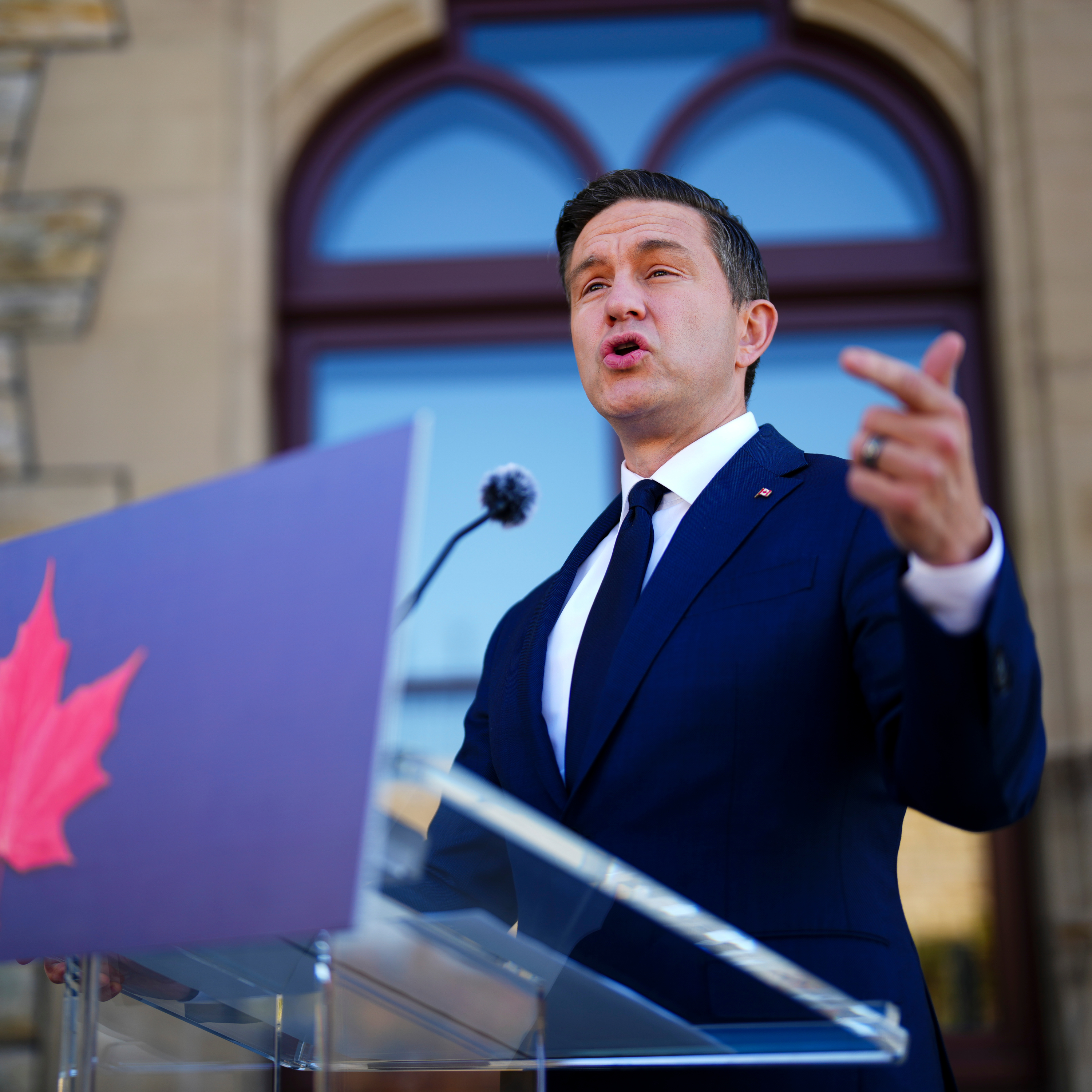
Front Burner
Politics! Poilievre calls out RCMP, auto woes
00:23:10
<p>Stephen Maher, a longtime federal politics reporter, is here to talk about Pierre Poilievre’s recent comments that the RCMP covered up for Justin Trudeau so he could avoid criminal charges and whether or not this will hurt or help his upcoming leadership review.</p><p><br></p><p>Plus, fallout from carmaker Stellantis’s plan to move a plant from Brampton to Illinois and what it says about the state of trade talks with the U.S.</p><p><br></p><p>We'd love to hear from you! Complete our listener survey <a href="https://cbc.ca/FrontBurnerSurvey" rel="noopener noreferrer" target="_blank">here</a>.</p><p><br></p><p>For transcripts of Front Burner, please visit: <a href="https://www.cbc.ca/radio/frontburner/transcripts" rel="noopener noreferrer" target="_blank">https://www.cbc.ca/radio/frontburner/transcripts</a>.</p>
Loading summary
Transcript62 lines
- [00:00]
A
If you're listening to this, you're ready. Ready to join the industrial intelligence generation. A generation defined not by age, but by a shared mindset to connect teams, accelerate efficiency and drive innovation. Using the power of Aviva software to reshape industries, turning real time insights into real world growth. Discover our stories@industrialintelligence.com join Generation I.
- [00:31]
B
This is a CBC podcast.
- [00:37]
A
Hey, everybody, I'm Jaime Poisson.
- [00:46]
B
Many of the scandals of the Trudeau era should have involved jail time. I mean, Trudeau broke the criminal code when he took a free vacation from someone with whom he had government business. It's just like it's right there in the criminal code. If the RCMP had been doing its job and not covering up for him, then he would have been criminally charged. And again, he probably violated the criminal code. And the SNC Lavalin scandal. These would normally have led to criminal charges, but of course, the RCMP covered it all up. And the leadership of the RCMP is frankly just despicable when it comes to enforcing laws against the Liberal government.
- [01:23]
A
So that was Conservative leader Pierre Poliev. Without evidence, accusing the RCMP of a cover up to protect former Prime Minister Justin Trudeau from criminal prosecution. He was talking to the hosts of a podcast called Northern Perspective. The accusation set off a lot of blowback, which I guess is predictable when the man who wants to be the prime minister calls the RCMP leadership despicable and accuses them of a criminal conspiracy. I'm talking today with Stephen Marr. He was on the show a lot during the election and is a longtime federal politics reporter. We're also going to talk about the state of trade talks with the US as tariffs continue to pound the auto sector. All right, let's get to it. Stephen. Hey, it's so great to have you back on front burner.
- [02:14]
B
It's a pleasure to be back.
- [02:16]
A
Oh, it's always a pleasure to talk to you. So, as I mentioned, POV went on this show and said that Trudeau deserved to be in jail for taking a vacation from the Aga Khan. That was what he was referring to. And that the RCMP covered up for him in that case, and probably that they also did during the SNC Lavalin case. And what did you make of those comments when you first heard them? Like, what was going through your head?
- [02:42]
B
Well, I thought that Pierre Poliev is trying to reach the people who will cast the deciding votes in the upcoming Conservative leadership review in January. And he's been taking a more strident kind of tone recently. On immigration, on diversity, equity and inclusion, and now going after Trudeau and the Mounties in a ill considered way. So I thought in that context, he's out there trying to reach the fairly strident Tories who will decide if he's going to continue as leader or not.
- [03:19]
A
Do you think he needs to reach them? Doesn't he already have them?
- [03:24]
B
Well, he wants to have a very high number in this leadership review in January. This is the kind of thing that plays out whenever someone loses an election. And sometimes, as we saw recently with Bonnie Crombie, for example, they don't get the number that they're looking for. Bonnie Crombie has announced she will resign as Ontario Liberal leader after party delegates narrowly voted against a new leadership race.
- [03:47]
A
Crombie received 57% support to stay on.
- [03:50]
B
As leader, far below the 66% that a grassroots faction of the party had set to have her resign. So he wants to be able to be sure and so he's got to motivate the people and make sure that they cast a ballot for him.
- [04:06]
A
Like you said, he says other stuff recently about immigration, but this one really seemed to strike a nerve. Right. What was it about these specific comments you think that people took most issue with?
- [04:19]
B
Well, they're ill considered nasty. He's always had a reputation as an attack dog, someone who will just go in and go for the jugular on every occasion. Now, in this case, as on the various cases throughout his career, he's gone too far and said something that he can't justify or back up.
- [04:42]
A
What were you hearing about the reaction from inside his own caucus? I know Politico reported, for example, that many of his own caucus members weren't aligned with their leader's remarks.
- [04:54]
B
Well, that's not surprising. And we heard from various Conservatives outside the caucus expressing dismay.
- [05:05]
A
What do you think about Polio's comments on the RCMP? Do you support his viewpoint? Conservative MPs returning to the House Monday were in no rush to defend their leader's comments.
- [05:15]
B
I Support the Blue Jays110 and I.
- [05:19]
A
Hope they win tonight.
- [05:20]
B
Is that your mission? From the perspective of Conservatives, this is a distraction. I do not believe that Pierre Poliev said to himself, well, I'm going to go into this interview with some very friendly podcasters or YouTubers and try to provoke a national story about my views on the rcmp. They were offhand comments, right? And so they reflect his kind of casual thinking and they do not necessarily line up with reality.
- [05:50]
A
Poliev accused the RCMP of covering up for Former Prime Minister Justin Trudeau during two scandals. In both cases, Trudeau was found to have violated the Conflict of Interest act. But the RCMP did not lay criminal charges. Questioned late last week about the criticism, the RCMP commissioner defended his force.
- [06:07]
B
There's no interference. I've, I, you know, if he has evidence that the RCMP interfered with criminal investigations, then he should present that evidence and to try to clean it up. He came out and said, well, I was only talking about Brenda Lucky.
- [06:24]
A
In a statement, Pierre Poliev says his.
- [06:26]
B
Comments were directed at former RCMP Commissioner.
- [06:28]
A
Brenda Lucky, whom he says has a lengthy track record of publicly documented scandals, deception and political interference to the benefit.
- [06:37]
B
Of the Liberal government. Now, there, there were serious things where she seemed to be. During the Porta Pick Inquirer, we learned that she was echoing Liberal talking points politically in a way that raised questions. Both Commissioner Luckey and then Public Safety Minister Bill Blair denied there was political interference. But the contents of her phone call with Nova Scotia Maoris suggest there was regular contact. Lucky has acknowledged being frustrated. A news release from Nova Scotia RCMP excluded details of the Porta Pic killer's weapons. She denies allegations that she was crossing ethical boundaries and trying to boost public support for the government's gun control agenda. But that's a far cry from suggesting that she went in and told her investigators in the Sensitive Investigations Unit to take it easy on Justin Trudeau. If he thinks that that's true, then we should get to the bottom of it. But he doesn't seem to have any evidence.
- [07:46]
A
Calling for the jailing essentially of his political opponent. I mean, it's something that we hear fairly often from Trump. Right. And, and being too Trumpy is an accusation people have thrown around quite often.
- [08:00]
B
Polly Ev is facing a number of negative headlines in the media, some drawing direct comparisons to language used by President Donald Trump. Political leaders on Parliament Hill are also making that link.
- [08:10]
A
Pierre Poiliev's notion that the former prime minister should be jailed. It's deeply worrying because this is the kind of thing going on right now in Trump's United States. You mentioned comments on immigration, but also he's talked about how Canadian cities are war zones. He sent out a petition calling to restore the merit principle and NDAI programs in the federal government. And I mean, I take your point that he's trying to win a leadership race in January with his base, but do you think that this is doing harm for him moving forward if he wants to be prime minister?
- [08:47]
B
Well, I do. He, since he became leader, I'm sure You'll remember the circumstances because I think you were covering it in Ottawa when the convoy arrived. And he was, was the convoy that in a way allowed Poiev to take over leadership of the party from Aaron o', Toole, who couldn't get onside with the convoy protesters. And the theory strategically seems to have been, well, let's swallow the People's Party of Canada, the anti vax people, the, you know, populous groundswell, and keep them onside at all costs. The Conservative Party of Canada cannot afford to have a rival party to its right. And so first look after those people and then extend from there. And in a lot of modern elections, motivating the base is more important than reaching the middle. But that strategy was not successful where suddenly a lot of voters in the middle switched during the last election. So he seems to be stuck in a way, paying attention to that base and giving the messages that they want. And you can see in the polling why that is, because according to an ecos poll that a lot of people keep sharing on social media, about 45% of Canadian conservatives approve of Donald Trump. So it makes sense in a way for him to keep feeding them messages. But then he gets jammed because more middle of the road Conservatives say, well, I don't, I don't like the sound of that. That's the pickle that he's got himself in. He's got one foot on either side of a barbed wire fence.
- [10:42]
A
It was interesting. I was looking at some polling from Spark Advocacy this week, and I mean, he's very popular among younger Conservative voters in particular, so. So that coalition that he created that didn't win him the election, but definitely gave him some gains that does seem to be holding quite, quite well, would you say?
- [11:04]
B
I think that one of the most impressive things about Mr. Pollyv is the way that he has engaged a lot of young people in politics and given them the sense that someone is looking out for them on issues like housing in particular and cost of living. And for a period of about two years, his tone, which is of anger and disgust with the previous government, the government of Justin Trudeau, perfectly matched the mood of many Canadians. The problem now is that the mood of Canadians has changed. And a lot of people are saying, well, let's give this Carney guy a chance. And he does not seem to naturally find a way to change his tone. And so it does not help him at all to be saying that Justin Trudeau should be locked up. Right. Like his overall strategy of appealing to the Trumpier Tories kind of Makes sense. But when he goes too far, as in this instance, and it seems like he keeps wanting to fighting an election against Justin Trudeau.
- [12:13]
A
Right, right. He's looking backwards.
- [12:15]
B
Yeah, yeah. And Canadians are ready to move on from Justin Trudeau and they're hoping he's having a nice time with Katy Perry. I think, you know, the moment has passed.
- [12:38]
A
Coming off the heels of these remarks about the rcmp, there was this column written by former Stephen Harper, a Dimitri Soudis, about the remarks, but really about Polya more broadly. And Soudas said that Poliev was, quote, dismantling the principled, serious, incredible Conservative Party. Harper worked so hard to lead and bring to power one of substance, maturity and integrity. He said the Poliev quote failed to make the jump from critic to leader, that the Conservative Party was built to serve the country, not the ego of a single leader. And essentially he said that he doesn't think he can win an election. What did that signal to you are the knives out here in the lead up to this leadership race, which has seemed up until now pretty much like in the bag for him. Right.
- [13:28]
B
Well, the big question to me is whether someone else wants the job. It reminds me a little bit of the position of Canadian Liberals before Mr. Trudeau left. I had so many conversations with Liberals at the time who would be saying, well, we'd like to get rid of them, but who would be better? So that's the question that Canadian Conservatives are facing now is who's the alternative? So that's what I first thought when Dimitri Soudas started to go after Poliev. An important thing to keep in mind here, I think, is that the long standing divide in the Canadian Conservative movement going back to the time of Diefenbaker, is from more moderate Eastern Tories and more populist Western Conservatives and reformers. So Soutas would be associated with the Eastern side. Right. He lives in Ontario from Montreal and is often a commentator on TV there. So it's not surprising to me that the Eastern Tories would hope that they'll get someone better than Mr. PollyB. What is not clear to me is whether they've got a candidate.
- [14:37]
A
Right. I mean, who even could it be? Have you seen, have you heard any names?
- [14:43]
B
Well, yes, people often talk about the Mulroneys, Carolyn, Mark, Ben, one of them. None of them seem to me to be positioned to do that right now. The person who I'm most interested in, and we'll see if he demonstrates any interest in this, would be Jason Kenney, the former Premier of Alberta who comes from a similar ideological place as Mr. Poliev, has long seemed to be interested in federal politics, but it's sort of more fulsomely a patriotic Canadian, a monarchist, and would not be susceptible to the same accusations of being Trumpish. But Mr. Kenny has not indicated that he's interested in this job and it's awkward when someone else has the job for him to indicate that he might be interested in it. Only Boost Mobile Boost Mobile will give.
- [15:51]
A
You a free year of service.
- [15:52]
B
Free year when you buy a new 5G phone. New 5G phone enough. But I'm your hype man. When you purchase an eligible device, you get $25 off every month for 12 months with credits totaling one year of free service, taxes extra for the device and service plan online only. Narvel Morso is one of the most famous indigenous artists ever. Looking at his paintings, it's easy to see why. Colors are intense, color is medicine. But look a little closer and you'll see something else. Fakes we believe it's the world's biggest art fraud. There are thousands of fake Norvell Morisot paintings beneath some of these forgeries, assaults, abuse and even an unsolved murder. I want my paint back. I know you killed that boy. Forged Available now wherever you get your podcasts. Foreign.
- [16:39]
A
Let'S move on to the US Trade war and I want to zoom in on the auto industry if we could. Stellantis recently announced that it is canceling its plans to build the electric Jeep Compass at a facility in Brampton. They're going to move their plant to Illinois. There are 3,000 jobs on the line here. And just today GM announced that they plan to stop making their electric vans in ingersoll, Ontario. That's 1,000 jobs up in the air.
- [17:06]
B
Is this a bad bet, do you think, on Ontario's part to put money into into this General Motors facility? And how do you get that money back? They breach a contract, we're going to sue them. Simple as that. And he knows that they breached a contract and we're going to make sure that we get another vehicle in that area.
- [17:21]
A
This is a heavily tariff sector and recently U.S. commerce Secretary Howard Lutnick said to a meeting of Canadian leaders that second is good enough for Canada that free trade, the free trade era is dead. And I think significantly that the US does not want Canadian made cars. How bleak a picture do you think this is painting when you look at some of this latest news all taken.
- [17:46]
B
Together, I think it's, it's Very worrying. If you've spent any time in southern Ontario among the people who work in those factories, you know that it's been an important engine of the Canadian economy since the 1960s. And this seems to be the gravest threat that it's faced since the auto pact was signed in 1965. And the basic outline of that arrangement was that we were going to let the Americans sell their cars in Canada, and in exchange, we would get some of the work. Donald Trump and Mr. Lutnick are saying they don't want that arrangement anymore. And it puts the premier and the union leaders and the Prime Minister all in a very difficult position because presumably there's a plan B and a plan C where we invite the Chinese to build EVs in Canada and offer them a similar arrangement. But the transition costs, you know, are. Would be extraordinary if, If Trump really, if Trump and Lutnick really want to insist on dragging the whole industry into the United States. We have a very difficult problem on our hands.
- [18:57]
A
This news, the Stellantis news, is set off an immediate rebuke from the government with Industry Minister Melanie Jolie calling the move unacceptable, threatening legal action and summoning the company's Canada head to Ottawa.
- [19:09]
B
The company has commitments under different types of agreements with the government, including the.
- [19:15]
A
Fact that we provided support for the retool of.
- [19:19]
B
Of the very Brampton facility that right now is sitting idle. So we will make sure that we push the company and we hold them to account.
- [19:31]
A
Poly have called on the government to release contracts it has with Stellantis that would outline subsidies the government has given or promised to it previously for doing business here and the terms of those deals. And my understanding is that we're talking about billions of dollars in subsidies here. A parliamentary committee is now going to get these contracts. And where do you think that that is headed?
- [19:50]
B
Well, it's very interesting and it's good opposition politics from the Conservative appointment on the committee. Garnet. Genius. The idea is that, you know, we'll see what kind of deal that the previous government made with this company. The context was very different then because Biden had brought in the Inflation Reduction act and was offering enormously generous tax credits. And the Trudeau government, seemingly frightened of losing our piece of the auto industry, was forced to match them, basically. So is it possible that the industry minister at the time got stampeded into signing unwise contracts if that's the case? If that was to be what the documents show, that would be embarrassing and difficult for the government because that industry minister was Francois Champagne, who's now the finance minister.
- [20:50]
A
Yeah.
- [20:50]
B
Right. So the Tories have a potentially very powerful attack on the go here and it looks like they are going to get the documents. So stay tuned.
- [21:14]
A
The other big industry here that I want to talk about is the lumber industry. That industry was just hit by another 10% tariff. And B.C. premier David Eby is saying that it is on a razor's edge and has been calling on the federal government for more support.
- [21:27]
B
We are calling on Ottawa to ensure that they're deploying the more than $1 billion they've committed to the forest sector with urgency. There is no time to wait. Jobs and mills are on the line.
- [21:41]
A
Eby also talked about how he thinks issues in provinces like Ontario are often more front of mind for the federal government. And it seems like there's clearly strain in this Team Canada approach here. What are you making of that?
- [21:54]
B
Well, there is, yeah. And it, and I suspect it will get worse. If you look at, you know, British Columbia is worried about the lumber and in Saskatchewan they're worried about the canola. And the Chinese tariffs on canola are there because to stay sweet with the Americans, we put 100% tariffs on Chinese vehicles. If you're Carney, you haven't got much choice but to put the auto industry in aluminum and steel up at the top of your priority list given where the his seats are and the population center is. But I, I can well see why the premiers of British Columbia and Saskatchewan and Alberta don't feel good about that.
- [22:39]
A
It may be worth noting here, Dominic LeBlanc is saying that they are now into a level of detail we hadn't seen previously in the negotiations. And the Globe is reporting that some kind of deal on steel, aluminum and energy might be ready by the end of the month. I just, I know that you talk to a lot of people in and around the government like, what is your sense of where these trade talks with the US are headed?
- [23:04]
B
Well, it's significant that Mr. LeBlanc is saying that now because when I talk to very well connected people who have the ear of Mr. LeBlanc and other senior members of the government, until recently, they did not have much idea of what was going on, which suggests that nothing was going on in the talks. So Mr. Carney sent some bouquets of flowers to Mr. Trump. He backed down on digital services tax. He praised him in the Oval Office. He appears to be trying to get them talking and he has to because the review of NAFTA is coming up and if we, if we can't get some kind of a deal with the Americans. It could be disastrous. It gives them an opportunity to radically change the trade relationship.
- [23:54]
A
Stephen, thank you so much. Great to have you.
- [23:57]
B
My pleasure. Thank you.
- [24:08]
A
Okay, that is all for today. I'm Jamie Poisson. Thanks so much for listening. Talk to you tomorrow.
- [24:16]
B
Foreign for more CBC podcasts, go to CBC CA Podcasts.