← Front Burner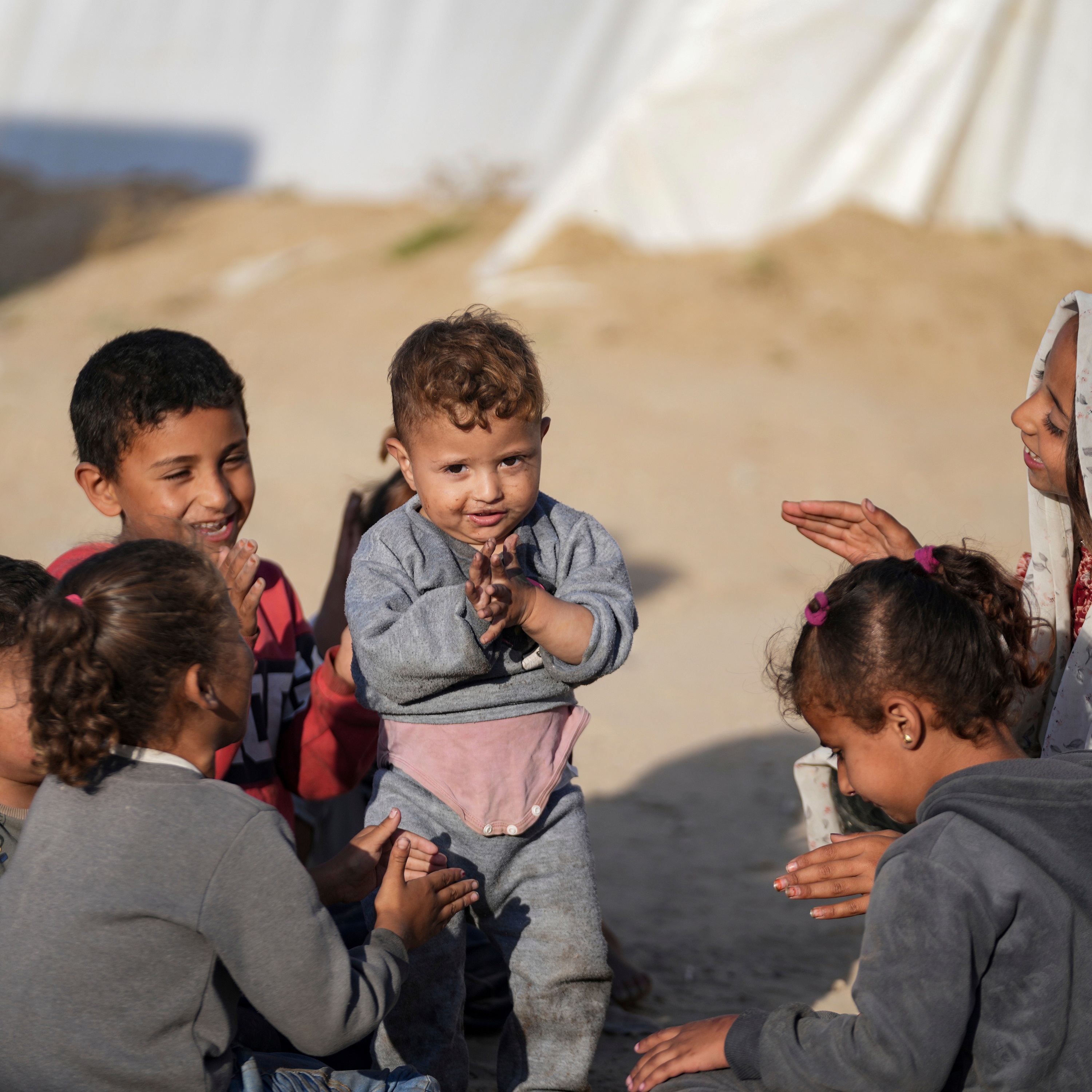
Front Burner
Portraits of childhood in Gaza
00:31:03
<p>Today, if all goes well, a ceasefire will begin in Gaza.</p><p><br></p><p>In phase one, Hamas has pledged to return all of the hostages, living and dead. For its part Israel will release hundreds of Palestinian prisoners, while withdrawing troops to an agreed-upon line in Gaza and maintaining majority control of the territory.</p><p><br></p><p>Beyond that, the details of Trump’s promise of a “strong, durable, and everlasting peace” are fuzzy, but for hostage families and people in Gaza, it’s a reason to hope. </p><p><br></p><p>Producer Allie Jaynes brings us a documentary that gives an on-the-ground perspective of what these past two years have been like for Gazans — especially for children. We hear from a 12-year-old with a popular Instagram “cooking show,” a girl living in a crowded displacement camp, and a music teacher giving lessons to kids all over Gaza to help them “escape the weight of war through the freedom of music.”</p><p><br></p><p>We'd love to hear from you! C...
Loading summary
Transcript89 lines
- [00:01]
Host/Interviewer
What happens when an identity is stolen? And then what happens when there isn't anyone or any document to help you get it back? He's saying, I'm innocent. I am William Woods. One William woods ended up in prison. The other went on to live a normal life for decades. I'm Kathleen Goldhar. And this week on Crime the two lives of William Woods. Find us wherever you get your podcasts.
- [00:32]
Narrator/Reporter
This is a CBC podcast.
- [00:35]
Jamie (Host/Producer)
Hi everyone, it's Jamie. I just wanted to take a moment to shout out some of the people who have been writing into the show. Again, thanks to Maxine, Louise, Lois, Michael and others who would like to hear more Canadian stories on the POD and fewer stories on US Politics. We hear you. We really appreciate this feedback. You can reach the show anytime at FrontBurnerCBC CA to tell us about the kinds of stories you want to us to cover and make sure that you are following us on your podcasting app of choice. It is the best way to make sure that you catch every episode. Today, if all goes well, a ceasefire will begin in Gaza. In phase one, Hamas has pledged to return all of the hostages, living and dead Israel to withdraw its troops to an agreed upon line in Gaza while maintaining majority control of the territory and to release hundreds of Palestinian prisoners. Beyond that, the details of Trump's promise of a strong, durable and everlasting peace are fuzzy. But for hostage families and the children and families in Gaza, it's a reason to hope. Today we've got a documentary for you that gives an on the ground perspective of what these past two years have been like for Gazans, especially in part one, we'll hear from a little girl who created an Instagram cooking show to take her mind off the war and show the world Gazan cuisine. In part two, another girl who's living in a displacement camp. And part three, a teacher who has been giving music lessons to displaced kids all over Gaza, helping them to, in his words, escape the weight of war through the freedom of music.
- [02:25]
Narrator/Reporter
They teach us that the music is. It's the food of the soul. I'm trying my best to make it the food of the body.
- [02:44]
Jamie (Host/Producer)
This episode is about children and adults trying to find some kind of normalcy amid the most horrific conditions imaginable. But it's also about people in those conditions, using joy and beauty not just as a distraction, but as a means of mental survival. I'll let our producer, Allie Jaynes, take it from here.
- [03:11]
Host/Interviewer
Part 1 Renaud I had been wanting to talk to Renad Atala for about nine months When I finally got a hold of her big sister Norhaan in August and and managed to set up a call with the two of them, like, I'm meeting a celebrity. She has lots of followers. Yeah, she's got like 1.5 million. It's so funny the way that's me and Tamara Al Ghaddanfari, a colleague who translated for us.
- [03:34]
Inaya Fari Walid Abuakar
Oh, there we go.
- [03:35]
Host/Interviewer
Hi, can you guys hear us? Hello. Hello.
- [03:39]
Inaya Fari Walid Abuakar
Hi.
- [03:40]
Host/Interviewer
Can you hear us? Okay.
- [03:41]
Jamie (Host/Producer)
Yes, we can hear.
- [03:43]
Host/Interviewer
Renat is 12 years old and she has this very popular Instagram account, which is which she started in 2024. Most of the posts are a kind of cooking show where she's making traditional Palestinian dishes with the limited supplies available to her dishes like a Gazan style lentil soup or the crunchy, syrupy dessert kanaf or okra stew. What I find so gripping about her account, and I guess what all these other people do too, is that you're seeing a kid trying her hardest to just be a kid, laughing and smiling and doing something she finds fun amid bombings, blockade, terrible hunger.
- [04:47]
Renaud Atala
I love cooking and my dream was to become a chef and open a big restaurant where people can enjoy the food I prepare. But during the war, schools had been closed, so I started cooking as a way to distract myself and reduce the sadness and stress I felt.
- [05:02]
Host/Interviewer
Renaud's family is in Deir El Bala in central Gaza. They've been lucky in the sense that their home is still standing and that they're still in it. But Noorhan and Renat explained that the three bedroom house was now crowned with 23 people, extended family members who had had to flee there from other parts of Gaza before the war.
- [05:23]
Renaud Atala
When I looked outside my window, I could see palm trees everywhere. You could see big and nice houses almost everywhere. In Tear El Bala, it was very, very beautiful. Now those nice and big houses are bombed and there are tents instead.
- [05:38]
Host/Interviewer
The first video Renaud ever posted was one that Noorhan filmed in March 2024. It was an unboxing video, the kind you might see kids do on YouTube with toys or clothes, except that this box was filled with aid from the uae. You don't have to see the video or to speak Arabic to understand how joyful she is at the sight of these bags of sugar and cans of meat, even as you can hear the drones in the background. By that point, Norhan explained, the price of sugar in Gaza had shot up from about a dollar US per bag to 30. Now she said, it's over 100. Renaaz started posting cooking reels soon after that.
- [06:39]
Renaud Atala
I really love the food from Gaza and Palestine. I cook with love so the world can see our food.
- [06:47]
Host/Interviewer
One of her favorite things she's cooked in the videos is the iconic Palestinian dish Maqluba Lena.
- [06:56]
Renaud Atala
I feel maqluba represents our homeland. It has vegetables, meat, chicken, rice. It represents the Palestinian generosity, and whatever they add to it, it turns out to be delicious.
- [07:10]
Host/Interviewer
Renaud cooked hers without any meat because there wasn't any.
- [07:16]
Renaud Atala
This is the orphan, Maqluba. We call it the orphan because it doesn't have any chicken. Let's do it.
- [07:23]
Host/Interviewer
As time has gone on, as Israel has imposed either total or partial blockades, she's had to get more creative in her cooking, filling a canister with cotton balls, then soaking them in alcohol and lighting them on fire instead of using cooking fuel.
- [07:48]
Renaud Atala
Today I'm not going to make Gazan labneh. Today it's the famine type of labneh.
- [07:52]
Host/Interviewer
The thick white dib ladne is typically made from strained yogurt and salt Renata improvised using water, powdered milk, vegetable oil and salt. And then she got that signature thickness by adding citric acid. The videos aren't all about cooking, though, and she's not always laughing. There are posts about the bombs overhead, about her hunger, about her fears of being displaced when there's nowhere safe to go.
- [08:23]
Renaud Atala
At any second, a displacement could happen, or shelling. So that stops me from making videos.
- [08:30]
Host/Interviewer
Last August, she posted about the painful rash on her face and neck, an issue that had become increasingly common in children in Gaza by last summer, as soap and other hygiene products ran out of and malnutrition increased.
- [08:44]
Renaud Atala
It feels as though someone is putting fire onto you. It really does burn.
- [08:50]
Host/Interviewer
She also posted about her relatives stuck in the north in Jabalia during Israel's siege of northern Gaza last fall.
- [08:57]
Renaud Atala
Some people die from starvation, others from the massacres. Either way, you end up dead in this genocide.
- [09:04]
Host/Interviewer
When we spoke in August, she hadn't posted a cooking reel in close to three months. Her family was down to eating one meal a day, and they also couldn't afford to use up fuel to cook one dish for an Instagram reel. Besides, she said, given how many Gazan kids are in full famine, going days at a time without food, it just didn't feel right to post about cooking. You have often written on your Instagram page about trying to stay positive, and I'm wondering if that's something that, that you're still able to do right now and sort of how you try to get through your days. Mentally.
- [09:47]
Renaud Atala
Of course, hope never leaves Gaza. But of course there's sadness and despair. We are tired, we are exhausted. One can't even eat. But thank God we have hope. God willing, this war will end and we will return to our everyday lives, eating whatever we want and going to school.
- [10:12]
Host/Interviewer
Do you still dream of being a chef and opening a restaurant?
- [10:17]
Renaud Atala
It is impossible to kill this dream. I am waiting until I'm old enough to open a big restaurant and serve everyone so that they can try Palestinian food.
- [10:28]
Host/Interviewer
A week after our interview, Nurhan Renaud and her twin brother evacuated to the Netherlands, where Nurhan had gotten a scholarship. Renaud posted about it on Instagram. A few days later, posing in front of some graffiti that said Free Gaza, she explained that while they had been able to get out, they had had to leave the rest of the family, including her mother and four other brothers behind. We escaped hoping to find safety, school and food, she wrote. But still, I don't feel like I survived. There's no such thing as surviving alone. It's either all of us or none. Inaya, of course, as Renaud was saying, being able to get out at all is rare, as is staying in your home. This is Anaya Fari Walid Abuakar with her family friend who's translating for us. He's encouraging her to try to practice her English.
- [11:39]
Narrator/Reporter
Okay, excellent.
- [11:41]
Host/Interviewer
Hinaia is also 12, almost 13, she made sure to note, and she's currently living in Al Mawazi, an enormous tent city on a tiny strip of sand near the water in southern Gaza. In June, the UN said that 425,000 people were sheltering in Al Mawazi. That's close to 48,000 per square kilometer. That number is likely much higher now, as people fleeing the IDF's invasion of Gaza City in the north seek shelter there first.
- [12:08]
Renaud Atala
And the Israeli military has launched a.
- [12:10]
Host/Interviewer
Massive ground incursion into Gaza City. This after weeks of intense bombardments across the territory's largest urban center.
- [12:19]
Narrator/Reporter
Every day, building by building, Israel makes more of Gaza City uninhabitable.
- [12:24]
Host/Interviewer
They came to Al Mawasi thinking that they're going to be seen space, they're going to find water, hygiene, they're going to find everything the Israeli forces advertise to when they ask Palestinians to evacuate to Al Mawasi. But they came here to the unknown.
- [12:40]
Jamie (Host/Producer)
Not finding anything and not even finding any space.
- [12:47]
Host/Interviewer
Israel designated Al Mawazi a humanitarian zone, but the UN and other rights groups have documented hundreds of attacks on tents there by the Israeli military.
- [12:58]
Inaya Fari Walid Abuakar
Life here is hard. There is sand and a lot of insects, and it's burning hot. It's very different from our lives back home.
- [13:06]
Host/Interviewer
Inaya is originally from the nearby city of Khan Younis, in an area that she has fond memories of.
- [13:13]
Inaya Fari Walid Abuakar
It was such a beautiful neighborhood. The apartment buildings were all lit up at night, and there was a grassy area where we would play. I used to go out with my friends and we would jump rope together and have fun. My dream was to become a doctor.
- [13:32]
Host/Interviewer
They first had to leave Khan Younis in January 2024.
- [13:37]
Inaya Fari Walid Abuakar
We were sitting in our home and suddenly tanks started coming close to our area and missiles were firing. We were very scared and so we fled in the middle of the night from Khan Younis.
- [13:48]
Host/Interviewer
They went to Rafah, then a few months later to Almawazi, then back to Khan Younis, but not to their house, to a camp. This August, they left for Al Mawazi, again fleeing on foot, she says, amid IDF strikes and gunfire.
- [14:04]
Inaya Fari Walid Abuakar
It was a situation of extreme fear. We were crying and so scared they were shooting at us. We ran and ran until we reached the camp, and we arrived at around 3:30 in the morning.
- [14:15]
Host/Interviewer
This past spring, when they were still in the camp in Khan Younis, Naya's father was killed. He was at work at the time.
- [14:26]
Inaya Fari Walid Abuakar
He was near a tent that was bombed and the shrapnel killed him. The ambulance took him to the hospital where he needed a blood transfusion, but a piece of shrapnel had pierced his heart and it killed him. At first they didn't tell us he died. I found out he had been killed, or people talking about it on the street. Then we buried his body and said our goodbyes. He was a very kind and loving father. He used to take us out to play. He never yelled at us. He loved us so much and gave us everything we asked for. If I kept talking about him until tomorrow, I still wouldn't be able to say everything about how good and kind he was.
- [15:09]
Host/Interviewer
Inaya says she still dreams of being a doctor, but given that she hasn't been in school for two years, she doesn't know if she'll be able to get her grades back up enough to do it. I asked her how she tries to find the strength mentally now to get through all of this.
- [15:27]
Inaya Fari Walid Abuakar
The family itself makes us forget the conditions we're living in. In my family, we try to distract ourselves with cooking, visiting relatives or playing with friends. It's not that we forget the things that happened, because this is unforgettable but being with friends and family helps us to get through this time.
- [15:47]
Host/Interviewer
Okay, we're going to take a quick break and when we get back, the music teacher giving classes to kids from all over Gaza to distract them from the bombs and the hunger.
- [16:12]
Narrator/Reporter
Hi, I'm Mike Figgis. I wrote and directed movies like Leaving Las Vegas and Time Code, and recently I was on the set of Francis Ford Coppola's infamous passion project Megalopolis, making a Fly on the Wall documentary. In Unfiltered, the Mike Figures Podcast, I'll share stories of watching a mad genius at work get Unfiltered the Mike Figures Podcast Wherever you get podcasts.
- [16:42]
Host/Interviewer
Part 3 Ahmed hello everyone.
- [16:45]
Narrator/Reporter
How are you? I miss you a lot, really. Today there's a lot of drones. I'm gonna sing a song today.
- [17:02]
Host/Interviewer
The first video that I saw of the music teacher Ahmed Abu Amsha was this one outside a tent where he was sitting with some of his music students. He got them to harmonize with the Israeli drones in the background. When I reached out about an interview in late August, he got back right away to say yes. But when we Briefly spoke over WhatsApp video to set something up, it was clear that wasn't going to be easy. He was in the midst of trying to find somewhere to relocate yet again with his wife and five kids. They were in Gaza City, where the IDF had begun a massive assault, the initial stages of its plan to take over and occupy the city.
- [17:52]
Narrator/Reporter
Israel has launched its offensive to take control of Gaza City despite international condemnation. The IDF says the city is a Hamas stronghold and says it's ending pauses that allowed humanitarian aid into Gaza's biggest population center.
- [18:08]
Host/Interviewer
Ahmed was clearly exhausted on our call and scared, and you could hear gunfire in the background. I'm looking for somewhere to go, he told me, but there is nowhere safe to go. So it wasn't until about 10 days later, when he had finally found a camp to relocate to in central Gaza, that we ended up doing an interview through a series of lengthy voice notes.
- [18:31]
Narrator/Reporter
Before this war, I'm always busy, I'm always working. I always have a lot of job. Friday and Saturday I just sit at home and take my family to wonderful places and have vacation there. Yeah, we was living a really good life.
- [18:57]
Host/Interviewer
Ahmed and his family used to live in Beit Hanun in the very northern tip of Gaza. He was working as a music teacher at the storied Edward Said National Conservatory of Music, as well as at the American International School in Gaza. He was also working as a composer, a sound engineer, and A player in a Palestinian TV band.
- [19:34]
Narrator/Reporter
I have a lot of things to do before this war.
- [19:39]
Host/Interviewer
Being from the far north, Ahmed and his relatives, including his parents and brothers as well as his wife and kids, were some of the first Gazans to get evacuation orders from the Israeli military in the hours following the Hamas led attacks Inside Israel. On October 7th, at 3 o' clock.
- [19:54]
Narrator/Reporter
In the morning we have a call that the Israeli sent that's meeting leave immediately at three o' clock you have only five minutes. We leave without shoes, running through the dark, darkness and after five minutes they blow all the block and we run away to Jabalia area. Jabalia.
- [20:24]
Host/Interviewer
In Jabalia they sought refuge in a school.
- [20:27]
Narrator/Reporter
And the next day, in the middle of the day, they strike the school and we ran away from there.
- [20:34]
Host/Interviewer
They tried to seek shelter in various spots in Gaza City, but it was being heavily bombed. Around that same time, the Edward Said Conservatory in Gaza City was also struck and badly damaged. Ahmed and his family fled south to Khan Younis, then later from Khan Yunus down to Rafah. By this point he was heartbroken and in pure survival mode. But it was in that camp in Rafah, about five or six months into the war that he first played music again.
- [21:04]
Narrator/Reporter
My friend bring a guitar and I hold it. Since the beginning of the war I'm not thinking about music, I'm just was thinking about how to protect my family and how to run away from, from the hell. So I hold the guitar and play and suddenly all the kids gathering around me and they are singing with me. So I wake up suddenly, oh my God, I. I forget that I'm.
- [21:30]
Jamie (Host/Producer)
No.
- [21:36]
Narrator/Reporter
The second day, the kids coming in the morning ask me for playing and singing together and I bring my guitar and sing with them. The third day, the fourth day, then I decided to make activity for the kids in the shelter and it was very nice.
- [21:58]
Host/Interviewer
Soon he and his family had to flee again, this time for Al Mawazi, the same massive camp where 12 year old Anaya is sheltering now. Ahmed started teaching kids there too. And from there he and some of the kids formed Gaza Bird Singing. They're a band, but also a project where he and his colleagues from Edward Said are giving lessons to children from the displacement camps.
- [22:20]
Narrator/Reporter
We work with a lot of kids, you know, we have 200 kids, girls and boys teaching them music. The families comes to my tent, they told me our kids is better. They, they forget the war, they are singing now. They have something to do and interested in music. I'm trying my best to use Music therapy to choose the, the warmth notes. And I changed my guitar tuning to 432. It's an old, an old tuning of the music instruments. It's give you some warmth and make, make you comfort. A lot of kids come to the music activity and they are not communicating a lot. They have a psychological problems like trauma. Their neighbors are dead in front their eyes. The strikes was near. Some kids are, they're flying in the air from the explosions.
- [23:46]
Renaud Atala
And.
- [23:48]
Narrator/Reporter
I know some kids, they lose their hands and, and, and you know, I'm trying my best, you know, when I see the smile upon the faces of the kids, like I have the world, that's make me strong, that's make me continuing my work. A girl called Naama, she has some piece of metal from the explosion inside her hand and she's still coming. They believe what they are doing. No one can stop them.
- [24:42]
Host/Interviewer
In January, after the ceasefire between Israel and Hamas, Ahmed and his family went back home to Beit Hanun. The two houses belonging to his extended family as well as his home recording studio had been badly damaged by bombardments. But he found one good room left in one of the houses.
- [25:00]
Narrator/Reporter
I put my family in the room and tried to clean the place for the activity. And the kids coming from Betlahia, Javelia, the villages beside Bitanon, we spent there two months. I think after that they ask us to leave Bit Hanun because the ceasefire is destroying and we go back to the middle of Gaza City.
- [25:33]
Host/Interviewer
That's where he was for six months. Continuing on with Gaza bird singing, teaching kids outside his family's tents.
- [26:13]
Narrator/Reporter
Good morning. Good morning my friends. You know, I just recorded this video to tell you we are okay, everything is okay. Last night was a lot of bumping and a lot of drones.
- [26:26]
Host/Interviewer
So often the sound of drones is too loud to play over.
- [26:31]
Narrator/Reporter
Someday when we have activities, it was very near and it has annoying sound and the kids can't play and you can feel they are exhausted from the sound and they stopped music. I told them, don't stop play, let's change it to something beautiful. They told me how it's impossible. I told them let it like a background of music holding one note and we gotta sing together. Shane so each time the drone coming, they are singing and smiling. So we change the bad sound, the war sound to something beautiful like music. And each time in the streets, in the tents, when it's coming, all the kids singing.
- [27:55]
Host/Interviewer
In March and April of this year, Israel imposed a total siege on Gaza. With no food coming in since then, it has led a trickle of aid in through the borders as well as airdrops, but experts say it's nowhere near enough to fend off mass starvation. The least aid has reached the north, including Gaza City. In late August, the world's leading authority on hunger, the Integrated Food Security Phase classification, confirmed that Gaza City was gripped by catastrophic famine. It's only the fourth time the IPC has declared a famine since its founding in 2004. The IPC noted as this famine is entirely man made. It can be halted and reversed.
- [28:38]
Narrator/Reporter
Sometimes you can feel the hunger inside their eyes. I don't know what to do. We they teach us that the music is it's the food of the soul. I'm trying my best to make it the food of the body. And they coming are starving and tired and after five minutes of singing they forget this feeling and you can see their eyes are glowing like they are heavy. They have a smile. You can feel the positive energy in the place and all the families around the music activity. You know, it's like tents between each other. They are singing with us and you know, when we are gathering and singing, we are healing themselves and trying to escape from this madness, from this war.
- [30:02]
Host/Interviewer
The camp where his family has yet again set up is on another beach in central Gaza. A few days after arriving, Ahmed posted a short video of himself and a group of boys smiling and laughing as they pulled a white parachute in the strong wind by the water.
- [30:18]
Narrator/Reporter
Hello everyone. Today we have a photo shoot. I'm going to put it above my.
- [30:23]
Host/Interviewer
Tents and for the in the caption, he explained that the parachute was going to be set up to shade the kids from the sun during music lessons. But the first they had taken it to the beach to play with, was pulling us and the children's laughter filled the air, he wrote. He continued, even though preparing the new space took so much time and effort, we do our best to create a place of joy and hope for the children.
- [30:48]
Narrator/Reporter
Foreign.
- [30:55]
Jamie (Host/Producer)
That is all for today. Special thanks to our translator, CBC News Network associate producer Tamara Al Ghadanfari. And thank you to our two voice actors, Riley Berger, who voiced Renaud, and Isla Blaymire, who voiced Anaya. Today's episode was produced by the wonderful Allie Janes, who is now on maternity leave. We will miss you, Ali. Good luck with everything. Front Burner was also produced this week by Joyta Shankupta, Matthew Amha, Matt Muse, Laura Donnelly, Simi Bassey, Sam McNulty and MacKenzie Cameron. Our YouTube producer is John Lee. Music is by Joseph Shabeson. Our senior producer is Elaine Chow. Our executive producer is Nick McCabe. Lokos, thanks so much for listening to Front Burner, and we'll talk to you next week.
- [31:59]
Narrator/Reporter
For more CBC Podcasts, go to CBC CA Podcasts.