← Front Burner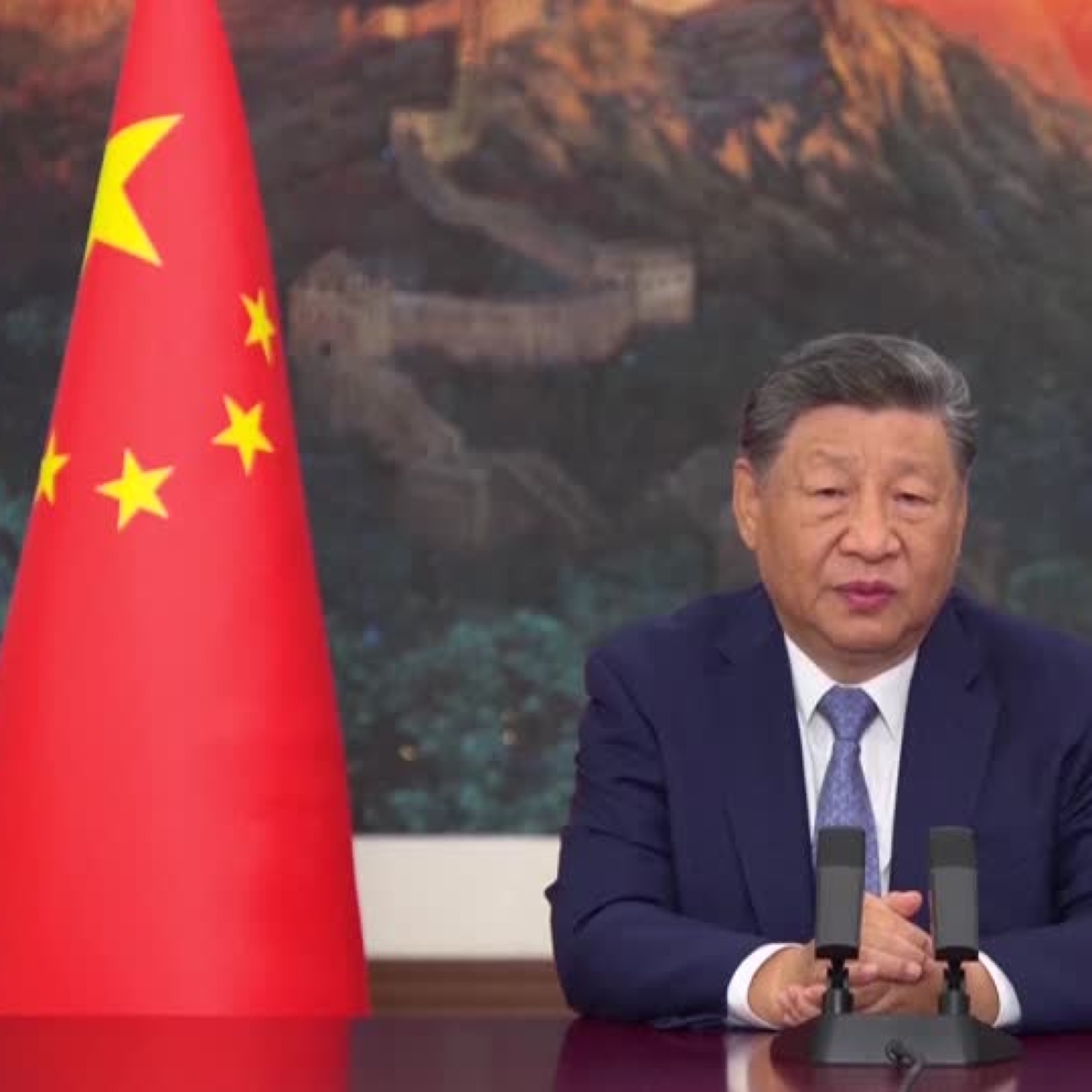
Front Burner
The secret to China’s dominance
00:28:26
<p>Dan Wang is a tech analyst and a research fellow at Stanford University’s Hoover History Lab. He’s one of the leading China analysts in the world right now and his new book is called “Breakneck: China’s Quest to Engineer the Future”.</p><p><br></p><p>Today on the show he explains his novel way of understanding the clash between China and the United States: China owns the future because it is an “engineering state” whereas the U.S. is a “lawyerly society” that often gets in its own way.</p><p><br></p><p>For transcripts of Front Burner, please visit: <a href="https://www.cbc.ca/radio/frontburner/transcripts" rel="noopener noreferrer" target="_blank">https://www.cbc.ca/radio/frontburner/transcripts</a></p>
Loading summary
Transcript58 lines
- [00:00]
Darina
Hi, I'm Darina, co founder of Quo. You might know us as openphone. My dad is a business owner, and growing up, he always kept his ringtone super loud so he'd never miss a customer call. That stuck with me. When we started Quo, our mission was to help businesses not just stay in touch, but make every customer feel valued, no matter when they might call. Quo gives your team business phone numbers to call and text on your phone or computer. Your calls, messages and contacts live in one workspace so your team can stay fully aligned and reply faster. And with our AI agent answering 24. Seven, you'll really never miss a customer. Over 90,000 businesses use quo. Get 20% off@quo.com tech, that's Q U O.com tech and we can port your existing numbers over for free. Quo. No missed calls, no missed customers.
- [00:57]
Dan Wang
This is a CBC podcast.
- [01:01]
Matthew Amah
Hi, I'm Matthew Amah, filling in for Jamie. There's been much talk about the US Finding itself in a new cold war, this time in direct opposition with China. Trump's global trade war, he says, centers on a bid to return manufacturing jobs back to the US after decades of them transferring overseas. But in that time, China's grown to hold over 27% of the world's manufacturing output, making the country a pretty indispensable part of the global supply chain. So is this much of a race at all? Dan Wang is a tech analyst and research fellow at at Stanford University's Hoover History Lab. He's one of the leading China analysts in the world right now. In his book, China's Quest to Engineer the Future, Dan arrives at the conclusion that China's claim to the 21st century is largely due to its identity as what he calls an engineering state. Whereas the US is a lawyerly society, often getting in its own way. We're going to get into exactly what that means, what the implications are, and whether there's any hope for the US to catch up. Hi, Dan. Thanks so much for coming on the show.
- [02:28]
Dan Wang
Thank you very much for having me.
- [02:29]
Matthew Amah
You lived in China for six years, starting in 2017, and you've written about your observations from that time, eventually kind of culminating in this book where you describe China as an engineering state. You lived in Hong Kong, Beijing and Shanghai and kind of traveled throughout the country, kind of, especially for someone who's never been there before. On the micro level, can you describe to me aspects of daily life that best illustrate what it's like to live in an engineering state?
- [02:57]
Dan Wang
I think the first thing to say about living in China is just how much fun one could have. China is just more than anything else, a densely textured place with a lot of wonderful cuisine, A lot of fun parts of daily life, and most especially amazing sorts of infrastructure. So the city that I identify the most with across my six years of living in China is the city of Shanghai, which I think is one of the most beautiful cities in the world. One is never very far from a subway station. One could go through these leafy boulevards to sit in cafes. And there's also just this incredible high speed rail system. And part of what I observed with the engineering State was in 2021, in the middle of the COVID pandemic, I took the high speed rail from Shanghai, China's richest city of about 25 million people. I took the high speed rail deep into China's interior, in the southwestern periphery, into a province called Guizhou, which is China's fourth poorest province. It is very, very mountainous, previously inaccessible, far away from the coasts. And throughout a five day bicycle ride I took now throughout the mountains, I saw that Guizhou has much better levels of infrastructure that one might find in New York state or California. Guizhou has about 15 airports. It has about 45 of the world's tallest bridges, not China's tallest bridges, but the world's tallest bridges. It has a high speed rail network. And it is just really remarkable the extent to which China is really intent on building great infrastructure for its people.
- [04:41]
Matthew Amah
I mean, given that there was that level of infrastructure there, I mean, what has that done, would you say, for the quality of life of folks living in places like Guizhou?
- [04:51]
Dan Wang
I think that people are broadly really happy to have new sources of infrastructure. When they take a look at some of these super tall bridges, they feel proud, and rightfully so, that their travel time to get from their village into a city has been cut from so many hours, perhaps just a fraction of that time. They're really proud to be able to take the high speed rail from the capital city into much richer cities like Shanghai as well as in Beijing. And for the most part, they feel that these big monumental projects are giving their province a sense of prestige. Now I think what some observers would also realize is that these super tall bridges are also saddling the province with enormous quantities of debt. Many parts of Guizhou's government is now fully focused on servicing its debt. The displacement has been an issue, especially around bigger projects like hydraulic dams, which are not so much present in Guizhou. But there is also an element of environmental waste in which the government has been pouring a lot of concrete, which is extremely carbon intensive, into the ground. But overall, I think that for most residents in China, whether one is a resident resident of a big city like Shanghai or the provinces like Weizhou, that sense of physical dynamism has pervaded throughout a person's life. That they see that their cities get better, that their transit systems get better. That gives them a measure of not only economic stimulus through the construction of these projects, but it also makes them have a sense of optimism for the future because they expect that their life will get better because it has over the previous years.
- [06:54]
Matthew Amah
As I understand it, you kind of arrived to this engineering state label when you found that our more traditional political labels of, you know, kind of socialist or communist versus capitalist don't necessarily describe the true nature of China's political reality, that it's not actually leftist. And can you explore that in further detail for me and why you think that this engineering state moniker is a more useful, maybe more complicated description? Yeah.
- [07:22]
Dan Wang
So throughout my six years of living in China, from 2017 to 2023, I experienced President Trump's first trade war.
- [07:30]
Darina
Game on here. A trade war between the United States and China is here. It's real. At the stroke of midnight, the US hit China with tariffs on $34 billion worth of goods. China immediately responded with its revenge, tariffs of equal value, accusing the US of launching the largest trade war in economic history and calling America trade bullies.
- [07:51]
Dan Wang
I experienced President Xi's darkening repression throughout the country. I saw how a lot of Chinese companies became bigger technological superstars. And the centerpiece of my time was the zero Covid program, which I lived through. Zero Covid itself could be understood as a bit of an engineering exercise in which the target is right there in the name. There's no ambiguity about what zero Covid could possibly mean. If we chose to lay down now, our efforts would have come to nothing. We unswervingly insist on zero Covid.
- [08:25]
Darina
The policy aims to stop reproduction of the virus as soon as it's detected, rather than just controlling it. Mass test and trace, strict isolation and extended lockdowns are used to get an area back to zero new infections as soon as possible.
- [08:40]
Dan Wang
And as I observed through all of these different things that I thought that socialist, autocratic, capitalist, neoliberal, these all feel like 19th century political science terms that are no longer really fit for purpose for describing the world as we ought to understand it today. It's China. Fundamentally leftist, right wing. Well, a little bit of both, all at the same time. And the way that I Try to describe China as an engineering state is to point out that first and foremost, the country is very, very interested in building big infrastructure, building monumental pieces of infrastructure, in part to inspire pride. As I, as I mentioned, Xi Jinping is also very interested in engineering the economy. Another part of what I lived through was this crackdown that Xi and the rest of the party state initiated against some of China's most dynamic companies working in consumer Internet.
- [09:34]
Darina
China is clamping down on its Internet sector. Not even the likes of e commerce giant Alibaba are still safe. With it receiving a record breaking fine in April, Beijing's competition regulator is dishing out fines and investigating some of the biggest names in the platform economy. After issuing anti monopoly guidelines that target.
- [09:54]
Dan Wang
Internet platforms at a stroke, President Xi more or less stopped the operations of a lot of online education companies, stopped a lot of minors from being able to play video games three hours a week.
- [10:08]
Matthew Amah
That's the absolute maximum amount of time.
- [10:11]
Darina
Under 18 teens can spend on video.
- [10:13]
Matthew Amah
Games in China after the country introduced.
- [10:16]
Darina
A drastic new limit to combat gaming addiction.
- [10:20]
Dan Wang
And there was an element of trying to push China's brightest young people, brightest university graduates, to not work on financial projects or consumer Internet projects, but to work on projects more of more importance to the state, something like semiconductors or aviation or chemicals. And I think the centerpiece of my book is also talking about how the engineering state is also made up of social engineers. I spend a lot of time thinking about zero Covid. I spend a lot of time thinking about the one child policy in which the country has treated the population as if it were just another building material to be torn down and remolded as it wishes.
- [11:02]
Matthew Amah
I mean, to kind of better understand how China came to be this nation of engineers, a technocratic society that makes stuff for the world. I've seen Deng Xiaoping being highly credited as the leader, one of the leaders that helped to send the country in this trajectory. Can you talk to me about what he did?
- [11:21]
Dan Wang
One of the things that Deng Xiaoping did was when he took power after the misrule of the Mao Zedong years. When Deng Xiaoping became top leader in the late 1970s, he surveyed the wreckage of the country and he took a look at Mao Zedong, who was a poet, who was a romantic, who was a mass murdering warlord, and decided that whatever Mao Zedong did, Deng Xiaoping was going to do the opposite. What was the opposite of the poets? Well, it was really to promote a lot of engineers into the senior leaders, into the senior leadership of the Communist Party. And so what we saw throughout the 1980s and the 1990s was that a lot of engineers ended up inside the Central Committee, inside the Politburo, such that by the year 2002, this was a bit after Deng Xiaoping passed away. All nine members of the Standing Committee of the Politburo, which is the highest ruling echelon of the Communist Party, all of them had engineering degrees. The top leader then, Hu Jintao, was trained as a hydraulic engineer. His deputy, the premier, was trained as a geologist. And I think this is one of the reasons that the modern engineering state took shape, because the Communist Party really wanted to demonstrate that it wasn't about ideological class struggle all the time. What it wanted to demonstrate was that it was able to build enormous projects like the Three Gorges Dam or very tall bridges or in more recent times, high speed rail, because it is committed to monumentalism and it is committed to economic development. But I would also say that China's engineering state also has a few older roots. If we take a look at some elements of China's imperial imperial history, the emperors were famous for building the Great Wall as well as the Grand Canal, a fortification system in the first case and then a water management system in the second case. That China is famous for administering an impartial exam towards its entire bureaucracy. So that the only way to get into court was to pass this pretty rigorous exam. And so these are some of the ways that I want to be playful with this idea. I don't want to take it too seriously. I think that it is not much more and not much less useful than using term like socialist or autocratic to describe China. But to be a little bit inventive with this framework to think about how China has been an engineering state for a very long time.
- [14:02]
Darina
Only.
- [14:03]
Matthew Amah
Boost Mobile.
- [14:04]
Darina
Boost Mobile will give you a free year of service.
- [14:06]
Dan Wang
Free year when you buy a new 5G phone. New 5G phone, enough. But I'm your hype man. When you purchase an eligible device, you get $25 off every month for 12 months with credits totaling one year of free service. Taxes extra for the device and service plan online only.
- [14:18]
Darina
What kind of person takes on the law? Can they ever really know what they're getting into?
- [14:22]
Matthew Amah
A really tough looking guy came up to us and said, are you part of this gay case? My family started getting death threats. I wasn't able to go outside alone anymore.
- [14:33]
Darina
I'm Phelan Johnson, host of CU in Court, a new podcast about the cases that changed Canada and the ordinary people who made history this is David and.
- [14:42]
Dan Wang
Goliath we have here.
- [14:43]
Darina
Find and follow. See you in court. Wherever you get your podcasts.
- [14:49]
Matthew Amah
You often hear criticism of the way that China builds and manufactures, whether for the way the government subsidizes these industries or for how much they can overproduce or run into issues having to do with things like overcapacity. So what are some of the pitfalls, from your view of the way that they tend to do things?
- [15:07]
Dan Wang
I think the pitfalls include building bridges to nowhere. Sometimes these nowheres become to somewheres after the bridge is constructed, but sometimes these nowheres stay nowheres. And what you have is a fantastically expensive bridge being built in pretty remote areas and not very used by many people, such that these bridges aren't really able to pay back their bonds. And so that has created a real financial drag with local governments, especially the Guizhou government. And a lot of big projects like the Three Gorges Dam project has also displaced about a million people from their homes when their villages had become flooded after the Three Gorges Dam had been built and had been in place. But I think what I would emphasize is that when it comes to physical dynamism, the benefits of the engineering state, I would say mostly outweigh the costs. I think that people really like having new and better subways, new and better highways, new and better bridges. It really makes people more optimistic about the future. And I would say that the elements of social engineering are mostly cost and very little benefit, that people have become really upset at projects like the one child policy as well as zero Covid as well as repressive elements against the ethno religious minorities in Xinjiang as well as in Tibetan. That. And so I think that for the most hand, physical engineering is mostly pretty good and social engineering mostly pretty bad.
- [16:42]
Matthew Amah
This may be a question kind of coming from a place of ignorance, but I'm curious to see what you might say of it. I mean, are there means for, you know, I mean, citizens of China to be able to petition their government on this front or to be able to make some of these criticisms or critiques known? I mean, how. How are you as somebody that, I mean, I mean, obviously live there, but has these connections to the West? How are you able to get a pulse on how folks are feeling in a climate maybe of repression or even silence in some sense?
- [17:10]
Dan Wang
I think that it is the case that Chinese do have some degree of a petition system. There's in fact a formalized petition system in which people line up, submit petitions and hope that their grievances could be redressed. And there is to some extent a protest culture in China. Every so often you would see these videos online of pensioners complaining that their pensions have been cut cut, or residents in some of the wealthier cities complaining that there's going to be a trash incinerator right next to their homes. And then they go out on the streets and they protest. And most famously, there were plenty of protests over zero Covid in the year 2022 when Beijing imposed vast lockdowns throughout the country.
- [17:55]
Matthew Amah
Protesters in China's largest city crying, down with the Chinese Communist Party and down with Xi Jinping.
- [18:04]
Dan Wang
We need to be brave, this man.
- [18:05]
Matthew Amah
Says, am I a criminal for holding.
- [18:07]
Dan Wang
A flower dragged away by police, but unclear if arrests alone can stop simmering.
- [18:13]
Matthew Amah
Anger from nearly three years of harsh.
- [18:15]
Dan Wang
COVID lockdowns boiling into something bigger. So I think in the first, at a first approximation, there is some degree of protest petition culture that is alive in China, but I think it is also a fairly limited sort of protest and petition system because there are plenty of cases in which the wishes of the people are not redressed, that plenty of people get arrested for their protests and are told, stop making such a fuss, you are embarrassing everyone, you need to go home now and stop it with your grievances. And I think that in this sort of authoritarian system, in this sort of an engineering state, there is only so much protest and dissent that the engineers are able to tolerate. They're very thin skinned type of people and they do not like it if they are embarrassed over long.
- [19:21]
Matthew Amah
So let's now pivot to the US for a little bit. You have referred to the United States, as we've talked about, as a so called lawyerly society in contrast to China's engineering state. If an engineering state builds things, what does a lawyerly society do?
- [19:36]
Dan Wang
The lawyers obstruct things, for better or for worse. So after I left China, I moved to the United States to be a fellow at the Yale Law School's Paltai China center, very substantially wrote this book. And so I moved away from the engineering state after living through zero Covid, which again I would sit to be an engineering project, and moved into one of the high temples of the lawyerly society in the United States. If we take a look at the United States, you'll find that plenty of US Presidents have gone to law school. If you read the Declaration of Independence, it really feels like the start of a legal brief. And in the modern era, the Democratic Party is especially lawyerly. And so I think there is this really striking dominance of lawyers in the American political elite, such that, as I say in my book, the US Government is a government made up of the lawyers, by the lawyers and for the lawyers. And the issue with lawyers is that they're able to block everything good and bad. So you don't have stupid ideas like the one child policy. We also don't really have functional infrastructure almost anywhere in the United States. And so that is kind of the great contrast they set up between these two great superpowers.
- [20:47]
Matthew Amah
Can you maybe give me an example of how being a lawyerly society kind of, you know, this tradition of obstruction has maybe hindered or limited America's plans for the future? I mean, or like even maybe like specific state project, maybe?
- [21:01]
Dan Wang
Sure. I love trains, and trains love me back. But not always. American trains have been very good. I'm right now a fellow at the Hoover Institution at Stanford University. And in 2008, the voters in California approved a referendum to build a big train project to connect San Francisco with Los Angeles. And it has now been about 17 years after the start of the referendum. How many people have actually taken any California high speed rail? The number is zero, because the first segment is supposed to start operating between 2030 and 2033.
- [21:38]
Darina
It was supposed to be finished in 2020, but five years after the deadline, it's still under construction with an estimated price tag of more than $90 billion in response.
- [21:47]
Dan Wang
And so this is a very expensive project that has been built at glacial speed, in part because lawyers have kept getting in the way of trying to stop the development of this project. One last example I'll give you is that I substantially wrote this book when I was a fellow at the Yale Law School. And sometimes I would take the train from New Haven, Connecticut, where Yale is based, down to New York City, and the train is fine. It takes about two hours to get from New Haven to New York. Pretty reliable. And I was radicalized when I saw a timetable from 1914 in which the trains used to be slightly faster to get from New York to New Haven. And it's not quite an apples to apples comparison because the trains now make more stops. But at a first approximation, Americans are not moving faster than they were 100 years ago. And this is again, I think, a failure of the Loyalist society, that there were a lot of homeowners around in Connecticut who put up their hands and said, we do not want a rail line in our backyard. They made the tracks longer and more curvy than they should have been. And this is a country that is not able to Build stuff.
- [23:07]
Matthew Amah
Since the start of Donald Trump's second term, one of his kind of stated core missions has been to compete with China in a serious way and bring manufacturing job jobs back to the United States. Before we get into some of how he's been aiming to do that, can you kind of briefly remind us how the manufacturing sector in the US Saw this decline in the first place and kind of how it was often working to the benefit of China?
- [23:31]
Dan Wang
The US Manufacturing sector has not been in good health. The US has lost quite a lot of over a million manufacturing jobs since 2008. A lot of that has not recovered. Output has been a little bit steady. But if you take a look at some of America's apex manufacturers, companies like Boeing, the planemaker, intel, the chip maker, Detroit automotive makers, as well as Tesla, most of them have been dealing with this unending series of tale of woe over the last few years. And in the case of Detroit over the last few decades. And I was really struck that in the early days of the pandemic, a lot of manufacturers in the United States were unable to retool their production lines in order to make essential medical equipment, things like cotton masks as well as cotton swabs. And I think that there is something quite fundamentally rigid and unhealthy about the US Manufacturing sector, in part because a lot of these manufacturing jobs had been moving to China over much of the last 30 years.
- [24:38]
Matthew Amah
Trump has kind of been aiming to correct this, in part with his trade war. The US has imposed 30% tariffs on China, and that's led to a pretty steep decline in Chinese exports to the US But China has managed to weather the storm so far by keeping up their exports to other countries. How effective do you think this will be for the US in their goal to have manufacturing jobs flow back into the country?
- [25:01]
Dan Wang
I would say almost completely ineffective. If we take a look simply at the number of manufacturing jobs since Liberation Day In April, the US has lost about 40,000 manufacturing jobs over the last five months. US manufacturing production has been contracting over the last six months. And I am highly skeptical of any agenda to make the US More of a scientific or technological power by cutting funding to the National Science foundation or the National Institutes of Health. I think it does not encourage a lot of appetite for foreign investment in the United States when Trump's immigration enforcers decide to raid a South Korean factory in the state of Georgia and deport about 300 South Korean engineers in chains. And so I think there is very little of Trump's agenda that I think is going to herald a great manufacturing renaissance. Perhaps one could be positive about some aspects of his, his energy agenda. Perhaps one could be positive about aspects of his regulatory agenda. But where it matters, in terms of immigration, in terms of workers, in terms of new forms of scientific development, all of the news has been, for the most part, I would say, unrelentingly negative.
- [26:26]
Matthew Amah
How do kind of smaller nations, especially, you know, American allies like Canada, get caught up in the middle of this lawyer versus engineer binary, do you think? And like, does this binary hold if we're talking about the west writ large? Like, like, is Canada also a kind of lawyerly society? Is England a lawyerly society? Is the same true of Germany and France and kind of countries like it? Or is this an observation that's kind of more unique to the United States?
- [26:50]
Dan Wang
Well, I would first begin by asking, is Canada even an American ally anymore? Now, Matthew, I grew up in Ottawa. I am Canadian. And I have distinctly felt that there is, you know, strange, it is very, very strange, strange that Donald Trump destabilized the Canadian relationship almost on a whim by making so many hostile annexation threats against Canada. My view is that Canada, by virtue of being a more reasonably sized country, also has slightly more reasonable elites. There's a term I like from a political scientist named Edvard Luttwak, who came up with this term great power autism, in which it said that a lot of superpowers tend to have really narrow focuses and tend to be really narrow, thoroughly minded. And I think it is the prerogative of the superpowers really to specialize, really to specialize in engineering and really to specialize in the lawyers. And other more reasonably sized countries like Canada, like the U.K. like the Netherlands, they don't tend to specialize so much. Now, what is a little bit strange to me is that Canada actually does seem to have a lot of the afflictions of the United States States without having so many lawyers in Parliament. But maybe there is also something to do with the common law system, which is an inheritance from the United Kingdom, in which there's a lot of people that are simply able to put up their hands, get a judge to sign onto their argument and block a lot of development. So I certainly think that Canada has not built enough housing that is abundantly clear. I think that Canada in particular ought to take a leave from both the Americans and the Chinese in terms of building bigger companies and better brands. I think that this has been a big Canadian weakness in not building better corporations that are able to compete on the global stage and I think that the Chinese have proved that they have been able to maintain a vast and robust manufacturing base. And this is something that Canada, I think, should also be a little bit better at. I was just taking a look at some data that showed that Canadian businesses have utterly collapsed in their business investment in industrial machinery. And so I think that there is an element of Canada which I find very cozy and tidy, but there is also an element of Canada that I wish could be much more ambitious than it presently is because a lot of ambitious Canadians do tend to move abroad. And I really wish that ambitious Canadians could actually find really excellent job opportunities at home and really make Canada into a. A bit more powerful of a country, especially over a more domineering neighbor right now.
- [29:37]
Matthew Amah
Really interesting stuff. Dan, thanks so much for coming on the show.
- [29:40]
Dan Wang
Thank you very much, Matthew.
- [29:49]
Matthew Amah
All right, that's all for today. I'm Matthew Amha. Thanks so much for listening.
- [30:05]
Dan Wang
For more CBC Podcasts, go to CBC CA Podcasts.