← Front Burner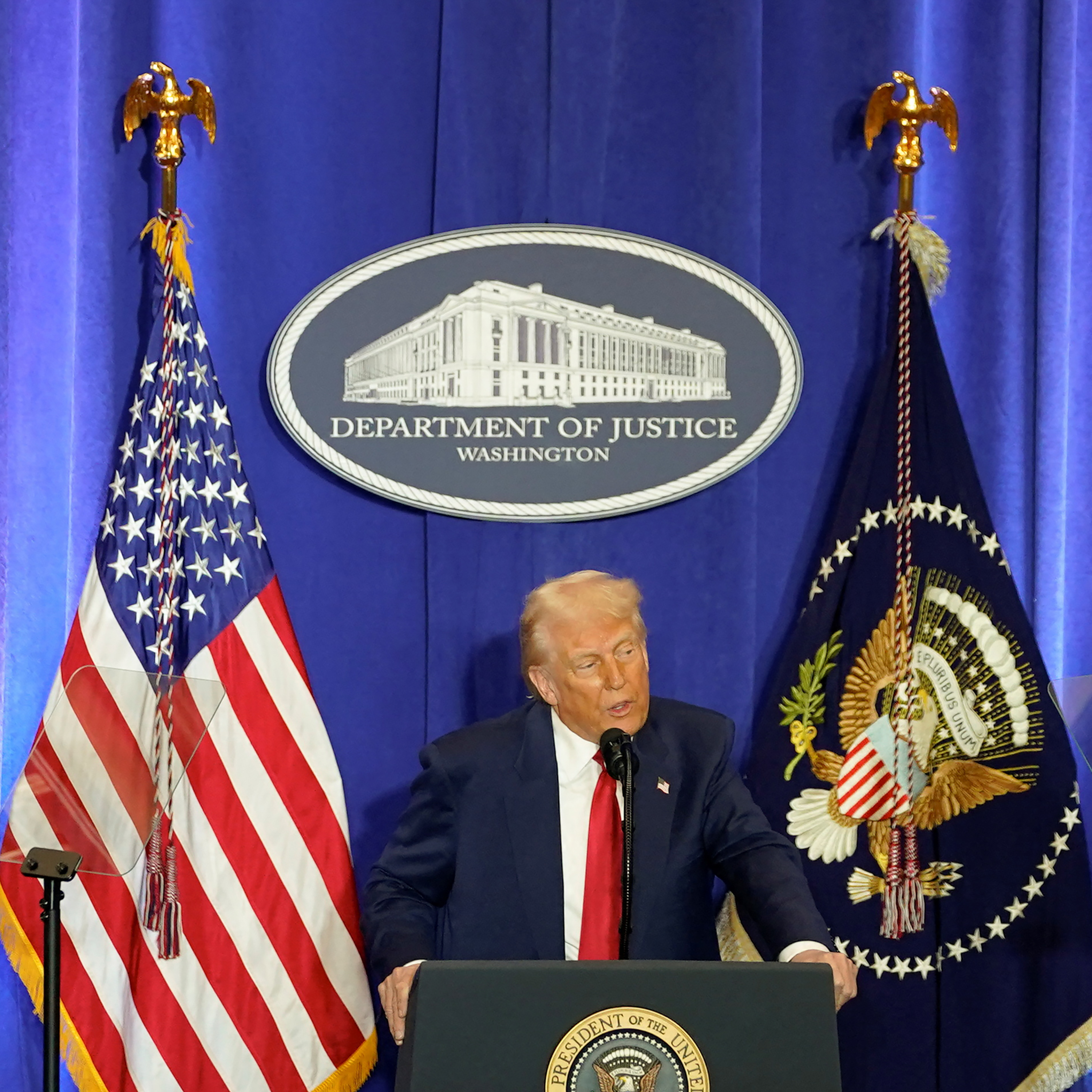
Front Burner
Trump's campaign of legal revenge
00:26:33
<p>Former FBI James Comey. Former national security advisor John Bolton. New York attorney general Letitia James. What do they have in common? All are now facing legal action from the U.S. government.</p><p><br></p><p>Benjamin Wittes, editor-in-chief of the U.S. nonprofit publication Lawfare, breaks down the Trump White House's campaign of legal revenge against the president's rivals and critics, and where it could be headed next.</p><p><br></p><p>We'd love to hear from you! Complete our <a href="https://insightscanada.qualtrics.com/jfe/form/SV_bfIcbmcQYPwjUrk?Podcast=Front%20Burner&Prize=Yes" rel="noopener noreferrer" target="_blank">listener survey here.</a></p>
Loading summary
Transcript72 lines
- [00:00]
CBC Announcer
Today we'll attempt a feat once thought impossible, overcoming high interest credit card debt. It requires merely one thing, a SOFI personal loan. With it, you could save big on interest charges by consolidating into one low fixed rate monthly payment. Defy high interest debt with a SOFI personal loan. Visit sofi.com stunt to learn more. Loans originated by SoFi Bank NA member FDIC don terms and conditions apply. NMLS 696891 this is a CBC podcast.
- [00:34]
Jamie Poisson
Hey everybody, it's Jamie. I was hoping that I could ask you a favor today. I know that we often have these opening pitches for you to hit the follow button so that you don't miss an episode. That's true, but it also helps us a lot, too. It helps this show grow and growth, makes it easier for us to keep doing this work and importantly, to keep trying to do more ambitious stuff. So if you wouldn't mind hitting follow on whatever podcast app you're on, we would really, really appreciate it. Okay, here's the show. Thanks so much.
- [01:06]
Benjamin Wittes
Breaking news.
- [01:07]
News Reporter
Former FBI Director James Comey has been indicted.
- [01:11]
Jamie Poisson
John Bolton, the former national security adviser.
- [01:14]
News Reporter
To Donald Trump, a longtime federal government official, has been indicted.
- [01:18]
Benjamin Wittes
A federal grand jury has indicted New York Attorney General Letitia James on two fraud related charges.
- [01:24]
News Reporter 2
But the Justice Department has now officially opened a criminal investigation into Lisa Cook.
- [01:29]
Benjamin Wittes
A criminal investigation of Adam Schiff is underway.
- [01:35]
Jamie Poisson
So these are some of the people in the legal crosshairs of a Trump administration that is increasingly using the courts or legal threats to go after its enemies. Today on the show, I am talking with Benjamin Wittes. He's the editor in chief of lawfare, a US Publication that describes itself as devoted to providing nonpartisan analysis of thorny legal issues. He's also a senior fellow at the Brookings Institution. We're going to discuss some of the cases that we've been seeing, whether we've seen anything like this before and where it could all be leading. Benjamin Hai, thank you so much for coming onto frontbrner.
- [02:12]
Benjamin Wittes
A pleasure. Thanks for having me.
- [02:14]
Jamie Poisson
First, I want to talk to you about the cases against Trump and the desire for revenge that they started. Trump would certainly say there was some orchestrated attempt, a witch hunt, to charge him with anything and everything under the sun. Right.
- [02:30]
Protester/Trump Supporter
Well, I don't know about downplaying the press up plays it. I think it's all a witch hunt. That's all. I think it's a witch hunt.
- [02:36]
Jamie Poisson
Do you think that he had a point?
- [02:38]
Benjamin Wittes
Well, there were certainly a lot of investigations of Donald Trump and a Certain number of them were, in fact, relatively trivial. However, he actually did a lot of things that were genuinely extraordinary and unusual. And some of them, like, for example, the Russia collusion allegations, never led to criminal charges, but a number of them led to very serious consequences. For example, the Ukraine matters led to his impeachment. The January 6th matters, of course, led to his indictment.
- [03:25]
Protester/Trump Supporter
There's a tense situation outside with protesters, many of whom were listening to President Trump's speech from this morning near the White House, and they marched down to Capitol Hill right outside the Capitol. There are scores of protesters outside this building right now. And we have been told by Capitol Police that the Capitol is in lockdown and that people, people cannot leave the building.
- [03:46]
Benjamin Wittes
Our colleague and his handling of classified material led to his indictment. Plus, there were a number of allegations in under state law in New York that led to lawsuits and other matters. Former President Donald Trump is found guilty on all 34 criminal charges against him in a New York courtroom.
- [04:11]
News Reporter
The case stemmed from Mr. Trump falsifying business records to cover up hush money payments to adult film actress Stormy Daniels ahead of the 2016 presidential election.
- [04:20]
Benjamin Wittes
And so, you know, there are two reasons why you can have a lot of investigative activity directed against you. One is that potentially that people are vindictive, and the other is that you did a lot of stuff that required investigation. And Trump was definitely in the latter category, at least in my opinion.
- [04:43]
Jamie Poisson
Do you think, though, that from the Democrats perspective, there was this genuine hope that really any of these cases would disqualify him from running again?
- [04:53]
Benjamin Wittes
Oh, absolutely. I think there were professional prosecutors who believed that they were merely investigating criminal activity or potential criminal activity, and were careful to avoid interfering in political processes. And then there were also a lot of people in the political arena who were delighted by the possibility that Donald Trump could end up in prison or end up with criminal convictions that would make it impossibly difficult for him to continue to run for office. And so I think, you know, there is a political dimension to the, certainly to the prosecution's. I don't want to make it sound like that means it shouldn't have happened. I think most of the cases brought against him were well founded, and notably, none of the criminal cases ever went away because the allegations were untrue.
- [05:57]
Jamie Poisson
Of all the cases brought against him, which ones do you think drove Trump? The craziest and kind of helped kick off arguably this revenge campaign that we're seeing now?
- [06:12]
Benjamin Wittes
Yeah, so, ironically, I think it was a case that was never brought against him, which was the Russia investigation. So the Russia investigation never produced charges against Donald Trump.
- [06:25]
News Reporter
Mueller's report lays out in excruciating detail how White House officials essentially saved Trump from himself in the obstruction probe. And it at times painted an unflattering picture of the Trump campaign and the conspiracy probe, but stopped short of accusing the president of criminal wrongdoing and determined that while the Trump campaign expected Russia's help, there was no coordination between the two sides.
- [06:47]
Benjamin Wittes
You know, they famously refused to make a determination as to whether any of Trump's conduct constituted an obstruction of justice, though they provided a lot of evidence that it did. That said the events that led to the Russia investigation, which involved the firing of Jim Comey as FBI director and the release of information by Comey that caused Special Counsel Mueller to be appointed, is kind of the urtext of Trump's fury and his belief in the witch hunt. And, you know, it's not an accident that these eight years later or nine years later, he still wants revenge against Jim Comey, who never brought it case against him. Right. Who never. You know, of all the 91, I think, criminal charges against Donald Trump, none of them is brought by Jim Comey. But he does feel a particular sense that the Russia investigation is sort of the origin story of the entire sequence of witch hunts. And so I think if you had to name one that is the root of his fury, it's probably that.
- [08:20]
Jamie Poisson
So given that. Walk me through what we are seeing with Comey right now, what he's facing right now.
- [08:28]
Benjamin Wittes
So Trump has had Lindsey Halligan, his hand picked U.S. attorney in Virginia, bring a case against Comey for allegedly lying to Congress. And this is a case that Halligan's predecessor refused to bring, believing that it did not have merit.
- [08:54]
News Reporter 3
The U.S. attorney, under heavy pressure from President Trump to charge a New York state official the President considers a political enemy, is stepping down. Earlier today, the President said he wanted to get rid of Eric Siebert, head of the Eastern District of Virginia. That's Siebert there. The President has been demanding that he charge New York Attorney General Letitia James with mortgage fraud. Siebert's office does not have enough evidence, they say, to bring an indictment.
- [09:19]
Benjamin Wittes
Mr. Siebert was thereupon removed and replaced with somebody who would bring the case. She then brought it without any assistance from any of the staff in that office because they would not participate in it. The case is almost devoid of factual material. So it's completely unclear at this stage what exactly he is alleged to have lied about or exactly about what. But the other factor that makes this case highly unusual is that Trump has railed against Jim Comey in literally dozens of truth social posts and tweets over the years. He talks about him a lot, and he has said that he wants him charged, he wants him indicted, and he makes very little secret of the fact that there is, you know, a substantial, one might even say overwhelming element of revenge in that desire.
- [10:31]
Jamie Poisson
I understand that Comey is planning to argue essentially that this is a malicious, politically motivated prosecution. Like that's going to be his legal argument.
- [10:42]
Benjamin Wittes
It will be one of them or one of them.
- [10:44]
Jamie Poisson
There will be many, I suppose. The other one is that he didn't. Didn't do any of this stuff that.
- [10:51]
Benjamin Wittes
And that the prosecutor was illegally appointed and that the indictment doesn't even really state an argument, a real case that he lied. So there's going to be many layers, and this is stuff that his lawyer has said in open court. You know, there will be many layers to the Comey defense.
- [11:18]
Jamie Poisson
Okay, I want to go through a couple more examples with you. Accusations that Trump and this administration are using the courts as path to revenge. Late last week, we saw John Bolton, Trump's former national security adviser, get indicted.
- [11:35]
News Reporter 3
By a federal grand jury in Maryland. Bolton facing eight counts of transmission of national defense information, 10 counts of retention of national defense information.
- [11:46]
Jamie Poisson
Bolton and Trump are, you know, not close anymore after Bolton left the Trump White House when the two increasingly didn't see eye to eye, and then wrote this really scathing tell all memoir about his time in Trump's administration. Bolton says he is the latest victim of Trump's weaponization of the Justice Department. And what are your impressions of the strength of this case?
- [12:09]
Benjamin Wittes
So this case is more complicated. It alleges facts concerning Bolton's conduct that, if true, are very disturbing and may very well establish the elements of the offense of mishandling, transmitting classified information to people who are not entitled to receive it, kind of storing it improperly. And so if you take the facts as alleged, Bolton may have a real problem. That said, there are elements of this indictment that, like the Comey and James indictments, are impossible to separate from the fact that the President hates the accused very personally and wants to create legal troubles for them. And Trump has said that openly. His White House has talked quite publicly and freely about this investigation of Bolton. And of course, the FBI director announced, all but announced that the Bolton, in a search on his house back in August was happening in real time. And so. And. And clearly somebody leaked the fact that it was happening to the New York Post at the time as well. And so there's clearly an effort to slime John Bolton that I think you can say there's reasons to be skeptical of this indictment too. That said, it's a much more substantial document and, and the allegations it contains are much more serious.
- [14:00]
Jamie Poisson
Okay, let's do Letitia James now. So this is the. The sitting New York Attorney General. She has now been indicted on federal charges of mortgage fraud. Trump's relationship with Letitia James has been fraught ever since she won a civil fraud case against Trump, his, his adult sons, and his real estate business. A judge found them liable for fraud for inflating the value of their properties, and Trump was ordered to pay something like 350 million bucks in penalties. Right. Why is Trump using mortgage fraud as a way to indict her? Tell me more about what's happening here.
- [14:36]
Benjamin Wittes
Yeah, so I think there's two reasons why mortgage fraud is attractive. The first is cuz it's basically what she accused him. Right. And so there's something, I don't know, fun about Jim Comey is famously stolid and a truth teller. So you accuse him of lying, and Letitia James accuses you of mortgage fraud. So you accuse her of mortgage fraud. So there's that. But the second reason, which may be more important, is that the Federal Housing Administration is run by a gentleman named Bill Pulte, who seems to keep producing mortgage fraud reports about the President's enemies and referring them to the Justice Department. And so Pulte has done the same thing with one of the Fed governors and with Senator Adam Schiff. And so I think the. Probably the, the more important element is just that this set of allegations was available.
- [15:47]
Jamie Poisson
Yeah, yeah. Just has someone going through, I don't know, all the mortgage applications of everyone Donald Trump doesn't like and. Exactly kind of what it seems like. Yeah. Okay.
- [15:58]
Benjamin Wittes
And if you do with that with enough people, I don't know how Canadian mortgages work, but in the United States, when you sit down to close on a house, you sign like a thousand documents in rapid succession, and each one of them, you know, usually prepared by somebody else. And so if every time you find a mistake or something that turns out not to be true or something that subsequent events contradicted, you define that as fraud and you indict somebody. Well, you can indict a lot of people that way.
- [16:35]
Jamie Poisson
We've been talking about people that the administration has been targeting, but I'd be curious to get your thoughts on how they have been going after institutions like the New York Times, for example, Trump is suing them for $15 billion for defamation for undermining his 2024 campaign.
- [16:56]
News Reporter 2
President Trump announcing on his social media platform that he's suing the New York Times and four of its journalists. In his post on Truth Social, he goes on to call the newspaper on one of the worst and most degenerate newspapers in the history of our country and claiming that is becoming a virtual mouthpiece for the radical left Democrat Party.
- [17:16]
Jamie Poisson
The law. What do you make of those moves? Those kinds of moves.
- [17:19]
Benjamin Wittes
Right. So this is another pressure tactic that the New York Times does not have legal exposure for this. It will win this case, but it will have to litigate this case. Right. And there are a number of other media organizations that have decided not to litigate these cases and have therefore settled with the President. Abc, ABC and cbs. And you know, if you are a news organization like the New York Times and all you do is publish news, you cannot settle these cases. And you don't settle these cases because your credibility is on the line. If you are a, a conglomerate like say Disney and some tiny piece of your business is news, you might have a completely different attitude, right? And you might be willing to settle cases, particularly if like some of these companies, you have pending business mergers before regulators. So there's that group. There's also law firms. And here again, some law firms have stood and fought and some have not. And so that's a sort of a mixed bag. Every firm that has fought has won, but some firms have capitulated. And then there are the universities where you see something similar. And so I think there's a fair way to describe it is that it's a, a pretty broad based legal press against both institutions and individuals who are perceived as not in the President's corner.
- [19:38]
Blue Apron Advertiser
You open the fridge, there's nothing there. So what's it gonna be? Greasy pizza? Sad Drive Thru Burgers. Dish by Blue Apron is for nights like that. These are the pre made meals of your dreams. At least 20 grams of protein. No artificial flavors or colors. No chopping. No clean cleanup. No guilt. Keep the flavor, ditch the subscription. Get 20% off your first two orders with code APRON20. Terms and conditions apply. Visit blue apron.com terms for more.
- [20:08]
Podcast Narrator
Norval Morzo is one of the most famous indigenous artists ever. Looking at his paintings, it's easy to see why.
- [20:15]
Benjamin Wittes
Colors are intense.
- [20:16]
News Reporter
Color is medicine.
- [20:18]
Podcast Narrator
But look a little closer and you'll see something else. Fakes.
- [20:22]
Benjamin Wittes
We believe it's the world's biggest art fraud.
- [20:24]
Podcast Narrator
There are thousands of fake Norvell Morisot paintings beneath some of these forgeries, Assaults, abuse, and even an unsolved murder.
- [20:32]
Benjamin Wittes
I want my paint back. I know you killed that boy.
- [20:36]
Podcast Narrator
Forged. Available now wherever you get your podcasts.
- [20:42]
Jamie Poisson
I wonder if you could just boil down for me how much of a departure this is from the historical norm here.
- [20:50]
Benjamin Wittes
It is a radical departure in a number of respects in the modern. And by modern, I mean sort of post Watergate era administrations of both parties just didn't do things like this. There is no previous example that I know of of sort of going after universities or law firms for, you know, having policies taking positions that are antagonistic to the administration or having faculty. There's no example of any president targeting his political foes with criminal prosecution with, you know, zero merit. Even before Watergate, you know, people who did some of this stuff didn't admit they were doing it. You know, Richard Nixon didn't go on television and say, yeah, we really do have an enemies list and we're going after those people. There is something about the, you know, you might say there's a civic myth of impartial justice, but people do. You know, people have for a long time tried to comport themselves in a fashion that comports with the civic myth, and that civic myth has been blown up.
- [22:18]
Jamie Poisson
Do you think that this will result in both sides doing more of this?
- [22:24]
Benjamin Wittes
Well, I would like to hope not. I would like to think that the next administration, be it responsible Republican administration or a responsible Democratic administration, would not do anything like this. I do think that when people do things like this, it is hard to avoid cycles of retribution. And so it raises the risk that the next administration will respond in kind. My hope is that the response to this by the courts and by voters and ultimately by Congress will be harsh enough that the incentive to respond in kind will be minimal.
- [23:15]
Jamie Poisson
How confident do you feel in that? Particularly that the courts in the US at all levels, will be a good enough check on this kind of stuff?
- [23:24]
Benjamin Wittes
I have very high confidence in the courts on these issues. There are a lot of issues in which I'm. I do not have confidence, particularly in the Supreme Court. But on. On these issues, I don't believe that Letitia James committed a crime, and I don't believe there is a court in the country that would find that she did. And so I. Am I confident that she will be vindicated? Yes. Do I think it is outrageous that she has to be? Yes.
- [23:59]
Jamie Poisson
Do you think this administration cares if they win or not? Or do you think that they just see value in putting these people through the wringer.
- [24:09]
Benjamin Wittes
So I do think they see value in putting people through the wringer, irrespective of whether they expect to win. And that's why I think the manner in which they lose matters. So it is not enough that Letitia James is acquitted or that the case against her is dismissed. It is very important that the next person who contemplates bringing an indictment like this understands that there are, for example, risks of sanctions to the prosecutor from the court, that there are risks to your bar license, that there is risk to your ability ever to have a job again practicing law. It's important. Like it's not merely important that they lose. It's important that they lose in a way that disincentivizes the behavior.
- [25:04]
Jamie Poisson
I think we all know that Donald Trump's enemy list is longer than the people in the institutions we've been talking about today. Is there a sense that there are more cases to come? If so, what are they?
- [25:18]
Benjamin Wittes
Yeah, so there are certainly more cases to come. The President has very specifically said he wants Senate Senator Schiff indicted.
- [25:27]
Protester/Trump Supporter
I think Adam Schiff is one of the lowest of the low. I would love to see him brought to justice. He is a dishonest, crooked guy. I don't know about the individual charge, if that even happens, but Adam Schiff is a serious low life.
- [25:42]
Benjamin Wittes
He has talked about some other people that he wants indicted or at least investigated. And so I assume that some of those indictments, some of those investigations will happen. I also assume that there will be serious investigations that he's demanded against liberal foundations that fund activity that he dislikes.
- [26:06]
Jamie Poisson
And so the Soros foundation maybe, or.
- [26:09]
Benjamin Wittes
The Soros foundation, you know, the ford foundation, the MacArthur Foundation, I do expect to see more of that. And again, that's part of the reason I think it's really important that they lose in ways that, that send a message. I also, you know, one of the things that the group of people we've been talking about, whether it's Comey or Letitia James or John Bolton, Soros foundation or Harvard University or, you know, the law firm of Wilmer Hale, is that these are all institutions that have money, people that have money or that have the capacity or that are connected enough in the legal community to get first rate defenses, and once you start doing this stuff, say, to protesters in the street, which has also been happening, these are people who are not necessarily in a position to defend themselves well. And so you can actually get a lot of repressive value out of completely frivolous investigations and cases if you're merely willing to direct them against people who are not in a position to fight back.
- [27:27]
Jamie Poisson
Yeah. Okay. That feels like a good place for us to land this conversation for today. Benjamin, thank you so much for this. It was really interesting talking to you.
- [27:36]
Benjamin Wittes
Of course, I'm happy to do it anytime.
- [27:40]
Jamie Poisson
Foreign. That's all for today. I'm Jamie Poisson. Thanks so much for listening. Talk to you tomorrow.
- [28:02]
CBC Announcer
For more CBC Podcasts, go to CBC CA Podcasts.